
A quartz crystal cluster is an aggregate of two or more quartz crystals that grew together on a shared matrix, along a cavity or fracture wall, or in contact with one another. The crystals may point in several directions, differ greatly in size, and preserve contact marks, healed breaks, coatings, inclusions, or associated minerals. A cluster is therefore a growth arrangement, not a promise that every point shares one root or faces upward.
This guide explains what a crystal cluster is, how quartz clusters form, which mineralogical names are useful, how natural and altered specimens differ, what affects value, and how to display and clean a cluster without damaging it. It also separates material facts from modern crystal culture and optional feng shui symbolism.
Quartz Crystal Cluster at a Glance
| Question | Direct answer |
|---|---|
| What is it? | Multiple quartz crystals grown as an aggregate on matrix, a cavity or vein wall, or each other. |
| Mineral identity | Quartz, silicon dioxide (SiO2). |
| Crystal system | Trigonal; well-formed quartz commonly shows a six-sided, pseudo-hexagonal prismatic habit. |
| Hardness | Mohs 7. Quartz resists scratching, but points, matrix, contacts, and repairs can still be brittle. |
| Common settings | Hydrothermal veins, open fractures, volcanic cavities and geodes, sedimentary cavities, alpine-type clefts, and pegmatitic pockets. |
| Value drivers | Crystal form, luster, color, composition, contrast, scale, stability, condition, rarity, treatment, provenance, and overall aesthetics. |
| Safest first cleaning step | A soft natural-hair or makeup brush, a hand blower, or a distant low-suction vacuum used through a mesh screen. |
| Symbolic meaning | In modern crystal culture, a cluster may represent cooperation, growth, community, or shared purpose. |

Quartz Mineral Basics and Crystal Habit
Quartz is silicon dioxide, SiO2, and one of the most widespread minerals in Earth’s crust. At ordinary surface conditions, collector quartz belongs to the trigonal crystal system. Its familiar six-sided outline comes from a pseudo-hexagonal habit: prism faces form the body, while rhombohedral faces commonly form the termination. Calling quartz simply “hexagonal” describes the visual habit but misses its crystallographic classification.

Quartz has a vitreous luster and a Mohs hardness of 7. Hardness measures resistance to scratching, not resistance to breaking. Quartz has no good cleavage, yet slender points can snap, crystals can detach at narrow contacts, and a porous or altered matrix may be much weaker than the quartz it supports. That distinction matters in display, cleaning, transport, and value assessment.
If you want a broader introduction to colorless quartz before comparing clusters, begin with Eastern Story’s clear quartz guide.
How Quartz Clusters Form
A cluster begins when silica-bearing fluid enters a space where quartz can nucleate and grow. That space may be an open fracture, a hydrothermal vein, a cavity in volcanic rock, a geode, a sedimentary void, an alpine fissure, or a pocket within a pegmatitic environment. Crystals may start on the wall rock, on an earlier mineral coating, on broken quartz, or on one another.
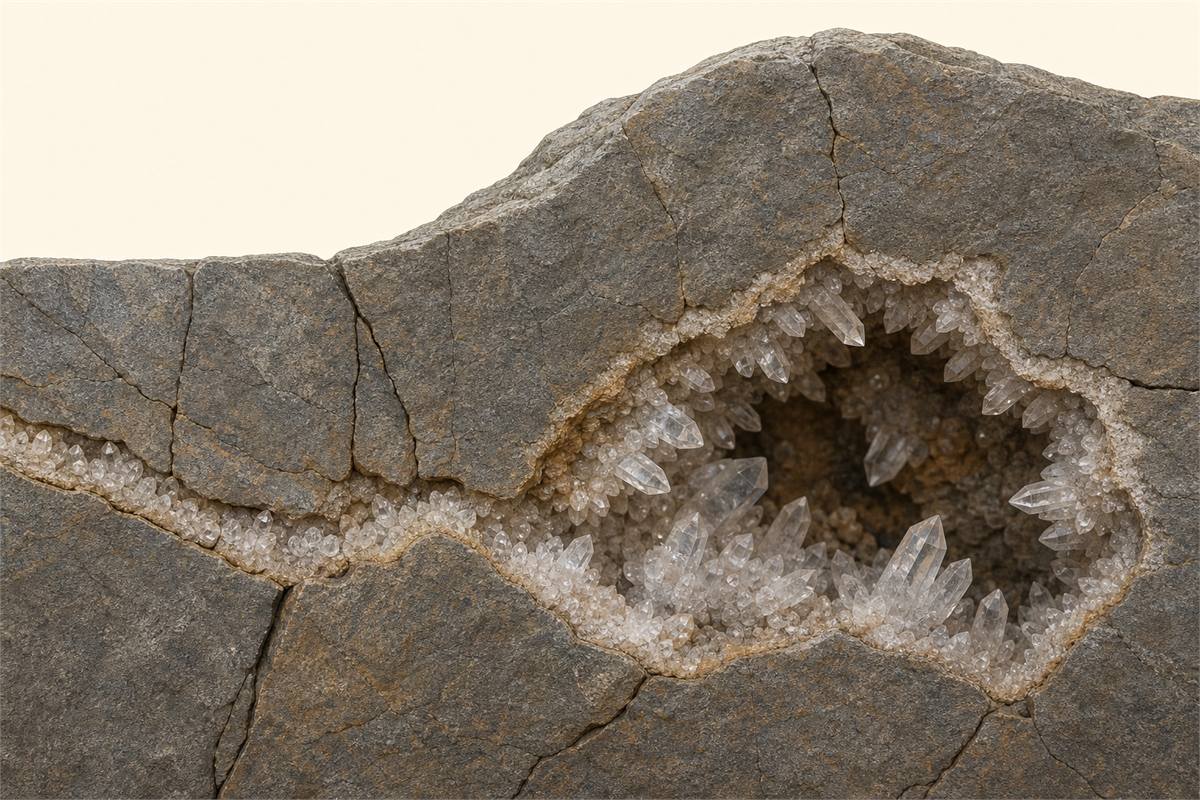
There is no single temperature, pressure, or formation time for every quartz cluster. Some grow from relatively low-temperature hydrothermal fluids; others belong to hotter pegmatitic or metamorphic systems. Crystal size and shape depend on silica supersaturation, temperature and pressure, fluid chemistry, available space, nucleation rate, flow, impurities, and interruptions in growth. A quiet cavity can support large crystals, but “stable conditions always make the biggest and most perfect points” is too simple: rapid growth, repeated breakage, dissolution, renewed growth, competition, and changing chemistry can all leave valuable structures.
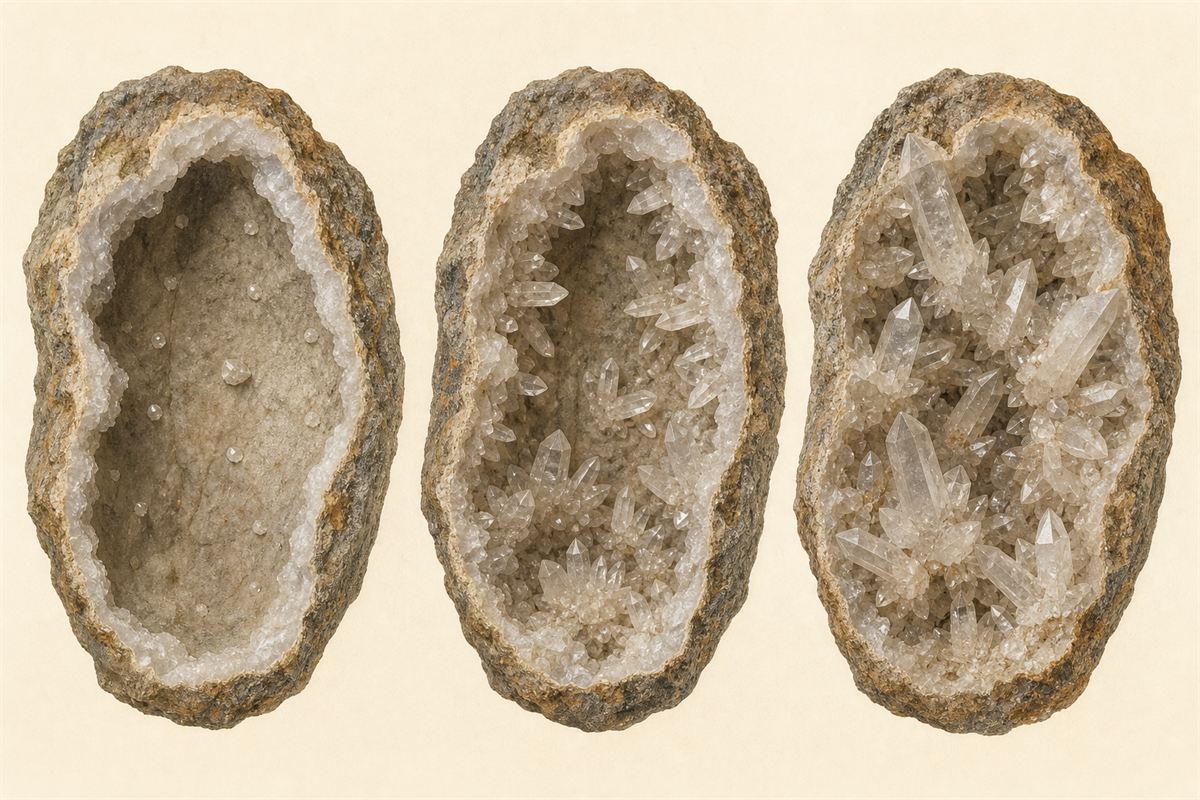
Arkansas provides a well-documented example. Quartz in the Ouachita Mountains occurs in veins and open fractures, with many collectible clusters formed as cavity fillings from hydrothermal solutions. Volcanic amethyst geodes show a different path: silica minerals line cavities in lava, and later crystal growth projects inward. Explore that cavity architecture in the amethyst geode guide.
Anatomy of a Crystal Cluster

- Individual crystals: separate quartz individuals within the aggregate. Some may be complete; others are partly buried or crowded.
- Matrix: the supporting rock or mineral base. It may include quartz, chalcedony, feldspar, carbonate, clay-rich material, or another host.
- Termination: the crystal faces that close a free-growing end. A broken point is not a termination.
- Contact point: a flat, indented, or irregular area where another crystal or the cavity wall limited growth.
- Growth striation: repeated surface lines related to crystal growth. Striations are informative but do not prove natural origin by themselves.
- Coating: a later mineral layer, stain, or human-applied surface treatment.
- Inclusion: material enclosed during growth, such as fluid, another mineral, or an earlier growth surface.
- Repaired or regrown area: a natural fracture that healed or received later quartz growth. This differs from a fresh shipping break or a glued repair.
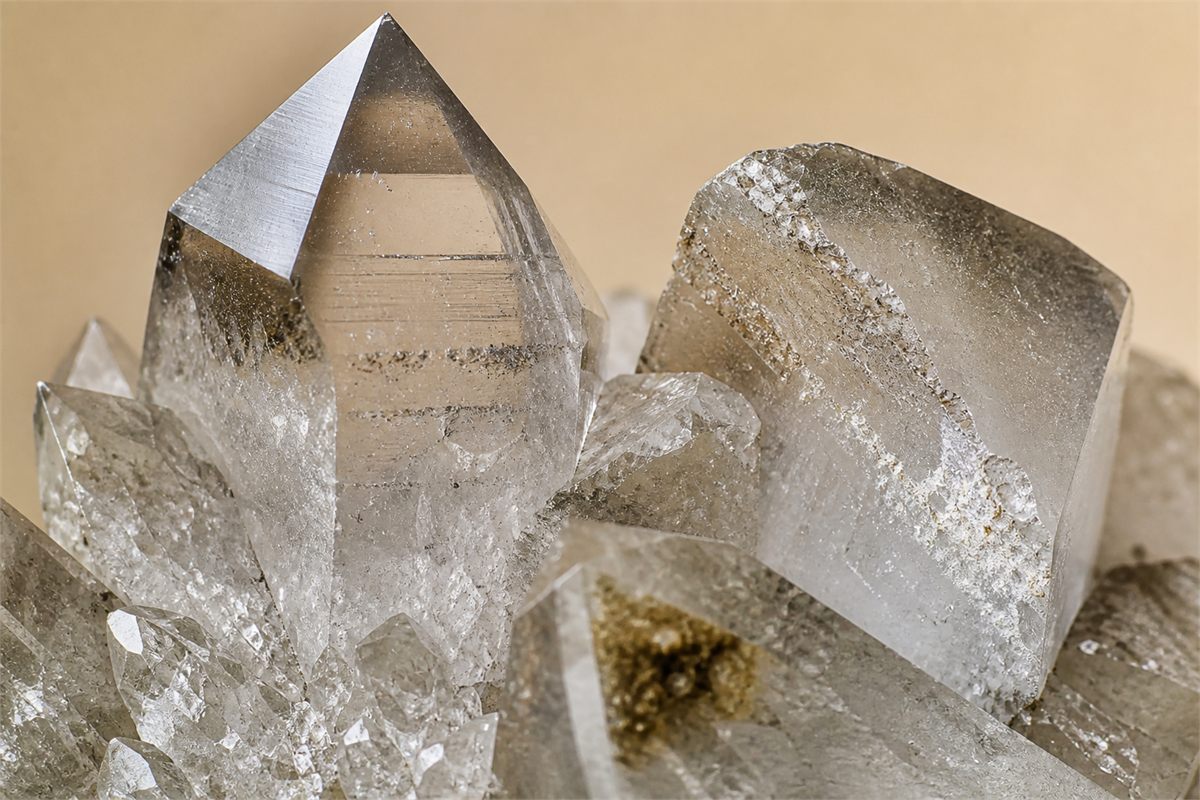
These parts explain why a natural cluster can have uneven points, nearly no visible matrix, a very regular drusy surface, or sharp crystals on several sides. They also explain why one attractive feature cannot authenticate the entire specimen.
Natural Growth Forms and Legitimate Mineralogical Terms

| Term | Useful meaning | Common misuse |
|---|---|---|
| Druse, drusy, or druzy | A surface coated with many small projecting crystals. | Used as if it were a mineral species or automatically a geode. |
| Geode | A durable rock body with an internal cavity lined by mineral material. | Applied to every open cluster on matrix. |
| Phantom quartz | An earlier crystal outline visible inside later quartz because of inclusions or color zoning. | Applied to any cloud, crack, or scenic inclusion. |
| Scepter quartz | A later-generation crystal head grown on an earlier quartz stem, usually with a clear change in form. | Applied to any top-heavy or damaged point. |
| Skeletal or hopper quartz | Edge-dominant or incomplete face growth produced by uneven growth rates. | Equated with every etched, stepped, or “elestial” trade specimen. |
| Japan-law twin | A true contact twin with two quartz individuals meeting at a characteristic crystallographic angle. | Applied to two crystals that merely touch or form a V. |
| Dauphiné or Brazil-law twin | Specific internal crystallographic relationships in quartz, often difficult to confirm from casual appearance. | Used for paired columns without crystallographic evidence. |
| Included quartz | Quartz containing identifiable or cautiously described enclosed material. | Naming every golden or black needle “rutile” without testing. |

Names such as “Lemurian quartz” belong to modern trade and spiritual culture, not to an accepted quartz species, a proven lost-civilization history, or a reliable locality. Chinese-market phrases that translate as “floating cluster,” “no-base cluster,” “four-sided cluster,” or “powder-fracture matrix” may be useful seller descriptions, but they have no automatic international mineralogical equivalent. Ask the seller to describe the visible structure rather than relying on a poetic category.
Quartz Varieties and Associated-Mineral Clusters
Clear rock crystal, milky quartz, smoky quartz, and amethyst all occur as clusters. Citrine can also crystallize naturally, but natural yellow quartz is uncommon and much market citrine is heat-treated amethyst. A bright orange cluster with a pale or white base and the familiar shape of an amethyst geode segment should be sold with that treatment disclosed. Eastern Story’s citrine guide explains why color origin matters.

Massive rose quartz is common enough for carvings and beads, but well-formed pink quartz crystals are comparatively rare. A dense, uniformly pink “rose quartz cluster” may therefore be dyed, coated, assembled, or made from another material. Color alone is not an identification.
Associated minerals can be central to a specimen’s beauty and value. Quartz may occur with calcite, fluorite, hematite, pyrite, prehnite, chlorite-group minerals, feldspar, mica, tourmaline, rutile, or many other species. Green phantom material may involve chlorite or another mineral, but the green color does not identify it automatically. “Rutilated quartz” should be reserved for quartz where the needles are reasonably identified as rutile; “titanium quartz” is often a trade term, not proof of titanium-bearing inclusions.

Origins and Provenance: What a Locality Label Can Tell You
Brazil, the United States, Madagascar, Namibia, Pakistan, India, China, and many other countries produce collectible quartz. A country name is only the first level of provenance. Brazil’s Minas Gerais, Arkansas’s Ouachita Mountains, Namibia’s Goboboseb Mountains, and the mineral districts of Gilgit-Baltistan in Pakistan are documented quartz-producing regions, yet each contains multiple localities, geologic settings, and specimen styles.
“Himalayan quartz” is especially broad. The Himalaya and adjacent high mountain systems span a vast area; a retail label may refer to Pakistan, India, Nepal, Tibet, or simply a marketing style. Clarity, matrix color, surface lines, or a “high-vibration” story cannot establish a mine. For meaningful provenance, look for a chain of information: country, region, district, mine or claim when known, collector or dealer history, date, old labels, and supporting photographs.

Provenance affects scientific interest, collectability, and price only when it is credible. A precise but unsupported mine name is weaker than an honest regional label.
Natural, Lab-Grown, Secondary-Grown, Assembled, and Treated Clusters

| Category | What it means | What to request |
|---|---|---|
| Natural cluster | Crystals and matrix formed through natural geologic processes. | Locality evidence, condition notes, and any cleaning or repair history. |
| Lab-grown quartz | Quartz grown hydrothermally with heat and pressure, typically from seed material. | Clear synthetic disclosure and whether the whole object or only some crystals are lab-grown. |
| Secondary-grown cluster | New crystals grown artificially over a natural or manufactured base. | Base material, growth method, dyes, coatings, and any natural components. |
| Assembled cluster | Separate crystals or fragments joined with adhesive, resin, cement, or another binder. | Join locations, adhesive type if known, and repair versus fabrication disclosure. |
| Dyed material | Color introduced into fractures, porous matrix, surface layers, or a coating. | Type of dye, color stability, and cleaning restrictions. |
| Heat-treated or irradiated quartz | Color altered by controlled heat, irradiation, or a sequence of treatments. | Which treatment was used and whether the color is stable under normal display. |
| Coated or “aura” quartz | A thin deposited layer, often involving metal or metal oxide, creates vivid or iridescent color. | Coating disclosure and care limits; abrasion can permanently change the finish. |
| Acid-cleaned or bleached specimen | Stains or matrix material removed or lightened after mining. | Cleaning history, remaining residues, and whether associated minerals were altered. |
| Repaired or stabilized specimen | Broken or weak areas joined or reinforced to preserve the object. | Repair map, adhesive or consolidant when known, and whether restoration is reversible. |

Hydrothermal synthetic quartz requires specialized equipment, heat, pressure, chemistry, and time; it is not accurately described as a universal “cheap overnight crystal.” Artificial growth can be asymmetric, striated, sharp, or attached to a base. Natural material can be regular, very fine-grained, prickly, or almost free of matrix. Cottony veils, fractures, growth lines, a rocky base, frost-like microcrystals, color, and touch are clues to investigate—not pass/fail tests.

Highly saturated cobalt blue, metallic, rainbow, neon green, or gold surfaces commonly point to coating, dye, laboratory growth, or another intervention, but “irradiated” is not a catch-all explanation. If the distinction matters, compare the cluster with Eastern Story’s natural vs artificial crystal guide and seek independent expert examination for valuable specimens.
Quality, Condition, and Crystal Cluster Value
There is no reliable universal price-per-pound or price-by-size chart for quartz clusters. Two pieces with the same dimensions can differ sharply in composition, damage, treatment, provenance, and aesthetic quality. Value is built from a combination of factors:

- Crystal form and luster: sharp faces, attractive habits, and reflective surfaces can add appeal.
- Color and transparency: important for some varieties, but not the only standard. Saturated amethyst, smoky zoning, inclusions, or strong contrast may matter more than perfect clarity.
- Composition: spacing, balance, direction, negative space, and how the cluster presents from its main viewing angle.
- Associated minerals: a well-formed calcite, fluorite, hematite, tourmaline, or other association may increase rarity and visual interest.
- Scale and stability: large pieces can be impressive, but an unstable base or unsupported points add risk and cost.
- Condition: recent chips, detached crystals, sawn bases, adhesive, and undisclosed repairs usually matter. Natural contacts, etched surfaces, healed fractures, and later regrowth may be part of the geology rather than simple “damage.”
- Rarity: unusual crystal habits, documented twins, fine inclusions, uncommon associations, and mine-specific material can command attention.
- Treatment and disclosure: treatment is not automatically bad, but undisclosed treatment weakens trust and collectability.
- Provenance: original labels, collection history, mine documentation, and reliable locality records can add value.
- Aesthetics: the final judgment remains visual. Dense is not always better, thin matrix is not automatically more natural, and perfect points are not the only collectible feature.

Buyer Inspection Checklist
- Request scale: dimensions, weight, and a photo beside a ruler or familiar object.
- See every side: ask for a natural-light video of the front, back, base, contacts, and underside.
- Inspect the base: look for saw cuts, drilled supports, cement, resin, paint, felt, and hidden joins.
- Check condition: ask separately about fresh chips, repaired points, detached crystals, stabilization, and natural contacts.
- Ask about treatment: heat, irradiation, dye, coating, metal vapor deposition, acid cleaning, bleaching, filling, and secondary growth.
- Clarify provenance: request the exact locality evidence rather than accepting a country or “Himalayan” label at face value.
- Review the label or report: confirm what a certificate actually covers. A report identifying quartz may not prove natural growth, treatment status, every inclusion, or the mine.
- Read the return terms: especially for online purchases, large objects, repaired specimens, and color that may look different under studio lighting.

Avoid home scratch tests, flames, hot needles, acid drops, solvent wiping, impact tests, and amateur radiation checks. These methods can damage a specimen, release unwanted fumes or particles, and still fail to answer the real question. A mineral dealer, experienced collector, conservator, or laboratory that accepts large specimens is the safer route for high-value material.

Safe Crystal Cluster Display
Choose the display location by weight, balance, point sharpness, light, heat, vibration, and traffic. A low, wide base is safer than a narrow perch. Use a professionally fitted stand for tall or valuable pieces. Museum putty can help with some small stable objects and compatible surfaces, but it should be reversible, used sparingly, and kept away from porous, friable, coated, or chemically sensitive areas.

- Keep clusters away from shelf edges, overhead ledges, crowded walkways, doors, and vibrating speakers or appliances.
- Place sharp points beyond the reach of children and pets.
- Check the furniture and shelf load rating for heavy specimens; use professional installation when the consequences of a fall are serious.
- Avoid strong direct sun and concentrated heat. Amethyst, smoky quartz, and some other colored or treated material can change with prolonged light or heat exposure.
- Keep displays away from cooking grease, bathroom splashes, cleaning chemicals, steam, and cable congestion.
- Move a cluster by supporting the matrix with both hands. Never lift it by a crystal point. Wear suitable cut-resistant gloves and eye protection for large, sharp, or unstable pieces; use two or more people when needed.

Decor and Optional Feng Shui Symbolism
A cluster works naturally as a focal object because repeated points catch light and create movement. On a console, cabinet, study shelf, or quiet reading surface, it can anchor a small arrangement of wood, paper, stone, or plants without needing an elaborate mystical display.

In modern crystal culture, many points growing together can symbolize cooperation, community, shared growth, and individuality within a group. In some feng shui practices, clusters are placed near an entry, in a living area, or on a work surface as symbols of welcome, clarity, gathering, or abundance. Wealth corners, the left-side “Green Dragon” position, point direction, mirror rules, and front-door restrictions vary by school and household. Treat them as optional symbolic frameworks, then let stability, safe circulation, light, and the room’s actual use make the final decision.
A cluster beside a computer or television is decoration, not electromagnetic shielding. Equipment heat, vibration, vents, wires, and the chance of a fall are better reasons to leave space around electronics. For a wider cultural overview, read the feng shui crystals guide.
Can a Crystal Cluster Cleanse or Charge Other Crystals?
Placing jewelry or small stones near a cluster can be a meaningful personal ritual or an attractive way to arrange a collection. Mineralogically, the cluster does not transfer a measurable physical “charge,” remove negative energy, demagnetize jewelry, purify air, or neutralize electromagnetic radiation. No fixed three-hour, overnight, full-moon, or compass-point schedule changes the material of the objects.
If you enjoy the ritual, protect the jewelry. Do not balance it directly on sharp points. Malachite, turquoise, fluorite, calcite, pearls, coated gems, metals, elastic, and cord can scratch, snag, tarnish, or break. Place the item in a small soft-lined dish beside the cluster, and keep heavy objects off fragile terminations. Eastern Story’s crystal cleansing guide offers more ways to separate symbolic practice from material care.

How to Clean a Crystal Cluster Safely
Identify the entire assemblage before introducing water or cleaner. The most sensitive component—not the quartz—sets the care method. Check the matrix, associated minerals, coatings, dyes, glue, repaired points, labels, felt, and stand attachments.

| Specimen type | Safer approach | Avoid |
|---|---|---|
| Unknown, valuable, fragile, coated, dyed, or repaired cluster | Soft brush, hand blower, or distant low-suction vacuum through mesh; consult a conservator for deeper cleaning. | Water, soaking, solvents, acids, alcohol, ultrasonic, steam, compressed air, and experiments. |
| Confirmed stable, untreated quartz with no sensitive matrix or associated minerals | Brief room-temperature or lukewarm water, a small amount of mild neutral soap if needed, a soft brush, thorough rinse, optional distilled-water final rinse, and complete air drying. | Thermal shock, long soaking, high-pressure spray, abrasive wiping, and sudden hot-to-cold changes. |
| Pyrite, metal sulfides, soluble salts, gypsum/selenite, or moisture-sensitive clay matrix | Dry cleaning and controlled storage; seek specialist advice for active alteration. | Routine washing or soaking. |
| Calcite, fluorite, malachite, soft or cleavable associated minerals | Dry clean by default until the assemblage and stains are identified; use a specialist for adhered grime. | One-method-fits-all washing, acids, vinegar, harsh soap, and scrubbing. |
| Aura-coated, painted, dyed, glued, filled, or stabilized surface | Dust gently without rubbing; follow treatment-specific instructions. | Alcohol, solvents, ultrasonic, steam, soaking, and abrasion. |

Ordinary chlorinated tap water does not automatically corrode quartz, though hard water can leave mineral spots. A distilled-water final rinse can reduce spotting on a suitable, fully washable cluster. Do not use paper towels around dense sharp points; fibers can snag and leave debris. Avoid hair dryers and compressed air because force, heat, cold, propelled grit, and condensation can damage delicate areas.
Salt water, acids, vinegar, bleach, alcohol, strong alkalis, ultrasonic cleaners, steam, pressure washers, and long soaks are poor default choices. Smoke from sage, incense, or wood can leave soot or oily film and introduces fire and indoor-air risks, so it is not a material-cleaning method. Moonlight, a nearby geode, or a bowl of stones may remain part of a personal ritual when used without moisture, heat, pressure, or surface contact.
Storage, Transport, Repair, and Conservation
Store a cluster in a rigid, stable tray or a custom box with soft inert padding positioned around the matrix, not pressing against terminations. Do not squeeze a many-pointed cluster into a cloth bag, where crystals can strike one another. Never seal a damp specimen. A glass cover can reduce dust, but it needs a stable base and enough ventilation to prevent condensation.

For transport, photograph the specimen and existing damage first. Support the base, immobilize the piece without point pressure, double-box valuable material, label orientation, and keep detached fragments with the documentation. Large specimens need a planned lift, suitable gloves, eye protection, and enough people or equipment for the load.

If a point breaks, save every fragment, take photographs, and avoid a quick household-superglue repair. Adhesive can stain porous areas, creep into fractures, age poorly, reduce value, and complicate later conservation. A mineral conservator can decide whether reattachment is stable, discreet, and reversible. For broader object-care principles, use the Eastern Story care guide.

Crystal Cluster Gift Guide
A cluster can make a thoughtful housewarming, studio, graduation, retirement, or collector gift. Match the piece to the recipient’s space and interests rather than choosing by a promised effect.
- For a first mineral specimen: choose a stable, palm-sized clear or amethyst cluster with an honest label and few vulnerable overhanging points.
- For a design-focused home: prioritize silhouette, matrix color, stand quality, and a viewing angle that suits the room.
- For a collector: choose documented locality, unusual growth, an associated mineral, or preserved old labels.
- For a symbolic gift: present the cluster as an image of shared growth, cooperation, or many individual paths held in one composition.
- For a home with children or pets: choose a compact specimen that can be enclosed or placed in a secure cabinet.
Include the mineral name, locality at the most honest level available, dimensions, weight, treatment and repair disclosure, care instructions, and the story behind your choice. Browse Eastern Story’s Blessing Collection for other objects and jewelry selected around symbolism, craft, and thoughtful gifting.

Frequently Asked Questions
Choose the Specimen, Not the Story Alone
The best quartz crystal cluster is not necessarily the clearest, densest, largest, or most perfectly pointed. It is the specimen whose mineral identity, growth, condition, treatment, provenance, stability, and visual character are honestly understood.
Buy with curiosity, display with respect for weight and sharpness, and clean according to the entire mineral assemblage. The result is a collection that preserves both the geology of the object and the personal meaning you choose to place around it.
Related Posts


0 Comments