
Peach blossom luck means romantic good fortune in modern Chinese: receiving affection, meeting potential partners, or finding that love and dating seem to move more easily. The Mandarin term is Tao Hua Yun (桃花运, táo huā yùn), literally “peach blossom luck.” It is common in everyday speech, entertainment, fortune-telling, and online relationship talk.
The phrase carries several historical layers, but they should not be collapsed into one origin story. A marriage poem in the Book of Songs, a Tang poem about beauty and absence, later fate-calculation rules, and modern slang all contributed different ideas. Today, people of any gender or sexual orientation may use “peach blossom luck” for romantic opportunities. It is best understood as cultural language—not a personal horoscope or a promise that a particular object will produce a relationship.
What Does Peach Blossom Luck Mean?
In its clearest modern sense, peach blossom luck is luck in romance. Someone said to be “walking in peach blossom luck” may be receiving more attention, meeting more possible partners, or beginning a new relationship. The phrase can be playful, admiring, teasing, or cautionary, depending on context.

The image is broader than a single flower. Peach blossoms open in spring and have long been used in Chinese literature to create scenes of youth, beauty, marriage, encounter, and change. Later fortune-telling traditions also used “peach blossom” as a technical label. Modern speech draws on both worlds without requiring the speaker to believe in divination.
Tao Hua Yun in Modern Chinese
The Chinese phrase Tao Hua Yun (桃花运) is pronounced roughly taow hwah yoon. Taiwan’s Ministry of Education dictionary gives two related senses: romantic entanglement or opportunity, and being fortunate in love or admired by others. It also records the phrase in the seventeenth-century vernacular story collection Xingshi Hengyan (《醒世恒言》). That citation is a verifiable historical use, not proof that the expression began there.
| Expression | Literal sense | Usual modern meaning | Useful English |
|---|---|---|---|
| 桃花运 (táo huā yùn) | Peach blossom luck | Romantic fortune, attention, or opportunity | Luck in love; romantic luck |
| 走桃花运 (zǒu táo huā yùn) | To walk through peach blossom luck | To be enjoying a fortunate period in romance | To be lucky in love |
| 桃花旺 (táo huā wàng) | Peach blossoms are flourishing | Receiving abundant romantic attention | Getting a lot of romantic interest |
| 桃花不断 (táo huā bù duàn) | Peach blossoms keep coming | A continuing stream of romantic possibilities | No shortage of admirers or dates |
Older dictionary examples often assume heterosexual courtship, reflecting the language of their time. Contemporary speakers can apply the phrase more inclusively. Its core idea is romantic attention, not a rule about who may love whom.

Peach Blossom and Marriage in the Book of Songs
The earliest major literary foundation is “Tao Yao” (《诗经·周南·桃夭》) in the Book of Songs. Its opening is among the most memorable flower images in early Chinese poetry: “桃之夭夭,灼灼其华”—the young peach tree is flourishing, its blossoms brilliant. The poem then turns explicitly to marriage: “之子于归,宜其室家.”
In this early context, yu gui (于归) means that the young woman is going to her marital home. Yi qi shijia (宜其室家) expresses a wish that she will be fitting or harmonious within the household. The later stanzas move from blossoms to abundant fruit and luxuriant leaves, while repeating the marriage and household blessing.

Traditional interpretation was not uniform. The Mao preface connected the poem to the transforming virtue of a royal consort, while later commentaries and modern literary accounts commonly describe it as a marriage or wedding song. The text itself clearly belongs to a marriage setting, but it never uses the phrase Tao Hua Yun (桃花运). It should therefore be described as an important source for peach blossom and marriage imagery, not “the first appearance of the word peach blossom luck.”
It is also easy to project modern dating language backward. The poem celebrates a bride and household in a patrilocal social world; it is not a statement about individual romantic chemistry, sexual orientation, or contemporary equality. Its enduring cultural power comes from the combination of radiant spring growth and a formal marriage blessing.
The “Human Face and Peach Blossoms” Story
A second literary layer comes from the Tang poet Cui Hu (崔护) and his poem “Written at a Village South of the Capital” (《题都城南庄》). Its central contrast is concise: “去年今日此门中,人面桃花相映红”—at this gate on this day last year, a human face and peach blossoms reflected each other’s red. The closing image finds the blossoms still smiling in the spring wind while the person is gone.
The four-line poem is preserved in the Complete Tang Poems. The fuller narrative—Cui Hu asking for water, meeting a young woman among the peach blossoms, returning the following year, and finding the gate closed—appears in later anecdotal records, most famously Meng Qi’s late-Tang Benshi Shi (《本事诗》) and subsequently the Taiping Guangji (《太平广记》). These records explain how later readers understood the poem, but they are not secure evidence for every detail of the poet’s biography. Even more dramatic versions involving illness, death, and revival belong to later storytelling.
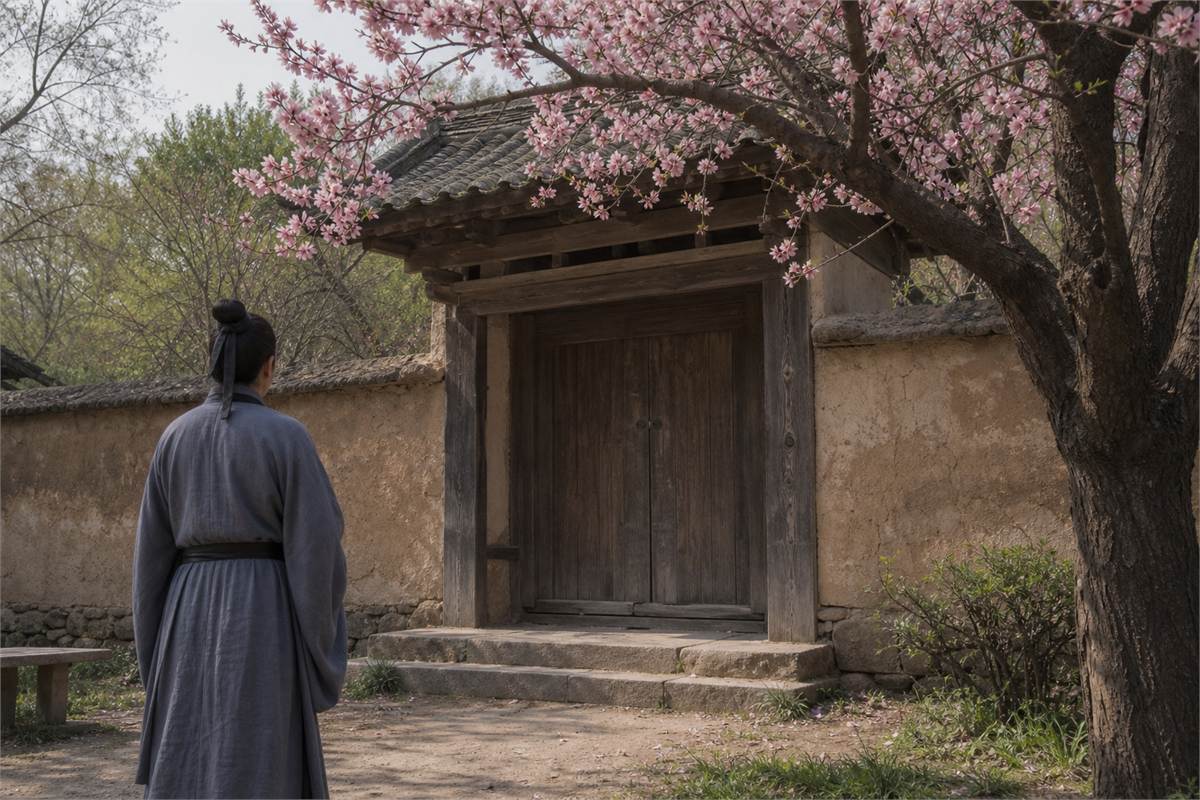
The idiom Ren Mian Tao Hua (人面桃花), “a human face and peach blossoms,” developed from this poem. The Ministry of Education’s Dictionary of Chinese Idioms records two main uses: a woman’s beauty compared with peach blossoms, and the sadness of returning to a familiar scene after the person once associated with it has disappeared. The idiom carries beauty, memory, missed timing, and change—not simply “love at first sight.”
How Literature Shaped Peach Blossom Romance
The Book of Songs and Cui Hu’s poem do different work. “Tao Yao” places the blossoming peach tree inside a communal marriage blessing. “Written at a Village South of the Capital” creates a private scene of encounter, absence, and memory. Later poetry, drama, fiction, art, and everyday speech could draw on either emotional pattern.

| Layer | Peach image | Relationship theme | Important limit |
|---|---|---|---|
| Book of Songs | Blossoms, fruit, leaves | Marriage and household blessing | The term 桃花运 does not appear |
| Cui Hu’s Tang poem | Face and blossoms reflected together | Beauty, encounter, absence, memory | The expanded romance story is later anecdotal tradition |
| Later literature and idiom | Peach blossom as a flexible emotional image | Beauty, courtship, missed timing, changing relationships | Meanings vary by genre and period |
| Modern speech | “Peach blossom” becomes romantic shorthand | Attention, dating opportunity, luck in love | Not a single uninterrupted doctrine from antiquity |
This layered history explains why peach blossom love meaning feels richer than a simple heart icon. The flower can suggest a wedding wish, a vivid meeting, an absent person, spring renewal, or the uncertainty of timing. It does not consistently symbolize fidelity, and no single text established it as a universal “love totem.”
Peach Blossom in Chinese Fortune-Telling Traditions
Peach blossom also became a label in Chinese fate-calculation traditions. This is where terms such as Xian Chi (咸池), the Peach Blossom Star (桃花星), and the four Earthly Branches Zi, Wu, Mao, and You (子、午、卯、酉) enter the discussion. They belong to technical or semi-technical systems of correspondence, not to the same historical layer as the early poems.

Xian Chi, peach blossom, and the four branches
In some BaZi (八字) manuals, Xian Chi or “peach blossom” is treated as a shensha (神煞), a symbolic marker derived from branch relationships. A common rule groups a year or day branch with one designated peach blossom branch:
| Reference branch group | Designated branch | Chinese |
|---|---|---|
| Shen–Zi–Chen | You | 申子辰见酉 |
| Yin–Wu–Xu | Mao | 寅午戌见卯 |
| Hai–Mao–Wei | Zi | 亥卯未见子 |
| Si–You–Chou | Wu | 巳酉丑见午 |
The table explains a rule inside one tradition. It does not show that Zi, Wu, Mao, or You automatically creates charm, that meeting one branch in a particular year will improve a love life, or that the rule can predict a relationship outcome. BaZi readers also disagree about whether to start from the year branch, day branch, or a wider chart, and about how much weight a shensha should receive.
Why different systems should remain separate
BaZi, Zi Wei Dou Shu, zodiac-year readings, compass feng shui, flying-star feng shui, and modern horoscope content use different premises and calculations. A “personal peach blossom direction,” a chart-based Xian Chi marker, and an annual room sector are not interchangeable. “Wall-inside peach blossom” (墙内桃花), “wall-outside peach blossom” (墙外桃花), Peach Blossom Sha (桃花煞), and similar labels are later interpretive categories whose definitions vary among schools and popular writers.

These systems can be studied as parts of Chinese divination history and living folk culture. They are not empirically validated methods for forecasting who will meet a partner in a certain week, year, zodiac cycle, or room direction. For a general reader, the useful distinction is simple: a fate-calculation rule describes a traditional framework; it is not an individualized result.
Readers who want background on the twelve animals and Earthly Branches can continue with Eastern Story’s Chinese zodiac symbols guide. That page explains the zodiac system without turning this article into a chart calculator.
Zheng Yuan, “Bad Peach Blossoms,” and Modern Slang
Modern Chinese relationship talk borrows the flower image to classify romantic experiences. Some expressions have technical uses in particular divination schools, while others are loose internet language. Their meanings depend on who is speaking.
| Term | Common modern use | A careful way to understand it |
|---|---|---|
| Zheng Yuan (正缘) | A “right” or destined long-term partner | A hopeful label for a compatible, committed relationship; compatibility still has to be observed |
| Lan Tao Hua (烂桃花) | “Rotten peach blossom”; unwanted or troublesome romance | A situation involving poor fit, dishonesty, instability, or unwanted attention—not a permanent label for a person |
| Tao Hua Jie (桃花劫) | A “peach blossom calamity” | Dramatic folk or online language for serious relationship trouble |
| Tao Hua Sha (桃花煞) | An adverse peach blossom influence in some systems | A school-dependent fortune-telling term, not a diagnosis |
| Wall-inside / wall-outside peach blossom | Domestic or socially external romance | Later interpretive categories that vary by source; neither term proves fidelity or instability |
In daily life, observable behavior is more informative than the label. A promising partner respects consent, keeps commitments, communicates honestly, and supports your autonomy. An unhealthy situation may involve manipulation, secrecy, repeated broken promises, control, or financial pressure. Those patterns matter whether anyone calls them “bad peach blossoms” or not.

Peach Flowers, Peaches, and Peach Wood Are Not the Same Symbol
The same tree produced several distinct cultural symbol systems. Treating all of them as one unified power creates false history.

| Object | Major cultural associations | Typical modern use |
|---|---|---|
| Peach blossom (桃花) | Spring, youthful beauty, marriage imagery, encounter, romantic attention | Floral art, love-themed gifts, jewelry motifs, the phrase 桃花运 |
| Peach fruit (桃) | Longevity, birthday blessing, immortality narratives, abundance | Birthday ceramics, paintings, carvings, festive gifts |
| Peach wood (桃木) | Protective and apotropaic folk traditions, door charms, carved objects | Bracelets, pendants, household crafts, folk-protection motifs |
| Peach Blossom Spring (桃花源) | An idealized hidden refuge through Tao Yuanming’s literary tradition | Landscape art and language for an idyllic place |
A peach is not documented as an ancient love token merely because its outline can look heart-shaped. Peach wood’s protective reputation also does not naturally make it a romance object. If peach wood interests you, Eastern Story’s peach wood bracelet meaning guide follows that protective and material tradition more closely.

Peach Blossom Charms, Crystals, and Folk Customs
Peach-blossom-themed objects can be meaningful as cultural symbols, design choices, gifts, or reminders. Popular examples include flower pendants, peach-pink beads, carved peach wood, red cord, porcelain with blossom motifs, paired objects, seals, and seasonal bouquets. Rose quartz, strawberry quartz sold under that trade name, rhodochrosite, moonstone, jade, and glass may also appear in modern “love luck” jewelry.

Material names deserve care. “Strawberry quartz” is a trade term used for more than one included-quartz material and sometimes for glass or manufactured look-alikes. Moonstone refers to feldspar with a characteristic optical effect, not every pale iridescent bead. Rose quartz, rhodochrosite, jade, dyed stone, resin, and glass have different identities, care needs, and prices. Ask a seller for the material name, treatments, dimensions, metal information, photographs, and return terms rather than choosing by a mystical product label.

What Symbolic Objects Do—and Where Real Change Comes From
A bracelet, flower arrangement, keepsake, or small ritual may make some people feel cheerful, focused, or ready for a new chapter. It can serve as a visual cue: reply to a friend, attend the class, update a dating profile, or remember a boundary. The response is personal and may be modest.

Relationship opportunities change through exposure, communication, choices, and other people’s independent decisions. Crystals, red strings, paired ornaments, water features, mirrors, lights, and compass placements have no established mechanism for making another person feel attraction or commitment. Keeping that boundary protects the cultural meaning of the object while leaving real decisions with the people involved.
Peach-Blossom-Themed Jewelry and Gift Ideas
A good peach blossom gift begins with the recipient, not a formula. Consider their taste, relationship to you, preferred colors, wrist or necklace size, metal sensitivities, fragrance or pollen allergies, daily routine, budget, and the cultural message they are comfortable receiving.

- Early dating: choose a light, low-pressure item such as a small floral charm, art print, bookmark, or seasonal bouquet. Avoid wording that assumes exclusivity or marriage.
- Established partners: a peach-blossom motif can mark a shared spring memory, anniversary, or place, especially when the note explains the personal connection.
- Friends: frame the gift around spring, renewal, confidence, or friendship unless romantic meaning is clearly welcome.
- Self-gifting: choose a material and design you will genuinely use. A wearable reminder works better when it fits your life.
- Material-focused jewelry: compare disclosed material, construction, finish, size, care, and return policy. Symbolism should not replace basic product information.

For wider cultural context, see Eastern Story’s guides to love bracelet meaning, red string bracelet gift meaning, and carnelian love symbolism. Each object has its own history and should not be treated as another name for peach blossom luck.
Safe and Respectful Home Decor
Peach blossom decor can make a room feel lighter and more seasonal without becoming a feng shui prescription. Use the same practical standards you would apply to any household object:
- Fresh flowers: check allergies and pet toxicity, contain pollen and thorns, use a stable vase, change the water, and clean spills promptly. Wilting flowers are a care issue, not a sign of “bad romance.”
- Small charms and beads: keep detachable parts away from children and pets.
- Car hangings: keep every ornament clear of the driver’s view, controls, mirrors, and airbag deployment zones, and follow local road rules.
- Candles and night lights: use stable, certified products, keep heat away from fabric and dried plants, and turn them off when unattended or sleeping.
- Water arrangements: prevent leaks, stagnant water, electrical contact, humidity, and mold. A bedroom water feature is optional decor, not a relationship requirement.
- Peach-wood swords: treat sword-shaped objects as folk craft or display pieces. Secure sharp or heavy forms, never aim them at people or keep them loose beside a bed, and check rules before carrying weapon-like objects in public.

Do not cut branches from public trees or someone else’s property. Avoid spraying perfume or unsuitable liquids on living plants. Whether to keep an ex-partner’s gifts, photographs, or contact details is a matter of privacy, emotional comfort, safety, and personal choice—not a compulsory cleansing ritual.
Evidence-Based Ways to Meet More People
If you want more dating opportunities, increase the number of respectful situations in which compatible people can actually encounter you. “Increasing your luck surface area” is a useful metaphor: it means creating more chances, not changing an invisible field.

- Choose recurring interest groups, classes, sports, cultural events, volunteer work, or community activities where conversation develops over time.
- Tell trusted friends that you are open to introductions, while giving them enough information about your values and boundaries.
- Use reputable dating platforms with privacy controls; keep early messages on-platform and verify inconsistencies before sharing personal information.
- Present yourself accurately. Clean grooming, clothes that fit the setting, an approachable posture, and attentive conversation help people understand who you are.
- Use color as style, not a signal from the universe. Pink, peach, lavender, red, or warm neutrals can feel welcoming if you enjoy wearing them.
- Practice starting small conversations, asking open questions, listening, and accepting a lack of interest without pressure.
- State whether you want casual dating, a committed relationship, friendship first, or another arrangement. Clarity reduces avoidable mismatches.
Social events such as weddings may introduce people, but the mechanism is ordinary social contact. Attend because you are invited and want to celebrate, not to “borrow” another couple’s fortune.
How to Recognize a Healthy Match
A healthy relationship is visible in patterns, not in a prediction. Look for consistency between words and actions, respect for time and boundaries, mutual effort, emotional and practical reliability, room for separate friendships and interests, and the ability to repair misunderstandings without intimidation.
Consent should be active, informed, specific, and reversible. A caring partner can hear “no,” “not yet,” or “I changed my mind” without punishment. Compatibility also includes how two people handle money, family expectations, exclusivity, sex, privacy, work, location, health, and long-term goals. No match needs perfection, but recurring behavior should make trust clearer rather than more confusing.

Dating Red Flags and First-Date Safety
“Bad peach blossom” is sometimes a convenient phrase, but specific warning signs are more useful. Slow down if someone overwhelms you with intense promises before knowing you, hides basic identity information, repeatedly changes their story, pressures you to leave a platform, asks for money or investment transfers, ignores consent, monitors you, isolates you from friends, humiliates you, or is dishonest about another partner.
For a first meeting, choose a public place, tell a trusted person where you will be, arrange your own transport, keep control of food and drinks, and decide in advance how you will leave. Protect your home address, workplace details, identity documents, passwords, verification codes, banking information, and intimate images. An online love interest who urgently requests cash, gift cards, wire transfers, cryptocurrency, or access to an account matches a common romance-scam pattern.

If a partner threatens, stalks, assaults, coerces, or controls money and movement, treat it as a safety issue rather than a fortune-telling category. Contact trusted support and appropriate local professional or emergency services. If leaving could increase danger, a local domestic-violence service can help with safety planning.

Should You Reconnect with an Ex?
Evaluate a possible reunion by the reason the relationship ended, not by Mercury retrograde, a zodiac forecast, or a “peach blossom year.” Ask whether the original problem has been named clearly, whether both people accept responsibility, and whether change has been sustained long enough to observe.

Useful questions include: Have dishonesty, addiction, distance, conflict style, family pressure, or incompatible goals actually changed? Is contact respectful and unpressured? Can you discuss boundaries and expectations before resuming intimacy? Are you drawn to the present person or to relief from loneliness and nostalgia? Reconnection may be reasonable when the evidence has changed; it is also reasonable to decline.
Peach blossom luck endures because it joins spring beauty, literary memory, marriage language, and the uncertainty of meeting another person. Let the symbol add meaning to a gift or a new season. Let real relationships be guided by opportunity, honesty, consent, safety, and behavior. Readers looking for a symbolic object can explore the Blessing collection with those priorities in mind.
Frequently Asked Questions

Related Posts


