
The safest way to cleanse crystals is to separate two different tasks: physical cleaning and symbolic cleansing. Physical cleaning removes dust, sweat, skin oil, and product residue. Symbolic cleansing—sometimes called an energetic reset or “demagnetizing”—belongs to contemporary spiritual and personal ritual. A method that feels meaningful as a ritual may do nothing to remove grime, while a cleaning method that works for plain quartz may damage a dyed stone, a soft mineral, a glued setting, or a bracelet clasp.
Before using water, salt, sunlight, smoke, soil, or any chemical, identify the mineral, any dye or surface treatment, and every non-stone component. When that information is unknown, use a clean, dry, lint-free cloth, store the piece separately, and ask the seller or a qualified gem professional what the material can tolerate. This guide explains how to cleanse crystals safely by making that decision-first approach the foundation of crystal care.
Crystal Cleansing at a Glance
- Safest default: a dry, lint-free cloth and a very soft brush used without pressure.
- Before water: confirm the mineral, treatment, coating, glue, metal, cord, and setting.
- Avoid as beginner defaults: soaking, salt water, dry salt burial, soil burial, chemical cleaners, steam, and ultrasonic machines.
- Low-contact rituals: quiet intention, moonlight through a dry window, sound at a safe distance, or resting the piece on a padded surface near a display cluster.
- Crystal water: do not drink or otherwise use water that has directly contacted a mineral.
- Frequency: clean for visible dirt, sweat, or component wear; choose symbolic cleansing according to personal practice rather than a fixed schedule.
Crystal Cleansing vs. Physical Cleaning: What Is the Difference?
Physical cleaning is a material-care task. It removes substances from the surface and helps you notice loose stones, stretched cord, corroding metal, chipped points, and unstable glue. The correct method depends on mineral hardness and toughness as well as porosity, cleavage, inclusions, treatments, construction, and condition. Hardness measures resistance to scratching; it does not tell you whether a stone is tough, waterproof, heat-safe, or suitable for an ultrasonic cleaner.
Energy cleansing is a cultural, spiritual, or personal ritual. Modern crystal cleansing is most visible in contemporary spiritual and New Age practice, where people may use moonlight, sound, smoke, visualization, geometric symbols, crystal clusters, or a spoken intention to mark a reset. Ideas such as crystals absorbing emotions, remembering previous owners, matching chakras, “left in and right out,” or returning to a higher frequency are belief-based frameworks rather than material-science measurements.
You can value a ritual without confusing it with maintenance. A brief sound ritual may provide a quiet moment of attention, but it will not remove sunscreen from a bracelet. Wiping a stone after exercise can protect its surface and fittings, but it does not have to carry spiritual meaning. Keeping the two purposes clear makes both practices more intentional.

Start Here: Identify the Stone, Treatment, and Setting
“Crystal” is a retail umbrella term, not a single care category. A collection may include quartz, feldspar, calcite, fluorite, gypsum, copper minerals, sulfides, porous rocks, glass, resin, dyed stone, coated beads, and assembled jewelry. Black obsidian, for example, is natural volcanic glass rather than quartz crystal. Two objects sold under the same popular name may also have different treatments or construction.

Six questions to answer before cleaning
- What is the material? Use the invoice, seller disclosure, laboratory report, or a gemologist—not color alone.
- Is it treated? Ask about dye, oil, wax, resin impregnation, stabilization, coating, irradiation, heat treatment, or surface filling.
- Is it a loose stone or an assembled object? Beads, pendants, carvings, clusters, and rings fail in different ways.
- What else is present? Check glue, elastic, silk or cotton thread, leather, plated alloys, silver, steel, copper, porous spacers, and painted details.
- What is its condition? Cracks, pits, loose settings, flaking coatings, friable surfaces, and chipped points call for dry handling and professional advice.
- What are you trying to do? Removing grime, freshening a worn bracelet, and performing a symbolic reset are three different goals.

If a listing uses only a marketing name such as “aura crystal,” “healing stone,” “cinnabar bracelet,” or “selenite,” ask for the actual material and treatment. Some “selenite” products are satin-spar gypsum; some “cinnabar” carvings are lacquer or resin rather than mercury sulfide; some bright stones are dyed or coated. Our natural vs. fake crystal guide explains why clear naming and treatment disclosure matter before care begins.
Crystal Care Safety Matrix
| Object or condition | Dry cloth | Brief rinse | Soaking | Salt | Strong light | Smoke |
|---|---|---|---|---|---|---|
| Unknown mineral, treatment, or construction | Best default | Wait for identification | Avoid | Avoid | Avoid | Use a smoke-free ritual |
| Plain, intact quartz or agate with no fittings | Yes | Usually reasonable | Rarely necessary | Not recommended | Limit for colored varieties | Optional ritual with ventilation |
| Soft, porous, dyed, waxed, coated, glued, or fractured material | Yes, gently | Only with specific guidance | Avoid | Avoid | Avoid prolonged exposure | Avoid residue and odor |
| Gypsum/selenite, pyrite, cinnabar, or friable mineral | Yes, with minimal pressure | Keep dry | Avoid | Avoid | Keep away from heat | Prefer a no-smoke option |
| Jewelry with metal, elastic, thread, leather, or glue | Yes | Only if every component allows it | Avoid | Avoid | Limit heat and direct sun | Residue may affect porous parts |

This matrix is intentionally conservative. It is more useful to pause and confirm an unfamiliar piece than to rely on a universal list of “water-safe crystals.” Treatment and construction can change the answer even when the mineral name is correct.

How to Clean Crystals Safely
1. Begin with a dry clean
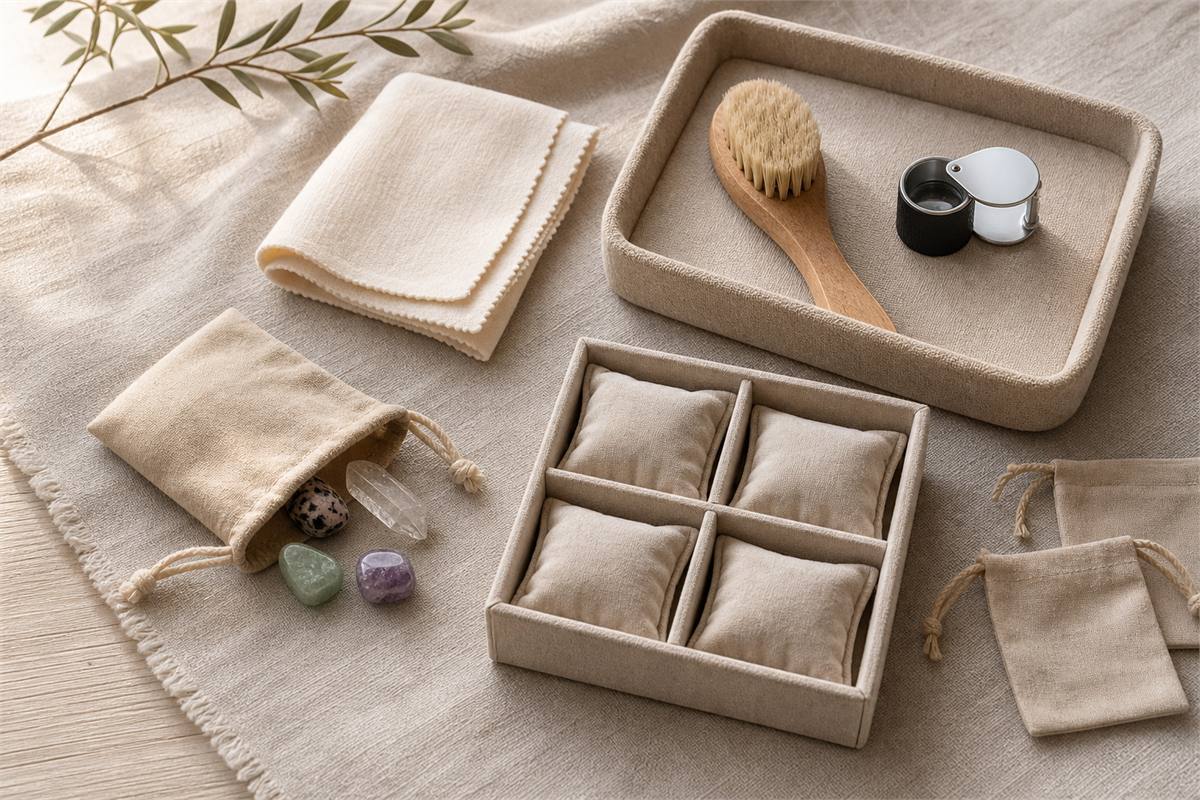
Place the object on a folded towel so it cannot roll or strike a hard surface. Use a clean microfiber or other lint-free cloth to lift fingerprints and surface dust. For crevices, use a new, very soft brush and almost no pressure. Hold clusters by the base rather than by points, and never scrub a flaky, fibrous, powdery, or already damaged surface.

2. Use a brief rinse only when every component is suitable
For a known, untreated, intact material that tolerates water—such as a loose piece of clear quartz or agate—a 10–20 second rinse in lukewarm water is usually enough to remove loose residue. Use a bowl rather than an open drain, and avoid sudden temperature changes. If oily grime remains and material-specific guidance allows it, use a tiny amount of mild dish soap, then rinse thoroughly. Long soaking adds risk without improving an ordinary clean.

Tap water is not a universal crystal corrosive. The more important questions are the mineral, treatment, exposure time, water chemistry, and attached components. When water spots are a concern, finish with a clean damp cloth and dry promptly instead of substituting a long soak in bottled or spring water.
3. Dry completely before storage
Blot—do not rub—a wet piece with a soft cloth. Set it on a dry towel in a shaded, ventilated place until holes, settings, recesses, thread, and elastic are fully dry. Do not accelerate drying with a hair dryer, heater, or direct sun. Before putting the piece away, inspect the setting, clasp, cord, bead holes, glue joints, and sharp edges.

Crystals That Cannot Go in Water—or Need Extra Caution
Searches for “crystals that cannot go in water” often produce absolute lists. A better answer explains the actual risk. Some minerals are soft or reactive; some rocks contain several minerals; some stones are porous; and many retail pieces are dyed, waxed, coated, stabilized, glued, or mounted. “Avoid soaking” is often more accurate than “water instantly dissolves it.”
Selenite and other gypsum varieties
Selenite, satin spar, and desert rose are forms of gypsum. Gypsum is very soft—about 2 on the Mohs scale—and prolonged moisture can dull, soften, groove, or damage its surface. Keep these pieces dry, handle them with clean hands, and use only a soft cloth or gentle air from a hand blower. Avoid soaking, wet wiping that leaves moisture in grooves, salt, steam, and ultrasonic cleaning.
Malachite, lapis lazuli, and turquoise
Malachite is a soft copper carbonate mineral that may also be waxed or otherwise treated. Avoid acids, ammonia, salt, soaking, steam, ultrasonic machines, and abrasive rubbing. A dry cloth is the safest home default. If a polished piece needs more than that, follow the seller’s treatment disclosure or ask a gem professional. The malachite guide gives additional context for this material.
Lapis lazuli is a rock composed of several minerals and is often dyed, oiled, or waxed. It does not simply dissolve on contact with water, but treatments and components may be unstable. GIA identifies warm, soapy water as the safest cleaning method for lapis while advising a test on a small, inconspicuous area because some dyes may move. Keep exposure brief, avoid solvents and prolonged soaking, and dry completely.
Turquoise is commonly porous and may be stabilized or treated. GIA permits warm, soapy water for turquoise jewelry but advises against steam and ultrasonic cleaning; heat, cosmetics, skin oils, and household chemicals can also affect appearance. Use minimal moisture, no soak, and prompt drying. A conservative dry-cloth routine is preferable when treatment is unknown.

Calcite, fluorite, and moonstone
Calcite is soft and readily scratched, and acids such as vinegar can etch it. Keep household acids, abrasive powders, salt, and long water exposure away from calcite. Fluorite is also soft and has perfect cleavage, so impact, heat, sudden temperature change, steam, and ultrasonic vibration are more important concerns than a claim that it instantly dissolves in water. For both, use a dry cloth as the default.
Moonstone is feldspar, not a water-soluble stone. It can be cleaned with warm, soapy water when the piece and setting are suitable. Its real vulnerabilities include cleavage, relatively poor toughness, high heat, and sudden temperature change. Avoid steam and ultrasonic machines, protect it from knocks, and use a soft brush rather than force.

Pyrite, hematite, cinnabar, and other metal-bearing minerals
Pyrite is iron sulfide. Water and oxygen can contribute to surface oxidation, especially in cracks, porous specimens, and humid storage, so keep pyrite dry and never use it for direct-contact crystal water. Hematite is iron oxide and is not identical to steel, yet porous pieces, mixed material, coatings, metal fittings, and incomplete drying can still lead to staining or deterioration. Use a dry cloth and avoid soaking or salt.
Cinnabar is mercury sulfide and the principal ore of mercury. Do not soak, heat, grind, abrade, polish, or place mineral cinnabar in water. Keep raw, chipped, or powdering specimens away from children and pets, wash your hands after handling, and seek specialist advice for damaged pieces. Because many red carved items sold as “cinnabar” are lacquer, resin, or another imitation, confirm the actual material before deciding how to care for it.
Obsidian
Obsidian is natural volcanic glass, not quartz. Plain, intact obsidian generally tolerates a brief rinse, but it can chip into sharp edges and may be scratched by harder materials. Treated surfaces, glue, metal caps, and cord still determine what an assembled piece can tolerate. Avoid thermal shock and place spheres or polished pieces on a towel so they cannot roll.

Can Crystals Go in Salt?
Salt burial and salt water are poor beginner choices. Dry crystals can scratch polished surfaces, work into fractures and bead holes, absorb moisture, leave residue, and contaminate porous material. Salt water adds corrosion risk for clasps, plated findings, wire, pins, foils, and other metal parts. It can also shorten the life of elastic, leather, and some threads.
Even when the stone itself appears stable, an assembled object is only as salt-safe as its most vulnerable component. If salt has personal ritual meaning, place it in a separate closed container near the crystal rather than touching the object. Do not use that salt for food, bathing, plants, or animals afterward.

Low-Contact Crystal Cleansing Rituals
When the goal is symbolic cleansing rather than stain removal, a no-contact or low-contact ritual reduces material risk. These methods are best understood as ways to focus attention, mark a transition, or reconnect with the meaning of an object. They are not universal scientific cleaning processes.
Moonlight and quiet intention
Place the crystal on a padded tray near a closed, dry window for an evening, or simply hold it and state the intention you want the object to represent. Direct outdoor exposure is unnecessary. A closed window avoids dew, rain, humidity, wind, pets, theft, falls, and temperature swings. Moonlight itself is a ritual cue; it does not need to strike the stone without glass.

Crystal clusters, geodes, and display trays
Resting one crystal near a cluster or geode is a popular contemporary ritual. Protect the object physically: sharp points and rough fragments can scratch softer stones, chip polished beads, snag cord, or tip under weight. Use a folded undyed cloth as a barrier, keep the piece stable, and never assume a heavy bracelet is safe on delicate crystal points. A cluster also needs ordinary dusting and safe storage; it is not a self-cleaning device.
Sound, visualization, and symbolic patterns
A bell, singing bowl, tuning fork, spoken phrase, meditation, or geometric pattern can serve as a personal reset ritual. No particular frequency—including 432 Hz, 528 Hz, or 4096 Hz—is required for safe crystal care. Keep instruments from striking the stone, use a comfortable sound level, and place fragile objects on a padded stable surface. Reiki symbols, runes, sacred geometry, chakras, and similar systems should be described within their own spiritual traditions rather than as mineral science.

Smoke Cleansing: Fire, Air, and Cultural Care
Smoke is not a physically universal or residue-free method. Soot and fragrance can settle on pale, porous, waxed, oiled, or textured surfaces, and odor can remain in cord, leather, wood, or fabric. Smoke can also irritate people and animals, trigger alarms, and create a fire hazard.
If smoke belongs to your practice, ventilate the room, use a fireproof holder, extinguish material completely, and keep the setup away from children, pets, curtains, paper, dry plants, and flammable finishes. Do not assume that white sage, palo santo, or any other plant is culturally neutral, ethically sourced, or safe for every household. A bell, quiet intention, or smoke-free incense alternative can preserve the ritual pause without burning anything.

Sunlight and Color Fading
Sunlight is not needed to clean a crystal, and direct sun adds heat, ultraviolet exposure, and thermal stress. Amethyst can lose color with prolonged heat or sunlight; other colored quartz, fluorite, kunzite, dyed stones, coatings, resins, adhesives, and display fabrics may also change. The exact response depends on color origin, treatment, intensity, temperature, and duration.
For both storage and ritual, use shade or indirect light as the safe default. Do not leave crystals on a vehicle dashboard, near a heater, or in a window that becomes hot. If a seller or gemologist confirms that a particular specimen is light-stable, that still does not make hours of direct exposure necessary.

How to Clean Crystal Jewelry With Metal, Glue, and Cord
A crystal bracelet or pendant is a system. The stone may tolerate water while the elastic, plated spacer, leather, dyed thread, adhesive, foil backing, or clasp does not. Sweat, perfume, sunscreen, hair products, soap, and household cleaners often affect the non-stone components first.

- Put jewelry on after perfume, lotion, sunscreen, and hair products have dried.
- Remove it before bathing, swimming, exercise, cleaning, gardening, and sleep if pressure or snagging is likely.
- After wear, wipe beads and metal separately with a dry cloth.
- Do not pull an elastic bracelet over the hand by one bead; roll it gently to reduce stretch.
- Keep water away from glued caps, doublets, foiled backs, dyed cord, and unknown plated parts.
- Check clasps, jump rings, prongs, knots, and elastic monthly when the piece is worn frequently.

If a piece contains multiple stones, follow the needs of the most sensitive material. For broader jewelry routines, continue with the Eastern Story care guide.
How to Store Crystals After Cleaning
Store only when the object is completely dry. Use individual undyed cloth pouches, lined boxes, or divided trays so harder stones and sharp points cannot scratch softer material. Do not pack a heavy sphere beside a fragile cluster or stack bracelets on top of delicate carvings.
| Storage risk | Safer choice |
|---|---|
| Scratches and chips | Separate compartments, soft pouches, padded sphere stands, and point protection |
| Color change | A cool drawer or closed box away from prolonged direct sun |
| Humidity and oxidation | A dry room; clean, dry desiccant nearby for moisture-sensitive specimens, without direct contact |
| Chemical exposure | Distance from perfume, cosmetics, cleaners, adhesives, mothballs, and acidic materials |
| Cord or clasp failure | Lay bracelets flat, avoid tight bends, and inspect components monthly during regular wear |
| Dust on clusters | A stable covered display or box, with gentle periodic dry brushing |

A sealed plastic bag is not automatically best. It can trap residual moisture, press against delicate points, or interact with some surface coatings. Use archival, clean materials and allow an object to dry fully before any enclosed storage. Inspect long-stored pieces every two to three months for moisture, odor, tarnish, powdering, flaking, loose settings, or stretched cord.
Crystal Water Safety: Should You Drink Crystal-Infused Water?
Do not drink water that has directly contacted a crystal, mineral specimen, bead, carving, or jewelry piece. Mineral identity may be wrong; the object may contain copper, mercury, sulfides, metals, dyes, resins, glue, polish, cleaning residue, or contamination from mining, handling, storage, and display. A clear stone is not automatically food-safe, and ordinary jewelry is not manufactured as food-contact equipment.

Do not use direct-contact “crystal water” as a face mist, skin spray, fabric spray, bath additive, pet water, or plant water. Those uses create unnecessary exposure and may stain surfaces, irritate skin, damage textiles, harm a plant or animal, or spread contamination. Discard water used to rinse a mineral; wash the container before ordinary use.

For a symbolic water ritual, keep the two completely separate: place a sealed bottle or covered glass of ordinary drinking water beside—never inside or beneath—a clean, stable crystal. The water remains ordinary water, the crystal stays dry, and the meaning comes from your intention rather than from any health or chemical effect. This is the only form of “indirect method” described here.
How Often Should You Cleanse Crystals?
Physical cleaning follows condition, not a mystical calendar. Wipe frequently worn jewelry after sweat, sunscreen, makeup, or visible fingerprints. Dust display pieces when buildup appears. Inspect often-worn clasps, knots, prongs, and elastic about once a month, and inspect stored pieces every two to three months. Clean immediately after contact with salt water, cosmetics, household chemicals, or dirt, using the safest method the material allows.

Symbolic cleansing has no material-care requirement or universal interval. Some people perform a brief ritual when receiving an object, after lending it, at a seasonal change, or when they want to renew an intention. Others never do. A sticky surface, dull film, tarnished clasp, loose bead, or stretched cord is a signal for practical care—not evidence that the crystal has absorbed negative energy.
A Simple Safe Crystal Care Routine
- Read the seller’s material and treatment disclosure.
- Place the object on a folded towel and inspect it under soft light.
- Remove dust and fingerprints with a dry lint-free cloth.
- Use water only when the mineral and every component are confirmed suitable.
- Dry completely in shade and check holes, settings, cord, and metal.
- Store separately in a cool, dry place.
- If desired, add a low-contact ritual such as intention, moonlight through a closed window, or sound at a safe distance.

Thoughtful care begins with the actual object. Once you know the material, treatment, and construction, you can protect its surface and still choose a personal ritual that feels calm and meaningful. Readers exploring the wider symbolic role of crystals can continue with the feng shui crystals guide or browse meaningful objects in the Blessing collection.
Frequently Asked Questions
Related Posts




0 Comments