
Rutilated quartz is quartz that contains visible inclusions of rutile. The host mineral is quartz, silicon dioxide (SiO₂), while rutile is titanium dioxide (TiO₂). The needles, rods, bundles, networks, or radiating clusters are inclusions inside the quartz; rutilated quartz is therefore a descriptive quartz variety, not a separate mineral species or a universal quality grade.
Golden rutilated quartz is the best-known appearance, but color alone cannot identify an inclusion. Yellow, red-brown, silver-gray, or black needles in quartz may be rutile or another mineral. A careful purchase separates four questions: what the host is, what the inclusion is, whether the object has been treated or assembled, and whether its appearance and durability suit the intended use.
Rutilated Quartz at a Glance
- Mineral identity: quartz host (SiO₂) with visible rutile inclusions (TiO₂).
- Typical habits: fine needles, hair-like rods, bundles, nets, radiating sprays, and occasional coarse crystals or aggregates.
- Key caution: a commercial color name is not a laboratory identification of the inclusion.
- Quality: judge identity, treatment, transparency, pattern, cut, polish, fractures, matching, provenance, and personal preference together.
- Care: clean stable untreated quartz briefly with warm water and mild detergent; use the most sensitive component as the rule for finished jewelry.
What Is Rutilated Quartz?
The direct gemological answer is simple: rutilated quartz is natural quartz whose visible inclusions have been identified as rutile. In English-language jewelry, the name often covers colorless or lightly tinted rock crystal with golden, orange, red-brown, gray, or dark rutile. In the market, similar-looking quartz may be sold under broader “hair quartz” names even when the inclusion has not been confirmed.
That distinction matters. “Quartz with needles” is an appearance description; “rutilated quartz” is a mineral claim about those needles. A seller may use a familiar trade name for convenience, but an expensive specimen or disputed piece deserves evidence that matches the claim.
Quartz Host and Rutile Inclusions
The host quartz
Quartz is a trigonal mineral with a Mohs hardness of about 7 and a relative density around 2.65. Its polished surface normally has vitreous luster. Those figures describe the quartz host, not every inclusion, filling, coating, glue, metal setting, or cord in a finished object.
Hardness is not toughness
Mohs hardness measures resistance to scratching. It does not mean that a bead, cabochon, ring, or carving is resistant to impact. Surface-reaching fractures, drill holes, thin edges, internal stress, poor setting design, fracture filling, and adhesive joints can all change durability. When an included quartz piece is struck, the practical concern is fracture of the quartz or damage to a treatment, setting, or string—not free-moving rutile needles breaking loose inside an intact host.
The rutile inclusion
Rutile is a tetragonal titanium-dioxide mineral. It can form slender acicular crystals, rods, prismatic crystals, twins, and aggregates. Many rutilated-quartz needles are extremely fine, so a supposed square or tetragonal cross-section is not a dependable home test. Orientation, the cut surface, magnification, and optical conditions limit what a buyer can see; microscopy and spectroscopy provide stronger evidence.

How Rutilated Quartz Forms
There is no single formation story for every rutilated quartz. Quartz and rutile occur in more than one geological setting, including hydrothermal veins and cavities, metamorphic rocks, and systems affected by pegmatitic or fracture-filling fluids. In one specimen rutile may predate the surrounding quartz and be enclosed as the quartz grows. In another, titanium may be redistributed and rutile may exsolve or form during changing temperature, pressure, or fluid conditions.
The relationship must be read from the actual specimen and its geological context. A fixed story in which rutile always crystallizes first from deep magma and quartz solution later wraps around it is too narrow. The age of an individual commercial object also cannot be assigned from appearance alone, so responsible descriptions avoid invented “millions of years” claims.
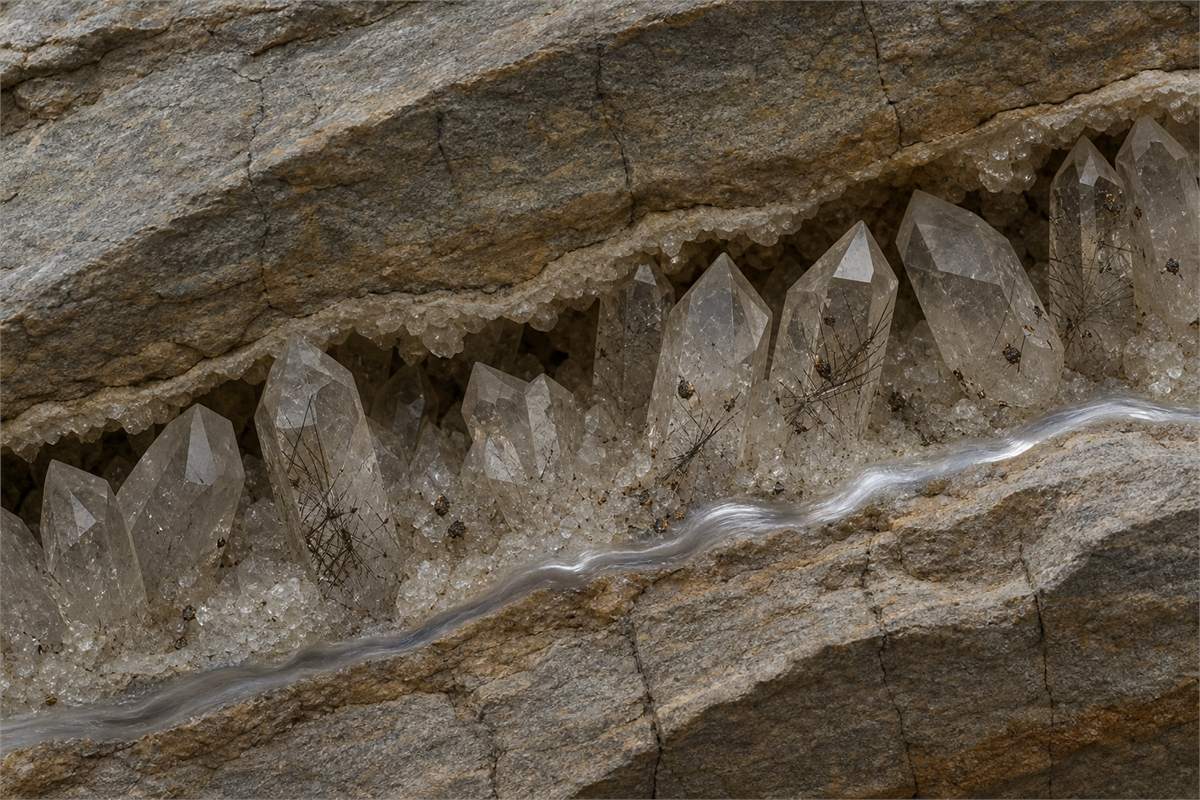
Rutilated Quartz Colors and Inclusion Habits
Rutile itself can appear yellowish, golden, orange, red-brown, gray, or very dark in quartz, and laboratory-confirmed examples include golden needles, coppery red needles, green networks, and silvery-gray tufts. Its appearance changes with thickness, oxidation state, associated minerals, lighting, the quartz body color, and the direction of observation.
| Visible appearance | What it can suggest | What it cannot prove |
|---|---|---|
| Golden to yellow-brown needles | A common rutilated-quartz appearance | That every yellow needle is rutile or that the stone has a particular origin |
| Red or coppery needles and plates | Rutile, hematite, or an association may be possible | A trade label such as red hair quartz is a mineral identification |
| Silver-gray needles or tufts | Laboratory-confirmed gray rutile exists | That every gray inclusion is rutile |
| Black needles or rods | Tourmaline, amphibole, rutile, or another mineral may need consideration | That “black rutilated quartz” and tourmalinated quartz are interchangeable |
| Yellow-brown sprays, flakes, or brooms | Goethite, hematite, rutile, or mixtures may occur in included quartz | That color and shape alone settle the identity |

Gold, Red, Silver, and Black “Hair Quartz” Trade Names
Names such as golden hair quartz, jin fa jing (金发晶); red hair quartz, hong fa jing (红发晶); copper hair quartz, tong fa jing (铜发晶); and silver hair quartz, yin fa jing (银发晶) are trade terms. So are “Venus hair,” “titanium flower,” “bird’s nest,” “straight hair,” “full hair,” “treasure bowl,” and “glass body.” These labels can efficiently describe a color, pattern, density, direction, or sales style, but they are not internationally standardized mineral varieties or laboratory quality grades.
Use the trade name and the evidence together. A listing can say “golden hair quartz” as a commercial style while a report separately identifies quartz, rutile inclusions, and any treatment. Commercial nicknames should not automatically determine composition, origin, rarity, or price.

Golden Rutilated Quartz vs Trade-Name “Titanium Crystal”
In parts of the jewelry market, titanium crystal, tai jing (钛晶), is used for quartz with especially bold, reflective, coarse-looking golden inclusions. It is not a separate mineral species and it is not an official top grade above golden rutilated quartz. Words such as “plate titanium” or “titanium board” may describe coarse crystals, stacked needles, oriented reflection, or another inclusion; only suitable testing can say what the material actually is.
The trade name also needs a boundary. Titanium aura quartz is generally quartz with a surface coating that creates iridescent color, while industrial titanium-bearing fused silica is a manufactured technical material. Those subjects concern naming and treatment; this page stays with natural rutile inclusions in quartz.
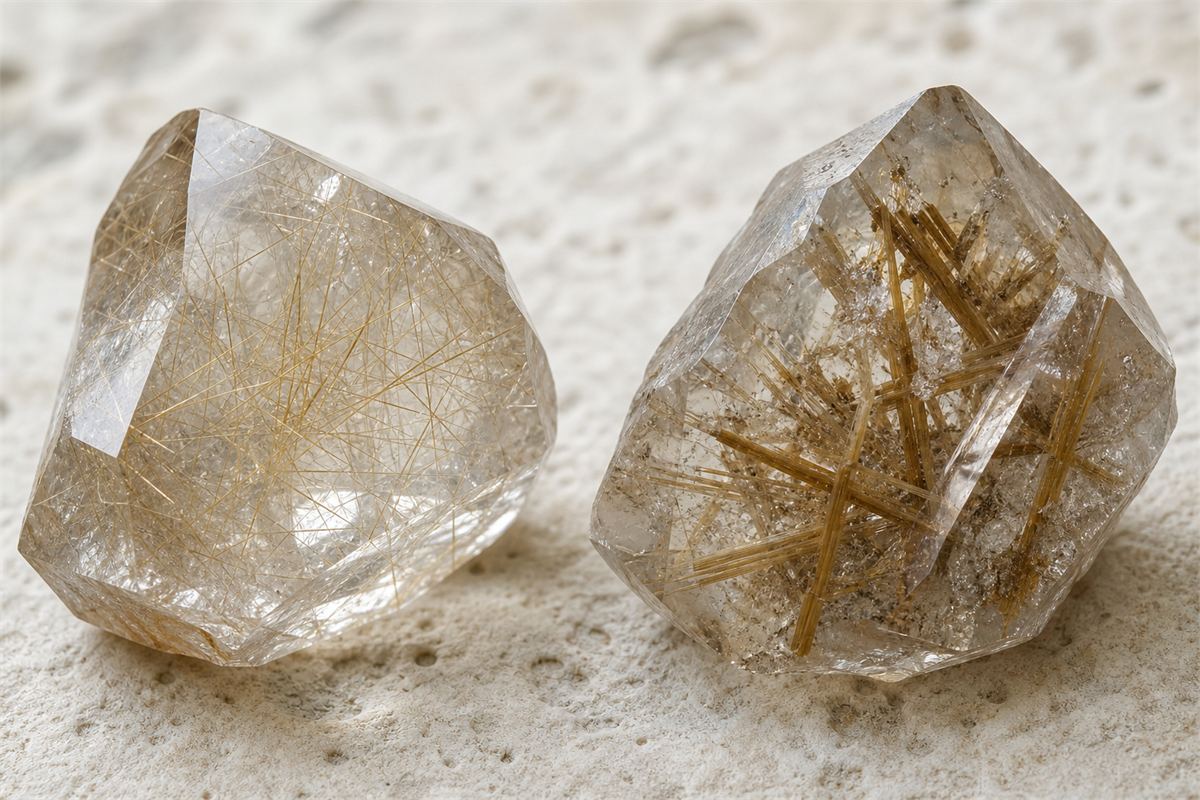
Needles, Bundles, Networks, Stars, and Rose-Like Patterns
Needles may occur singly, in parallel groups, as tangled networks, as radiating sprays, or in patterned aggregates. A six-rayed inclusion “star” can form where rutile needles radiate from a core such as hematite. Sagenitic networks can reflect twinning or intersecting crystal growth. These internal patterns belong to quartz-with-inclusions; they should not be confused with a free-standing rutile mineral specimen, a rutile knee twin, or a separate hematite rose.
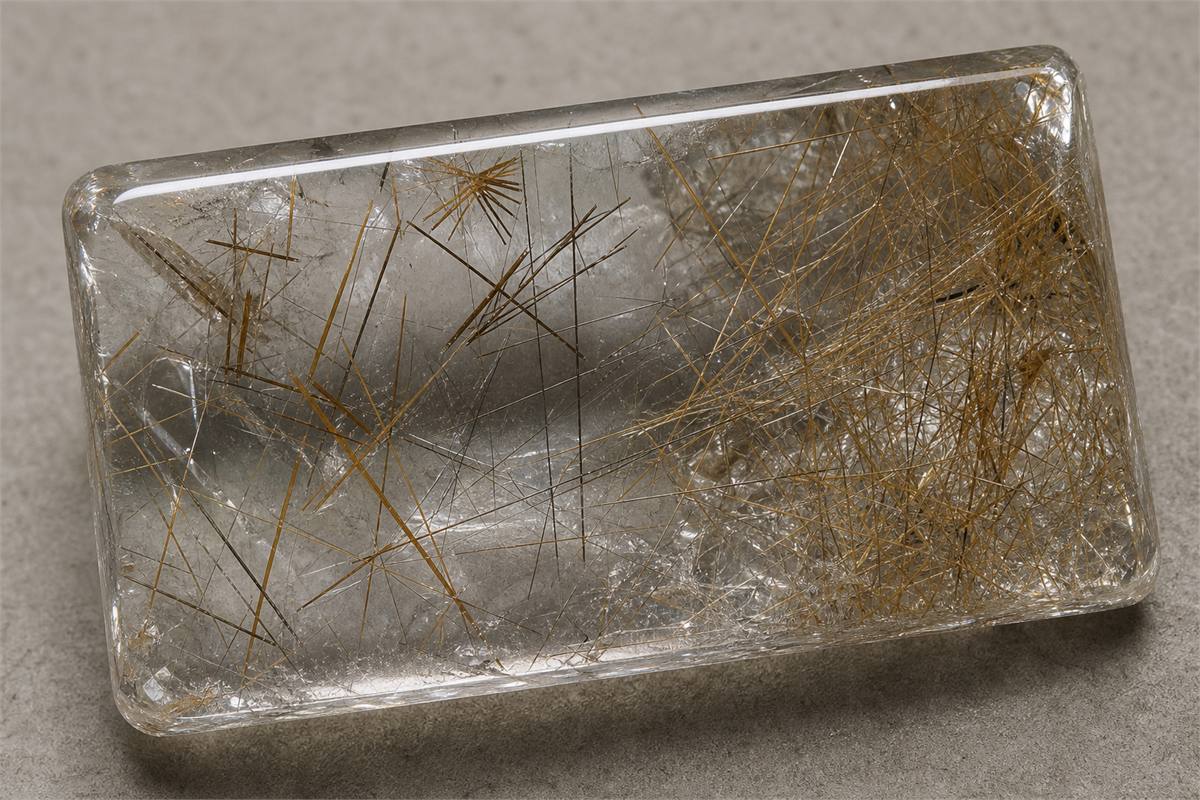
“Rose,” “flower,” “star,” and “firework” are visual descriptions unless a mineralogical habit has been demonstrated. A rose-like cluster in quartz may consist of platelets of hematite rather than rutile. Likewise, the commercial term “plate titanium crystal” does not mean the inclusion is the TiO₂ polymorph brookite, historically called板钛矿 in Chinese. Rutile, anatase, and brookite share the TiO₂ composition but have different structures.

Chatoyancy and Other Optical Effects
Rutile can reflect and scatter light, creating flashes, bright lines, or strong contrast against transparent quartz. True chatoyancy requires sufficiently parallel inclusions, a suitable domed cabochon, and the correct viewing direction so that a concentrated moving band crosses the stone. A bright reflection or “straight-hair” appearance in a bead is not automatically a cat’s-eye effect.
Asterism also requires a specific optical relationship among oriented inclusions, cut, and observation geometry. A radiating needle cluster inside a stone is an inclusion pattern; a star that appears on the surface as moving light is an optical phenomenon. A cutter may orient a cabochon to reveal a band or star, but many attractive rutilated-quartz pieces are valued simply for their internal composition.

Sources and Why Origin Does Not Equal Quality
Rutile-included quartz has been documented from multiple localities, including Brazil, Australia, the United States, and China. Published reports also show that inclusions and formation histories can vary among deposits and even among pockets within one deposit. A trading or cutting center is not automatically the geological source of the rough; for example, a place known for processing and sales should not be presented as the mine origin without provenance.
Origin cannot reliably be read from color, needle density, or clarity alone. “Brazilian” is not a universal quality grade, and a story about an old mine closing or material becoming scarce needs documentary support. If origin matters to the purchase, ask for a chain of provenance, a mine or locality name, dates, invoices or collection records, and a laboratory opinion where applicable. Even strong provenance describes where an object came from; it does not replace an assessment of treatment, condition, workmanship, or appeal.

Specimens, Faceted Gems, Cabochons, Beads, and Carvings
Rutilated quartz appears as natural crystals and clusters, mineral specimens, faceted stones, cabochons, tablets, beads, carvings, pendants, and rings. Faceting can make the host lively and frame an inclusion as part of the design; it is not restricted to perfectly clean material. Cabochons can strengthen pattern and chatoyancy. Tablets and freeform cuts give a needle network room to read. Beads turn many small views into a repeated sequence, while carving can use an inclusion as a landscape or focal line.

The cut should serve the individual rough. Look for intentional orientation, balanced proportions, even polish, protected thin edges, and a face-up view that shows the feature the seller emphasizes. A dramatic pattern can justify a non-standard shape, but dead areas, windowing, heavy weight retained without visual purpose, or fractures placed at a drill hole still deserve scrutiny.

How to Evaluate Rutilated Quartz Quality and Durability
Rutilated quartz quality is not a single ladder from low grade to “collector grade.” Different buyers may prefer a sparse golden spray, a dense copper network, a gray star, a clean faceted stone, or a rugged natural specimen. Use a factor-by-factor description so the comparison remains transparent.
- Identity and disclosure: Is the host quartz, is the inclusion identified, and are treatments or assembly stated?
- Transparency: Does the host give the desired view of the inclusions? Dense rutile can reduce transparency and still create an intentional design.
- Color and contrast: Judge the actual face-up color under neutral lighting, not a nickname or saturated seller photo.
- Inclusion pattern: Look for an arrangement you enjoy—sparse, dense, parallel, tangled, radiating, or networked—without assuming one is universally superior.
- Cut and orientation: Check how the cutter framed the needles, bright reflections, possible chatoyancy, and weight distribution.
- Surface and polish: Inspect facet junctions, cabochon symmetry, bead roundness, drill holes, and exposed cavities.
- Fractures and durability: Note surface-reaching fractures, impact chips, thin sections, and damage near drill holes or prongs.
- Matching: In a strand, compare bead diameter, body color, transparency, pattern, polish, and hole alignment.
- Craft and setting: Consider metal edges, adhesive, elastic, clasp, prongs, and repairability.
- Provenance and preference: Treat documented origin as information, then decide whether the total object suits your aesthetic and use.

Natural cloudiness, fractures, or dark points are not proof of authenticity, and a clean natural stone is not automatically suspicious. Glass, resin, and synthetic materials can contain deliberate defects. Condition matters because a beautiful internal pattern can coexist with a durability problem; request clear side views and close-ups before purchase.

Treatments, Imitations, and Composites
| Category | What it is | What a buyer should request |
|---|---|---|
| Natural quartz with rutile | Quartz containing rutile inclusions | Identification of host and inclusion; condition and provenance where relevant |
| Dyed material | Color introduced into fractures, pores, a coating, or another host | Written color-treatment disclosure and care limits |
| Fracture-filled or impregnated quartz | Resin, glass, or another filler used in fractures or cavities | Type and extent of filling, stability, and repair/cleaning limits |
| Coated quartz | A surface layer used to change color or iridescence | Coating disclosure and instructions that protect the surface |
| Composite or assembled stone | Two or more pieces joined by cement or another method | Assembly map, component identities, and adhesive care |
| Glass or resin imitation | Non-quartz material made to resemble included quartz | Material disclosure; do not rely on a single bubble or touch test |
| Synthetic quartz | Laboratory-grown quartz | Natural-versus-synthetic conclusion and any inclusion or treatment disclosure |
| Other included stone | Quartz or another host containing non-rutile needles | Specific inclusion identification when the name affects value |

What Home Inspection Cannot Prove
A loupe can help you map fractures, drill holes, surface coatings, possible filled areas, and the relationship between a needle and the polished surface. It cannot by itself confirm that the host is natural quartz, that every needle is rutile, or that a stone is untreated. Likewise, regular needles do not prove synthetic origin, branching does not prove natural origin, a bubble does not automatically mean glass, and an exceptionally clean stone is not automatically an imitation.
Skip ice-cold touch tests, weight guesses, wet tissues, alcohol, needles, scraping, flames, soaking experiments, magnets, and high-intensity-light tricks. They are weak evidence and may damage a coating, filler, resin, cord, adhesive, or setting. For a broader explanation of observation limits, read how to tell if a crystal is real and the natural crystal vs artificial crystal guide.

How to Read a Laboratory Report
Start with the laboratory, not the logo printed by the seller. Check the organization’s credentials and scope, then verify the report number through its official channel. Match the photograph, measurements, weight, color, shape, and identifying marks to the exact item. A report for one bead or sample does not cover an entire batch unless the sampling plan and conclusion explicitly say so.
- Confirm the host material: quartz, glass, resin, another gem, or an assembled object.
- Look for a natural or synthetic conclusion where the laboratory offers it.
- Read the inclusion wording: rutile, hematite, tourmaline, unidentified needles, or another conclusion.
- Review the treatment disclosure: filling, coating, dye, impregnation, assembly, or no indication within the limits of testing.
- Check whether origin was actually tested and stated; many standard identification reports do not determine locality.
- Remember that a gem report normally describes identity and detected treatments. Quality grade, market price, and investment outlook are separate judgments unless the report expressly addresses them.
Depending on the question and sample, a qualified laboratory may use refractive index, polariscopic observation, microscopy, Raman spectroscopy, FTIR, UV-Vis, X-ray fluorescence, or other elemental and structural methods. Not every instrument is needed for every stone. For wholesale buying, add sampling, sealed reference samples, specification tolerances, written treatment disclosure, and return terms rather than treating one report as a certificate for the whole lot.

Rutilated Quartz Price and Value Factors
There is no universal rutilated quartz price per gram or per carat. A loose cabochon, matched bracelet, carved pendant, crystal specimen, and documented collector object are different markets. Prices also move with seller overhead, workmanship, locality documentation, fashion, platform fees, return protection, and the buyer pool. Commercial names and spiritual stories can add marketing premiums without changing the measurable material.
A sound comparison records the same facts for each object: date, currency, sale type, dimensions, weight, host and inclusion conclusion, natural or synthetic status, treatments, condition, cut or setting quality, provenance, and whether the number is an asking price, retail price, estimate, or completed sale. Then compare like with like. Needle density, width, direction, gold color, chatoyancy, or a “full hair” label may influence a particular design market, but none creates an automatic multiplier.
Value the whole object. High transparency may show inclusions beautifully, while dense rutile may produce stronger pattern but less light transmission. A rare-looking arrangement can be appealing yet weakened by a surface-reaching fracture. A matched bracelet demands selection across many beads; a fine faceted gem depends on orientation and polish; a specimen may depend on natural crystal form, matrix, repair history, and provenance. These are descriptive factors, not investment promises.

Choosing Rutilated Quartz Bracelet Bead Size and Fit
Choose a rutilated quartz bracelet by measured fit, not by gender labels. Bead diameter changes visual scale, weight, flexibility, and internal space. Large round beads project farther from the wrist and can make an elastic bracelet feel tighter even when its nominal circumference looks similar.
Measure and test the actual bracelet
- Measure the wrist at the place where the bracelet will sit, using a soft tape or a strip of paper held comfortably against the skin.
- Decide the wearing preference: close, regular, or loose. Add only the amount of ease that feels comfortable for that design and activity.
- Ask for the finished inner circumference or test the actual bracelet on a sizing cone. A bead count multiplied by bead diameter is not the same as wearable inner circumference.
- Include spacers, charms, knots, clasps, and elastic tension in the fit. Large beads and bulky components reduce usable space.
- Check weight, hand movement, keyboard use, sleeve clearance, and whether the bracelet rotates into hard surfaces.
- For stacked wear, separate sharp metal edges, high settings, and harder gemstones that can scratch quartz; also prevent quartz from abrading softer gems.

There is no universal one-finger rule and no fixed mapping from wrist size to bead diameter. For a more detailed measuring method, use the crystal bracelet size and fit guide. The published rutilated quartz bracelet guide covers bracelet-specific design, wear, and buying context, while this page keeps the broader mineral and quality view.
Buying Pendants, Rings, and Specimens
Pendants
For a pendant, inspect the drill, bail, wire wrap, or bezel. The feature should face forward without placing a fracture at the main load point. Ask for side lighting and back lighting so you can judge both the face-up pattern and the host transparency. Confirm the total weight and chain compatibility rather than buying from an isolated carat number.
Rings
Rings receive more impact than pendants. Favor a setting that protects vulnerable edges and keeps prongs away from surface-reaching fractures. Check the underside for open cavities, glue, foil, coatings, or joined components. A dramatic high dome may show a pattern well, but its height also changes snagging and collision risk.
Mineral specimens
For a specimen, distinguish a natural quartz crystal with rutile inclusions from a polished stone, a repaired crystal, a glued group, or an independent rutile twin associated with quartz. Request overall dimensions, close-ups of contacts and terminations, repair and stabilization disclosure, locality documentation, and a stable display base. Size alone is not a quality measure; natural form, damage, restoration, mineral association, and provenance matter.

How to Clean Untreated Rutilated Quartz
For stable, untreated rutilated quartz without prominent fractures or a sensitive setting, use lukewarm water, a small amount of mild detergent, and a soft lint-free cloth or soft brush. Clean briefly, rinse thoroughly, and dry completely. Water used this way is a cleaning medium, not a test of authenticity.

Remove jewelry before high-impact work, swimming, hot tubs, saunas, or activities where loss is likely. Avoid sudden temperature change and extreme heat. Store pieces in a separate pouch or compartment: diamond and corundum can scratch quartz, while quartz can scratch softer gems. Inspect elastic, knots, clasps, and drill holes periodically and restring when you see looseness, fraying, cuts, or loss of elasticity rather than following a fixed replacement calendar.
The Eastern Story jewelry care guide provides wider guidance for mixed-material pieces. Always follow the most sensitive part of the object.
Care for Filled, Coated, or Assembled Jewelry
If the stone has prominent fractures, fracture filling, impregnation, a surface coating, glue, elastic cord, enamel, foil, or a complex setting, avoid soaking, steam, and ultrasonic cleaning unless the seller or a qualified jeweler gives written approval for that exact construction. Ultrasonic risk comes from fractures, fillings, adhesives, settings, and unknown treatments—not from loose rutile needles being shaken out of intact quartz.
Perfume, sweat, cosmetics, and household detergents usually create buildup or threaten metal plating, adhesives, elastic, coatings, and porous components before they attack the quartz host. Wipe the complete jewel after wear and keep salt, smoke, ash, intense sun, and prolonged water away from unknown or mixed materials. A cleansing ritual is a personal symbolic practice, not a substitute for physical jewelry care.

Modern Symbolism and Gemological Evidence
In modern crystal lore, golden rutilated quartz is often associated with clarity, confidence, momentum, prosperity, or a bright personal outlook. These are contemporary symbolic interpretations and gift language, separate from mineral identification and laboratory evidence. Gemology can test composition, structure, inclusions, treatments, and sometimes origin; personal meanings belong to the wearer’s story rather than a measurable health, career, sleep, or financial result.
Choose the wrist that feels comfortable, interferes least with work, and reduces collisions. Choose combinations for weight, surface hardness, metal edges, skin sensitivity, color, and design. That practical approach respects both the beauty of the object and the meaning a wearer may choose to give it.

Frequently Asked Questions
Related Posts


0 Comments