
An amethyst geode is a hollow rock cavity lined with purple quartz crystals. Most large display pieces sold as an amethyst cave began as gas cavities in volcanic rock, then filled gradually with silica-rich fluids that deposited chalcedony, quartz, and finally amethyst along the inner walls. Amethyst is the purple variety of quartz: silicon dioxide (SiO₂) with a Mohs hardness of 7.
In Chinese, an amethyst geode is commonly called Zǐ Shuǐjīng Dòng (紫水晶洞), literally “purple crystal cave.” It can be appreciated as geology, mineral décor, a collector’s specimen, or a feng shui (风水) symbol. This guide explains how amethyst geodes form, what their trade names mean, how value is judged, how to recognize treatments and repairs, where to display one safely, and how to clean it without damaging hidden materials.
Amethyst Geode Facts at a Glance
| Mineral | Amethyst, the purple variety of quartz |
|---|---|
| Chemical formula | SiO₂ |
| Mohs hardness | 7 for the quartz crystals; the complete object may include softer minerals, coatings, cement, resin, or adhesives |
| Common host | Volcanic rock cavities, especially vesicles in basalt |
| Typical internal layers | Host rock, possible green mineral lining, chalcedony or agate, quartz, amethyst, and occasional secondary minerals |
| Major commercial sources | Rio Grande do Sul, Brazil, and Artigas, Uruguay |
| Main value factors | Color, crystal character, aesthetics, condition, size, stability, provenance, treatments, repairs, and transport complexity |
| Best first cleaning method | Soft dry brush plus a low-suction vacuum held at a distance behind a mesh screen |

How Amethyst Geodes Form
Many famous South American amethyst geodes occur in basaltic lava flows. As lava cools, dissolved gases can separate from the melt and collect as bubbles. Some bubbles grow, elongate, or join neighboring cavities. Once the lava hardens, these voids become spaces in which later minerals can develop.

Silica-bearing fluids then move through fractures and porous zones in the rock. Silica precipitates on the cavity walls over repeated episodes. Fine-grained chalcedony or banded agate may form first, followed by larger quartz crystals that point inward toward the open space. Under suitable chemical conditions, later quartz grows as amethyst.
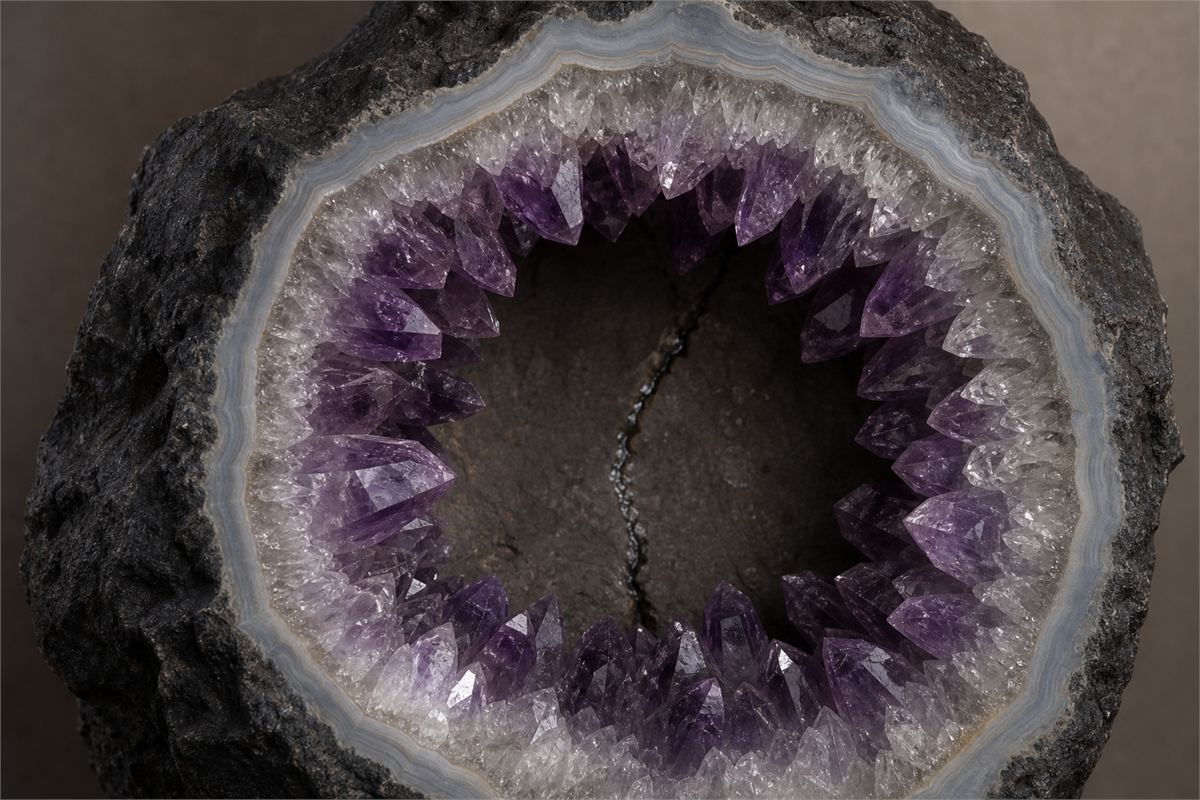
This is a useful general model, not a rigid recipe. Different deposits have different fluid histories, temperatures, wall-rock reactions, and growth interruptions. A specimen may show clear agate bands, a nearly uniform chalcedony wall, several generations of quartz, or secondary minerals deposited after the amethyst. The sequence also varies within a single mining district.
How long does formation take?
A geode records multiple geological events, but its age should not be described with a universal phrase such as “billions of years.” The age of the host lava, the timing of cavity formation, and the later mineral-growth stages are related but not identical. Without deposit-specific dating, the most accurate description is that the geode formed through long-term geological processes after its host rock solidified.
Inside an Amethyst Cave: Rock, Agate, Quartz, and Companion Minerals
A cut amethyst cave often looks like a set of nested materials. Understanding those layers helps with buying, cleaning, repair disclosure, and mineral identification.

| Possible layer or feature | What it is | What buyers should know |
|---|---|---|
| Basalt or volcanic host rock | The dark outer rock that originally contained the cavity | It may be trimmed, painted, sealed, or partly covered for presentation and transport. |
| Celadonite, chlorite, or another green lining | A green mineral-rich zone between host rock and silica layers in some deposits | Color and texture vary; a green rim is not present in every geode. |
| Chalcedony or agate | Microcrystalline silica, sometimes visibly banded | Banding can be beautiful and informative, but a thick agate rim is not automatically a universal quality grade. |
| Colorless or milky quartz | Earlier or later quartz growth around the purple zone | White tips and pale zones can reflect natural growth, later quartz, damage, coating, or repair; context matters. |
| Amethyst | Purple quartz crystals growing toward the cavity | Crystal size, color distribution, luster, damage, and overall composition should be judged together. |
| Calcite and other secondary minerals | Later minerals that grew on or between quartz crystals | Calcite is common. Iron oxides such as goethite or hematite may also occur. Gold-colored needles should not be called “titanium quartz” without mineral evidence. |
If a seller highlights an unusual associated mineral, ask for the basis of the identification. A label, supplier statement, or visual resemblance may be a starting point, but valuable specimens deserve a qualified mineral identification rather than an attractive trade nickname.

Why Amethyst Is Purple: Color Centers, Zoning, Light, and Heat
Pure quartz is colorless. Amethyst color develops when iron-related defects are incorporated into quartz and later affected by natural ionizing radiation. The resulting color centers absorb parts of visible light and create purple. Temperature and geological history also influence which color centers remain stable.

This is why “darker means more iron” is too simple. Color depends on where iron sits in the crystal structure, its oxidation state, radiation history, temperature, growth sector, and viewing conditions. Many crystals show color zoning: purple may be concentrated near the tips, in bands, or in alternating growth sectors. A white tip may be natural color zoning or later colorless quartz, although abrasion, broken points, fillings, and coatings can create a similar impression.
Color should be judged in indirect daylight and ordinary room light. Very dark purple can be dramatic, but a near-black cave may hide crystal form and internal sparkle. “Royal purple,” “wine purple,” and similar phrases are trade descriptions, not standardized grades. Prolonged intense light can fade some amethyst, while high heat can lighten it or shift its color toward yellow, brown, green, or colorless tones. Keep a display away from strong sun, fireplaces, radiators, and other heat sources.

Brazilian vs. Uruguayan Amethyst Geodes
Rio Grande do Sul in southern Brazil and Artigas in northern Uruguay are the best-known commercial sources for large basalt-hosted amethyst geodes. Their deposits belong to the wider volcanic province of the Paraná Basin, yet specimens from each market often show different tendencies.

| Market tendency | Brazil, especially Rio Grande do Sul | Uruguay, especially Artigas |
|---|---|---|
| Typical display size | Large caves and tall cathedral forms are common in the trade. | Many pieces are smaller or more compact. |
| Typical color impression | Often lighter or more variable purple. | Often deeper, more saturated purple. |
| Typical crystal habit | Larger or more open crystal points are common. | Fine, densely packed crystals are common. |
| Buying implication | Useful for dramatic floor pieces and architectural scale. | Useful for saturated color and compact display. |
Color alone cannot prove origin. Cutting style, backing, base construction, dealer history, export records, mine information, and reliable provenance are more useful. A seller who names a specific country or district should be willing to explain how that information followed the specimen through the supply chain.

Amethyst Geode Types and Trade Names
The mineralogical object is an amethyst-lined geode. The shapes used in shops are created by natural form, sawing, trimming, polishing, mounting, and marketing. Common names include:

- Amethyst cave or cathedral: a tall, upright half-geode with an arched opening.
- Amethyst geode pair: two complementary halves cut from one geode, ideally sold with documented matching surfaces.
- Tabletop geode: a smaller piece with a flat or fitted base.
- Geode slice: a cross-section showing host rock, agate, and crystal layers.
- “Dinosaur egg,” “wealth basin,” “money bag,” or “smiling opening”: market or symbolic names based on outline and presentation.
- “Five Elements” shape: a modern symbolic classification that matches silhouettes with the Five Elements Wu Xing (五行).
These trade names can be useful for browsing, but they are not mineralogical grades and do not establish origin, rarity, or value. A thunderegg is also a different geological term and should not be used as a synonym for an amethyst geode.

What Determines Amethyst Geode Quality, Value, and Price?
There is no universal “AAA” grading system for amethyst geodes. Price reflects a combination of mineral quality, visual appeal, condition, scale, provenance, preparation, and logistics. Two specimens of similar height can differ greatly because one has better color and a stable natural-looking composition, while the other has hidden repairs, a weak base, or expensive handling requirements.
The main pricing variables
- Color: attractive saturation, brightness, and usable detail in normal light. The darkest piece is not automatically the best.
- Color distribution: harmonious zoning can be beautiful; distracting pale patches or brownish areas may reduce appeal.
- Crystal character: luster, intact terminations, pleasing size, density, and arrangement. Large crystal points are not universally superior to fine crystals.
- Composition: balance among opening, depth, rim, crystal field, and outer silhouette.
- Condition: broken points, loose fragments, unstable cracks, scratches, stains, chipped rims, and concealed repair.
- Associated minerals: well-identified calcite or other minerals may add interest when aesthetically integrated and undamaged.
- Size and weight: large pieces offer visual impact, but also require stronger bases, freight, insurance, equipment, and installation.
- Provenance: credible mine, district, collection, export, or dealer records can support confidence.
- Treatments and construction: dye, coatings, glued crystals, resin, assembled sections, crack repairs, paint, and cement backing affect value according to extent and disclosure.
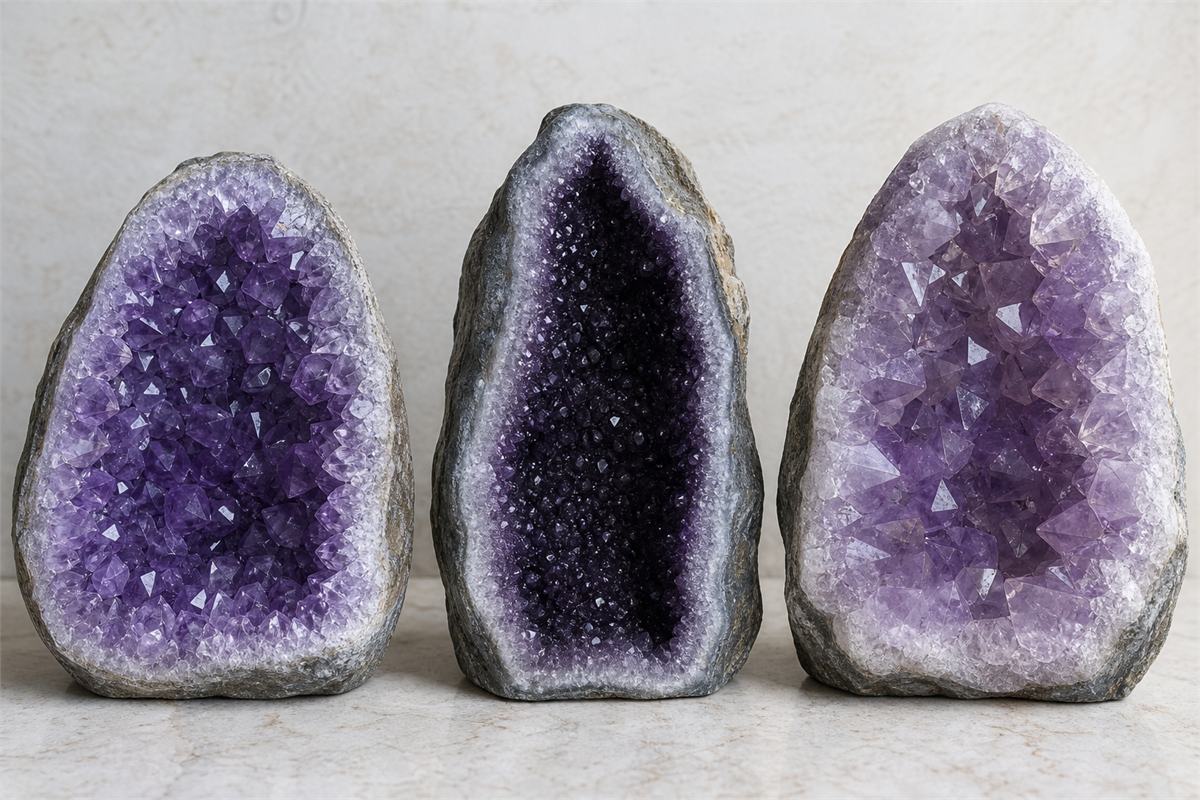
Compare the total delivered and installed cost, not only the specimen price. A large geode may require a crate, lift-gate delivery, pallet jack, stair assessment, reinforced display furniture, professional movers, and anti-tip hardware.

Real vs. Fake Amethyst Geodes: Dye, Coatings, Repairs, and Assembly
Most buying problems are more nuanced than “real” or “fake.” A piece can contain natural amethyst yet also have a painted shell, repaired fracture, concrete backing, resin fill, added crystal, or assembled base. The key questions are what is natural, what has been altered, whether the work is stable, and whether it was disclosed.

| Feature to inspect | What may be normal | What deserves clarification |
|---|---|---|
| Outer shell | Trimmed rock, protective paint, sealant, or a fitted base | Thick coating that hides joins, cracks, or the relationship between matrix and crystal lining |
| Backing | Cement or concrete added for stability and transport | Undisclosed backing, excessive weight, moisture damage, or backing used to conceal assembly |
| Color | Natural zoning from pale lavender to deep purple | Purple concentrated in cracks, on exposed surfaces, or on adjacent cement; unnatural overspray or wipe marks |
| Crystal field | Variable point size, inclusions, healed fractures, later quartz, and occasional broken tips | Repeated glue lines, detached clusters set into sockets, glossy resin pools, or many identical added points |
| Rim and joins | Natural fractures and cut or polished edges | Straight seams through unrelated crystal patterns, mismatched halves, filler, or a change in matrix across a join |
| Repairs | Professional stabilization can preserve a specimen | Repairs presented as untouched material or without an explanation of extent and method |

Natural fractures, inclusions, and uneven color can support a geological interpretation, but none is a standalone proof of authenticity. Avoid scratch tests, fire, solvents, acids, repeated tapping, or attempts to calculate the density of the complete object. A whole geode may combine quartz, host rock, void space, cement, metal, resin, and moisture, so the density of pure quartz does not identify the assembled specimen.

For a high-value purchase, ask an independent mineral expert to examine the piece, or confirm that a gemological or mineralogical laboratory can accept a specimen of its size. The evaluation should match the question: mineral identity, treatment detection, structural stability, provenance, or insurance value may require different expertise.
How to Choose an Amethyst Geode: A Buyer’s Checklist
Online listings often show only the sparkling front. A serious buying decision needs the entire object. Ask the seller for the following before payment:
- Natural-light photos and video. Request indirect daylight plus ordinary indoor light, without heavy filters or saturated purple lighting.
- Front, back, sides, top, base, and opening. Include close-ups of the agate rim, crystal tips, companion minerals, cracks, joins, and repaired areas.
- Exact dimensions. Record overall height, width, depth, opening size, footprint, and base dimensions. Confirm whether measurements include the stand.
- Exact weight. Weight affects furniture, floors, freight, lifting, and installation.
- Treatment and repair disclosure. Ask specifically about dye, heat, coatings, paint, resin, glue, replaced crystals, fracture repair, assembly, cement, and metal supports.
- Source documentation. Request country, region or mine when known, along with invoices, collection history, export documents, or other records that traveled with the piece.
- Condition report. Ask whether any crystals are loose, whether cracks are active or stabilized, and whether the base rocks or wobbles.
- Return and damage terms. Confirm inspection period, return freight, insurance responsibility, delivery method, concealed-damage procedure, and who handles installation.

Compare specimens in the lighting and room scale where they will be displayed. The right choice is not always the deepest purple or largest crystal teeth. A balanced cave that reveals its structure, fits the room, and arrives with clear disclosure is often the stronger purchase.

Amethyst Geode Meaning, Home Display, and Feng Shui
The word amethyst comes through Greek amethystos, meaning “not intoxicated,” which connects the stone with later themes of sobriety, composure, and clear thought. The popular story of Bacchus, Diana, and a maiden named Amethyst is best understood as a later literary retelling, not a securely documented original myth from classical Greece.

In modern feng shui, the inward-facing cave and purple color are often read as symbols of collected blessings, dignity, reflection, and a space that gathers attention rather than scattering it. Trade names such as “wealth basin” build on that symbolic reading. The phrase Purple Qi Comes from the East, Zǐ Qì Dōng Lái (紫气东来), comes from the cultural legend surrounding Laozi and an auspicious purple cloud; it is a separate cultural allusion rather than an ancient amethyst tradition.

Use these ideas as cultural symbolism and personal ritual. Material science explains the geode’s quartz, color centers, stability, and geological origin; it does not turn a mineral display into a physical mechanism for wealth, health, sleep, memory, relationships, or exam results.
Where to place an amethyst geode
- Living room: use it as a focal object where indirect light can reveal the crystals without prolonged sun exposure.
- Entryway: choose a broad, stable location outside the main walking path and away from a door swing.
- Study or office: a small geode can serve as a visual symbol of reflection and concentrated work, provided the desk or shelf is rated for its weight.
- Traditional wealth corner: some feng shui schools favor the far corner from the entrance or another calculated wealth position. Methods vary, so combine the chosen tradition with safe placement and good room design.
- Shop or reception area: place it where visitors can see the crystal interior without touching sharp points or crowding the piece.
There is no single universal rule for the direction of the opening. Prioritize the best view, reflected light, dust exposure, structural stability, anti-tip anchoring, and safe circulation. Avoid a position over a bed, beside a narrow passage, on an unstable shelf, or where the object could fall toward a seated person.
An amethyst cave is sometimes used as a symbolic resting place for jewelry. It cannot be scientifically described as cleansing or charging other crystals. If the practice is meaningful to you, treat it as a personal ritual and place jewelry in a smooth dish inside or beside the geode so metal, cord, and skin-facing surfaces do not scrape against sharp crystal points.
Large Amethyst Geode Safety, Moving, and Installation
Amethyst geodes range from small hand-sized specimens to installations weighing hundreds of kilograms. Quartz is hard, but crystal tips can chip, the host rock can fracture, and tall caves can be top-heavy. Treat a large geode as a heavy architectural object.
- Use a floor, plinth, cabinet, or table with a verified load rating and a wide, stable footprint.
- Add a compatible non-slip pad and an anti-tip restraint designed for the specimen and mounting surface.
- In earthquake-prone areas, secure the geode to an engineered base or wall connection.
- For exceptionally heavy pieces, ask a qualified professional to assess floor loading, especially on upper stories.
- Keep the geode away from edges, crowded routes, play areas, pets, and places where a child might climb the stand.
- Protect fingers from sharp points, wear closed-toe shoes, and use rated lifting equipment rather than pulling on the crystal rim.
- Hire professional art, stone, safe, or piano movers when weight, stairs, narrow turns, or valuable finishes make the move complex.

Before delivery, measure doors, elevators, stairs, turning radii, ceiling height, and the final base. Confirm whether the shipping crate can be opened indoors and how the specimen will be transferred from pallet to display. Photograph the unopened crate and every side of the piece during unpacking so freight damage can be documented promptly.

Amethyst Geode Gifts, Shipping, and Presentation
An amethyst geode gift suits a housewarming, new office, studio opening, milestone, or collector who enjoys natural objects. Its most graceful message is specific: a purple quartz cave for reflection, a lasting geological object for a new space, or a distinctive piece of mineral art.

Choose a size the recipient can safely display. Include dimensions, weight, origin information, repair disclosure, cleaning instructions, and any stand or restraint. For a large surprise gift, coordinate delivery and installation in advance; an object that requires a pallet jack should never arrive without the recipient’s knowledge.

For a more wearable alternative, explore meaningful objects and jewelry in the Eastern Story Blessing collection. A card can describe the geode’s natural formation and symbolic theme without promising a result for the recipient.
How to Clean an Amethyst Geode
The safest default is dry cleaning. Use a soft artist’s brush or anti-static brush to loosen dust. Hold a low-suction vacuum several centimeters away, with fine mesh secured over the nozzle so loose crystals or fragments cannot be pulled inside. Work from the top downward and support the object so brushing cannot tip it.

When water may be appropriate

Quartz itself tolerates clean water, but a complete geode may also contain calcite, gypsum, dyes, paint, cement, resin, fillers, metal, and adhesives. Identify the companion minerals and backing first. If the specimen is confirmed to be water-safe, use a small amount of distilled water, a little mild detergent, and a soft brush. Keep the cleaning brief, drain every cavity, and dry the piece completely in moving room-temperature air.
What to avoid
- Vinegar, lemon juice, and other acids
- Bleach, alcohol, strong solvents, and abrasive cleaners
- Ultrasonic or steam cleaning for a large, repaired, dyed, backed, or mixed-mineral specimen
- High-pressure water, forceful compressed air, and prolonged soaking
- Cleaning putty or gel, which can lodge between fine crystals
- Furniture oil, “crystal oil,” polish, wax, or fragrance smoke
Move a complex, valuable, repaired, or very large specimen as little as possible and use a mineral conservator or experienced professional for deep cleaning. For broader material-safe habits, see the Eastern Story Care Guide and Material Guide. Readers who want the quartz mineral background can also continue with our clear quartz guide.
A Thoughtful Way to Choose an Amethyst Cave
The best amethyst geode is not defined by one superlative. Look for a specimen whose color remains attractive in real room light, whose crystals and layers are visible, whose repairs and backing are clearly disclosed, and whose weight can be supported safely. Good provenance, careful handling, and honest condition information matter as much as trade names.

Approached this way, an amethyst cave can be several things at once: a record of volcanic and fluid history, a sculptural purple quartz display, a meaningful gift, and—if it suits your tradition—a cultural symbol of collected blessings and reflective space.
Frequently Asked Questions
Related Posts


2 Comments