
Bodhi means awakening or enlightenment: a liberating realization at the heart of Buddhism. The word carries the sense of waking up and seeing clearly. It speaks to wisdom joined with compassion, and to the patient practice of meeting life with greater awareness.

In East Asian culture, Bodhi is written as puti (菩提). The same word appears in the Bodhi tree, bodhicitta, Bodhisattva, prayer beads, bracelets, and meaningful gifts. These uses share a connection to awakening, but they name different ideas and objects. Understanding those differences makes the symbol richer—and helps a Bodhi bead become a thoughtful companion rather than a vague spiritual label.
What Does Bodhi Mean in Buddhism?
Bodhi comes from Sanskrit and Pali vocabulary associated with waking, knowing, and becoming aware. “Awakening” is often the clearest first translation because it preserves that image: confusion gives way to direct understanding, as though a sleeper has opened their eyes.
This is deeper than ordinary intelligence or a sudden clever idea. In Buddhist teaching, Bodhi concerns insight that transforms how a person understands suffering, change, attachment, and the self. It is expressed through conduct as well as knowledge. Clear seeing opens into patience, ethical care, and compassion for other beings.

The title Buddha comes from the same family of meaning and is commonly understood as “awakened one.” Buddhist traditions describe awakening through different teachings, stages, and practices, so a short definition should leave room for those living differences. The shared center is simple: Bodhi is awakening from ignorance into liberating wisdom.
Bodhi, the Bodhi Tree, Bodhi Beads, and Bodhicitta
Four closely related terms are often blended together. A quick distinction keeps the spiritual idea, living tree, bead material, and compassionate intention in their proper places.
| Term | What it means | What it can carry in daily life |
|---|---|---|
| Bodhi (菩提) | Awakening or enlightenment | A wish for wisdom, clear seeing, and inner growth |
| Bodhi tree | The sacred fig, Ficus religiosa, associated with the Buddha’s awakening at Bodh Gaya | Rooted patience, shelter, contemplation, and the possibility of awakening |
| Bodhi beads | A market and cultural family of beads made from several plant materials | Prayer, counting, mindful touch, collecting, wearing, remembrance, and gifting |
| Bodhicitta | The “mind of awakening,” especially the Mahayana aspiration toward awakening for the benefit of beings | A compassionate intention that joins personal growth with care for others |
Bodhi is the core idea. The tree preserves the remembered place of awakening. Beads make that meaning tangible through touch and time. Bodhicitta turns the wish outward, joining wisdom with compassion. A Bodhisattva is a being oriented toward this path of awakening and the welfare of others; the term deserves respect, but a broad Bodhi meaning guide does not need to become a complete map of Buddhist doctrine.

Why the Bodhi Tree Symbolizes Awakening
Buddhist tradition places Siddhartha Gautama’s awakening beneath a sacred fig at Bodh Gaya. The species is Ficus religiosa, a member of the fig family. It has broad, heart-shaped leaves with long tapering tips and may remain evergreen or shed part of its foliage according to climate and season.

Like other figs, it bears rounded syconia: enclosed fig structures containing many tiny flowers. These soft figs are very different from the large, hard materials usually drilled for modern Bodhi bracelets and malas. The sacred tree and the commercial bead family meet through meaning, not through a single universal botanical source.

The tree’s cultural power comes from the story it holds. Its shade evokes stillness; its roots suggest steadiness; its moving leaves make wakefulness feel alive. A Bodhi leaf, tree silhouette, or seed-like form can therefore carry a wish for patience and clarity during study, transition, meditation, or a new beginning.
What Are Bodhi Beads Actually Made From?
“Bodhi bead” is a cultural and market umbrella rather than a precise plant name. Different seeds, fruit stones, and hard palm endosperm have entered devotional, collecting, and jewelry traditions under Bodhi names. Their textures inspired names such as stars and moon, vajra, phoenix eye, and Bodhi root.
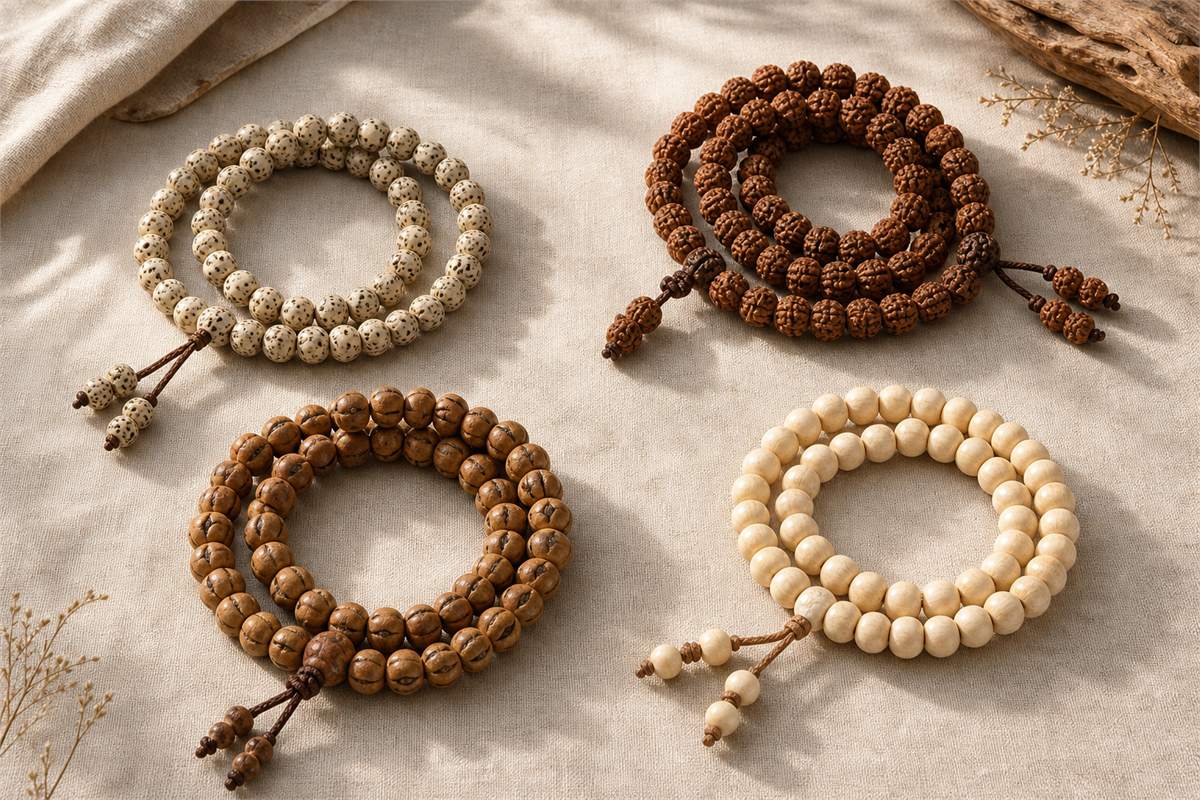
| Common bead name | Material identity | Meaning often welcomed |
|---|---|---|
| Xingyue / Star and Moon Bodhi (星月菩提) | A rattan-palm bead; published market research identified material traded as Daemonorops jenkinsiana, now generally placed in the genus Calamus. The pale surface carries dark “stars” around a larger “moon.” | Quiet focus, patient learning, and keeping one’s original intention |
| Jingang / Vajra Bodhi (金刚菩提) | Deeply ridged Elaeocarpus fruit stones, widely known as Rudraksha; more than one related species may appear in trade. | Resilience, courage, steadfast practice, and strength through change |
| Fengyan / Phoenix Eye Bodhi (凤眼菩提) | Eye-marked fruit stones from jujube relatives in the genus Ziziphus. Published sources identify different species or regional lots, so the trade name is clearer than assigning every strand to one species. | Wisdom, attentive seeing, dignity, peace, and thoughtful guidance |
| Bodhi Root (菩提根) | A pale, dense palm material associated with Corypha umbraculifera. Despite its name, the bead is made from hard seed material rather than a plant root. | Beginnings, simplicity, calm companionship, and growth over time |
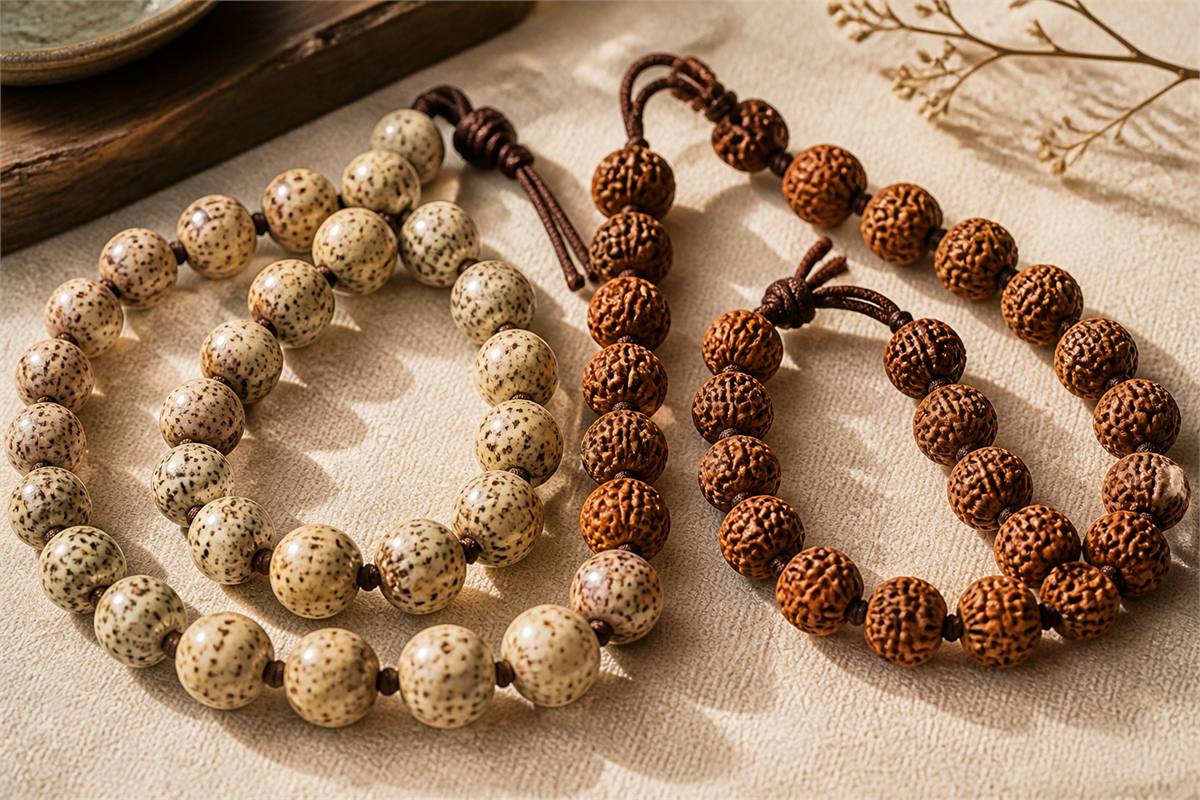
A bead’s cultural name can remain meaningful while its material is described accurately. This distinction also respects different uses. Some strands are malas for recitation, some are counters or devotional keepsakes, and others are bracelets chosen for beauty, collection, daily touch, or gifting. Purpose, practice, and the holder’s relationship with a strand shape its devotional or everyday context.

Traditional malas are often made with 108 beads, although other counts also exist. When used for recitation, the strand helps the fingers keep place. When worn as jewelry, the same tactile rhythm can become a quiet reminder to pause, notice, and return to one’s intention.
Bodhi Bead Meaning: Wisdom, Compassion, and Companionship
People choose Bodhi beads because the word gives natural material an inner direction. A strand can carry a wish for awakening, wisdom, compassion, patience, clarity, peace, protection, or steady growth. It may be worn to invite calm attention into an ordinary day, held during prayer, kept beside a journal, or given to welcome a new chapter.
The emotional meaning often grows through repetition. Fingers return to the same beads; the surface slowly warms; the strand accompanies travel, study, change, and rest. In this way, Bodhi becomes a medium through which people hope to bring about clearer choices, kinder relationships, inner steadiness, and a more beautiful life.

- For a beginning: a wish to meet the next chapter with an open and clear mind.
- For a season of learning: patience, curiosity, and the wisdom to keep growing.
- For a difficult transition: courage, steadiness, and the ability to see beyond immediate confusion.
- For meditation or prayer: continuity, compassionate intention, and a rhythm that supports attention.
- For a meaningful gift: peaceful companionship and the blessing ping’an ruyi (平安如意)—peace and the hope that life unfolds as wished.
Let the wish and the relationship guide the choice. Xingyue may suit a story about patient study; Jingang can honor resilience; Fengyan can express admiration for wisdom; pale Bodhi Root can welcome simplicity and a fresh beginning. For a deeper look at one eye-marked material, read the Fengyan Bodhi meaning guide.
How to Choose, Use, and Gift a Bodhi Strand
Begin with the role the object will play. A practice mala should feel comfortable bead by bead and use a construction suited to regular counting. An everyday bracelet should sit comfortably, move naturally, and use a cord appropriate to the bead weight. A collectible strand may place more emphasis on coherent texture and natural variation. A gift should begin with the recipient’s life moment and the message you want the strand to carry.
- Name the intention. Choose clarity, compassion, peace, resilience, patience, or another wish that feels true.
- Identify the material. Read the full bead name and botanical description, especially when care depends on a smooth palm material, a ridged fruit stone, mixed metals, or a particular cord.
- Respect the context. Prayer, decoration, collection, and gifting can sit beside one another, while devotional use carries its own traditions and personal commitments.
- Let the design breathe. Natural textures, restrained spacers, and a calm color palette allow the bead’s character and the chosen wish to remain central.
- Add a personal blessing. A handwritten line about clear seeing, kind action, or peaceful progress gives the object a relationship and a story.

A simple message might read: “May this accompany you with clarity, patience, and peace in everything ahead.” The Eastern Story Blessing collection offers more meaningful objects chosen around wishes and life moments.
Natural Patina and Gentle Care
Bodhi materials often change through use. Touch and friction smooth raised areas; air exposure contributes to oxidation; trace skin oils and perspiration affect color; and time gives the surface a softer luster. In Chinese collecting culture, this mellow surface development is called patina, or baojiang (包浆). The evolving surface becomes a visible record of material, handling, and time.
Slow change is part of the appeal. Heavy sweat, added oil, hard brushing, long soaking, high heat, or attempts to force a darker color can trap grime, weaken cord, distort pale materials, or make ridges brittle. Clean, fully dry hands are a practical care habit. Smooth beads usually respond well to a soft dry cloth, while textured Jingang and Fengyan benefit from a clean soft brush used gently in grooves.
- Keep the strand dry and wipe away perspiration after wear.
- Avoid long immersion, household cleaners, cosmetics, perfume, and chemical residue.
- Store away from direct sun, radiators, high heat, sharp temperature changes, and hard objects.
- Let a damp strand dry slowly in shade with ordinary airflow.
- Inspect the cord, holes, knots, and metal fittings as well as the beads.

Moonlight or a quiet resting place may be part of someone’s personal ritual, while the physical care remains dry, gentle, and material-aware. For a fuller explanation of surface change, see the Bodhi bead patina and care guide.
Carrying the Meaning of Bodhi
Bodhi begins as awakening, then branches into a living tree, a compassionate intention, and many kinds of beads. The sacred fig remembers the Buddha’s awakening; bodhicitta joins wisdom with care for beings; a mala supports practice; and a bracelet or keepsake can carry a personal wish for clarity, patience, peace, and growth.

The most meaningful Bodhi object is one understood clearly and chosen with heart. Let its material be truthful, its use be respectful, and its message be warm. Over time, it can become a quiet companion—a small reminder to see more clearly and respond with greater compassion.
Frequently Asked Questions
Related Posts





3 Comments