
Natural crystal is quartz that crystallized in a geological environment, while “artificial crystal” may mean either laboratory-grown synthetic quartz or decorative crystal glass. Natural quartz crystal (天然水晶) is mainly silicon dioxide, or SiO₂, and buyers value its one-of-a-kind inclusions and mineral history. Synthetic or hydrothermal quartz (合成水晶/养晶) is also crystalline SiO₂, grown under controlled conditions and often very close to natural quartz in structure and composition. Crystal glass, including some lead crystal glass (铅晶质玻璃), is glass rather than quartz. Choose natural quartz for mineral individuality, synthetic quartz for consistency, or crystal glass for cut brilliance, design, and budget.
Natural Crystal, Synthetic Quartz, and Crystal Glass at a Glance
| Material | How it is made | What it is | Typical visual character | Best for |
|---|---|---|---|---|
| Natural quartz crystal | Crystallizes through natural geological processes | Crystalline SiO₂ | Natural growth zoning, inclusions, healed fractures, or eye-clean areas | Mineral beauty, individuality, collecting, symbolic gifts |
| Synthetic quartz | Grown from high-purity quartz in a laboratory, commonly by the hydrothermal method | Crystalline SiO₂ with a structure and properties close to natural quartz | Often high clarity and consistent color; seed-plate remnants or parallel growth features may appear | Reliable supply, controlled color and size, precision applications, consistent jewelry |
| Crystal glass | Melted and formed from a glass recipe, then cut or molded | Glass, not crystalline quartz | Strong cut sparkle, uniform color, possible round bubbles or flow lines | Fashion jewelry, glassware, ornaments, decorative brilliance |

This distinction matters because “natural vs fake crystal” is not always a simple real-or-fake choice. A correctly disclosed synthetic quartz is a real laboratory-grown quartz crystal. A well-made crystal glass ornament is genuine glass craftsmanship. The buying problem begins when a seller describes one material as another or hides dyeing, fracture filling, coating, or other treatment.
What Is Natural Quartz Crystal?
Natural quartz grows when silica-rich fluids or melts crystallize under suitable geological conditions. Its ideal chemical formula is SiO₂. Quartz has a Mohs hardness of about 7, is brittle despite that hardness, and commonly has a density near 2.65–2.66 g/cm³. Jewelry specimens may be reported across roughly 2.56–2.66 g/cm³ as inclusions, variety, porosity, and test method vary. Density describes mass per volume; it is not the same property as thermal conductivity or the cool sensation felt against skin.

Quartz is also birefringent. Its double refraction (双折射) splits light traveling through most directions in the crystal into two rays with slightly different refractive indices. Under suitable orientation and magnification, this may create a faint doubled edge or line. Natural and hydrothermal synthetic quartz share this property, so birefringence can support a quartz-versus-glass check but cannot by itself prove natural origin.
Natural inclusions are features, not automatic flaws
Natural crystal may contain cotton-like veils, internal fractures known in the trade as ice cracks (冰裂), cloudiness, fluid or gas-liquid inclusions, color bands, growth zoning, and associated minerals. Rutilated quartz contains needle-like mineral inclusions; green phantom quartz can show layered mineral scenes that resemble mountains or gardens. These internal landscapes make each piece difficult to repeat.

Not every natural crystal has visible inclusions. Fine natural quartz can be eye-clean, especially in a small or carefully cut stone. Conversely, visible inclusions do not automatically make a specimen valuable. Beauty, transparency, color, durability, rarity, cutting, and the overall composition of an inclusion scene all influence market appeal. A balanced natural veil can be more desirable than a distracting fracture, while a clear stone can be natural even when no inclusion is visible without magnification.
For a deeper introduction to the quartz family, see what clear quartz is and how it is used. The green phantom quartz guide explains how mineral inclusions become both a gemological feature and a modern jewelry symbol.
What Is Synthetic or Hydrothermal Quartz?
Synthetic quartz, also called laboratory-grown or hydrothermal quartz (合成水晶/养晶), is grown by recreating part of the natural hydrothermal process inside a pressure vessel. High-purity quartz nutrient dissolves in a hot alkaline solution and recrystallizes on a seed plate in a cooler growth zone. Commercial growth may take about 1–3 months, or tens to more than one hundred days, depending on the crystal, equipment, and desired size.

The finished material can have the same SiO₂ composition, quartz crystal structure, hardness, refractive behavior, and piezoelectric character as natural quartz. Its controlled supply and consistency make it important for frequency-control components, electronics, optics, and other technical uses. In jewelry, controlled color and clarity allow matching stones and repeatable designs.

High clarity alone does not identify synthetic origin because both natural and hydrothermal quartz can be very clean. A retained seed plate, a boundary along the seed, certain parallel or chevron-like growth features, and diagnostic twinning or spectroscopy can help a trained gemologist. Many seed remnants are removed during cutting, which is why finished high-value quartz may require laboratory testing rather than a home inspection.
What Is Crystal Glass or Lead Crystal Glass?
Crystal glass (人造水晶玻璃) is a glass material designed for clarity, brilliance, weight, sound, cutting, or decorative effect. It is not a quartz crystal even when silica-rich raw materials are part of the glass recipe. Makers may add metal oxides to change refractive index, dispersion, density, workability, and luster.

Lead crystal glass (铅晶质玻璃) is one traditional category. European industry classification uses 24% lead oxide as the minimum for the “lead crystal” designation, while full lead crystal has a higher threshold. That 24% figure is a labeling and formulation reference, not a description of every product called crystal: modern brands also use lower-lead or lead-free glass recipes. Product composition should be taken from the maker’s disclosure rather than guessed from sparkle or brand reputation.
Glass can offer superb precision cutting, vivid color, matched components, and dramatic brilliance at a predictable price. It is widely used in wine glasses, chandeliers, ornaments, fashion accessories, and cut decorative jewelry. Those qualities give crystal glass real design and gift value; the material simply belongs in a different category from quartz.

Natural Crystal Meanings by Color and Variety
Crystal meaning (水晶寓意) belongs to crystal culture, Eastern jewelry symbolism, modern spiritual practice, and personal interpretation. The associations below are a language for intention and gifting rather than laboratory properties.

| Crystal | Common cultural symbolism | Often chosen for |
|---|---|---|
| Clear quartz / white crystal (白水晶) | Clarity, purification, focus, and a fresh beginning | First crystal, study desk, versatile everyday gift |
| Amethyst (紫水晶) | Wisdom, study, composure, and supportive connections | Students, exam preparation, thoughtful work gifts |
| Rose quartz (粉水晶) | Love, gentleness, friendship, and emotional openness | Partners, close friends, anniversaries, self-care rituals |
| Citrine (黄水晶) | Opportunity, optimism, abundance, and confident action | Entrepreneurs, sales professionals, new ventures |
| Green phantom quartz (绿幽灵) | Steady career growth, earned income, patience, and progress | Career milestones, promotion, business encouragement |
| Rutilated quartz (发晶) | Presence, confidence, decisive energy, and leadership | Managers, founders, public-facing work, bold style |

The broader Feng Shui crystal meaning guide explores how different stones are used in modern symbolic practice. If price and quality are your main concerns, the rose quartz price and buying guide shows how color, clarity, treatment, size, and workmanship shape one crystal market.
How to Tell If a Crystal Is Real
Begin by defining “real.” Are you checking whether an item is quartz rather than glass, whether quartz is natural rather than synthetic, or whether its color and fractures have been treated? Each question requires different evidence. Use several observations together and reserve a gemological report for valuable purchases.
1. Study inclusions and growth features in neutral light
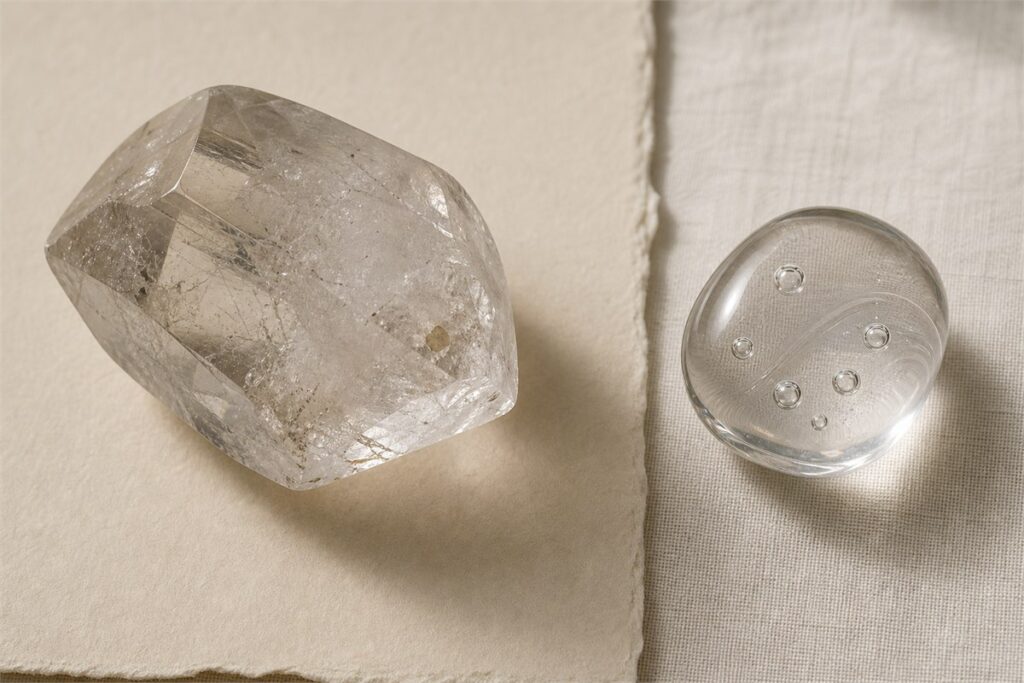
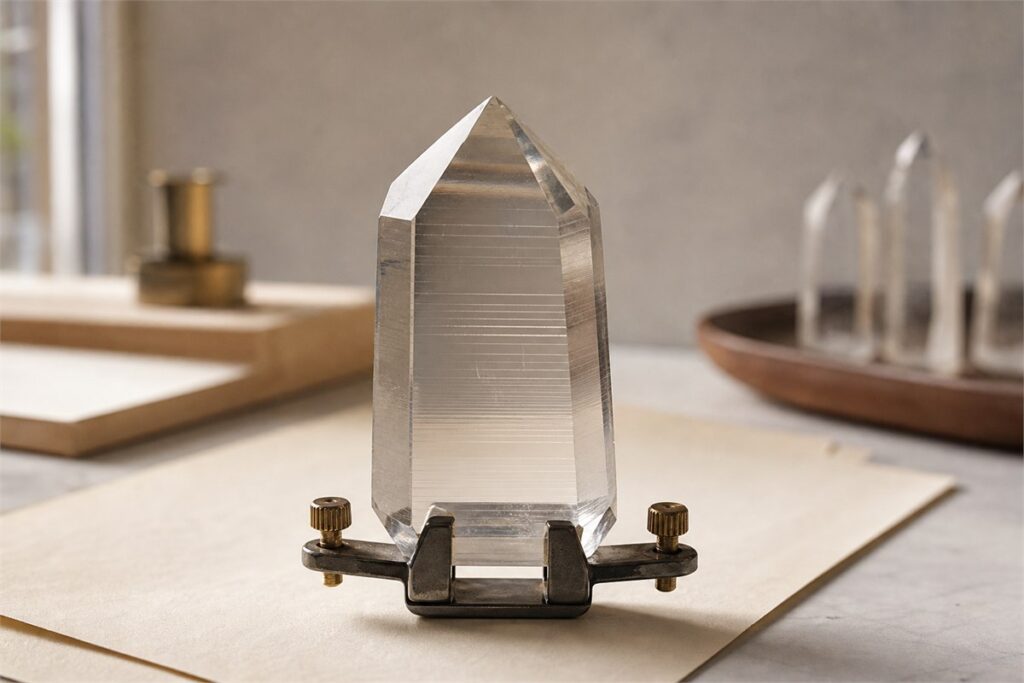
Use daylight or soft neutral light, a loupe if available, and a slow close-up video. Natural quartz may show irregular veils, healed fractures, clouds, color bands, fluid inclusions, or mineral crystals. Glass often shows perfectly round bubbles, flow or stirring lines, molded repetition, or identical internal patterns across many beads. Synthetic quartz may be unusually consistent and can show a seed-plate boundary or parallel growth features, but it can also contain inclusions and look natural.
2. Be cautious with vivid, perfectly even color
Natural color often changes gradually or follows growth zones. Extremely bright, uniform color in a low-priced “flawless” strand deserves closer inspection. In dyed crackle or artificially fractured crystal, pigment may collect along sharp fractures, around drill holes, or in surface-reaching cavities. Strong livestream lighting can conceal these clues, so request natural-light photos and detail video.

3. Use cool feel and weight only as supporting clues
Quartz often feels cool at first contact and has a substantial feel for its size, but glass can also feel cool, and lead crystal glass may be heavier than quartz. Small beads warm quickly, while settings, room temperature, and the wearer’s skin change the result. Touch and heft can flag lightweight plastic or obvious resin; they do not establish natural origin.

4. Understand what double refraction can and cannot show
A faint doubled line seen through a transparent quartz piece can be consistent with birefringence. Ordinary glass is generally singly refractive, so a properly performed optical check can help separate some quartz from glass. Orientation, curvature, facet shape, magnification, and strain can affect what you see. Synthetic quartz is also birefringent, and a rounded bead may distort or magnify text even without providing a clean diagnostic result.

5. Treat drill holes, sound, and UV as preliminary observations
Chipped drill holes, molding seams, or pooled dye can be useful warnings, but good glass can be drilled cleanly and natural quartz can chip. A light tap may produce a clear or dull sound depending on thickness, shape, cracks, and mounting. A 365 nm ultraviolet lamp may reveal some dyes, adhesives, fracture fillers, or glass additives, yet natural and synthetic quartz reactions also vary. None of these observations is decisive alone.
6. Protect the jewelry during testing
Quartz hardness is about 7, but a finished stone can still chip, fracture, loosen from a setting, or damage another surface. Do not scratch a bead with a knife, metal needle, or file, and do not use finished jewelry to scratch window glass. Non-destructive viewing, seller disclosure, and professional testing protect both the object and your return rights.
7. Read the certificate, not just the word “crystal”
For a high-value piece, request a report from a recognized gemological laboratory and match its number, measurements, weight, and photograph to the item. Read the identification and comments for natural origin, synthetic origin, dye, coating, filling, irradiation, heating, or other treatment. A report identifies tested material and disclosed features; it does not grade your personal taste, guarantee future resale, or turn ordinary material into an investment.

8. Compare the full buying story
Look for consistent naming across the product title, description, certificate, invoice, and packaging. Ask for treatment disclosure, return terms, natural-light media, bead size, weight, and close-ups. A very low price combined with perfect color, identical patterns, and “all-clear natural crystal” language is a reason to slow down—not because natural clarity is impossible, but because rarity, size, workmanship, and price should make sense together.
How Much Do Natural Crystal Gifts Cost?
Natural crystal gifts and jewelry span roughly $10 to $10,000+. The range reflects crystal variety, size, transparency, color, inclusion scene, rarity, cutting, setting, brand, craftsmanship, and documentation. Many beginner strands—especially clear quartz, rose quartz, smoky quartz, or modest mixed-crystal designs—can be found for under $100. Large collector specimens, exceptional color, dramatic mineral inclusions, fine jewelry settings, and rare high-grade material occupy the upper end.

Price alone never identifies origin. Synthetic quartz can be valuable when precision, cut, or design matters, and branded crystal glass can command a premium for craftsmanship. Compare the seller’s material description with the object in front of you, then decide whether you are paying for mineral rarity, controlled crystal growth, glass cutting, jewelry design, or brand experience.
Crystal Healing, Chakras, and “Energy” in Context
Crystal healing, chakra associations, five-elements correspondences, astrology, and “energy cleansing” belong to crystal culture and modern spiritual practice. Some wearers use a stone during meditation, journaling, prayer, breathwork, or a daily intention ritual. The object can create a meaningful pause, hold a memory, and offer psychological comfort through attention and ritual.

Quartz also has genuine physical properties: its piezoelectric behavior is useful in oscillators, sensors, timing devices, and electronics. That engineering property is different from a claim about treating illness or changing destiny. In a responsible crystal practice, symbolic jewelry can accompany reflection and well-being routines, while medical and mental-health needs are handled with qualified care.
Natural origin is meaningful to people who value a stone’s geological story, but “natural has more energy” is a belief within some spiritual communities rather than a gemological measurement. A synthetic crystal or glass keepsake can carry equal emotional value when its design, memory, or giver matters to the wearer.
How to Clean, Wear, and Store Crystal Jewelry
- Limit chemical contact: remove crystal jewelry before applying perfume, shampoo, body wash, dish soap, hairspray, or household cleaners.
- Skip heat and prolonged soaking: avoid hot springs, steam, sudden temperature changes, long immersion, and extended strong sunlight. Heat and sunlight can affect some colored quartz, treatments, cords, adhesives, and settings.
- Prevent impact: quartz resists scratching but remains brittle. Take it off for exercise, heavy housework, or tasks involving tile, metal, and hard tools.
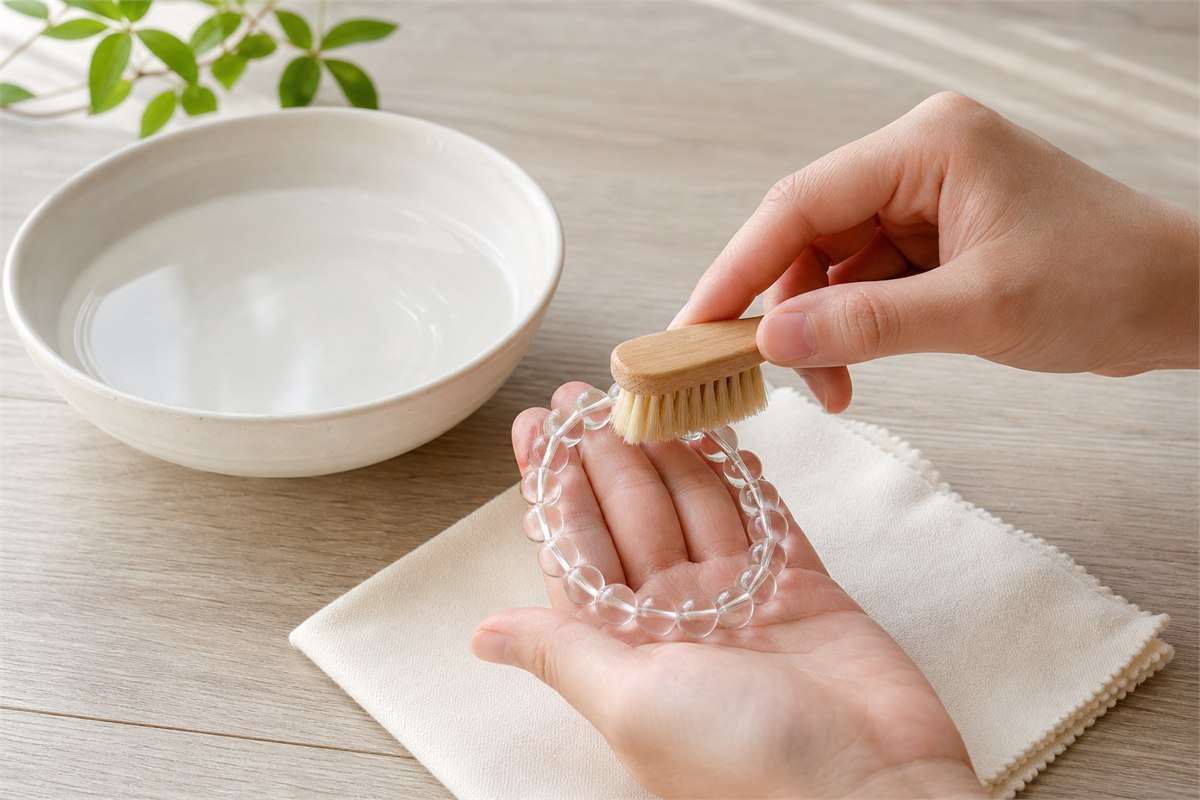
- Clean gently: when the jewelry construction permits, use clean water, a soft cloth, and a very soft brush, then dry the piece promptly and thoroughly.
- Use ultrasonics cautiously: avoid ultrasonic cleaning for stones with fractures, fillings, coatings, unknown treatments, glued parts, delicate settings, or weakened cord.
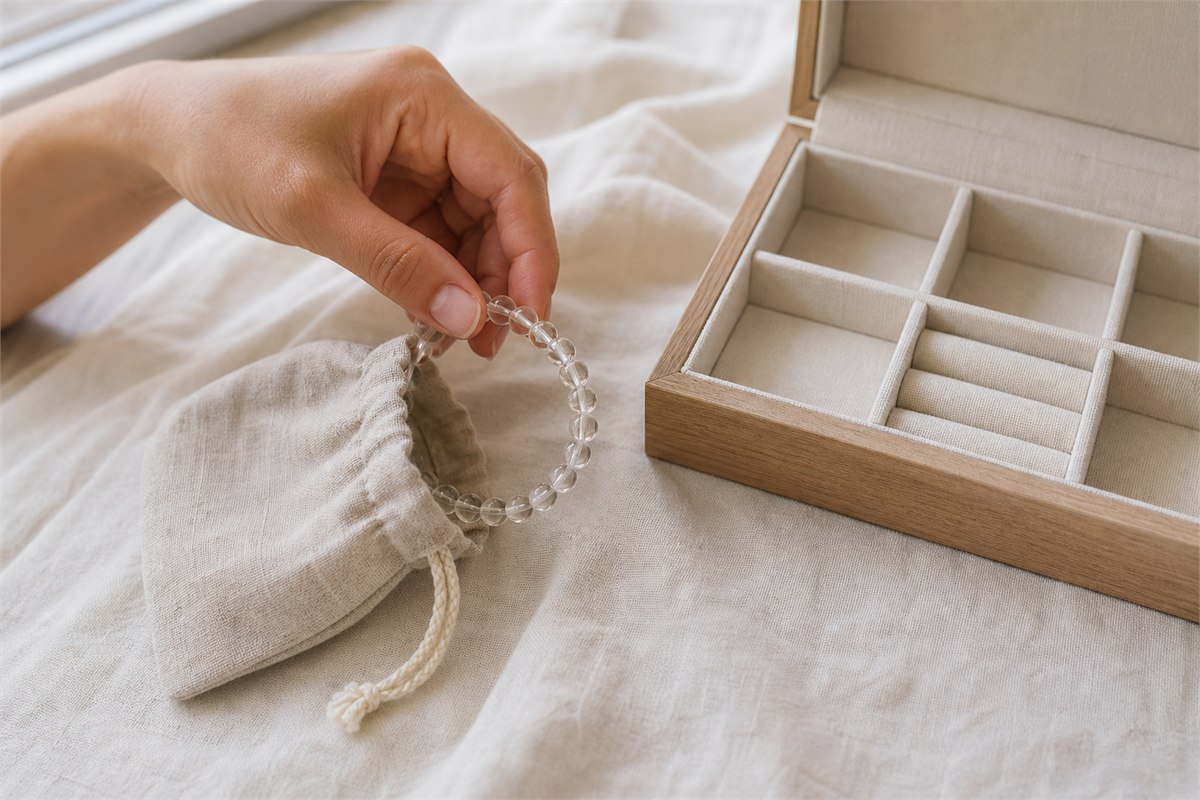
- Store separately: place each piece in a soft pouch or lined jewelry box so beads, metal edges, and harder materials do not strike one another.
Moonlight, a crystal cluster, brief running water, sound, smoke, or sage are used by some enthusiasts as cleansing rituals (消磁/净化). These are cultural and personal practices, not maintenance requirements. Choose a ritual that is safe for the material and setting; practical cleaning and dry storage remain the foundation of care. For more material-specific routines, use the Eastern Story Care Guide and Material Guide.

Crystal Gift Guide: Match the Material to the Person
A natural crystal gift emphasizes geological individuality: its veil, color band, mineral inclusion, or internal landscape exists in that exact form only once. It can express, “I chose something as individual as you.” Synthetic quartz emphasizes clean consistency and color control. Branded crystal glass emphasizes cutting, fashion, sparkle, and joyful design. None is automatically a lesser gift when the material is described honestly.
- Partner or close friend: rose quartz or strawberry quartz for tenderness, affection, friendship, and warm connection.
- Student, exam candidate, or thoughtful colleague: amethyst for wisdom, focus, composure, and encouragement.
- Entrepreneur or career milestone: citrine for opportunity and optimism, or green phantom quartz for steady progress and earned success.
- Versatile blessing: clear quartz for clarity, peaceful intention, and a clean aesthetic that suits many styles.
- Protection and steadiness: obsidian or smoky quartz can express grounding, guardianship, and calm strength. Obsidian is natural volcanic glass rather than quartz, so label it accurately.
- Fashion-focused recipient: precision-cut crystal glass or a branded crystal piece for sparkle, color, design, and an easy everyday statement.
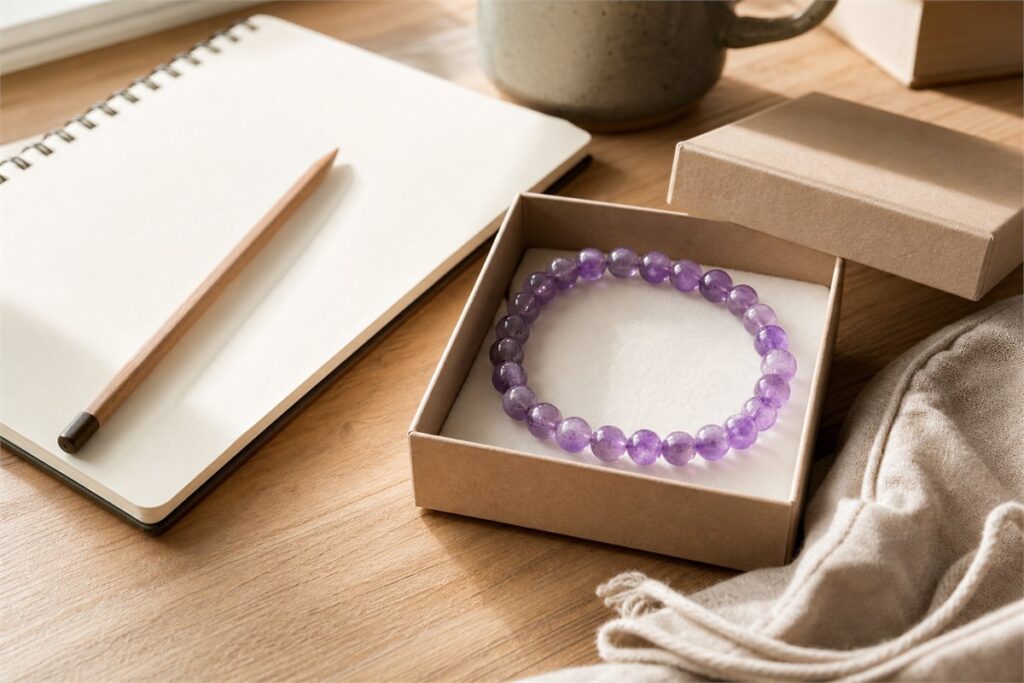
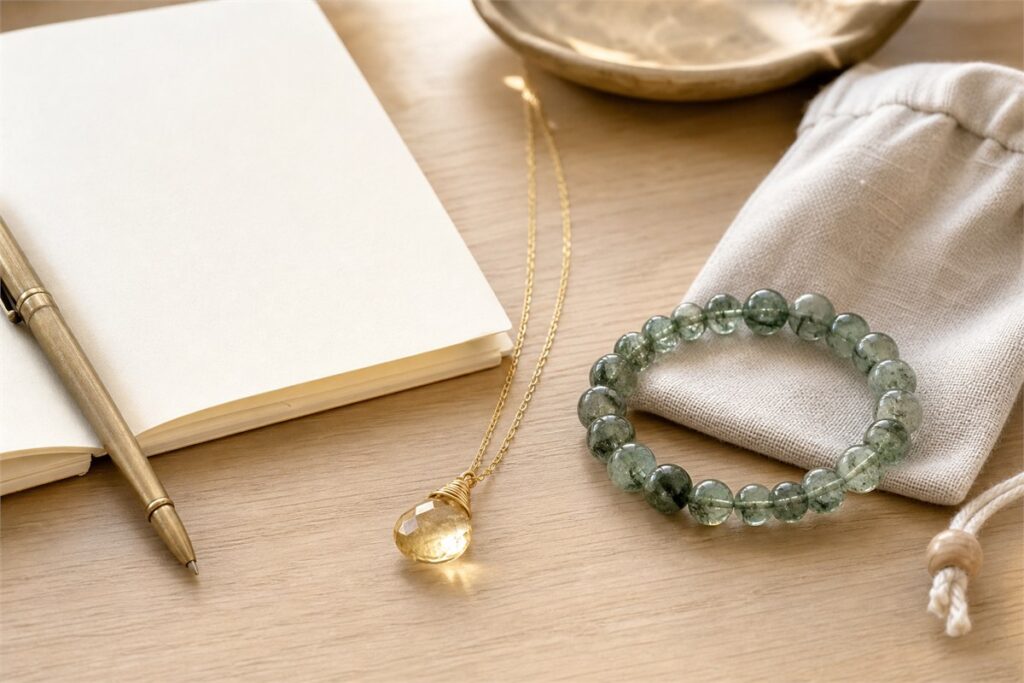
Crystal gifts suit New Year, a promotion, a new business, exam season, an anniversary, travel, or the zodiac birth-year tradition Benmingnian (本命年). Add a handwritten card that keeps the symbolism personal and natural:
“May this crystal remind you of your clarity, courage, and steady progress.”
“Chosen for its one-of-a-kind pattern—and for someone equally unforgettable.”
“A little light for your desk, your next chapter, and all the work you are proud of.”

Browse the Eastern Story blessing collection for symbolic jewelry, or continue through the Story library to compare materials, meanings, and gift traditions.
Frequently Asked Questions
Choose the Material Story You Want to Carry
Choose natural quartz when you value geological origin, natural inclusions, and mineral individuality. Choose synthetic quartz when consistency, controlled growth, matching color, or technical precision matters. Choose crystal glass when cutting, fashion, decorative sparkle, and a controlled budget are the priority. The best choice is the one you enjoy, can wear or display comfortably, and can buy through transparent material and treatment disclosure.
Related Posts


