
Lotus and water lilies are different aquatic plants. In this guide, lotus means the sacred lotus (Nelumbo nucifera), a member of Nelumbonaceae; water lily means the ornamental water lilies commonly placed in Nymphaea, in Nymphaeaceae. A lotus usually has shield-shaped leaves attached near the center, prominent flowers above the water, and a cone-shaped receptacle that becomes a familiar seed head. A water lily commonly has floating leaves with a radial cleft and flowers at or just above the surface. These are strong clues, not inflexible rules.
English “lotus” and Chinese 莲 can be broader in religion, art, translation, and horticulture than a field guide would allow. In everyday Chinese, 莲花 often refers to 荷花, the sacred lotus, but an ancient image titled “lotus” may depict a water lily, and a stylized lotus throne may not preserve enough botanical detail for a species identification. The safest method is to separate three questions: what plant is present, what name the source uses, and what the image means in its own culture.
Lotus vs water lily at a glance
| Clue | Sacred lotus | Water lily |
|---|---|---|
| Scientific placement | Nelumbo nucifera; Nelumbonaceae; order Proteales | Common ornamentals are Nymphaea spp.; Nymphaeaceae; order Nymphaeales |
| Leaf attachment | Petiole joins near the center of a shield-shaped blade | Petiole commonly joins at the basal cleft |
| Leaf position | Mature aerial leaves usually stand above water; young floating leaves also occur | Leaves usually float; crowding or vigorous growth can lift some leaves |
| Flower position | Usually held clearly above water | At the surface or above it, depending on species and cultivar |
| Receptacle and fruit | Distinct obconical receptacle develops into the lotus seed head | No lotus pod; fruit develops and often matures below the surface |
| Underground stem | Rhizome; edible lotus cultivars produce the vegetable called lotus root | Rhizomes or tuber-like structures vary by group and are not a general invitation to eat the plant |
| Typical color clue | White, pink, red, and related cultivated shades; no true blue sacred lotus | Broader cultivated palette can include blue, violet, yellow, white, pink, and red |
| Best identification method | Use several traits together: leaf attachment, cleft, flower height, receptacle, fruit, and growth habit | |
A useful first look is “center-attached leaf plus lotus pod” versus “cleft floating pad without a lotus pod.” Do not decide from color or height alone. A lotus can make floating juvenile leaves, while tropical water lilies may raise flowers well above the surface.
Names, families, and why “lotus” can be ambiguous
The sacred lotus is Nelumbo nucifera, genus Nelumbo, family Nelumbonaceae, order Proteales. Modern classification therefore does not place it in the water-lily family. Familiar garden water lilies are mainly species and hybrids of Nymphaea, family Nymphaeaceae, order Nymphaeales. Their shared aquatic appearance reflects similar habitats more than close relationship.

Names still resist a one-line rule. In Chinese daily speech, 荷花 and 莲花 often name Nelumbo nucifera, while 睡莲 names Nymphaea. Yet “lotus” in museum catalogues and religious translations can be a conventional English name for several aquatic flowers. Ancient Egyptian “blue lotus,” for example, is normally the blue water lily Nymphaea caerulea, not Nelumbo nucifera. Botanical precision begins with a scientific name, but cultural interpretation must also respect the historical vocabulary.
How to tell lotus from water lily
Leaves: attachment and cleft are stronger than height
A lotus leaf is peltate: its petiole meets the blade away from the edge, close to the center. The blade is usually round and lacks the deep radial opening familiar on a lily pad. Mature aerial leaves often rise like umbrellas, and their waxy surface sheds water efficiently. Early in the season, however, lotus plants also produce floating leaves.
A typical Nymphaea leaf floats and has a cleft running from the margin toward the point where the petiole attaches. Leaf margins, mottling, and texture vary widely among hardy and tropical groups. Crowded plants can push pads above the water, so position alone is not decisive.

Flowers, receptacles, and fruit
The lotus flower surrounds a conspicuous upside-down-cone-shaped receptacle. Its individual carpels sit in separate cavities; as the flower ages, the receptacle enlarges into the recognizable lotus seed head containing nut-like fruits commonly called lotus seeds. This structure is the most reliable visual clue in a mature flower or fruiting plant.

Water lilies do not make a lotus pod, but they do make fruits and seeds. After pollination, the developing fruit of many Nymphaea species is drawn under water and matures there. The center of a water-lily flower varies with species, cultivar, and stage, so “flat flower center” is not a universal test.

Opening rhythm and color
Both plants can open and close across several days. Many hardy water lilies are day-blooming, while tropical water lilies include both day- and night-blooming cultivars. Lotus flowers also follow a multi-day rhythm rather than remaining continuously open after the first morning. Weather, temperature, and cultivar affect the schedule.

Blue or violet is a useful hint toward a water lily because sacred lotus does not produce a true blue flower. It is still only a hint: lighting, editing, glazing, enamel, and artistic invention can change color. Combine color with leaf attachment and fruiting structure.
Common exceptions and identification traps
- Floating lotus leaves: young or submerged lotus growth can lie on the surface before aerial leaves appear.
- Raised water-lily flowers: many tropical cultivars hold blooms above the pads, and vigorous plants may lift leaves.
- Missing fruit: a flower photographed before or without successful pollination offers no fruit clue.
- Double flowers: extra petals can conceal reproductive parts in both cultivated groups.
- Miniature does not mean a new species: “bowl lotus” or 碗莲 is a horticultural and market category for compact lotus cultivars, not a separate botanical species.
- Garden labels vary: popular trade names may be translated, duplicated, or applied inconsistently. Buy by a traceable cultivar name and grower description rather than a viral list.
When only a blossom is visible, an honest label such as “stylized aquatic flower” can be more accurate than forcing a species. When a living plant is available, inspect several mature leaves, the petiole attachment, the flower stalk, and any developing fruit.

Growing lotus and water lilies in containers
| Need | Lotus | Water lily |
|---|---|---|
| Container | Wide, sturdy, and without sharp internal edges that can damage spreading rhizomes | Wide aquatic basket or solid container sized to the cultivar and growth habit |
| Medium | Heavy loam or a labeled aquatic-plant medium; avoid buoyant peat-rich potting mix | Heavy clay loam or aquatic-plant medium that stays in place underwater |
| Water depth | Set for the cultivar and growth stage; start shallower while shoots establish, then adjust | Measure from the crown to the surface and follow the cultivar label; hardy and tropical groups differ |
| Light | Best flowering generally needs abundant direct sun | Most flower best in strong sun, though tolerance varies by cultivar and climate |
| Feeding | Use aquatic-plant fertilizer according to its label | Use aquatic-plant tablets or another labeled product according to directions |
| Winter | Hardiness depends on cultivar, rhizome depth, and local winter conditions | Hardy and tropical water lilies require different winter treatment |
Water, soil, light, and feeding
Choose the plant before choosing the container. Large lotus cultivars can overwhelm a decorative bowl, while compact lotus types still need enough horizontal room for their rhizomes. Water-lily depth is measured from the growing crown, not from the bottom of an arbitrary pot. Nursery instructions for the named cultivar should override a universal depth copied from the internet.
Use dense mineral soil or a purpose-made aquatic medium. Ordinary lightweight potting mix can float, cloud the water, and release nutrients. Add only fertilizer labeled for aquatic plants and keep it embedded in the growing medium. Excess nutrients encourage algae and should never be washed into a stream, lake, or storm drain.

Hardy and tropical water lilies
“Water lily” is not one winter-care category. Hardy water lilies can survive cold winters when the crown remains below the freezing zone appropriate to the local climate. Tropical water lilies need warm water and may be treated as annuals or overwintered with specialist methods. Night-blooming cultivars are common among tropical groups. Local nursery guidance is more useful than a single calendar because frost dates and pond temperatures vary.
Safe care for cut water lilies
Cut water lilies are more cultivar-sensitive than ordinary bouquet flowers. Start with a clean vase, clean tools, and cool fresh water. Remove foliage that would sit below the waterline, recut a small amount from the stem with a clean sharp blade, and place the stems in water promptly. Use the water depth and flower-food directions supplied by the grower or florist, because stem structure and handling differ among cultivars.

Keep the arrangement in a cool position with bright indirect light, away from strong sun, heating vents, and ripening fruit. Replace cloudy water, wash the vessel, and remove decaying material promptly. Do not automatically submerge the flower head, strip green floral parts, force water into a hollow stem, squeeze the stem, or follow a fixed angled-cut rule unless the supplier gives that instruction for the exact material. Aggressive handling can bruise tissue and promote decay.
A cut water lily may close as part of its natural daily cycle; closing is not automatically a sign that the flower has died. Vase performance varies too much by cultivar, maturity, temperature, and transport history for one lifespan number to describe every stem.
Lotus in Chinese literature and auspicious design
In Song-dynasty writing, Zhou Dunyi’s Ai Lian Shuo (《爱莲说》, “On the Love of the Lotus”) gives the lotus an enduring moral voice. The brief phrase “出淤泥而不染” describes emerging from mud without being stained; the essay also praises a stem that is open within and upright without. The text helped make the lotus a model of the junzi, the cultivated person, but it did not invent every earlier or later lotus meaning.

Wordplay creates a second layer. 莲 (lotus) can echo 连 (continuous), which supports rebuses such as 连年有余, often pictured with lotus and fish to wish for continuing abundance year after year. Lotus blossoms and seed heads can participate in images of fertility and descendants, including 连生贵子 in particular decorative contexts. 青莲 may invite a 清廉, “incorruptible,” association in later language and imagery. These are visual and verbal wishes, not promises produced by planting or wearing a motif.

For a related example of 莲 (lotus) and 连 (continuous) wordplay in decorative art, see Eastern Story’s guide to the lotus-and-carp motif in jade carving. This comparison page keeps its focus on the boundary between sacred lotus and water lily.
Lotus in Buddhist art
Lotus imagery is central to many Buddhist visual traditions. Blossoms, lotus seats, pedestals, mandalas, ponds, and repeating petals can evoke purity, awakening, sacred presence, and the pure-land environment. The metaphor of a clean blossom arising from muddy water is powerful, but its meaning changes with the text, school, period, region, and object.
A sculpture catalogue may correctly call a pedestal a lotus throne even when its carved petals cannot be assigned to Nelumbo nucifera. That is an iconographic identification, not a botanical one. Likewise, blue, red, white, and pink lotus terms in Buddhist literature and art can operate as sacred color categories or translation conventions. Avoid turning every lotus image into one uniform doctrine or treating a stylized color as proof of a plant species.

Water lilies in ancient Egypt and Monet’s art
The Egyptian blue water lily
The flower often called the ancient Egyptian blue lotus is Nymphaea caerulea, a water lily. In Egyptian art it appears with pools, papyrus, offerings, people, and deities. Its opening in daylight contributed to associations with the sun, regeneration, fertility, and rebirth. The exact meaning depends on the object: a marsh bowl, funerary image, temple scene, and banquet image do not all say the same thing.

This example shows why common names must be handled carefully. Calling the plant “blue lotus” follows historical English usage; calling it Nymphaea caerulea states its botanical identity. It should not be used as evidence that sacred lotus has naturally blue flowers.
Readers comparing the motif with scarabs, papyrus, and other ancient Egyptian forms can continue with Eastern Story’s ancient Egyptian jewelry guide.
Monet’s Nymphéas
Claude Monet’s Nymphéas, usually translated as Water Lilies, belongs to modern Western art, not to the evidence for traditional Eastern lotus symbolism. Monet developed the cycle from his garden at Giverny from the late 1890s until 1926. The monumental panels at the Musée de l’Orangerie create an immersive environment of water, reflection, sky, and plants. They are a useful comparison for modern water-lily aesthetics precisely because their historical setting is different.

How to read stylized lotus motifs in art and jewelry
Begin with the catalogue or inscription. A museum title may record a traditional motif name even when a modern viewer cannot recognize the plant. Next, examine the visual evidence: a central receptacle, seed head, center-attached round leaf, or upright pond scene supports lotus; a cleft pad and surface composition support water lily. Then inspect context. A Buddhist pedestal, Egyptian marsh scene, Chinese fish-and-lotus rebus, and Monet-inspired enamel each has a different interpretive framework.
Do not assume that every row of pointed petals is a botanical portrait. Artists compress, repeat, rotate, and combine petals to fit halos, borders, vessels, textiles, and jewelry. On a highly abstract object, describe the established motif first—“lotus-petal border,” for example—and state a species only when the evidence warrants it.

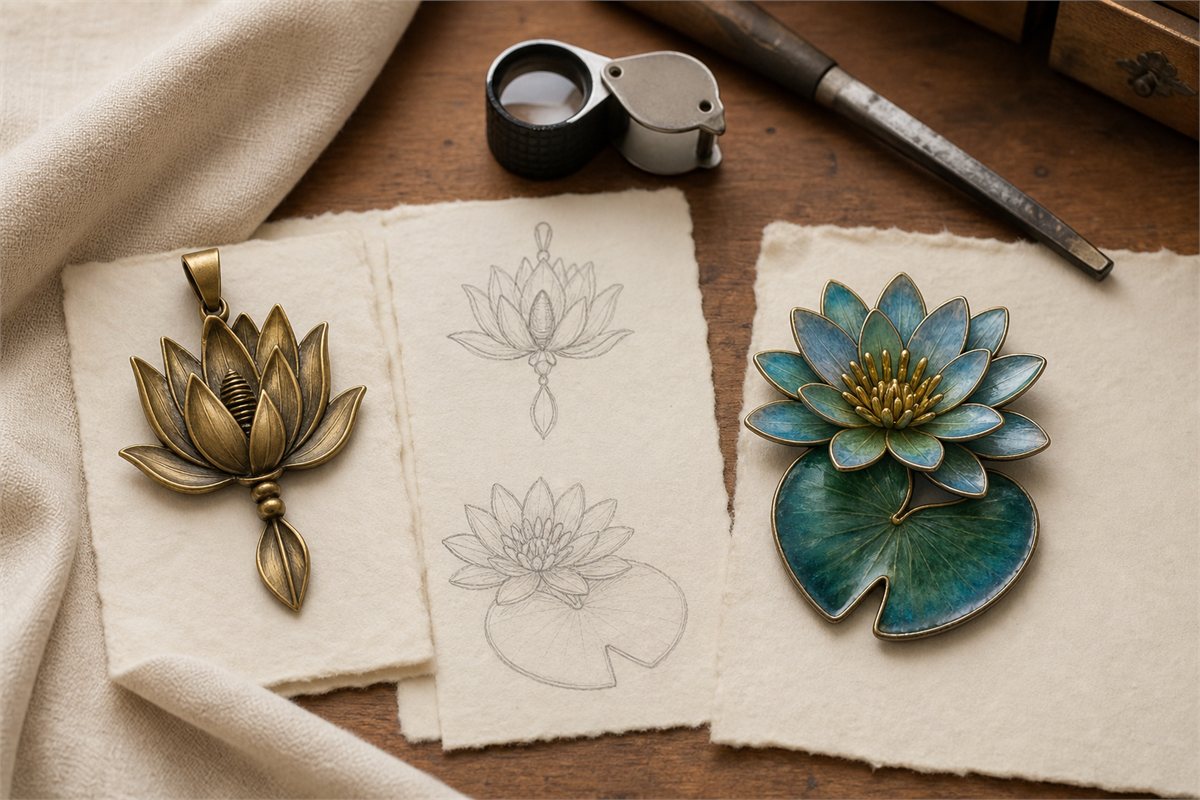
- For botanical identification: prioritize morphology and several independent traits.
- For art history: prioritize title, date, place, material, inscription, comparable objects, and curatorial scholarship.
- For a modern product: consider both its visible form and the maker’s stated symbolic intention.
Ecological and household safety
Keep garden plants contained. Never release lotus or water-lily plants, rhizomes, tubers, seeds, soil, or aquarium water into natural waterways. A desirable pond plant can spread beyond cultivation, and rules differ by region. Check local invasive-species lists and water-management requirements before buying, dividing, or disposing of aquatic plants.
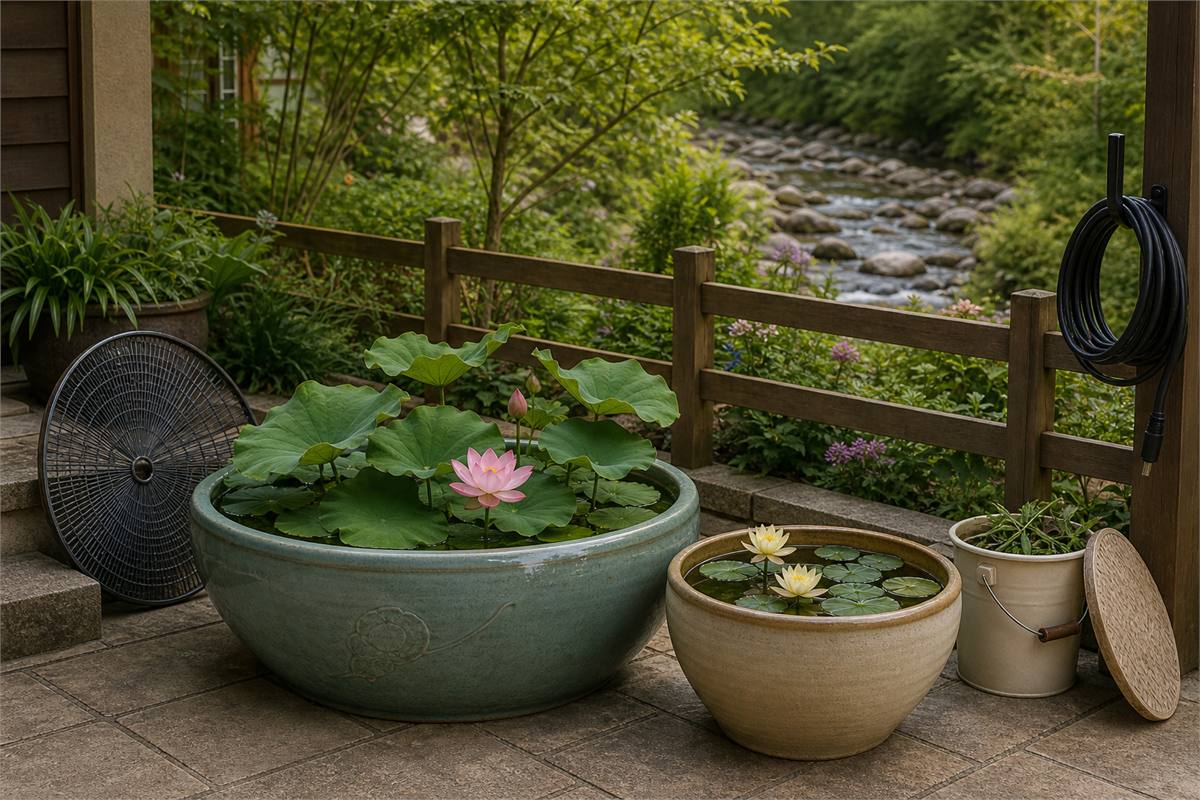
Plan containers and ponds as water features. Secure heavy vessels on a load-bearing surface; protect children and pets from open or deep water; manage mosquitoes without harming wildlife; and keep pumps, lights, and extension connections suitable for wet locations. Do not encourage tasting an ornamental plant. Edibility depends on species, cultivar, plant part, growing water, contaminants, and preparation. For general object maintenance rather than plant care, use the Eastern Story care guide.
Common lotus and water-lily myths
- “Lotus always means Nelumbo nucifera.” Often in modern botanical writing, but not across every translation, religion, museum label, or historical common name.
- “All lotus leaves stand and all lily pads float.” Useful as a first clue, but growth stage and cultivar create exceptions.
- “Water lilies have no fruit.” They produce fruits and seeds; development commonly continues below water.
- “Every water lily opens by day.” Both day- and night-blooming water lilies exist.
- “A blue aquatic flower must be a sacred lotus.” True blue points away from Nelumbo nucifera and often toward a water lily or artistic color choice.
- “A stylized lotus can always be identified to species.” Motif names and botanical identity are different kinds of evidence.
- “Aquatic rhizomes are interchangeable foods.” Never generalize edibility across lotus and water-lily species.
Frequently Asked Questions
Related Posts


