
A bat sachet carries a wish for good fortune to stay close. In Chinese, the bat’s name, fú (蝠), sounds like the blessing character Fu (福). Embroidered on a fragrant pouch, shaped into its fabric, or carved into a scent container, the bat brings that wish into everyday life. It makes a thoughtful gift for a new year, a birthday, a reunion, or someone you want to keep in your thoughts.
A little pouch can hold a surprisingly personal message: “May your days be peaceful,” “May happiness find you in your new home,” or simply, “Take this blessing with you.” Its color, companion motifs, and fragrance give the message its own character. Even as the scent softens, the stitched blessing remains a keepsake.

Why a bat belongs on a fragrant gift
The bat motif is a familiar bearer of happiness in Eastern decorative art. On a sachet, its spread wings can make fortune seem to be arriving or accompanying the person who carries it. This way of turning a sound into an image gives an everyday accessory an affectionate second meaning: a small bat becomes a small blessing.
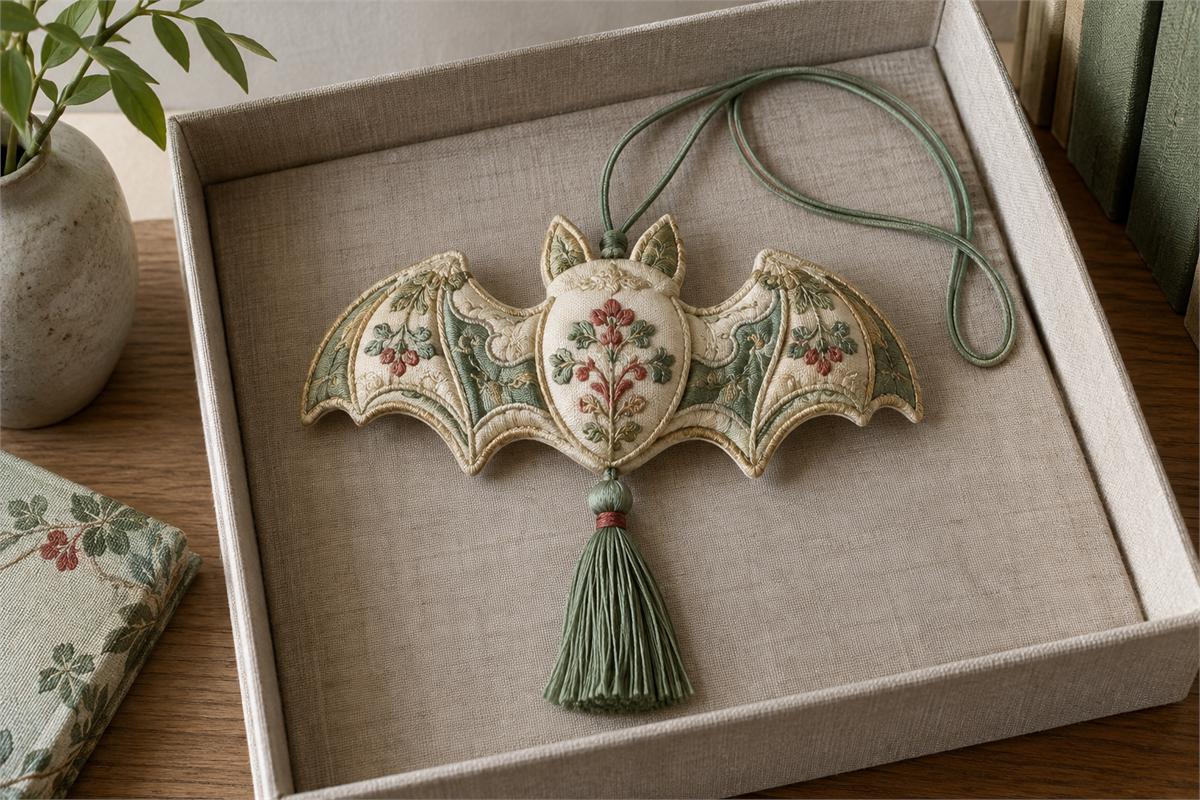
Xiangbao (香包), “fragrant pouch,” and Xiangnang (香囊), “scent sachet,” are closely related names used for aromatic bags and containers. A fabric version usually combines an outer pouch with dried fragrant material or a separate scent insert. Some are sewn closed; others have an opening for replacing the filling. A bat sachet may be embroidered with bats, made in a bat shape, or decorated with a small bat fitting.

The fragrance adds intimacy. A favorite floral note can recall a person, while familiar embroidery can recall a family celebration. Giving such an object says that someone’s ordinary days matter to you. A pouch kept on a bag, at a writing desk, or among personal keepsakes can carry that feeling long after the occasion itself.
Reading the blessings in the whole design
Start with the number of bats, then notice what they surround, carry, or fly beside. A peach, a coin, and a longevity character each add a different wish. The same bat can belong to several beautiful compositions.
| What appears on the sachet | Meaning to look for | A wish it can carry |
|---|---|---|
| 1 bat | Fu (福), blessing and good fortune | May good fortune accompany you. |
| 2 bats | A pair of blessings or doubled happiness in the composition | May happy moments arrive together. |
| 5 bats | Wufu (五福), the Five Blessings | May your life be rich in blessings. |
| A bat with a pierced cash coin | Fortune Before Your Eyes (福在眼前) | May happiness and prosperity be close at hand. |
| A bat with a peach or Shou | Fu Shou Shuang Quan (福寿双全), blessing and longevity together | May your years be happy and plentiful. |
| 5 bats surrounding Shou or a longevity peach | Wu Fu Peng Shou (五福捧寿), Five Blessings supporting longevity | May a long life be surrounded by every blessing. |
| Red bats flying among clouds | Hongfu Qitian (洪福齐天), great blessings reaching the heavens | May your good fortune be as vast as the sky. |
Five bats: a generous wish for a whole life
The classic Five Blessings in the Shangshu (尚书), also called the Book of Documents, are longevity, wealth, health and peace, love of virtue, and a peaceful completion of life. Together they imagine a life with enough to live on, time to enjoy it, a kind heart, and dignity through its final years.
Five bats can express Wufu Linmen (五福临门), the wish for the Five Blessings to arrive at one’s door. The design can communicate that greeting without depicting a literal doorway or five coins. When the bats deliberately encircle a longevity emblem, the more specific “Five Blessings supporting longevity” reading becomes especially fitting. For a birthday card, “May your years be filled with health, kindness, comfort, and joy” carries the warmth of the idea naturally.

Coins, peaches, and the character at the center
The bat-and-coin composition uses a visual pun. Qián (钱), “coin,” echoes qián (前), “before,” and the opening in an old cash coin is its “eye.” Together with the bat’s Fu, they suggest fortune before your eyes. A bat carrying a coin makes an appealing gift for a fresh start or new business. A pair of bats adds an affectionate sense of abundance; the surrounding design gives the wish its more personal focus.

The longevity peach, Shoutao (寿桃), brings the wish for long life. The Shou character (寿 / 壽) makes that wish visible in writing. A single bat beside either can join blessing with longevity, while five surrounding bats bring in Wufu. This is why a peach-shaped pouch with bats can feel particularly tender as a birthday gift.

Lettering can also make a pouch personal. Shou written 守 means “to keep” or “guard,” while 寿 means longevity. A modern design bearing 守 can carry a wish to cherish and keep happiness close. Reading the actual character lets the gift message reflect what is on the pouch.
Clouds, gourds, and wishes that continue
Auspicious clouds (祥云) give the scene a graceful, heavenly setting. In a cloud-and-bat composition, red bats are particularly expressive: red, hóng (红), echoes the “vast” or “great” in Hongfu (洪福). Red bats among clouds can therefore carry Hongfu Qitian. A blue or green ground offers a quieter setting for the same upward flight; the full pattern, including its colors and inscriptions, guides the reading.

The gourd, Hulu (葫芦), brings its own associations with blessing, well-being, and continuity. Its name also lends itself to Fu Lu wordplay. A gourd-shaped bat sachet can welcome good fortune and prosperity, while a bat paired with a deer (鹿) makes the Lu (禄) sound especially clear. The resulting Fu Lu Shuang Quan (福禄双全) wish joins blessing with prosperity and advancement.

Trailing vines can give the pattern a feeling of happiness continuing across generations. An upside-down bat can play on fortune “arriving,” through the sound shared by dào (到, arrival) and dào (倒, inverted). These details make a lovely addition to a gift message when they are part of the design.
Cloth, embroidery, and openwork containers
Silk, satin, brocade, cotton, and linen offer different settings for the blessing. Brocade carries a woven pattern; embroidery adds a design with stitches. A soft cloth pouch may feel familiar and intimate, while a lustrous embroidered surface gives a birthday or festival gift a more ceremonial presence.
In the stitching, smooth satin stitches can fill a bat’s wings, small knot stitches add raised details, and couching holds decorative thread against the surface with smaller securing stitches. Panjin embroidery (盘金绣) uses gold-colored thread laid and secured in this way. Its glint can bring a wing or cloud to life without making the thread solid gold.

Regional embroidery traditions include Su embroidery (苏绣) from Jiangsu, Xiang embroidery (湘绣) from Hunan, Shu embroidery (蜀绣) from Sichuan, and Yue embroidery (粤绣) from Guangdong. Qingyang sachets (庆阳香包) offer another rich tradition, bringing flat embroidery and three-dimensional forms together. A maker’s own story can connect a gift with a particular place and practice. The fabric and motif alone do not identify which regional workshop made a pouch.
Look at both faces: the back may carry a flower or another blessing, while the edge binding, cord, and tassel complete the object. A decorative Chinese knot can add a wish for connection. Peach and gourd shapes reinforce their companion motifs; a lotus shape adds associations with purity and renewal. Round, heart-shaped, and folded geometric pouches let the fabric and embroidery take the lead. Tiger-shaped pouches belong to another familiar festival tradition, often carrying wishes for a child’s protection.

Scent containers also have a history beyond cloth. The Palace Museum holds a Qing gold filigree sachet with a hollow body, an opening clasp, and openwork petals, as well as a jade pouch-shaped sachet decorated with bats and longevity imagery. These individual objects show how the same intimate practice could take different material forms. Filigree builds delicate forms from fine metal wire; openwork jade carving opens spaces through stone.
For a modern metal scent locket, the hollow compartment and its intended insert matter. A solid jade bat pendant is a hanging ornament, while a sachet holds aromatic material. Yajin (压襟) names an ornament worn at the clothing front, so a hanging sachet may form part of a Yajin arrangement. A waist-hung pouch has a different placement. Hebao (荷包) is a broader pouch term and can refer to something used for belongings rather than scent. These names help you picture how a piece will accompany its recipient.

Giving a bat sachet through the seasons
The Dragon Boat Festival, Duanwu (端午), has a close connection with fragrant sachets. Aromatic plants, bright thread, and protective imagery belong to seasonal customs through which families welcome well-being and wish to keep harm away. A bat brings Fu into that festival language: good fortune carried near the person you care about.

The same gift can mark many other moments. Its meaning becomes more personal when you choose the motif around the wish you want to send.
- New Year: a red bat or clouds welcome abundant blessings and a hopeful beginning. “May good fortune stay with you through the year” is an easy message to share.
- A birthday: peaches or Shou join Fu with a wish for long, happy years. For a parent, grandparent, mentor, or cherished friend, the thought is one of gratitude and continuing companionship.
- A wedding or anniversary: a pair of pouches, or a design with paired bats, can celebrate a shared life. As wedding favors, sachets pass the couple’s happiness on to their guests.
- A housewarming or new venture: a coin-and-bat design welcomes fortune into a new chapter. A small pouch on a keepsake stand can make the greeting part of a new home.
- A reunion, Mid-Autumn visit, or thank-you: a pouch in a favorite color offers an affectionate companion to the gathering. It can also thank a teacher or someone whose kindness has mattered to you.
A handmade or personalized sachet can carry affection between partners, friends, and family. Choosing the thread, adding a tassel, or sewing a short message into the gift makes time and attention part of what is being given. For a friend who is moving away, a simple card might read: “Carry a little Fu with you. May your new days bring peace, happiness, and all that you hope for.”

For a gentler greeting, Ping An Ru Yi (平安如意) wishes someone peace and things going as they hope. Write it because it matches your feeling for the person. Their preferred colors, memories, and comfort with fragrance are the most useful guides to a gift they will enjoy keeping close.
A little companionship in everyday life
A cloth bat sachet can hang from a bag or an appropriate clothing fastening, where its wings and tassel move lightly as you walk. Choose a position that protects the stitching from zippers and rough hardware. A key ring or phone attachment needs a secure loop and a pouch that will not be crushed in daily use. For traditional dress, check the full hanging length so it rests comfortably at the intended place.

At home, a dry wardrobe hook, desk stand, or shelf can give the pouch a quiet place among familiar things. Keep scented fillings from direct contact with clothing and finished furniture. An unfilled decorative pouch works beautifully for someone who prefers their room fragrance-free.

A car keepsake can carry Yi Lu Ping An (一路平安), a wish for a peaceful journey. Secure it where it cannot obstruct the driver’s view, mirrors, controls, or airbags, and follow local rules on hanging objects. Use fragrance only if everyone sharing the car is comfortable with it; a scent-free version can carry the same thoughtful greeting.
Choosing the fragrance and adding a personal touch
Fragrance is a matter of preference. Sachets may contain dried flowers, herbs, aromatic woods, blended scented material, or a removable insert. Mugwort, clove, mint, lavender, and osmanthus appear in different blends. Sandalwood and agarwood offer different woody scent traditions. The ingredient list tells you more than a broad label such as “herbal” or “natural.”
For a gift, ask what the recipient already enjoys and whether they prefer an unscented object. A mild smell does not establish an ingredient’s safety, and strong fragrance does not tell you whether it came from a plant or a manufactured blend. Choose a clearly described filling and use it according to its instructions. Keep health and protection wishes in the gift message; choose the scent for enjoyment.
If you are personalizing a sachet, start with an empty pouch and, if fragrance is wanted, a compatible ready-filled insert. Add a well-secured tassel, bead, or embroidered initial. An insert keeps loose material contained and makes replacement easier. Avoid pouring fine fragrance powder through decorative holes or adding essential oil directly to embroidery. A refill product should be intended for that container and used as directed.

For pregnancy or breastfeeding, check a specific fragranced product with a healthcare professional before use. If fragrance causes a rash, headache, coughing, or breathing irritation, stop using it. Keep sachets, cords, beads, and fillings away from babies and young children, and out of every infant sleep space. Keep oils and aromatic fillings out of pets’ reach, away from their bedding, and off their coats; ask a veterinarian about use around a sensitive animal. A fragrance-free keepsake is a thoughtful option in a shared home.
Simple care for the pouch and its fragrance
Gentle care lets the blessing remain part of daily life. Keep the pouch dry, away from strong sunlight, heat, perfume sprays, and damp storage. Remove it before bathing or swimming. Support the body when handling it rather than pulling on the tassel or embroidered threads.
- Cloth and embroidery: follow the maker’s cleaning instructions. A washable empty cotton pouch and a lined silk pouch with metallic embroidery need different care. Avoid soaking an assembled sachet; dyes, lining, decoration, and filling all affect how it responds to water.
- Metal details: gently wipe suitable modern fittings with a soft dry cloth. Avoid polish or liquid cleaners on mixed materials unless specifically recommended. Leave snagged metallic threads in place for the maker or a textile specialist to repair.
- Filling: replace a removable insert when its scent no longer suits you. Check first that the pouch is designed to open; do not force seams or clasps. Dampness, visible mold, or an unusual odor calls for removing the filling from use rather than masking it with more fragrance.
- Storage: store only when fully dry, with cords untangled and delicate embroidery protected from rubbing. Keep refill products in their own packaging according to their storage instructions. Older or fragile pieces are best treated as keepsakes, with specialist advice before cleaning or refilling.
Fragrance fades at different rates with the filling, airflow, heat, and how often the pouch is carried. Refresh it according to its condition and the maker’s guidance. The care guide offers further help with mixed-material objects.
Frequently Asked Questions
A blessing to keep close
A bat sachet brings a generous wish into a small, familiar form. One may remind you of a birthday, another of a journey, another of the hands that chose its color and tied its cord. Choose the pattern that speaks to the life you hope for, or the happiness you wish for someone else. Explore the Eastern Story blessing collection for more objects that carry a story and a wish into everyday life.

Related Posts