
The Chinese Zodiac Pig is the twelfth animal in the zodiac and is paired with Hai (亥), the twelfth Earthly Branch. In Chinese cultural imagery, pigs commonly suggest household plenty, stored resources, comfort, and the satisfaction of completing a cycle. Hai is pronounced hài; it is classified as Yin Water and is associated with the traditional 21:00–23:00 double-hour, the tenth branch month, early winter, and the north-northwest sector. These are calendar and symbolic correspondences, not predictions about a person’s future.
Chinese Zodiac Pig at a Glance
| Question | Direct answer |
|---|---|
| Position | 12th and last animal in the twelve-sign cycle |
| Chinese names | Pig: Zhu (猪); Earthly Branch: Hai (亥), pronounced hài |
| Branch classification | Yin Water in the common five-phase correspondence |
| Traditional time | Hai hour, about 21:00–23:00 |
| Season and month | Early winter; the tenth branch month, conventionally associated with the tenth lunar-month position but defined differently in specialist solar-term calendars |
| Direction | 330°, broadly north-northwest |
| Recent Pig years | 1935, 1947, 1959, 1971, 1983, 1995, 2007, 2019; next: 2031 |
| Popular cultural meanings | Plenty, saving, family provision, comfort, generosity, and completion |

The Pig page has a narrower purpose than Eastern Story’s complete Chinese Zodiac Signs guide. That pillar page explains all twelve animals. This guide concentrates on the Pig, Hai, Pig years, cultural imagery, jewelry, and gifts.
Why Is the Pig Last in the Chinese Zodiac?
The reliable answer is structural: Hai is the twelfth Earthly Branch, so the Pig paired with Hai occupies the twelfth position. The order is Rat, Ox, Tiger, Rabbit, Dragon, Snake, Horse, Goat, Monkey, Rooster, Dog, and Pig. When the cycle ends with Pig, it begins again with Rat.
Popular Great Race stories make that order memorable. In widely told versions, the Pig arrives late because it stopped to eat or sleep. Details vary among families, books, and regions, so the tale should be read as folklore rather than the historical origin of the calendar. The claim that the Pig was delayed while feeding hungry people is not a stable, well-attested version and is not needed to explain the animal’s position.
Being last also gives the Pig a natural design language of completion: the close of a twelve-part sequence, a finished round, and a pause before renewal. This is why “completion” can be a fitting message on a graduation, retirement, milestone, or end-of-year gift without turning the object into a promise of results.

What Does Hai (亥) Mean?
Hai is a calendar sign first and an animal label second. The Earthly Branches are twelve recurring markers used for years, months, days, traditional double-hours, and directions. The ten Heavenly Stems combine with the twelve branches to form a 60-unit cycle. The animal Pig is the familiar cultural partner of Hai, but the character 亥 itself is not the everyday written word for pig; modern Chinese normally writes pig as 猪.

Pronunciation, element, time, month, and direction
- Pronunciation: Hai is written 亥 and pronounced hài, with a falling fourth tone in Mandarin.
- Order: It is branch 12, following Xu (戌) and preceding Zi (子) when the cycle restarts.
- Yin and five phase: Common correspondence tables classify Hai as Yin Water.
- Hai hour: One traditional double-hour, approximately 21:00–23:00 in modern clock notation.
- Hai month: The tenth position in the branch-month sequence and an early-winter period. In solar-term systems it begins around Lichun-style calendrical boundaries rather than automatically matching every day of the civil lunar month.
- Direction: About 330°, usually described as north-northwest.

Some metaphysical charts add “hidden stems,” branch combinations, clashes, harms, and self-punishment categories. Within that vocabulary, Hai is commonly said to contain Ren Water and Jia Wood; Yin–Hai is listed as a six-harmony pair, Hai–Mao–Wei as a three-harmony group, Si–Hai as a clash, Shen–Hai as a harm, and Hai–Hai as a self-punishment. These are classifications within particular divination systems. They do not establish how two people will relate, and they do not require anyone to buy or avoid Tiger, Rabbit, Goat, Snake, Monkey, or Pig designs.
Pig Years and the 60-Year Stem–Branch Cycle
A Pig year returns every 12 years, but the complete stem–branch name returns every 60. The element label in phrases such as “Wood Pig” or “Metal Pig” comes from the Heavenly Stem paired with Hai in that year. It should not be used to infer leadership, wealth, health, temperament, or life outcomes.

| Gregorian year commonly labeled Pig | Stem–branch | Common English label |
|---|---|---|
| 1935, 1995, 2055 | Yi Hai (乙亥) | Wood Pig |
| 1947, 2007, 2067 | Ding Hai (丁亥) | Fire Pig |
| 1959, 2019, 2079 | Ji Hai (己亥) | Earth Pig |
| 1911, 1971, 2031 | Xin Hai (辛亥) | Metal Pig |
| 1923, 1983, 2043 | Gui Hai (癸亥) | Water Pig |
Do not assign a zodiac animal from the Gregorian year alone if the birthday falls in January or February. In everyday lunar-calendar use, the animal year changes at Lunar New Year, not January 1. For example, the 2019 Ji Hai year began on February 5, 2019, while the 2031 Xin Hai year begins on January 23, 2031. A person born earlier than the applicable New Year date remains in the preceding zodiac year under this convention. Some Bazi schools instead use the solar term Lichun, so specialist calculations may apply a different boundary.

What the Pig Symbolized in Household and Farming Life
Pigs mattered because they were practical household animals. They converted food scraps and agricultural by-products into meat and manure, and a well-stocked pig enclosure represented resources that could be raised, consumed, exchanged, or offered. Archaeological finds and early tomb objects—including miniature pigsties—show that pigs could stand for the material provisions of a household and the wealth expected to accompany the deceased.
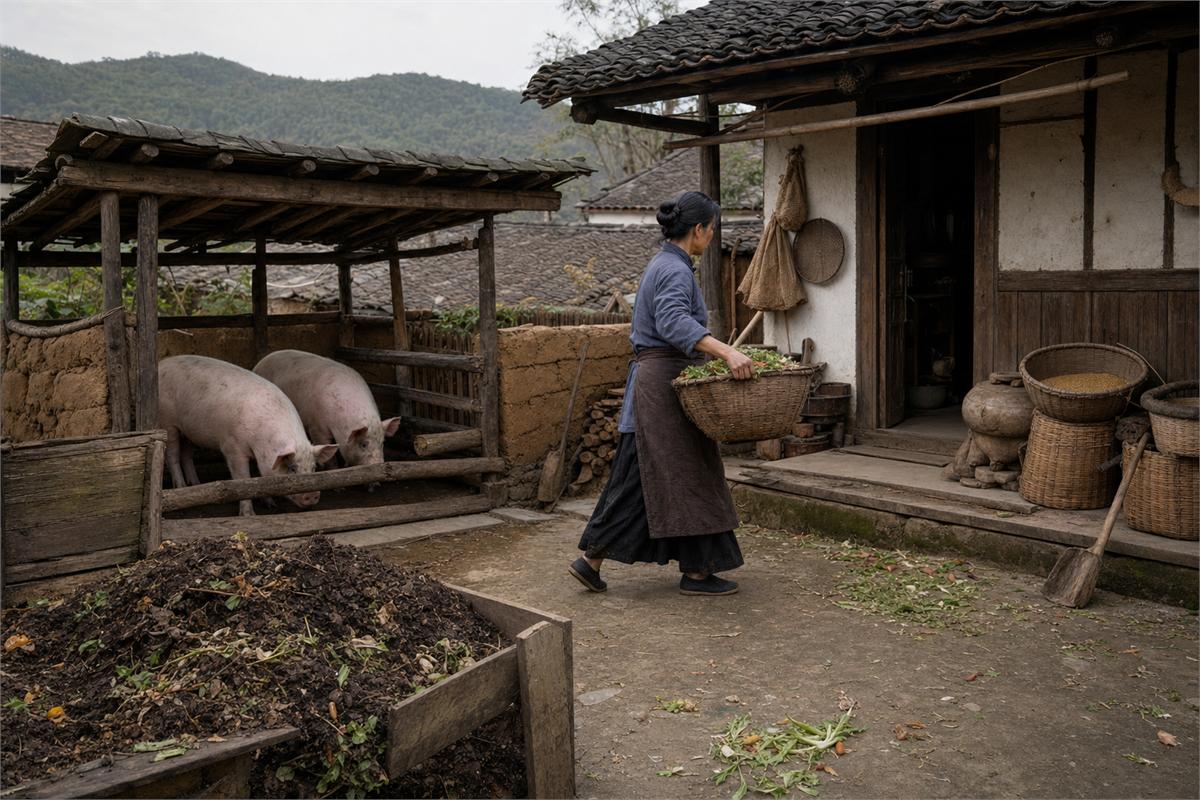
The Chinese character for home or family, Jia (家), visually joins a roof component, 宀, with the old graph for pig, 豕. That structure supports a real connection between pigs and settled household life. It does not prove the simplified slogan that “a house only became a home if it contained a pig,” but it does show how deeply domestic animals and dwelling space were joined in early writing and imagination.

Pig imagery therefore developed a broad vocabulary of sufficiency: food in the household, livestock in the pen, fertility of the farm, and reserves for future use. Calling the Pig a symbol of abundance is reasonable when that context is stated. Calling every Pig-born person naturally rich or destined for comfort is not.
Piggy Banks, New Year Art, Food, and Auspicious Language
The pig-shaped money box gives the animal an especially clear modern association with saving. Whether a design is playful ceramic, carved wood, metal, or printed illustration, the action is concrete: small amounts are placed aside and accumulated. In a gift, that makes a piggy bank appropriate for a child learning to save, a first home, or a practical milestone. It symbolizes stored resources because of what the object does, not because it produces money.

New Year pictures, paper cuts, envelopes, stamps, toys, and zodiac ornaments often use a round, well-fed Pig to suggest plenty and celebration in a Pig year. Museums preserve Pig zodiac figures in pottery, porcelain, jade, and other materials across many centuries. The imagery is not one national design with one fixed message: regional workshops, festivals, and eras developed different forms.

Pork also appears in family meals, ancestor offerings, weddings, and local festival customs, but practice varies by region, religion, household, and historical period. It is safer to describe a roasted pig, pig’s trotters, or pork offerings within a named local custom than to claim one rule for all Chinese communities. Claims that pig’s trotter universally means examination success through a “hoof/title” pun, that pigs were everywhere used to drive out evil, or that the animal always represented many descendants need local evidence and should not be treated as nationwide origins.
“Golden pig,” “fortunate pig,” and similar phrases are common festive design language. Historical nicknames such as “black gold” have been applied to valuable dark-colored resources in several contexts, including livestock and manure in local accounts, but the phrase is too variable to serve as a universal ancient title for pigs. The stronger, clearer cultural explanation is the animal’s observable role in household provisioning and agricultural life.
Are Pig Zodiac Personality Traits Reliable?
Popular zodiac descriptions often call Pig-born people sincere, generous, tolerant, pleasure-loving, calm, or stubborn. These are folk character sketches, not personality science. A birth-year animal cannot measure honesty, resilience, ambition, compatibility, health, or financial ability.
The most respectful way to use the language is as a shared story. A gift card might say, “The Pig is often associated with warmth and generosity in zodiac folklore.” It should not say that the recipient will become wealthy, is naturally passive, must avoid certain people, or will experience a particular outcome in 2026. The 2026 Bing Wu Horse year does not supply evidence for career, investment, relationship, or medical forecasts for Pig-born readers.
Pig Zodiac Jewelry: Motifs, Materials, and Colors
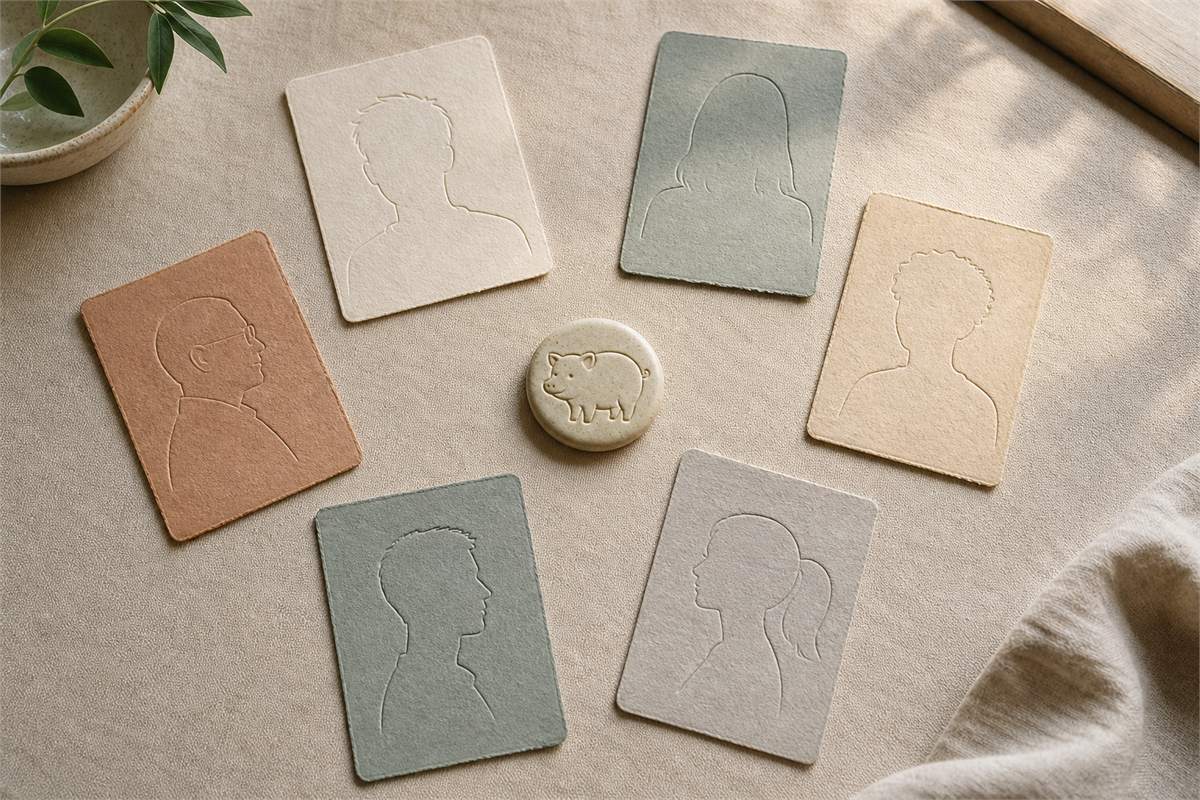
A Pig charm can be literal—a rounded pig, snout, curled tail, or the character 猪—or more restrained, using 亥 as the central mark. A full animal silhouette reads quickly as a zodiac gift. The branch character suits someone who enjoys calligraphy, calendars, or a quieter design. Cloud lines, knots, circular frames, and the blessing character Fu (福) can add a broader auspicious vocabulary when the composition remains legible.

| Material or component | What to inspect | Practical care note |
|---|---|---|
| Gold, silver, steel, or alloy | Solid versus plated construction, hallmark where applicable, smooth solder joins, secure jump rings, clasp action | Keep dry, wipe after wear, and avoid perfume, chlorine, and abrasive polish unless suitable for the stated metal |
| Jadeite or nephrite | Evenly finished surface, stable drill holes, protected carving edges, comfortable weight | Resists wear well but can chip at thin edges; use a soft cloth and avoid impact |
| Quartz and other stone beads | Chips around drill holes, bead-to-bead abrasion, coatings, dye transfer, matched hole size | Mixed stones may react differently; use the gentlest method required by the most sensitive component |
| Pearl | Smooth nacre, secure knots or settings, enough space to prevent rubbing | Keep away from acids, perfume, prolonged moisture, and abrasive surfaces |
| Enamel | Clean edges, full coverage, no lifting or sharp exposed metal | Avoid hard knocks and abrasive cleaning |
| Red cord or elastic | Firm knots, no fraying, secure charm connector, elastic recovery | Keep dry, avoid overstretching, and replace when whitening, cracking, or loss of recovery appears |

Black, deep blue, white, and metallic tones are sometimes connected with Water and Metal in modern five-phase styling; red is widely used in festive and blessing designs; green jade and warm gold are established jewelry colors. Treat these as design inspiration, not Pig-exclusive lucky colors. Aquamarine, citrine, obsidian, moonstone, quartz, pearl, jade, and red agate should be chosen for visible color, translucency, texture, durability, construction, and the recipient’s taste—not for claims that they attract wealth, heal, calm, cleanse energy, or change destiny.
How to Choose the Right Size and Construction
- Confirm the object type. A pendant, bracelet charm, key ring, bag charm, brooch, desk object, and money box have different weight and safety requirements.
- Measure rather than guess. For a bracelet, measure the wrist and add the maker’s recommended ease. For a necklace, compare the chain length with the recipient’s preferred neckline.
- Check every connection. Tug gently on jump rings, bails, knots, clasps, settings, and glued joints. A heavy charm needs a connector designed for its weight.
- Feel the edges. Snouts, ears, hooves, character strokes, and carving points should not scratch skin or catch knitwear.
- Consider skin contact. Ask about known metal sensitivities and choose clearly stated materials. Plating can wear with friction and moisture.
- Match weight to use. A desk ornament can be substantial; an everyday bracelet charm should not constantly strike the wrist or pull the bracelet off-center.

Pig Zodiac Gift Ideas by Occasion
| Recipient or occasion | Useful gift direction | Message that stays in proportion |
|---|---|---|
| Pig-year birthday | Small Pig or Hai pendant, bracelet charm, stationery, or desk figure | “A personal sign from the twelve-year cycle.” |
| Lunar New Year | Festive ornament, red-cord charm, envelope, or piggy bank | “A warm wish for a well-provided year.” |
| Graduation or first job | Hai bookmark, restrained pendant, or saving box | “The last zodiac sign marks completion and a new cycle.” |
| Housewarming | Ceramic or wooden Pig object with a short note about household provision | “For a home filled with shared meals and thoughtful saving.” |
| Collector or culture reader | Well-made branch-character object or museum-inspired zodiac figure | Explain Hai, its order, and the 60-year cycle. |
| Child | Age-appropriate soft object, large stationary decoration, story card, or supervised money box | Use it to introduce the zodiac and saving. |

For a Benmingnian gift, red may be chosen because it belongs to a living folk custom, not because the object guarantees protection. Eastern Story’s Benmingnian guide explains the return-year tradition, while the Blessing collection offers broader symbolic-gift directions.
Children and religious imagery
Small charms, loose beads, detachable eyes, clasps, button batteries, and short pieces of broken cord can create choking or swallowing hazards. Long cords can create entanglement risks. Follow the maker’s age guidance, keep small jewelry away from young children, and use adult supervision.

Modern commercial lists often pair Dog and Pig with Amitabha Buddha as a “zodiac guardian.” That pairing is a popular modern Chinese zodiac–Buddhist devotional culture, not a core Buddhist teaching and not a rule that every Pig-born person should follow. If giving an Amitabha image, consider the recipient’s beliefs, explain the context respectfully, and avoid presenting the image as a tool that guarantees safety, longevity, calm, or fulfilled wishes.
A Practical Buying Checklist
- Verify the recipient’s sign using the relevant Lunar New Year boundary, especially for January and February birthdays.
- Choose Pig (猪) for an immediately readable animal motif or Hai (亥) for an Earthly Branch design.
- Check stated material, plating, surface finish, clasp, jump rings, drill holes, knots, and settings.
- Confirm dimensions, weight, chain length, bracelet fit, and whether the charm can be removed.
- Reject sharp edges, loose parts, unstable coatings, weak elastic, and connectors too light for the charm.
- For children, assess choking, swallowing, cord-length, breakage, and supervision risks.
- For religious imagery, make sure the recipient welcomes it and include respectful cultural context.
- Write a specific message about identity, completion, family provision, saving, or shared cultural memory—never a guaranteed outcome.

How to Clean and Store Pig Zodiac Jewelry
Care for the most sensitive part of the piece. A hard stone may tolerate brief moisture while its cord, elastic, glue, enamel, plating, or pearl does not. After wear, wipe the item with a clean soft dry cloth. Keep it away from perfume, lotion, chlorine, salt water, household cleaners, and prolonged dampness. Remove jewelry before showering, swimming, strenuous exercise, or sleeping when the construction may snag or stretch.
Do not soak an assembled mixed-material piece or use moonlight, crystal clusters, salt, or water as an “energy-cleansing” routine. Store the item completely dry in a soft pouch, lined box, or separate compartment so harder surfaces and metal edges cannot scratch it. Inspect knots, elastic, bails, drill holes, and clasps regularly. Stop wearing the piece if a crack, sharp chip, loose charm, opened knot, or failing elastic appears. See the full Jewelry Care Guide for material-first instructions.

Frequently Asked Questions
The Pig as a Cultural Symbol, Not a Prediction
The Chinese Zodiac Pig joins three useful ideas: the twelfth position in a repeating calendar, the Hai branch’s time-and-direction correspondences, and the lived history of pigs as household resources. Together they explain why Pig designs can suggest abundance, saving, warmth, and completion. The meaning is strongest when the date is checked, the object is well made, and the gift message remains cultural rather than predictive. Eastern Story’s Editorial Policy explains this evidence-first approach to symbolism.
Related Posts


0 Comments