
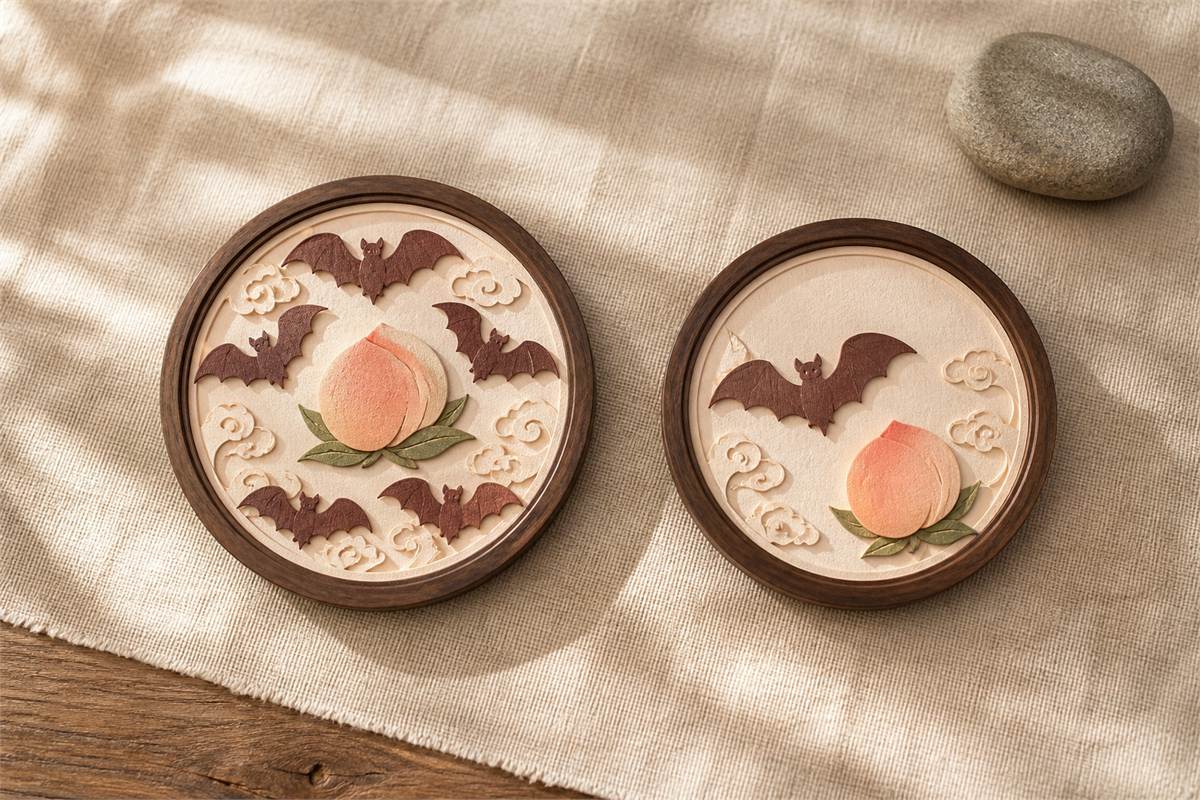
Wu Fu Peng Shou (五福捧寿) means “the Five Blessings presenting longevity.” It is a warm visual wish for a life rich in years, well-being, peace, good character, sufficiency, and fulfillment. The best-known form places five stylized bats around the longevity character Shou (寿), although real objects vary: the center may be a different form of Shou, a longevity peach, or another longevity image, and the five bats may be arranged unevenly, woven into a border, or partly hidden by the shape of the object.

The design turns a birthday blessing into a circle of care. It is not simply “five bats plus a character.” Its emotional heart is the hope that long life will be accompanied by health, tranquility, virtue, material ease, family harmony, and a graceful sense of completion.
What Wu Fu Peng Shou means
The name has three parts: Wu Fu (五福), the Five Blessings; Peng (捧), to present, uphold, or gather respectfully around; and Shou (寿), longevity. Together they create the image of blessings gathering around a long and meaningful life.
In this decorative language, the bat motif carries blessing because the word for bat, bianfu (蝙蝠), contains fu (蝠), pronounced like the fu (福) of good fortune. Five bats can therefore stand for the Five Blessings. The central longevity image gives those blessings a focus.
They express a wish—a medium through which people hope to bring about wealth, health, virtue, longevity, or a specific outcome in life. In Wu Fu Peng Shou, these hopes are held together as one generous vision of a beautiful life.
The classical Five Blessings
The Hongfan (洪范) chapter of the Shangshu gives the classical list in a compact line: “一曰寿、二曰富、三曰康宁、四曰攸好德、五曰考终命.” In reader-friendly English, these are longevity, wealth or sufficiency, health and peace, love of virtue, and the fulfillment of one’s natural span of life.

| Classical wording | A warm, everyday reading |
|---|---|
| Shou (寿) | Long life, with time to enjoy and nurture what matters |
| Fu (富) | Sufficiency, abundance, and the means for a secure life |
| Kangning (康宁) | Health, peace, and a settled heart |
| You haode (攸好德) | Loving and practicing goodness |
| Kao zhongming (考终命) | Bringing a full life to its natural completion |
This list is broader than a wish for years alone. Longevity is surrounded by the conditions that help life feel whole: enough resources, calm and health, moral warmth, and completion. That is why the motif can speak not only to birthdays but also to retirement, anniversaries, a new home, and family heirlooms.
A later popular phrase, Fu Lu Shou Xi Cai (福禄寿喜财)—blessing, prosperity or rank, longevity, joy, and wealth—is a familiar modern retelling of a fortunate life. It is meaningful in its own context, but it is not the same list as the Five Blessings in the Shangshu.
How to recognize the complete motif
Start with the whole composition rather than one isolated element. A clearly documented example may show five bats surrounding a round Shou character, as in a Qing white-jade belt buckle in the Palace Museum. Other objects distribute the bats around a vessel, place them beside repeated longevity characters, or combine them with peaches, clouds, ribbons, and borders.

- Look for a group of five blessing signs. They are often bats, but stylization, cropping, wear, or the shape of an object can make the count difficult.
- Find the longevity focus. It may be a Shou character in round, seal-script, elongated, or geometric form; in some recorded designs a peach or longevity figure carries the same focus.
- Read the relationship. The elements should work together as blessings presenting, surrounding, or supporting longevity.
- Use the object record when available. Museum titles and catalog notes help distinguish a named Wu Fu Peng Shou design from a general bat-and-longevity decoration.
Five bats do not have to be perfectly equidistant or all face the center. The central character is not always circular. A single photograph may omit the reverse, foot, rim, or border where another bat appears. Naming should therefore follow the complete image, the object’s own record, and its cultural setting.
Why the motif changes across objects
Wu Fu Peng Shou is a visual sentence, and craftspeople adapt its grammar to different surfaces. On a bowl, bats can travel around the curved wall while a Shou medallion anchors the front. In embroidery, they may become a compact roundel. In jade, openwork can turn wings and clouds into one flowing outline. In a print, the blessing may be carried by figures, peaches, and other birthday imagery rather than appearing as a rigid diagram.

The British Museum’s late-Qing woodblock print titled Five-Happinesses and Longevity presents the idea through civilian door officials and auspicious objects. A Palace Museum design drawing for a late-Qing bowl combines blue bats, a round Shou character, peaches, ribbons, and Wan marks. These examples show why the name depends on the complete composition rather than a formula applied to every bat, peach, or Shou character.
Peaches, longevity figures, clouds, and Wan patterns
Longevity peach
The longevity peach, Shoutao (寿桃), carries wishes for long life and birthday happiness. Peach decoration, peach-shaped birthday buns, and the mythic peaches associated with the Queen Mother of the West belong to connected but distinct layers of tradition. In a Wu Fu Peng Shou composition, a peach can strengthen the longevity theme without turning myth into a claim about everyday fruit.

Shoulao and the longevity image
Shoulao (寿老), the popular Old Man of Longevity, may appear in richer birthday scenes. The familiar elderly figure developed over a long history that includes stellar associations, religious traditions, and folk art. His appearance and attributes vary, so a beard, staff, peach, deer, or crane should be read as part of the whole scene rather than as a fixed identification checklist.
Auspicious clouds
Auspicious cloud patterns, Xiangyun (祥云), can bring a heavenly, celebratory atmosphere, but they also do practical design work: filling space, linking separate motifs, and guiding the eye around a curved or circular surface. Their meaning comes from form and context; “cloud” and “fortune” should not be treated as a universal historical wordplay.

Wan mark and endless Wan pattern
The Wan mark (卍) has a long and diverse religious and cultural history across Asia. In traditional Eastern decorative settings it can contribute ideas of auspiciousness, abundance, or continuity. A repeated, linked geometric field is known as Wan Zi Bu Dao Tou (万字不到头), the “endless Wan pattern,” and should be identified separately from a single Wan mark. Not every combination of bats and a Wan mark has the same fixed name.
In modern viewing, historical background and the full visual setting matter. Direction, angle, or color alone is not a reliable shortcut for interpreting every use of the sign.
Do not confuse Wu Fu Peng Shou with nearby blessings
| Theme | What makes it different |
|---|---|
| Five Blessings, Wu Fu (五福) | The broad idea or classical set of five blessings; it does not by itself name a Shou-centered composition |
| Fu Shou Shuang Quan (福寿双全) | A wish for blessing and longevity together, often expressed through a paired rebus |
| Fu Lu Shou (福禄寿) | A three-part blessing of fortune, prosperity or rank, and longevity, sometimes personified by three figures |
| Five bats, Wu Fu (五蝠) | A five-bat group can signify the Five Blessings, but naming the full motif still depends on the longevity focus |
| Fu Zai Yan Qian (福在眼前) | A separate rebus generally identified through the actual combination of bat and coin imagery |
| Bai Shou or Tuan Shou patterns | Many Shou forms or a round Shou design emphasize longevity through writing, not necessarily through five bats |
The same caution applies to names such as Hong Fu Qi Tian (洪福齐天) or Fu Shou Wan Dai (福寿万代). Red bats, clouds, coins, Wan marks, and longevity signs can support these readings in documented combinations, but one element alone does not settle the name.
A blessing for birthdays and family life
Wu Fu Peng Shou feels especially natural at birthdays because it wishes for more than age. It surrounds longevity with the qualities that make the years precious. For a parent, grandparent, mentor, or loved one, it can say: may life be long, peaceful, well provided for, guided by goodness, and shared with those who matter.

- For a birthday: “May the Five Blessings gather around a long, healthy, and joyful life.”
- For retirement: “May the years ahead bring peace, abundance, good health, and fulfillment.”
- For a family home: “May this home welcome harmony, virtue, comfort, and lasting blessing.”
- For an heirloom: “May good wishes and family love continue through the generations.”
The motif does not prescribe a gender, zodiac sign, age threshold, or way to wear it. Its message can accompany anyone whose gift is meant to carry bai shi ru yi (百事如意)—may all things follow your wishes—together with peace, health, goodness, and longevity.

Five blessings gathered around a beautiful life
Wu Fu Peng Shou endures because its picture is easy to love and its wish is unusually complete. Bats turn sound into blessing; Shou gives the circle a heart; peaches, clouds, figures, and continuous patterns add warmth when the object’s context supports them. Together they offer a vision of long life held by health, peace, sufficiency, virtue, family affection, and fulfillment.

Explore the Eastern Story blessing collection for objects chosen by the wish they carry, or compare the peach-and-bat composition in our guide to Nine Peaches and Five Bats.
Frequently Asked Questions
Related Posts


One Comment