Chinese Knot Meaning is the blessing language of a woven cord: unity, continuity, auspicious red color, harmony, protection, love, and meaningful gifting. A Chinese knot, or Zhongguo Jie (中国结), is usually made from one continuous cord that turns, loops, tightens, and returns into a symmetrical form. That structure is why the knot is more than decoration. In Eastern folk tradition, it becomes a visible wish that good things remain connected.
This guide explains what a Chinese knot means, where the tradition comes from, how different knot types carry different wishes, how colors change the message, how continuous knots are used in bracelets and pendants, and how to choose Chinese knot jewelry or gifts today. It keeps this page focused on the Chinese knot as a woven blessing symbol, while related pages such as red string bracelet meaning, lucky symbols, and the Blessing collection carry nearby topics.
Chinese Knot Meaning at a Glance

- Core meaning: blessing, unity, continuity, harmony, reunion, protection, and good wishes.
- Original term: Chinese knot Zhongguo Jie (中国结), a traditional Eastern decorative knotting art.
- Main visual cues: one continuous cord, symmetrical body, red or festive color, looped pattern, tassels, and sometimes jade, gold, beads, or a blessing character Fu (福).
- Best uses: home decor, car hanging ornaments, keychains, wedding gifts, festival gifts, red-cord bracelets, pendants, clothing buttons, packaging details, and modern Eastern-inspired jewelry.
- Page boundary: this page explains the Chinese knot itself. Red string, jade, Double Happiness, five-color cord, and Pixiu have their own deeper meanings and should be linked as nearby topics rather than merged into one page.
What Is a Chinese Knot?

A Chinese knot is a handmade decorative cord object created by folding, looping, pulling, and shaping thread into a balanced knot. Classic examples are made with silk cord, nylon cord, cotton rope, jade cord, or red thread. Many finished pieces are red, but Chinese knots can also appear in gold, green, blue, purple, black, white, soft gray, macaron colors, leather, metal wire, and modern mixed materials.
The form matters. A strong Chinese knot is usually symmetrical from top to bottom and left to right. Many designs are also similar on the front and back, with the beginning and end of the cord hidden or visually connected. This gives the knot its feeling of completion. The object looks like a small woven universe: one line enters, turns many times, and returns as a complete sign.
In everyday language, people often use “Chinese knot” broadly. It may refer to a large red wall hanging, a small keychain, a car charm, a red bracelet knot, a jade pendant cord, a decorative button on Tang-style clothing, or a modern jewelry motif made in gold. The shared idea is the same: a cord becomes a symbol of connection and blessing.
History: From Practical Knots to Eastern Decorative Art

The cultural history of Chinese knots begins with practical cord use. Early people used knots for fastening clothing, binding tools, recording matters, and marking agreements. The Eastern classic Yijing records the old idea of governing by knotted cords before written marks replaced that system. This memory of “knotting to record” helps explain why a knot could become associated with trust, order, and remembered promises.
From the Shang-Zhou period through the Qin-Han period, cord gradually moved from practical tool into ritual and ornament. Jade pendants needed cords. Official seals used tassels and bands. Clothing, sachets, and formal objects used tied details. These were not yet the fully named modern “Chinese knot” system, but they established the role of cord as a carrier of identity, etiquette, beauty, and blessing.
During the Tang-Song period in Eastern history, knotting became more mature as decoration. It appeared in clothing, belts, hair ornaments, Buddhist decorative settings, and poetic imagery. The love knot Tongxin Jie (同心结), meaning two hearts joined as one, became a powerful emotional image. By the Ming-Qing period, knotting reached a rich craft stage. Knot types multiplied, folk usage widened, and decorative knots appeared in room hangings, sedan curtains, lanterns, gift packaging, and personal ornaments.
In modern cultural organization, this craft was named and systematized as Chinese knot Zhongguo Jie (中国结). It is widely recognized as a traditional Eastern decorative knotting art, and the craft entered China’s national intangible cultural heritage list in 2008. Today it can appear in cultural museums, festival decor, jewelry collections, public events, and modern design systems.
Why Chinese Knots Mean Blessing, Unity, and Harmony

The first layer is wordplay. In Mandarin, the word for knot, jie (结), sounds close to auspiciousness, ji (吉). That sound relationship links the knot with good fortune, blessing, and favorable wishes. This is why Chinese knots are often placed around New Year, weddings, birthdays, housewarming, and other important moments.
The second layer is shape. A Chinese knot is often round, full, balanced, and symmetrical. It suggests reunion, family harmony, and a complete life. When one cord runs through the entire structure, the viewer can also read it as continuity: life continues, relationships continue, blessings continue, and care remains connected.
The third layer is emotional language. In Chinese, “knot” also appears in words connected with joining, forming bonds, marriage, sworn friendship, and emotional attachment. Classical poetry uses knot imagery to express longing and deep feeling, as in the idea of a heart like a double-threaded net filled with thousands of knots. In this sense, a Chinese knot is a quiet emotional object. It can hold love, friendship, kinship, loyalty, and memory without needing loud language.
Finally, the knot carries a craft philosophy. One continuous cord becomes many turns, and many turns become one whole. This “one line to the end” idea echoes Eastern ways of thinking about balance, transformation, and completeness. A handmade knot also carries time. When someone knots it slowly and gives it as a gift, the blessing is not only in the symbol; it is also in the patience of making.
Common Chinese Knot Types and Their Meanings
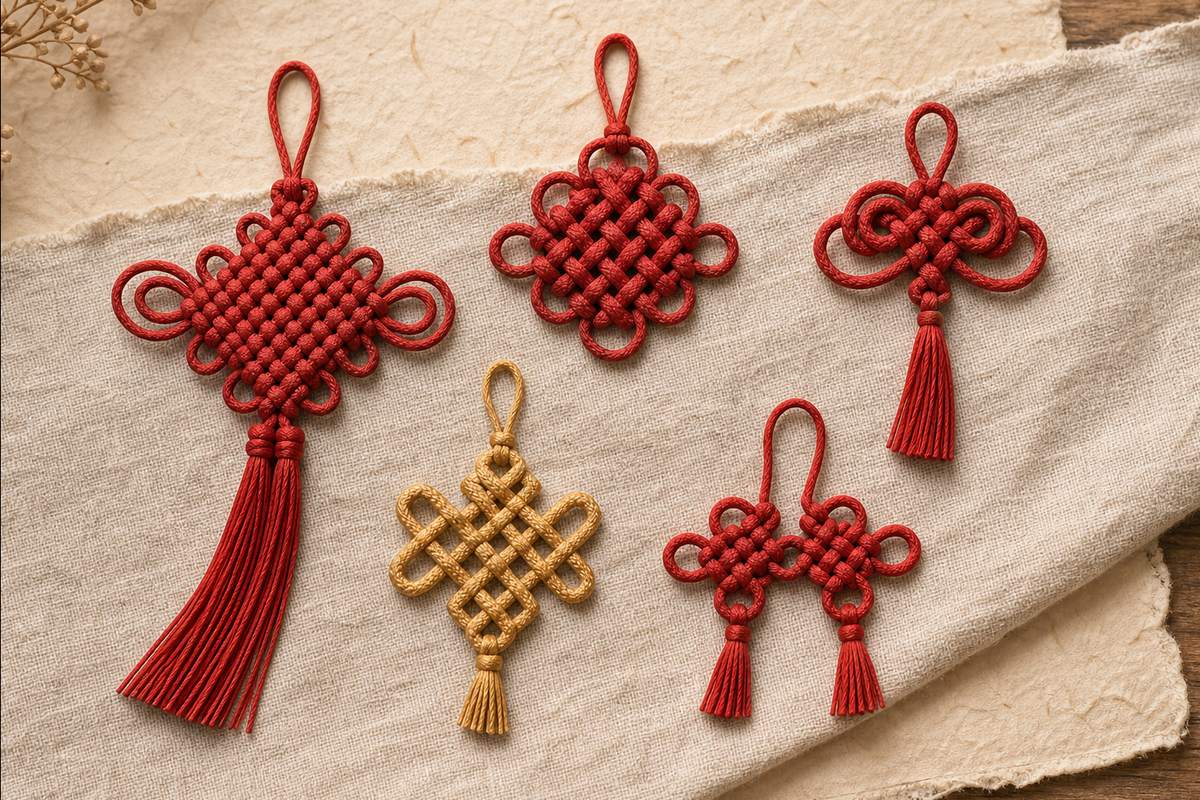
Different knot forms carry different wishes. In practice, several knot types are often combined into one hanging ornament or bracelet so the gift can express a richer message.
| Knot type | Chinese term | Main meaning | Best use |
|---|---|---|---|
| Auspicious knot | Jixiang Jie (吉祥结) | Great fortune, smooth wishes, auspicious arrival | New Year hangings, keychains, bracelets, general gifts |
| Peace knot | Ping’an Jie (平安结) | Safety, calm protection, smooth daily movement | Car charms, bag charms, children’s bracelets, daily wear |
| Ruyi knot | Ruyi Jie (如意结) | Wishes fulfilled, things going as hoped | Jade pendants, fan ornaments, study or career gifts |
| Pan Chang knot | Pan Chang Jie (盘长结) | Continuity, long life, lasting companionship, endless connection | Wedding gifts, elder gifts, large hangings, car ornaments |
| Double coin knot | Shuangqian Jie (双钱结) | Good things in pairs, prosperity, paired success | Business gifts, wealth-themed ornaments, bracelets |
| Love knot | Tongxin Jie (同心结) | Two hearts joined, loyal affection, lasting love | Wedding gifts, couple tokens, romantic gifts |
| Double Happiness knot | Shuangxi Jie (双喜结) | Double joy, wedding happiness, paired celebration | Wedding rooms, wedding favors, couple gifts |
| Cloud knot | Xiangyun Jie (祥云结) | Auspicious clouds, smooth rising fortune, graceful blessing | Career gifts, study gifts, festival decor |
| Butterfly knot | Hudie Jie (蝴蝶结) | Beauty, arrival of blessing through the hu/Fu sound association | Birthday gifts, elder gifts, feminine ornaments |
| Diamond knot | Jingang Jie (金刚结) | Firm protection, strength, durable blessing | Bracelets, protective cords, children’s gifts, Benmingnian wear |
The Pan Chang knot deserves special attention because its looping, unbroken structure is one of the strongest visual expressions of continuity. It can mean long life, unending blessing, and lovers or family members staying connected. The Tongxin knot is more emotional: it is tied to love, marriage, and the wish that two people remain of one heart. The Double Coin knot is more outward-facing, used for prosperity, paired success, and business blessings.
Red Chinese Knot Meaning and Color Symbolism
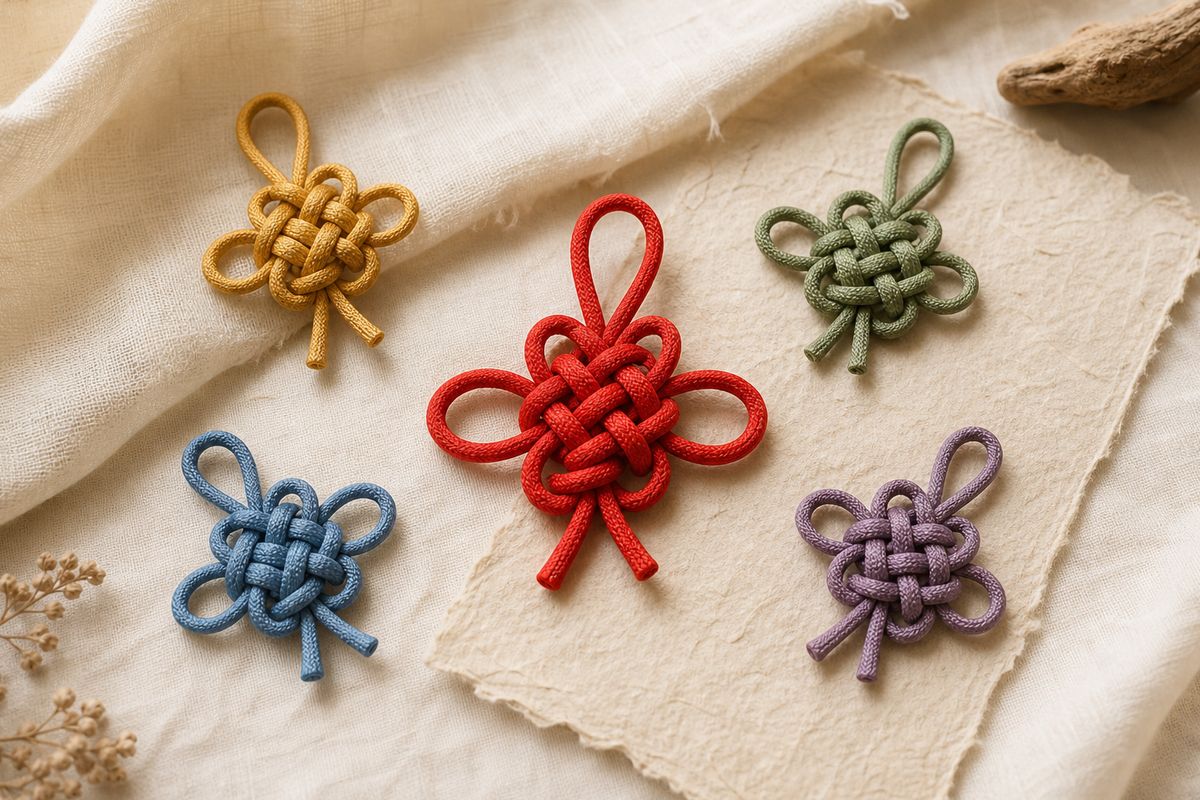
Red is the classic Chinese knot color because it carries joy, celebration, warmth, protection, and festive blessing. A red Chinese knot often appears during Spring Festival, weddings, birthdays, openings, housewarming, and family reunions. The red cord makes the blessing visible from a distance, which is why large red knots are common on doors, in living rooms, and in holiday displays.
For a wearable object, red changes the feeling of the knot. A small red knot on a bracelet or pendant gives the piece a clear blessing tone. It can turn jade, gold, turquoise, amber, crystal, or a simple keychain into a more culturally expressive object. For the broader red-cord meaning, including fate, protection, and daily wearing, read the Eastern Story guide to red string bracelets.
| Color | Cultural expression | Common use |
|---|---|---|
| Red | Joy, celebration, auspiciousness, protection, prosperity | Spring Festival, weddings, home decor, red bracelets |
| Gold or yellow | Wealth, brightness, harvest, dignity, high status | Holiday ornaments, jewelry, business gifts |
| Green | Vitality, health, growth, natural harmony | Jade pairings, spring gifts, calm home decor |
| Blue | Stillness, wisdom, depth, trust | Modern interiors, refined accessories |
| Purple | Elegance, mystery, nobility, refined beauty | Formal gifts, jewelry, modern decorative pieces |
| Five-color cord | Balance of the five phases, family harmony, seasonal protection | Festival bracelets, children’s cords, Dragon Boat Festival traditions |
Modern design has expanded the palette. Soft gray, muted beige, macaron colors, dark red, brown, and metallic tones can make the knot feel less like a festival prop and more like a refined everyday object. This is especially useful for new Eastern-style home decor, contemporary jewelry, and cultural product packaging.
How Chinese Knots Are Used: Home, Jewelry, Clothing, and Gifts

Chinese knots are flexible because they can be large enough for a wall or small enough for a bracelet. A large knot in the living room, entrance, or doorway brings a clear festive atmosphere. A car hanging ornament usually carries a peace message. A keychain or bag charm makes the blessing portable. A knot on gift packaging turns the wrapping itself into a wish for connection.
In clothing, knots appear as buttons, closures, waist ornaments, and collar or sleeve details on Tang-style clothing, qipao, Hanfu, and modern new-Eastern fashion. In shoes and handbags, knotting can become a surface motif or decorative accent. In home design, Chinese knot structures may be translated into screens, lamps, furniture patterns, wall art, and brand packaging symbols.
In jewelry, Chinese knot meaning becomes more intimate. Flat knots, snake knots, diamond knots, corn knots, and other continuous knot structures can form bracelets, pendant cords, necklace cords, waist chains, bag charms, phone straps, and small protective cords. They are often paired with jade, Hetian jade, jadeite, turquoise, amber, crystal, gold, silver, or small blessing charms.
This is where the knot connects naturally with Eastern Story’s product world. A knot is chosen for meaning rather than appearance alone. It can be worn with intention, used as a quiet reminder, or given as a small object of care. For readers choosing a symbolic object, the Blessing collection is the clearest next path.
Continuous Knotting: 4 Classic Bracelet and Pendant Cord Styles

Continuous knotting means repeating a basic knot one after another to create a chain, bracelet, necklace cord, waist cord, or hanging ornament. The four styles below are especially useful for readers who want to understand why a finished Chinese knot bracelet looks the way it does.
Caisson Knot: Compact and Flat for Bracelets, Necklaces, and Waist Cords
The caisson knot Zaojing Jie (藻井结) has a tight structure and a flat square front. It is one of the practical choices for continuous woven cords. A typical method begins with two cords or one cord folded in half, fixed at the top with a double connection knot. The maker forms four same-direction single knots, threads the cords through the center opening, turns the lower knot upward, tightens gently, and repeats the sequence to build a neat chain.
Corn Knot: Three-Dimensional and Floral
The corn knot Yumi Jie (玉米结) creates a four-cornered, raised texture that can look like small flowers or a vine when repeated. It uses four strands, often arranged clockwise. The basic rhythm is simple: strand 1 presses over 2, 2 presses over 3, 3 presses over 4, and 4 passes through the opening made by 1. Tighten evenly, keep the order, and repeat. The result is a decorative cord with strong texture.
Diamond Knot: Durable and Protective
The diamond knot Jingang Jie (金刚结) is tight, symmetrical, and durable. It is often used for hand cords, protective cords, and pendant strings. One common method uses a folded red cord as the central axis, then another cord wraps around it. The left strand forms a loop over the axis; the right strand wraps around and passes through the left loop; both ends are tightened. Repeating the same direction creates a strong, even chain.
Snake Knot: Simple, Round, and Useful Between Beads
The snake knot She Jie (蛇结) is one of the easiest continuous knots. It forms a small rounded cylinder and works well as a spacing knot between beads or as a simple children’s bracelet cord. Two strands are enough: one strand loops over the other, the second passes through, and both are tightened evenly. The main discipline is consistency. Each loop should face the same direction and receive the same tension.
For beginners, the biggest lessons are practical: keep tension even, do not over-tighten the first knots in a long chain, fix the starting end with tape or pins, and adjust the shape while knotting instead of waiting until the end. A simple pair of scissors, lighter, awl, foam board, and pins can make the work much easier. Burned cord ends should be sealed neatly and hidden on the back of the knot.
Chinese Knot Gift Meaning by Occasion

A Chinese knot is a strong gift because it can be matched to the relationship and the occasion. The object says “may good things stay connected” in a form that is easy to display, carry, or wear.
| Occasion | Recommended knot | Gift meaning |
|---|---|---|
| Housewarming | Ruyi knot or floral Tuanjin knot | Wishes fulfilled, full home, bright future, festive atmosphere |
| Spring Festival | Auspicious knot or Fu character knot | Great fortune, five blessings, New Year joy |
| Car gift | Peace knot or flat knot | Safe travel, smooth roads, daily protection language |
| Wedding | Pan Chang knot, Double Happiness knot, or love knot | Lasting marriage, joined hearts, double joy |
| Business opening or promotion | Double coin knot or cloud knot | Prosperity, paired success, smooth progress, rising career |
| Study or exam | Ruyi knot, Wenchang knot, or cloud knot | Learning progress, wishes fulfilled, bright prospects |
| Elder birthday | Shou character knot, butterfly knot, or Pan Chang knot | Long life, Fu blessing, family respect |
| Benmingnian or children | Diamond knot or peace knot | Protective blessing, age-year care, safe growth |
| Daily self-use | Small red knot, snake knot, flat knot, or bracelet cord | A portable reminder of blessing and calm intention |
Handmade gifts carry an extra layer. A handmade Chinese knot requires patience, focus, repeated tightening, and careful shaping. When someone gives a knot they made by hand, the gift says that time and attention were woven into the object. That is why a small keychain, bracelet, or car charm can feel more personal than its size suggests.
Chinese Knot Jewelry Price and Buying Guide

Chinese knot jewelry has become a popular new-Eastern style because it turns a traditional blessing form into an everyday wearable object. Gold Chinese knot rings, knot-shaped pendants, red-cord bracelets, jade-paired cords, and mixed-material charms all use the same symbolic foundation: connection, continuity, and blessing.
For gold Chinese knot jewelry, price often follows metal weight, design complexity, and workmanship. A Chinese knot ring in the 3-5 gram range is commonly priced around $3,000-$5,000, with labor fees counted separately. Chinese knot necklace or bracelet designs often sit around $2,000-$8,000, while inlaid or more complex designs cost more. Some Chinese knot series pieces can reach a resale reference around $12,000, depending on condition, style, and material.
For daily wear, comfort matters as much as symbolism. A 3-5 gram gold piece is usually easier to wear every day than a heavier sculptural design. For cord jewelry, check whether the knot texture is clear, the lines are smooth, the connection is clean, the ends are hidden well, and the piece does not snag fabric. For large festival hangings, symmetry and fullness are more important than fine jewelry weight.
Choose by occasion. A wedding gift can use a larger love knot, Pan Chang knot, or Double Happiness design. A daily bracelet can stay simple with red cord, flat knot, snake knot, or diamond knot. A refined gift can combine a small knot with jade, gold, or a quiet blessing charm. For more material context, Eastern Story’s Hetian jade guide and jade meaning guide are useful next reads.
Modern Chinese Knot Design: Beyond New Year Decor

Modern Chinese knots are no longer limited to bright red festival hangings. They now appear as bag charms, car charms, phone straps, jewelry cords, pendant chains, shoe decorations, clothing closures, home soft decor, cultural product packaging, gift boxes, fridge magnets, bookmarks, brand logos, and public event motifs. Designers also abstract the crossing, looping structure into graphics for packaging, posters, and visual identity.
The material range has expanded as well. Nylon cord and thick cotton rope remain common for traditional hangings, but silk cord, leather, metal wire, waxed cord, and mixed-media structures make the knot more wearable and more suitable for modern interiors. A muted cotton-linen knot in a tea room, a small knot attached to a jade pendant, or a gold knot ring can all carry the same symbolic root while serving very different lifestyles.
This is the strongest modern role of the Chinese knot: it translates an old blessing structure into objects people can carry, gift, and keep close. It can be ceremonial, romantic, playful, refined, or practical. The best examples do not treat the knot as a random “Eastern” decoration. They use its structure, symmetry, color, and craft to make the meaning visible.
How to Choose a Strong Chinese Knot

Start with the object’s purpose. For a home entrance, a larger red or gold knot with tassels can create a festive blessing. For a car, a smaller peace knot is easier to use. For a bracelet, choose cord that feels smooth, durable, and comfortable against the skin. For a pendant, make sure the knot supports the weight of the jade, crystal, gold, or other charm.
Then check workmanship. A good Chinese knot should be symmetrical, evenly tightened, and clean at the ends. The line should not twist randomly. The knot should look full but not strained. If there are beads, jade pieces, metal fittings, tassels, or packaging details, they should support the knot instead of distracting from it.
Finally, match the meaning. Choose red for celebration and protection language, gold for prosperity and festive brightness, green or jade for harmony and refinement, blue for calm trust, and purple for elegance. For a romantic gift, choose Tongxin knot or Double Happiness forms. For elder gifts, choose Pan Chang, Shou, butterfly, or longevity-themed combinations. For daily blessing jewelry, keep the form smaller and more wearable.
Continue the Story

Chinese knot meaning is part of a larger Eastern Story symbol system. If you want the broader red-cord context, read Red String Bracelet Meaning. If you want a wider symbol map, read Lucky Symbols Around the World. If you are choosing a wearable blessing or meaningful gift, explore the Blessing collection.
Related Posts


One Comment