
The Xiezhi crown (獬豸冠, xièzhì guān) is an ancient Chinese official headdress associated with fair judgment, integrity, and the courage to confront wrongdoing. Also called the law crown, or faguan (法冠), it takes its name from the single-horned justice beast Xiezhi (獬豸). Worn by censors and certain officials entrusted with law and oversight, the crown made a powerful wish visible: may those who hold authority see clearly and act fairly.

That wish reaches beyond official life. The crown’s story speaks to anyone trying to remain honest under pressure, protect what matters, or begin a new chapter with a clear conscience. Its strength lies in the meeting of discernment and compassion—a firm sense of right and wrong, joined to care for the people affected by our choices.
What does the Xiezhi crown symbolize?
The crown brings together several closely connected virtues. Its horn evokes clarity; its association with upright officials gives that clarity a purpose. It asks for the steadiness to recognize an unfair act and the courage to respond.
Discernment: seeing beyond appearances
In the legend, Xiezhi recognizes the person in the wrong during a dispute and confronts that person with its horn. This is the idea behind ming bian shi fei (明辨是非), discerning right from wrong. In everyday life, the same wish can mean listening carefully, looking beyond a confident voice, and choosing thoughtfully when feelings or competing demands cloud the way.

Fairness and integrity: keeping an upright heart
The law crown carried an expectation of impartial conduct. Rank, wealth, and personal advantage were to yield to a just judgment. Its association with qing zheng lian jie (清正廉洁), upright and uncorrupted conduct, also turns the gaze inward: a person entrusted with judging others must examine their own actions. The crown therefore represents both responsibility toward others and fidelity to one’s principles.

Courage and protection: standing beside what is right
Xiezhi confronts wrongdoing rather than looking away. On an official crown, that image expressed the courage to challenge misconduct, including misconduct by the powerful. As a guardian symbol in Eastern culture, it also carries a wish to ward off harmful influences and welcome peace. A contemporary object inspired by this story can accompany someone who hopes to speak honestly, set a fair boundary, or protect a more peaceful life.
The creature behind the crown
Xiezhi belongs to a world of legendary creatures. Early accounts describe it in sheep-like or cattle-like terms; later art gives it varied, sometimes more elaborate forms. Its best-known attribute is a single horn and the ability to distinguish right from wrong. It has its own identity alongside the auspicious Qilin (麒麟) and other Eastern guardian beasts. A mane, scales, or a fierce face alone does not identify an image as Xiezhi.

One enduring story connects the creature with Gao Yao (皋陶), the legendary minister associated with judgment in the age of the sage rulers. In the Lunheng, a one-horned sheep helps him resolve doubtful cases by touching the guilty party and leaving the innocent alone. The story gives fairness a memorable form: a guardian that sees through confusion. The crown carried that ideal into the appearance of officials.
Why Xiezhi is connected with the character for law
The old character 灋, an earlier form of 法 (fǎ, law), preserves a striking cultural connection. The Han dictionary Shuowen Jiezi explains it through water, the justice beast represented by 廌, and 去, removal. Water evokes evenness; the beast confronts what is wrong; removal completes the image of setting things right.

The shorter form 法 was already recognized in antiquity. This is an ancient relationship between written forms, rather than a change introduced by modern simplified-character reforms. For a reader looking at the crown, the connection adds another layer of meaning: the creature of discernment is woven into an old explanation of law itself.
Who wore the Xiezhi crown?
The crown is especially associated with yushi (御史), usually translated as imperial censors. Their work included scrutinizing officials and reporting misconduct. Early descriptions also connect the law crown with personnel of the Tingwei (廷尉), an important judicial office. Later rules name particular officials concerned with legal administration and oversight.
These offices belonged to changing imperial systems. A censor’s work was broader than the familiar work of a modern courtroom judge, and the crown’s wearers varied with dynasty, office, and ceremony. Its shared meaning was the obligation to uphold standards with a clear and courageous mind.

Was it a royal crown?
In this name, guan means a formal cap or headdress. The Xiezhi crown became known as an official law crown, distinct from the imperial ceremonial crowns that readers may picture when they hear “crown.” Yet its origin stories also reach back to a ruler of Chu.
The Huainanzi associates King Wen of Chu with wearing a xie crown, while another traditional account tells of a Chu king obtaining the wondrous creature and making a crown in its likeness. These are literary traditions about the crown’s beginnings. They explain the enduring Chu connection without turning the capture of a mythical animal into a historical event.
How the law crown changed across dynasties
The connection with justice endured through changes in the crown’s construction. Reading those changes makes the headdress more vivid: cloth, an upright support, an ornament, and a horn could all carry part of its meaning.
Qin and Han: the law crown and its iron support
Early costume accounts describe a Chu connection and tell of Qin adoption of the crown for officials who enforced the law. In the Han-era Duduan, the law crown is described as five cun high, with cloth wrapped around an iron support. This is a measurement belonging to that historical description. Keeping the original unit preserves its setting.
Names such as faguan (法冠, law crown), zhuhou (柱后), and Xiezhi guan appear in the early crown tradition. Tieguan (铁冠, iron crown) became an associated name recalling its iron structure. The image of iron also suited the ideal of an official who would remain firm under pressure.

Sui and Tang: ornaments and the discerning horn
The Tongdian records two pearls added to a Jinxian crown in the Sui Kaihuang period as horn forms. Its description of the Tang law crown specifies one horn in Xiezhi’s form for officials of the Censorate at the investigating-censor level and above. These details belong to particular costume descriptions; two ornamental elements on a crown need not mean a two-horned Xiezhi creature.

Song: a carved wooden horn on a Jinxian crown
The Song Shi describes the Xiezhi crown as a form of the Jinxian crown (进贤冠), a formal official headdress. A wooden Xiezhi horn was carved above its beams and coated with bi, a blue-green pigment. The number of beams followed the wearer’s prescribed rank. The horn expressed the legal role while the underlying crown also conveyed position within the court.

Ming and Qing: the story carried into official robes
Ming ceremonial dress retained Xiezhi additions for certain officials, while Xiezhi also appeared on the insignia of officials charged with oversight. These badges made the creature visible on the robe itself. The crown and the robe emblem could belong to different parts of a dress system, so this was more than a simple replacement of a hat with embroidery.
Under the Qing, Xiezhi remained an emblem on the robes of specified censorial and supervisory offices, within a different system of court headwear. The continuing thread was the justice beast and its ethical meaning. Qing badge use should therefore be understood through Qing dress, rather than imagining every official wearing the same ancient horned crown.
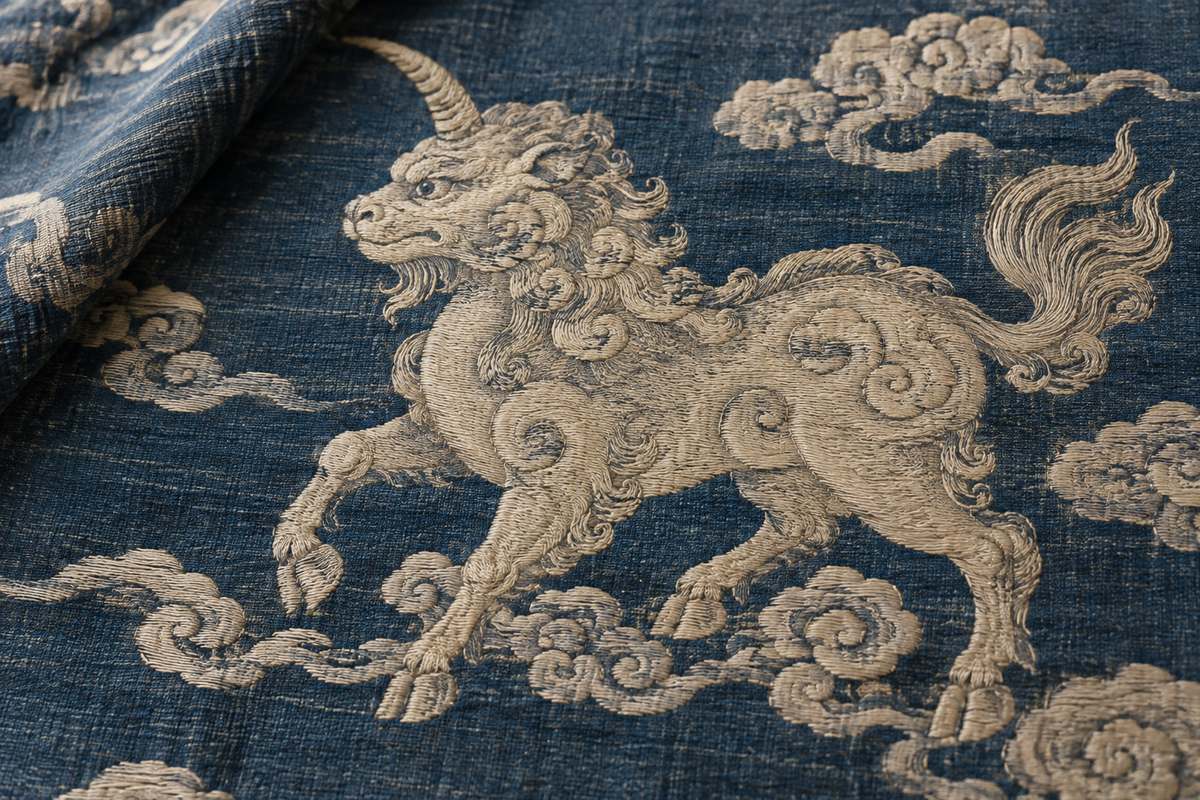
Crown, rank badge, and Xiezhi motif: how they relate
A buzi (补子), often called a rank badge or Mandarin square, is the textile insignia seen on official robes. A Xiezhi badge (獬豸补) presents the creature on that textile surface. The law crown carries the same cultural association through a headdress and its ornaments. The object changes, but the wish for upright conduct remains recognizable.

| Form | What you are looking at | Meaning it emphasizes |
|---|---|---|
| Xiezhi crown / law crown | An official headdress whose form and ornaments depend on the period | Discernment and the responsibility of office |
| Xiezhi rank badge | A woven or embroidered robe insignia showing the creature | Upright oversight expressed through official dress |
| Xiezhi sculpture or motif | The creature represented in stone, metal, textile, or another medium | Justice, courage, and guardianship |
| Modern crown-inspired ornament | A contemporary design referring to the crown or its horn | A personal wish for clarity, integrity, and a peaceful path |
Surviving textiles help bring this relationship to life. Tsinghua University Art Museum holds a late-Qing Xiezhi badge woven in kesi (缂丝), or silk tapestry, on a blue ground. Its catalog identifies Xiezhi with censors, apart from the usual bird emblems of civil rank. The beast on the cloth is an official insignia, rather than a picture of someone wearing the crown.
When looking at a painting, reconstruction, or performance costume, first notice the whole headdress and then its separate ornaments. The robe, setting, and identified period help explain what the wearer represents. A modern stage design may draw on this visual vocabulary freely; a named historical crown has a more specific costume context.
From the court to familiar symbols of guardianship
Xiezhi’s protective presence also reaches beyond clothing. At the Palace Museum’s Hall of Supreme Harmony, it is eighth in the sequence of ten small roof animals, counting from the dragon and excluding the leading rider. That position belongs to this particular roof procession. Here the justice beast joins an architectural company of auspicious guardians.

Modern legal culture continues to find expressive power in the creature. The gavel used by the Siming District People’s Court in Xiamen, presented in the Beijing cultural-heritage account of the country’s first modern court gavel, has a Xiezhi-shaped upper head. Southwest University of Political Science and Law also uses a stylized front-facing Xiezhi in its emblem. Such examples show how a memorable creature can carry an aspiration for fair judgment across very different objects.
Carrying the crown’s meaning into a new chapter
A contemporary Xiezhi-themed ornament can be chosen for the quality its story celebrates. A crown silhouette refers particularly to responsibility and upright office; a full beast evokes the guardian; a horn-inspired line offers a quieter expression of clarity and courage. Pendants, brooches, hair ornaments, and small keepsakes are possible ways to interpret those ideas. The design and the story should make their connection understandable.
For someone finishing their studies, it can carry the wish to meet the next stage with a clear mind and a generous heart. For a friend taking on new responsibilities, it can express confidence in their fairness. For yourself, it may mark a decision to live more honestly, speak with greater courage, or protect the calm you have worked to build.
A personal message makes that intention your own: “May you see clearly, stand with courage, and walk an upright path.” Or pair the story with ping an ru yi (平安如意): a wish for peace and for life to unfold as hoped. Among family and close friends, the most meaningful choice is one that reflects a shared story and the recipient’s taste.

If you choose a reconstructed headdress to wear, check how it sits and fastens, and support the crown body when handling it. Protect a projecting horn during storage. For a smaller ornament, follow the maker’s guidance for its actual materials; the care guide offers general care principles.
The Xiezhi crown leaves us with a beautiful image: strength guided by fairness, and clarity joined to care. Explore the Eastern blessing collection for objects that carry wishes of peace, courage, and a meaningful life.
Frequently Asked Questions
Related Posts


