
A jade bat pendant carries a wish for good fortune, happiness, and blessings close to the heart. In Chinese, the bat syllable fú (蝠) sounds exactly like Fu (福), the character for blessing. Carved in jade, that happy association becomes something you can wear, hold, and give to someone you love. A single bat welcomes fortune; five bats gather the Five Blessings; peaches, coins, bamboo, and other companions give the wish its own character.

The appeal of a jade bat necklace lies in this meeting of a lively little form and a deeply familiar hope: may life be kind, may the people we love be well, and may good things find their way home. Its wings can look playful, graceful, or almost like curling clouds. The piece that feels right may mark a new beginning, keep a family blessing nearby, or simply bring a small moment of joy to an ordinary day.
Why a bat carved in jade feels like a blessing
Within Eastern decorative traditions, the bat symbol gives visible form to Fu. The word can embrace happiness, good fortune, a peaceful household, and a life rich in things worth cherishing. A jade bat is worn to invite these blessings into daily life: fú yùn suí shēn (福运随身), good fortune accompanying you wherever you go.
Jade’s cultural meaning adds tenderness and continuity to that wish. Jade, yu (玉), has long been associated with grace, moral character, and precious regard. Its smooth curves and gentle luster make a personal blessing feel close and enduring. A pendant passed from one generation to another can carry the memory of the giver as vividly as the carving itself.

The animal in nature is a winged mammal; the bat in decorative art is an auspicious motif shaped by language and imagination. Carvers often simplify the head, fold the wing membranes into elegant curves, or let the body merge with a larger pattern. A recognizable silhouette and an inviting expression can carry the story beautifully, whether the design is detailed or spare.
The wishes held in different jade bat designs
Look at the number of bats, the characters around them, and the objects they accompany. Together they form a little visual message. The same open wings may frame a coin, shelter a peach, or sweep around a longevity character, making each pendant’s blessing more personal.
One bat, a pair, and the Five Blessings
One bat offers a direct wish: may you have Fu. Two bats can express blessings doubled or shared, an especially affectionate reading for a pair of people or a household. Their pairing invites a message of happiness together; the exact name of a more elaborate design comes from its complete composition.
Five bats evoke Wufu (五福), the Five Blessings. The Hongfan chapter of the Shangshu (《尚书·洪范》) names them as longevity (寿), wealth (富), health and peace (康宁), love of virtue (攸好德), and completing life peacefully (考终命). Read together, they imagine a life with enough to live on, a generous heart, well-being, and a good beginning-to-end journey.

This is the warmth behind Wufu Linmen (五福临门), the Five Blessings arriving at the door. In a small jade pendant, five separate bats may be arranged around an open center or among other motifs. Let the actual count guide this reading; a single bat already carries a complete and heartfelt wish for good fortune.
Five bats around longevity, and blessings with a peach
When five bats surround the longevity character Shou (寿), the composition is Wu Fu Peng Shou (五福捧寿), Five Blessings embracing longevity. A peach at the center can also bring the five-bat grouping into a birthday or longevity theme. These designs turn the broad hope of Wufu toward someone whose presence you want to cherish for many years.
A bat with a longevity peach (寿桃) joins Fu with long life, often expressed as Fu Shou Shuang Quan (福寿双全): enjoying both blessing and longevity. A peach, Shou character, or a clearly recognizable longevity figure supplies that part of the wish. In more elaborate carvings, the longevity star Shouxing (寿星) commonly appears as an elderly figure with a high forehead, staff, or peach; those identifying details distinguish him from an ordinary person in a scene.

A bat beside a coin: blessing before your eyes
A bat holding or resting beside a traditional square-holed coin can carry Fu Zai Yan Qian (福在眼前), blessing before your eyes. The word for coin, qián (钱), sounds like “before” or “in front,” qián (前), while the central opening is the coin’s “eye,” qiányǎn (钱眼). Bat, eye, and coin come together as a wish for happiness close at hand.

On a pendant, this can be an intimate message for someone beginning a new chapter: may you recognize the good opening before you. The bat may hold the coin in its mouth, spread its wings above it, or curl around it. Coins also bring a prosperity association; additional peaches, characters, or paired coins can give a particular carving a fuller reading.
Red bats, bamboo, clouds, and the sea
A red bat brings another pleasing play on sound: hóng fú (红蝠), red bat, echoes hóng fú (洪福), abundant blessing. A red bat among auspicious clouds (祥云) can support the wish Hong Fu Qi Tian (洪福齐天), blessings as vast as the heavens. In jade carving, a contrasting warm-colored area may give the bat this festive emphasis, while the wider scene carries the sky imagery.

Bamboo and bat can read as zhù fú (祝福), offering blessings: bamboo’s zhú (竹) echoes zhù (祝), and the bat supplies Fu. Bamboo’s upright stems and rising joints also suit wishes for resilience and steady progress. This has its own gentle emphasis, alongside the familiar wish Zhu Bao Ping An (竹报平安), bamboo bringing tidings of peace.

A bat over a clearly depicted sea can evoke Fu Ru Dong Hai (福如东海), blessings as abundant as the Eastern Sea. Waves give this image its expansive feeling. A sunrise may enrich the composition; curling clouds by themselves invite a skyward reading. Looking at the whole little landscape helps you find the words that belong to it.

Ruyi, gourds, and the Heavenly Official
A jade ruyi (如意) shape brings the wish that life unfold as the heart hopes. Paired with a bat, it makes a lovely expression of fortunate, fulfilling days. The gourd, hulu (葫芦), adds its familiar association with Fu Lu (福禄), blessing and prosperity. These combinations can make a pendant feel especially suited to home, companionship, and a shared future.

Tianguan Ci Fu (天官赐福), the Heavenly Official bestowing blessings, is a scene with a particular Daoist figure. Look for his official robes, ceremonial headwear, accompanying inscription, and the description of the design. A Buddhist figure has its own identity and story; an unnamed person with a bat is best appreciated through the elements that can actually be recognized. When Tianguan is clearly depicted, the pendant carries the joyful idea of blessings descending from heaven.
Jade colors that give the wish its own mood
The same bat motif can feel quietly luminous in pale jade, fresh in green, or festive with a warm red accent. Hetian jade (和田玉) belongs to the nephrite jade tradition. Jadeite, feicui (翡翠), is another familiar jade material, with a broad range of colors and translucency. Understanding jadeite and nephrite helps you enjoy the character of the stone you are choosing.
Nephrite often has a soft, gently lustrous appearance that suits rounded wings and close-fitting plaques. White jade (白玉) lends a calm, light mood; green nephrite, biyu (碧玉), gives the motif a rich, leafy presence. Biyu is a green variety within nephrite, including the material described in the Hetian jade tradition. Jadeite can range from softly opaque to translucent, in colors including white, green, lavender, and reddish brown.

For a personal gift, pale tones might express a wish for peaceful days, green might recall renewal, and a reddish accent might feel like a joyful welcome to good fortune. These are ways to choose a mood and tell your own story. Ask for the specific material description; the name Hetian jade on its own is not a statement that the piece was mined in Xinjiang.
Color accents deserve their own names. A surface skin on nephrite and the brown coloring called sugar color (糖色) describe different color features; neither should automatically be called red jadeite. Red jadeite, hongfei (红翡), belongs to the jadeite material context, while Nanhong agate (南红玛瑙) is a red chalcedony material. Each can carry a warm blessing in its own right. A photograph’s color or shine alone does not establish a stone’s origin, treatment history, or age.
How the carving brings the little bat to life
A pendant’s charm often begins with the sweep of its wings. Some bats look rounded and affectionate, others almost weightless. Notice how the head meets the body, how the wings frame a peach or coin, and how the spaces between them let the design breathe. A graceful outline can be just as absorbing as a richly detailed scene.
Relief jade carving (浮雕) offers several kinds of beauty. Shallow relief lets a bat emerge subtly from a smooth plaque; high relief gives the body and wings more projection. A carving in the round can be enjoyed from several sides. The pleasure lies in how the form suits the stone and the wish it carries, with each approach offering a different balance of intimacy and movement.

Openwork jade carving (镂雕) lets light and open space become part of the design. A pierced wing or airy coin surround can make the bat seem to float. Thin bridges, tips, and suspension holes need especially thoughtful handling, so a delicate piece may suit occasional wear or a cherished display better than a busy everyday routine.

With Qiaose (俏色), the art of using a stone’s contrasting colors, a carver can place a warm patch on the bat and leave the neighboring coin or peach pale. That small decision gives the blessing a focal point. The relationship between the color and the carving matters more to the visual story than a uniformly even surface.

Look for comfortable edges, a clear silhouette at the size you will wear, and details that remain pleasing when the pendant turns. If the maker’s process interests you, their account of the work is the useful place to begin. A single drill mark or a smooth curved line does not reveal the full making process. Choosing a pendant you love is also an invitation to appreciate the person and decisions behind it.
Wearing a jade bat as an everyday companion
A simple cord gives the bat room to stand out against a white shirt, knitwear, or linen. Black can frame a pale carving quietly; red can extend its celebratory feeling. A fine metal chain brings a different rhythm, especially with a small mounted pendant. A suitable 18K gold chain or silver chain can work when its strength, clasp, and connection suit the piece.
For a more flowing look, a pendant can accompany a soft blouse, a modern Eastern-style jacket, or a dress with an open neckline. Choose its scale by the silhouette you enjoy and how comfortably it sits. A broad flat plaque rests differently from a rounded carving; photographs with a ruler and views of the reverse help you imagine that fit.
- Check the cord, knot, bail, and clasp before putting the pendant on, especially after a period in storage.
- Keep fine wing tips away from zippers, other pendants, and hard work surfaces.
- Take it off for contact sports, strenuous chores, bathing, and sleep if the necklace could catch or press against the body.
- For a bag charm, choose a protected position where it will not swing against keys or hardware. If used in a vehicle, keep it secure and clear of the driver’s view and controls.
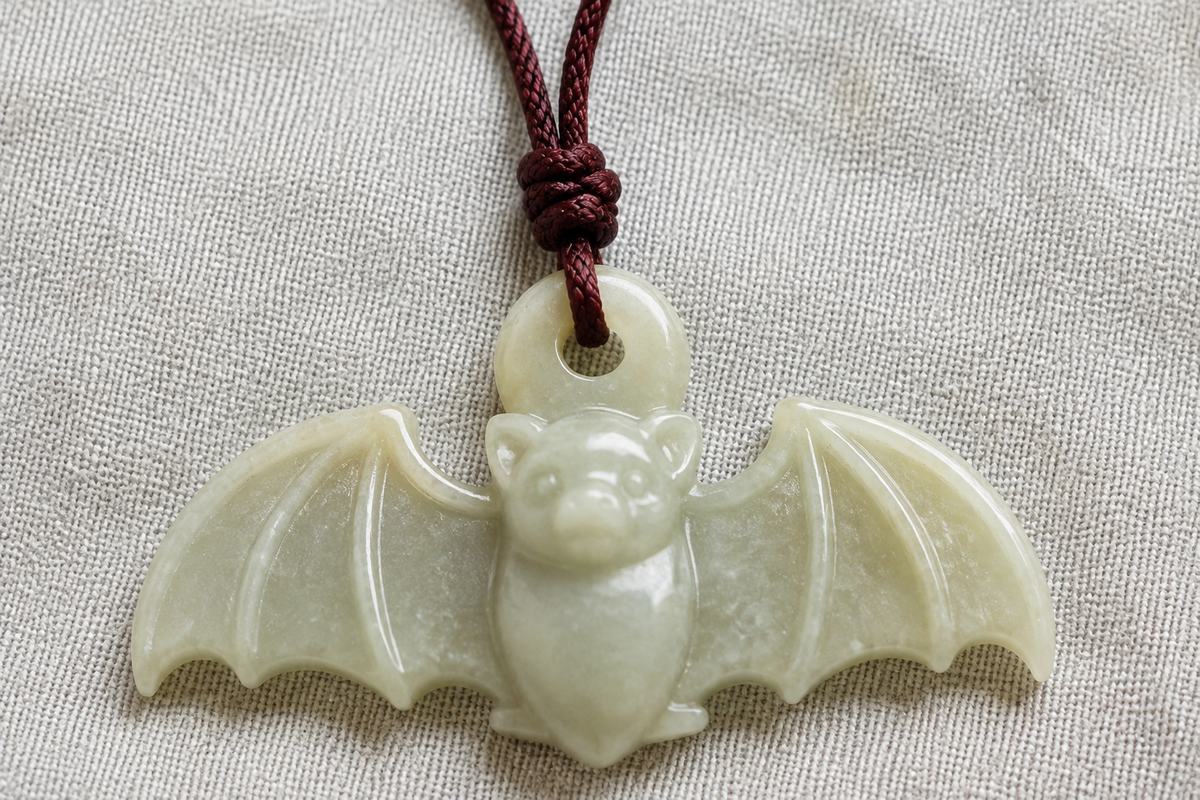
A bat shown upside down is sometimes read through dào (倒 / 到), “inverted” and “arriving,” as blessing arriving. On jewelry, the intended hanging position also follows the design and suspension. Wear it as the piece is made to sit comfortably, and enjoy the message that its composition brings.
Giving a jade bat pendant with a wish that feels personal
The most touching gift begins with what you hope for the person receiving it. A pendant can say “I am thinking of you” every time it is worn. Its value in the relationship grows from the moment, the story, and the care with which it was chosen.
For a parent, elder, or treasured mentor: a bat with a peach or Shou character makes a tender birthday, Lunar New Year, or retirement gift. Five bats embracing longevity widen the wish to a rich and peaceful life. A card might read, “May your days be full of blessing, good health, and the joy of having us close.”

For a partner or someone building a home: a pair of bats can speak of shared good fortune, while a ruyi or gourd adds wishes for fulfillment and prosperity. “May happiness find a home with us” makes the meaning intimate. Choose colors and shapes that echo the recipient’s taste or a memory you share.
For a friend beginning something new: graduation, a move, a new job, or the opening of a business can be celebrated with a simple bat or bat-and-coin pendant. “May good fortune accompany your next chapter” offers encouragement, affection, and confidence in the journey ahead.

For a younger family member: a jade bat can be kept as a family memento with a note about who gave it and why. For infants and young children, an adult-kept keepsake is the appropriate form; neck cords and small loose pieces present entanglement and choking hazards. When the child is older, wearing can be considered with an age-appropriate design and adult guidance.
For your own pendant, the occasion may be quieter: returning to a meaningful habit, finding steadiness after change, or welcoming a season of possibility. Ping An Ru Yi (平安如意), peace and life unfolding as you wish, is a beautiful thought to carry close.
Gentle care for a meaningful piece
Jade has good toughness, but slender carved details and existing cracks remain vulnerable to impact. Place the pendant on a soft surface when changing its cord, and store it separately in a soft pouch or lined compartment. Check the suspension regularly for fraying, worn metal, loose fittings, and rough spots around the hole.
For routine cleaning, use a clean, soft cloth lightly dampened with water, then dry gently. Where the material, treatments, and setting allow it, a little mild soap with lukewarm water can remove surface residue. Glued mounts, dyed cords, mixed materials, and older repairs need care suited to those components. The jewelry care guide offers further help with everyday handling.

Keep the piece away from strong cleaners, acids, intense heat, and sudden temperature changes. Apply perfume or cosmetics before putting it on, and wipe away residue after wear. Oils and prolonged soaking are unnecessary for routine upkeep. Leave steam and ultrasonic cleaning to someone who understands the particular stone, treatments, and setting.
If the pendant falls, stop wearing it until the carving and its connections have been checked. A chip, crack, or loosened fitting may require repair, especially near a wing or drilled hole. Store the piece safely while deciding whether it can be worn again or kept as a treasured memento. The affection it carries remains part of its story.
Frequently asked questions
A little jade, a wish carried close
A jade bat pendant brings a generous idea into a small, beautiful form: good fortune can be welcomed, cherished, and shared. Choose the wings, color, and companion symbols that make the wish feel like yours. Explore Eastern Story’s blessing jewelry and meaningful objects for pieces that carry care, hope, and the wish for a beautiful life.
Related Posts


