
Sandalwood and agarwood are two treasured aromatic materials, but they are not the same kind of “fragrant wood.” Sandalwood, tanxiang (檀香), is valued mainly for fragrant heartwood produced by trees in the Santalum genus. Agarwood, chenxiang (沉香), is resin-enriched wood that develops in certain Aquilaria, Gyrinops, and related trees through a complex defense response to injury and biological stress.
The difference shapes everything that follows. Sandalwood often feels warm, creamy, woody, and reassuringly steady. Agarwood can unfold in changing layers—cool, honeyed, floral, fruity, leathery, herbal, smoky, or deeply resinous. One can accompany an everyday tea table or quiet room with gentle continuity; the other often invites slower, more attentive listening. Neither is simply “better.” Each carries a different atmosphere, cultural presence, and way of marking a meaningful moment.

Sandalwood vs agarwood at a glance
| Point of comparison | Sandalwood | Agarwood |
|---|---|---|
| Botanical source | Fragrant heartwood from Santalum species, especially Indian sandalwood (S. album) and Australian sandalwood (S. spicatum) | Resin-enriched wood from agarwood-producing trees, especially Aquilaria and Gyrinops species in the Thymelaeaceae family |
| How aroma forms | Aromatic oil accumulates in mature heartwood and roots; sapwood and every part of a log are not equally fragrant | Resinous compounds accumulate in localized wood after injury, stress, microbial activity, and the tree’s defense response |
| Typical scent | Warm wood, soft sweetness, creaminess, gentle spice | Variable layers that may include cool wood, honey, flowers, fruit, herbs, leather, smoke, or balsamic resin |
| Scent behavior | Usually more stable and continuous within a known species and product | Often changes with the resin zone, piece, distillation, and heat |
| Common forms | Sticks, powder, chips, essential oil, beads, fans, and carvings | Chips, powder, sticks, distilled oud oil, beads, and carvings |
| Price pattern | Broad range, generally more approachable | Usually higher, with an exceptionally wide range shaped by resin content, scent, form, source, and rarity |
| Good fit | A warm daily atmosphere, blended incense, an accessible first aromatic wood, or a softly fragrant object | Focused scent appreciation, evolving aroma, a contemplative tea setting, or a small amount of distinctive material |
They become fragrant in different ways
Sandalwood: fragrance concentrated in heartwood
True sandalwoods belong to the genus Santalum. As a tree matures, aromatic oil becomes concentrated mainly in its heartwood and roots. The paler sapwood contains much less of the scent for which sandalwood is prized, and oil distribution varies within the tree. It is therefore more accurate to call sandalwood a naturally aromatic heartwood than to say that every part of an entire trunk smells equally strong.

Indian sandalwood usually refers to Santalum album, a species associated with India but also cultivated elsewhere, including Australia. Australian sandalwood usually means Santalum spicatum, a distinct species native to Australia. Their oils and scent profiles are not interchangeable. A seller’s country name may describe origin, species, plantation location, or merely a market category, so botanical name and actual source are more useful than a broad label alone.
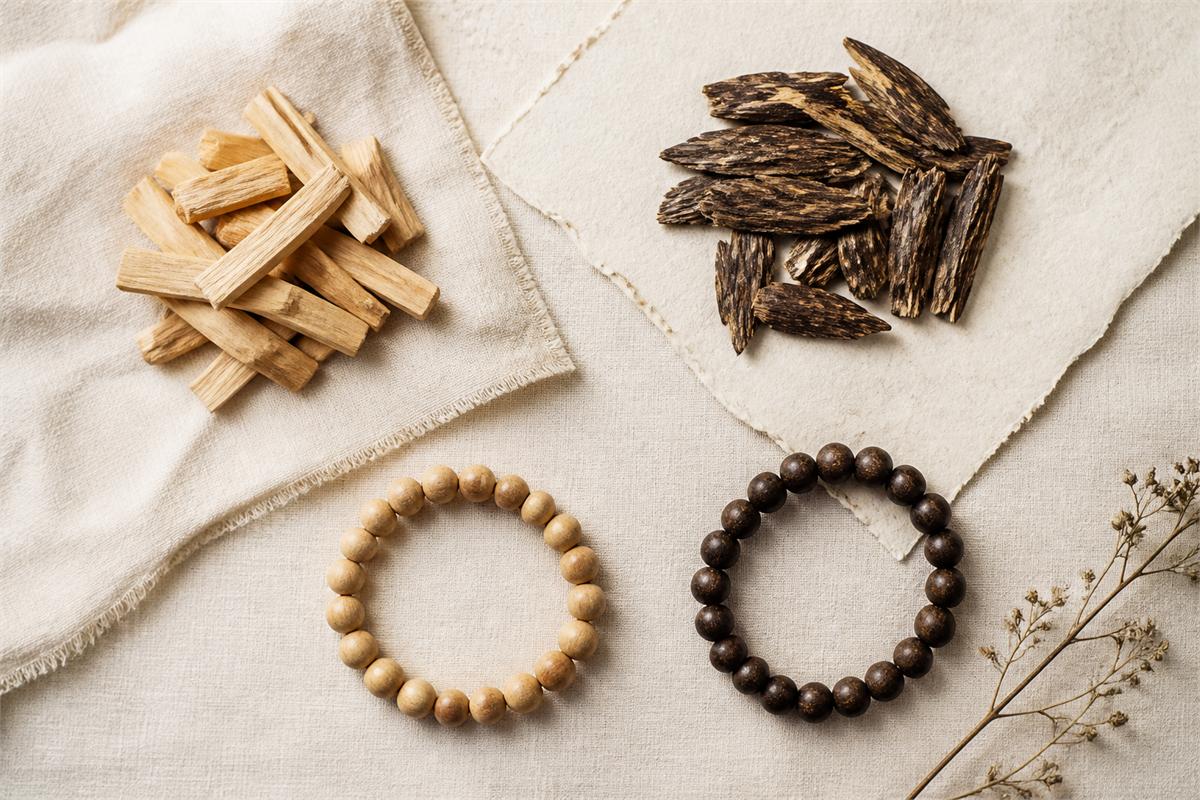
Trade names such as “old mountain sandalwood,” “new mountain sandalwood,” Tonga sandalwood, Fiji sandalwood, and Timor sandalwood are used inconsistently. They can reflect regional trade history or a seller’s scent and quality grouping, but they do not create an automatic equation between place, species, age, and grade. The most helpful listing connects the name to a species, source, product form, and clear ingredient statement.

Agarwood: resin develops through a defense response
Agarwood is not the ordinary pale wood of every tree called Aquilaria or Gyrinops. In suitable species, physical damage, insects, weather, microbial activity, and other stresses can trigger defense pathways that deposit aromatic resin in particular areas. The result is a wood-and-resin material, often appearing as darker veins or patches among lighter tissue. Formation is complex and variable; it is not a universal “fungus aging for decades,” and a single named fungus does not explain every piece.

Agarwood can form naturally, and it can also be induced in cultivated trees through carefully managed wounding, biological inoculation, chemical induction, or combined methods. Cultivated or induced material is not automatically false, while “wild” is not automatically superior or lawful. Resin distribution, scent, processing, and traceable origin still need to be considered.
Chinese guanxiang (莞香) is closely associated with Aquilaria sinensis and the incense history of southern China. Hui’an and Sin Chew—or Xingzhou—are broad market systems rather than botanical grades: they can group material by historic trading routes, regions, scent tendencies, and customary cutting or grading practices. Qi’nan or kinam (奇楠/棋楠) is even less uniform across Chinese, Japanese, and commercial usage. It may describe an exceptional sensory category, particular texture and resin behavior, a named cultivated lineage, or a sales label. None of these names alone proves species, wild origin, age, or value.

Sandalwood vs agarwood smell
Sandalwood often begins where it continues: rounded wood, gentle sweetness, soft spice, and a creamy impression. Indian sandalwood is commonly sought for a rich, smooth profile, while S. spicatum may present a drier, nuttier, or more openly woody character. Species, heartwood oil, age, distillation, storage, and any added ingredients can all alter the result.
Agarwood is more changeable. A chip warmed gradually may begin with a cool or green lift, move toward honey, dried fruit, flowers, leather, old books, herbs, or balsamic wood, and finish darker. Another piece may follow a completely different path. Higher heat can emphasize smoke and char while hiding delicate opening notes. This is why enthusiasts often describe agarwood as something to “listen to”: attention follows the aroma as it moves.

These descriptions are a vocabulary, not a promise. “Milky,” “cool,” “medicinal,” and “sweet” are sensory impressions rather than ingredients, and individual perception varies. Compare products in the same form, in the same ventilated room, and at a similar concentration. Smelling a bracelet beside burning incense, or comparing a perfume accord with a raw chip, tells you more about product form than about the woods themselves.
Sticks, chips, oils, beads, and carvings are different experiences
Incense sticks
An incense stick is a formula, not a raw-wood test. It may combine sandalwood or agarwood powder with binder, other botanicals, charcoal, or added fragrance. Sandalwood works beautifully as a warm base in blended incense; agarwood may be used more sparingly to add resinous depth. Choose a clearly described formula intended for burning, and let scent preference—not ash shape, ash temperature, or a dramatic “all-natural” claim—guide a careful trial.

Chips and powder
Chips bring the material itself closer to the foreground. Sandalwood chips often release a continuous warm aroma; resinous agarwood chips may change noticeably as different areas heat. Powder exposes more surface area, so it releases aroma and burns differently from a chip. Grind, humidity, packing, resin level, and heating method all matter. Follow the burner and material maker’s directions instead of relying on one fixed temperature or weight for every species and grade.

Sandalwood essential oil and agarwood oud oil
Sandalwood essential oil is distilled from aromatic wood, while natural agarwood oil—often called oud oil—is distilled or otherwise extracted from resin-bearing material. In perfumery, “oud” can also mean a blended accord that recreates an agarwood impression without natural agarwood. Read whether a product is a pure oil, diluted preparation, fragrance blend, or finished perfume.

Concentrated oils require product-specific handling. Do not swallow them or apply an undiluted oil directly to skin. Use only in a compatible diffuser or topical preparation and follow the finished product’s directions. A traditional medical record is not a home-treatment instruction, and fragrant wood or oil should not replace care for anxiety, insomnia, breathing problems, skin conditions, or other health concerns.
Bracelets, pendants, and carvings
In jewelry and small carvings, fragrance becomes part of touch and memory. A sandalwood bracelet may offer smooth grain and quiet warmth; an agarwood bracelet may show localized resin and a gentler unheated aroma. Round beads, barrel beads, flatter beads, 108-bead strands, pendants, and small auspicious carvings can be chosen for comfort, personal aesthetics, prayer, or as a gift carrying wishes for peace, clarity, and harmony.

Weight, dark color, visible lines, warmth from rubbing, sinking in water, or a photograph cannot authenticate a bracelet or prove wild origin, age, region, or grade. Avoid scraping, burning, soaking, solvent tests, and other destructive home experiments. For form-specific guidance, visit the sandalwood bracelet guide and agarwood bracelet guide.
Which is more expensive, agarwood or sandalwood?
Agarwood is usually more expensive than sandalwood when comparable finished forms and quality levels are considered. Resin formation is irregular, fragrant sections may represent only part of the harvested wood, sensory grading is complex, and rare profiles attract strong demand. Sandalwood also requires mature aromatic heartwood and responsible forestry, but its fragrance is distributed more predictably through usable heartwood.
There is no responsible universal price table for “sandalwood versus agarwood.” A $30 blended incense box, a $300 bracelet, a small vial of oil, and raw wood sold by weight are different products. Current prices also depend on species, net material weight, resin or oil content, formulation, workmanship, legal source, seller margin, and market date. Exceptional auction figures do not describe ordinary retail material, and price alone cannot prove identity or quality.
For a useful comparison, match like with like: stick against stick with ingredients and net weight disclosed; bracelet against bracelet with bead dimensions and construction stated; oil against oil with volume, concentration, extraction, and carrier described; chip against chip with species and source information. Small samples are often the kindest first step. They let you learn what brings ease, focus, or a sense of welcome to your own space before committing to a larger object.

Sourcing and conservation are part of the choice
All species of Aquilaria and Gyrinops are listed in CITES Appendix II. Depending on the species, product, source, exemption, and countries involved, international movement may require CITES permits and compliance with national import and export rules. Appendix II does not mean that every item is banned; it means that international trade is controlled. Requirements can differ for chips, oil, powder, finished products, personal effects, and commercial shipments, so buyers and travelers should check the current rules of the exporting and destination countries before moving material across a border.
Sandalwood supply chains also deserve care. Santalum album and S. spicatum are different species with different growing regions and management systems, and some sandalwood populations have faced overharvest and illegal trade. Choose lawful, traceable material with a stated botanical identity and origin where possible. Cultivated sources can offer a meaningful path toward enjoying fragrant woods without making rarity the object of desire.
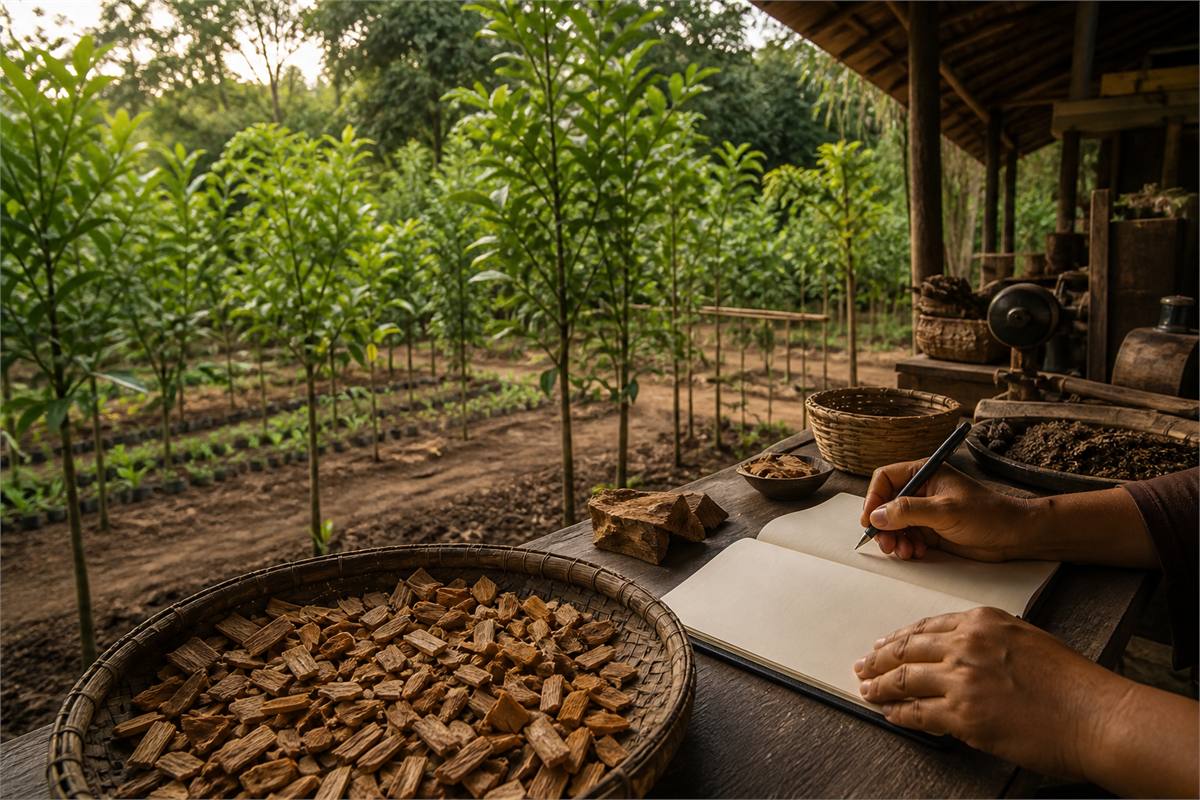
Be cautious when a seller uses “Mysore,” “old mountain,” “Hui’an,” “Sin Chew,” “wild,” “sinking,” or “kinam” as if the word settles every question. No color, aroma note, water test, grain pattern, weight, touch, photograph, or place name can independently establish all of species, legality, natural formation, age, and grade. A responsible choice rests on a coherent description, traceable supply chain, and a seller willing to distinguish fact from market vocabulary.
Which aromatic wood should you choose?
- Choose sandalwood when you want a warm and steady background for tea, reading, reflection, welcoming guests, or a meaningful everyday gift.
- Choose agarwood when you enjoy a quieter, changing aroma and want to spend time noticing how a small amount unfolds.
- Choose a blend when sandalwood’s continuity and agarwood’s resinous depth create the atmosphere you love. There is no universal ratio; use a professionally formulated product or compare small amounts safely.
- Choose a bracelet or carving when touch, craftsmanship, symbolism, and the wish carried by the object matter more than filling a room with scent.
- Choose samples first when you are still learning. The fragrance that helps a room feel cared for—and makes you want to return to that quiet moment—is the right beginning.

There is no evidence-based rule that sandalwood must be used by day and agarwood by night. Both can accompany meditation, tea, reading, prayer, or a calm pause when their scent and product form suit the person and setting. What matters is the life moment you hope to shape: warmth for a shared table, clarity for a new beginning, peace after a busy day, or a thoughtful gift that carries the wish ping’an ruyi (平安如意)—peace and fulfillment.

Safe use and practical care
When burning incense
Use a stable, purpose-made, heat-resistant holder on a noncombustible surface. Keep continuous ventilation, start with a modest amount, and place smoke away from faces and shared breathing zones. Keep incense and hot equipment away from children, pets, paper, curtains, loose clothing, and other combustibles. Never leave it burning when nobody is present or while anyone is asleep. Confirm that the ember is fully extinguished and the holder is cool before moving or cleaning it. Eastern Story’s incense lighting guide covers the full sequence.

People with asthma, smoke sensitivity, or other respiratory concerns may find any incense smoke uncomfortable. A smoke-free ritual—a beautiful unlit object, a scent journal, tea, music, or quiet breathing without fragrance—can carry the same intention. In a home shared with animals, give them clean air and a way to leave; the incense and dogs guide explains additional precautions.
For wood, beads, carvings, and oil
Keep raw wood and finished objects away from prolonged direct sun, high heat, and strong neighboring odors. Store dry chips or powder in clean, labeled containers; never seal damp material. Whether beads tolerate brief contact with water depends on the species, finish, adhesive, inlay, cord, and construction, so follow the maker’s care instructions. Remove jewelry before swimming, bathing, cleaning, or using products that may affect wood, coatings, or string.
Separate storage is useful when two objects have strong, different scents, but it is not a universal rule that every sandalwood and agarwood item must always be isolated or airtight. A dry, clean box or pouch that protects the specific object from abrasion and unwanted odor is often enough. Keep oil bottles tightly closed, upright, away from heat and light, and use them only as their finished labels direct.

Two fragrant woods, two ways of making space for meaning
Sandalwood offers rounded warmth and continuity; agarwood offers resinous depth and surprise. Their botanical sources, formation, scent behavior, product forms, prices, and trade responsibilities are different enough that one should never be treated as a simple upgrade from the other.
Choose by the experience you hope to welcome. A softly scented sandalwood bracelet can accompany an ordinary workday; a small agarwood chip can turn a tea session into close listening; an unlit carving can hold a wish for peace without adding smoke to the room. They express a wish—a medium through which people hope to bring about wealth, health, virtue, longevity, or a specific outcome in life. The most meaningful choice is lawful, thoughtfully made, safe for its setting, and able to become part of a life lived with care.
Frequently Asked Questions
Related Posts


0 Comments