
The White Tiger, Baihu (白虎), symbolizes courageous protection, righteous strength, and the wish for peace. In Chinese mythology, it is the western guardian of the Four Symbols (四象), associated with autumn, the Metal phase, the color white, and seven western lunar mansions. Its appeal is the strength to face difficulty while protecting what matters: home, loved ones, personal principles, and a hopeful future.
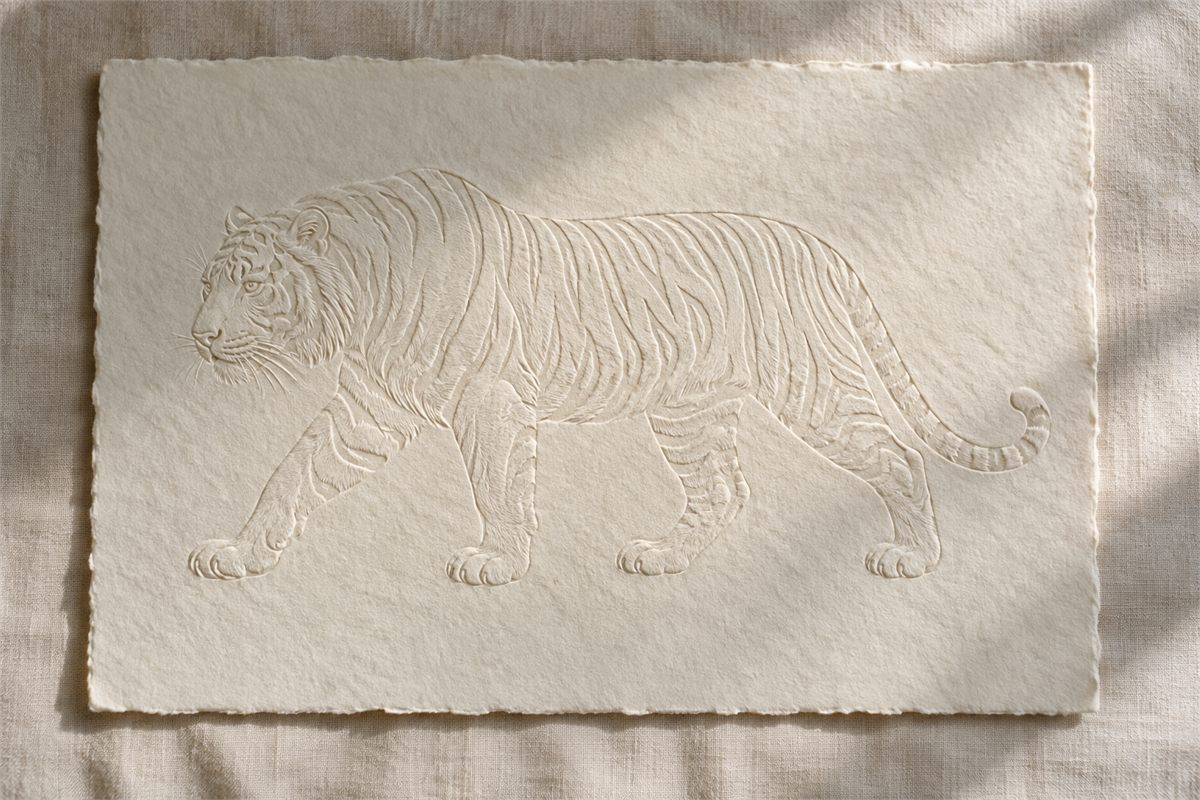
A White Tiger pendant or meaningful object can carry that wish into a new chapter. It may celebrate a promotion, accompany someone leaving home, or express a simple, heartfelt blessing: May you move forward bravely and return in peace. Behind this intimate message is a story that stretches from the stars to temple guardians, household crafts, and contemporary design.
What does Baihu mean? Courage with a protective heart
Baihu brings together qualities that can seem different at first: fierce resolve and a caring purpose. Its martial presence expresses the courage to stand firm, defend a boundary, and act with integrity. Its protective role gives that courage a direction. Strength becomes something used in the service of people and principles worth keeping safe.
This makes the White Tiger especially meaningful when life asks for composure: taking on responsibility, beginning again after a difficult period, completing a demanding project, or learning to speak with confidence. In modern gift language, it carries a wish for clear judgment, steady energy, and the courage to follow through.

Auspicious strength and the wish for peace
The White Tiger also has an auspicious side. In the Book of Song, traditions of favorable omens connect a benevolent white tiger with a ruler who avoids cruelty. The image joins authority with compassion and imagines a world where power supports peaceful life. That is a beautiful strand of Baihu symbolism to carry into a gift: firmness joined with kindness, and the hope that good order allows people to flourish.
In Eastern protective symbolism, a tiger image is chosen to welcome safety and ward off harmful influences. A Baihu gift can therefore express ping’an ruyi (平安如意), a wish for peace and for life to unfold as hoped. For someone building a home, career, or family, its guardian presence can hold both determination and tenderness.

Why the White Tiger belongs to the west, autumn, and Metal
The Four Symbols organize the sky into four great directional guardians. Baihu stands in the west, opposite the Azure Dragon, Qinglong (青龙), in the east. The Vermilion Bird, Zhuque (朱雀), belongs to the south, and the Dark Warrior, Xuanwu (玄武), usually shown as a tortoise entwined with a snake, belongs to the north.
| Guardian | Direction | Season | Five Phases correspondence |
|---|---|---|---|
| Azure Dragon — Qinglong (青龙) | East | Spring | Wood |
| Vermilion Bird — Zhuque (朱雀) | South | Summer | Fire |
| White Tiger — Baihu (白虎) | West | Autumn | Metal |
| Dark Warrior — Xuanwu (玄武) | North | Winter | Water |
Within Wuxing (五行), the Five Phases, west, autumn, Metal, and white belong to the same network of correspondences. This is why Baihu is “white.” The name carries a place in the cosmos as well as a visual identity. A bronze, dark-stone, or ink-drawn tiger can still represent Baihu when its surrounding figures, inscription, or design establish the western guardian.

Autumn gives this symbolism much of its feeling. Harvest brings gathering and completion; pruning makes room for what comes next. Metal evokes a clear edge, resolve, and the ability to shape and refine. Read as a personal aspiration, the White Tiger encourages someone to gather their strength, finish what matters, and make room for a more settled life. Its Metal association can enrich a wish to protect hard-earned prosperity, while its central story remains courageous guardianship.

Related traditional groupings have their own identities. “Four Spirits” can refer to the dragon, phoenix, Fenghuang (凤凰), tortoise, and Qilin (麒麟) in the Book of Rites. Some five-direction schemes place the Yellow Dragon, Huanglong (黄龙), at the center with Earth. The familiar Four Symbols remain the four directional guardians shown above.
Baihu’s seven western lunar mansions
Baihu’s celestial story begins with the twenty-eight lunar mansions (二十八宿), arranged in four groups of seven. The traditional western sequence is Kui, Lou, Wei, Mao, Bi, Zi, and Shen: 奎、娄、胃、昴、毕、觜、参. Together they give the western guardian a home in the sky.
A lunar mansion is a division of the sky associated with a named star pattern, or asterism. The same name can refer to that principal asterism within the larger division. The counts below describe those principal patterns in the traditional Song of the Sky Pacers star-counting tradition; each wider mansion contains additional stars and asterisms.
| Mansion, in traditional order | Principal asterism | A familiar part of the modern sky |
|---|---|---|
| 1. Kui (奎), “Legs” | 16 stars | Stars spanning Andromeda and Pisces |
| 2. Lou (娄), “Bond” | 3 stars | Aries |
| 3. Wei (胃), “Stomach” | 3 stars | Aries |
| 4. Mao (昴), “Hairy Head” | 7 traditional stars | The Pleiades star cluster, M45, in Taurus |
| 5. Bi (毕), “Net” | 8 stars | The Hyades region and Aldebaran in Taurus |
| 6. Zi (觜), “Turtle Beak” | 3 stars | The small group around the head of Orion |
| 7. Shen (参), “Three Stars” | 7 principal stars | Orion, including its three Belt stars |
The seven mansions are more expansive than seven isolated stars. Mao offers a particularly lovely example: its traditional seven-star pattern lies in the Pleiades, a physical star cluster containing many more members. Bi includes Aldebaran, known as Bishu Wu (毕宿五), which appears near the Hyades from Earth but is a foreground star. Shen includes the three bright stars of Orion’s Belt within its larger seven-star pattern.
Artists have imagined different parts of the celestial tiger in these groups. A painted tail, head, or shoulder follows a particular diagram or artistic tradition; the mansion sequence gives a more dependable way to recognize the western group than a single fixed outline of the animal.

Finding a little of Baihu in the night sky
For many observers at northern mid-latitudes, winter evenings offer an inviting starting point: find Orion’s three Belt stars, then look toward Taurus for reddish Aldebaran and the small, close gathering of the Pleiades. A star chart set to your location and time will help you continue toward Aries, Pisces, and Andromeda. Baihu’s traditional western identity stays the same as its stars rise, cross the sky, and set.
The Moon takes about 27.3 days to complete an orbit relative to the distant stars. The traditional mansions helped observers describe its changing position, but their widths differ, so its passage is not an exact one-mansion-per-night schedule. This sky story adds a quiet romance to Baihu: a guardian imagined across stars that people can still seek together.

When the stars become stories
Later stories give star spirits vivid personalities. In Journey to the West, Kui Mu Lang (奎木狼), the Wood Wolf of Kui, appears as the Yellow-Robed Demon. The star official Mao Ri Xingguan (昴日星官), associated with the rooster, helps Sun Wukong (孙悟空) overcome the scorpion spirit. These characters belong to the literary life of the mansions; they add another layer to the pleasure of recognizing a celestial name.
Shen also appears in the poetic pairing Shen and Shang (参商), used for people separated from one another. Its background is the contrasting appearances of the Orion and Antares regions in the night sky. Read as poetry, it speaks to distance and longing, making the sight of familiar stars a moving reminder of someone far away.
From military courage to guardian art
Banners, formation, and the tiger tally
Baihu’s association with disciplined force runs through military symbolism. A traditional formation described in the Book of Rites places the Vermilion Bird in front, Xuanwu behind, the Azure Dragon on the left, and the White Tiger on the right. Such imagery links courage with coordination and shared order. The guardian has a defined place within a larger whole.
The tiger tally, hufu (虎符), offers a related image of authority. A tally was divided into two matching halves, held by the relevant parties and brought together to validate a command. Surviving tiger-shaped examples show how naturally the animal expressed military power. A hufu is identified by its role as a tally; a tiger shape alone does not establish that it depicts the celestial Baihu.

A guarded world in tombs, tiles, and mirrors
In historic funerary art, directional guardians surround a protected space. White Tiger images on tomb walls, coffins, and burial objects express the wish that the deceased should rest within an ordered and sheltered world. Seen alongside the other guardians, the tiger becomes part of a larger picture of care extending beyond a single lifetime.
Roof-tile ends bring this expansive symbolism into a compact circle. Han examples curl an energetic animal within the edge of the tile; mirrors and other decorated objects can gather the guardians around a shared center. Clouds, stars, and companion creatures help tell the story. The tiger’s stretched body or turned head can convey alertness even in a very small design.

A small Northern Song porcelain Baihu in the Metropolitan Museum of Art dates to the 11th century. Its bluish-white glaze gives the western guardian a quiet, luminous presence. Such objects show how a commanding symbol can also feel composed and intimate, an enduring inspiration for meaningful objects today.
Jianbing Shenjun, the Daoist guardian
In Daoist tradition, Baihu is known as Jianbing Shenjun (监兵神君), a divine guardian associated with military oversight. Paired with Qinglong’s Mengzhang Shenjun (孟章神君), this presence can take the form of a protective general at a temple entrance. The celestial tiger and the personified guardian share a religious connection, expressed through the setting and imagery of the temple.
In traditional feng shui, the dragon and tiger also lend their names to flanking forms that shelter a site. “Azure Dragon on the left, White Tiger on the right” is understood from the orientation used in that setting. In a modern home, a Baihu object can simply be given a stable, uncluttered place where its story feels welcome: a shelf beside treasured books, a study, or a quiet display of meaningful pieces.

White Tiger, zodiac Tiger, folk guardian tiger, and Tiger Lord
Tiger imagery carries several kinds of meaning. Knowing the story behind a piece helps you choose a gift that says what you intend. A celestial guardian can honor resolve, a zodiac tiger can celebrate someone’s birth sign, and a soft cloth tiger can hold a family’s wish for a child’s safe growth.
| Tiger image | Cultural home | Meaning to carry into a gift |
|---|---|---|
| Baihu (白虎) | Four Symbols, western stars, autumn, Metal | Courageous guardianship, integrity, and peaceful strength |
| Zodiac Tiger (生肖虎) | Third animal of the twelve-year zodiac cycle; Yin (寅) branch | Vitality, bold beginnings, and a personal connection to a birth sign |
| Folk guardian tiger | Household crafts, protective images, and local customs | Family care, vitality, and wishes for safe growth |
| Tiger Lord — Hu Ye (虎爷) | Temple and folk devotion, especially in Taiwan and Southeast Asian communities | Protection and blessings within a particular local religious tradition |
| Natural tiger or zoological white tiger | Wildlife, animal portraiture, and animal-inspired design | Love of the animal, nature, and its strength |
The zodiac Tiger is third in the twelve-animal sequence. Its Yin (寅) Earthly Branch is associated with Yang Wood and the traditional 3–5 a.m. time period. Here, Yin is the name of the branch 寅. These are different correspondences from Baihu’s western Metal identity, allowing each tiger story to retain its character.

Folk tiger imagery feels close to family life. Tiger-head hats and shoes (虎头帽、虎头鞋), tiger pillows, and cloth tigers (布老虎) turn a powerful animal into a companion for children. Their bold eyes, lively faces, and protective expressions carry the hope that a child will grow with health, courage, and affection. An embroidered tiger face can hold that wish whether or not it refers to the Four Symbols.

Hu Ye, the Tiger Lord, has a temple identity of its own. Local accounts describe a tiger serving or protecting a deity, with devotees seeking blessings through that relationship. A small carved tiger sold as a Tiger Lord should be understood through that story and its maker’s description. Eastern guardian-beast traditions contain many such distinct figures, each with a particular way of expressing protection.

Is Baihu the same as a real white tiger?
The mythological White Tiger and the white-coated animal share a striking image, but their explanations are different. Baihu’s white color belongs to directional and seasonal symbolism. A living white tiger’s coat comes from inherited pigmentation.
A 2013 genetics study identified a recessive change in SLC45A2 behind the familiar white tiger coloration. These tigers retain dark stripes and typically have blue-toned eyes; they are a color variant rather than a separate species or subspecies. White coloration by itself does not make survival in the wild impossible.

Mohan, a white tiger captured in India on May 27, 1951, became an important founder in captive white-tiger breeding. The 2013 study described 1958 as the year the last known free-ranging white tiger was shot. Close-relative breeding can introduce serious health problems, which should be distinguished from the coat-color variant itself.
For someone who loves the animal as well as its stories, tiger imagery can carry a further wish: that living tigers have protected habitats, prey, and room to thrive. This affection for wildlife sits naturally beside the cultural admiration of courage and guardianship.
White Tiger jewelry: a small companion for a brave chapter
A Baihu pendant, bracelet charm, ring, or engraved plaque can be chosen to welcome courage and protective energy. The design may be poised and powerful, or softened into a small, rounded companion. What gives it emotional weight is the relationship between its story and the person who carries it.
Three ways to express the guardian’s character
Quiet light. A white, silver, and gray palette can echo Baihu’s western color. Transparent clear quartz or the soft glow of a moonstone bracelet creates a gentle setting for a small tiger charm. Paired with linen, a plain shirt, or an understated dress, the guardian becomes a subtle part of everyday life.

Warm resolve. Gold tones against dark beads create a more sculptural presence. A tiger eye bracelet brings a moving band of light, while obsidian offers a deep, glossy background. Amber-toned warmth can carry another mood; an amber bracelet feels especially suited to someone drawn to earthy color and a sense of continuity.

Affectionate playfulness. A resting tiger, rounded face, or miniature figure can make the guardian feel approachable. Enamel coloring can pick out its stripes, while a brushed or polished finish changes the way light moves over the form. A stylized hat or a pearl-like accent belongs to the particular design; the maker’s account explains whether it refers to Baihu, a temple figure, or an imaginative animal character.

Silver, gold, stone, and colored finishes give a piece its appearance. Sterling silver contains 92.5% silver, often expressed as 925. The Metal phase gives Baihu its cultural correspondence. You can choose the material and palette that feel right for the recipient while keeping the blessing centered on courage, care, and a steady heart. For a piece worn often, a comfortable size and secure attachment help it become a familiar companion; follow its material-specific care instructions.
Animal jewelry and Baihu have different design stories
A tiger in contemporary jewelry may celebrate the animal itself. Cartier’s Nature Sauvage collection, for example, includes a Tigre design using yellow, orange, brown, and white diamonds with onyx. Its Panthère designs depict a panther. These are distinct animal subjects; a Baihu piece adds the particular story of the western celestial guardian.
Meaningful White Tiger gifts, from a pendant to a place at home
Begin with the person and the moment you want to honor. Someone accepting a challenging role may love a poised tiger charm. A friend setting up a home may prefer a small sculpture. A person who watches the stars may feel closest to the seven-mansion story. The same guardian can carry a different, personal message in each relationship.
| Life moment | A thoughtful form | A message for the gift |
|---|---|---|
| A new role, graduation, or ambitious project | Pendant, bracelet charm, or a small desk sculpture | May you meet each challenge with courage and clear judgment. |
| A move or a first home together | Baihu sculpture, framed artwork, or a Four Symbols display | May this home welcome peace, warmth, and good fortune. |
| A hard-won completion or retirement | A carefully chosen ceramic or keepsake | May what you have built bring a peaceful and fulfilling next chapter. |
| A loved one leaving home or beginning again | A small wearable or keepsake chosen for their style | May courage travel with you, and may you always find a place of peace. |
| A friendship built around art or the night sky | A star-pattern scarf, print, or beautifully illustrated object | May we keep finding wonder beneath the same stars. |

Objects that make the story personal
A sculptural Baihu inspired by historic tile or relief designs can bring an alert, protective presence to a study. A tiger-painted tea cup or lidded tea bowl can connect the blessing to a shared daily ritual. A ceramic panel, ink drawing, or star-pattern textile offers a quieter way to live with the image, especially for someone who enjoys art more than jewelry.

Playful gifts have their own warmth. A model to assemble can turn the exchange into time spent together; a plush tiger or bag charm can make a brave companion feel affectionate. A textile or toy chosen for a child should suit the child’s age and use. A family keepsake can also be displayed by an adult as a lasting wish for the child’s well-being.
Tibetan objects carry their own traditions. Thangka painting is a religious art form, and a gau or gawu (嘎乌) is a portable shrine or reliquary. A tiger design on a small painting or metal case needs its own cultural description. For a Baihu gift, choose an object whose stated story connects clearly with the western guardian you wish to celebrate.
A tiger paired with a lu lu tong (路路通) bead can bring together protective courage and a wish for open paths ahead. This jewelry combination gives the gift a personal message of progress and opportunity.

A few personal words can make the choice memorable: “For your courage, and for everything you protect.” Or add ping’an ruyi (平安如意): “May you live in peace, and may your hopes unfold beautifully.” The White Tiger offers a strong form for a tender intention.
Frequently Asked Questions
Carry courage, welcome peace
Baihu’s story holds a beautiful balance: the resolve to meet life fully and the wish to keep what is precious safe. Whether kept close to the heart or given a place at home, the White Tiger can accompany a hope for brave beginnings, meaningful completion, and a peaceful future. Explore Eastern Story’s blessing collection for objects that carry your own wishes, stories, and care.

Related Posts


