
Chinese guardian beasts are not one fixed team of magical animals. They belong to several overlapping traditions: celestial symbols that organize direction and season, auspicious creatures associated with ethical rule, tomb and architectural guardians, judicial emblems, and later folk or commercial symbols used in jewelry and home décor. Understanding the difference between these traditions makes Qinglong, Baihu, Zhuque, Xuanwu, Bixie, Pixiu, Qilin, Baize, and Xiezhi far more meaningful—and prevents modern product lore from being mistaken for ancient scripture.
In Chinese, the verb phrase bixie (辟邪) means to ward off harmful or inauspicious influence. It can describe an intention, the function of an object, or the name given to a particular winged guardian beast. That flexibility is one reason English guides often collapse very different creatures into a single “protection animal” category. This guide keeps their histories, visual forms, and modern uses distinct.
Chinese Guardian Beasts at a Glance
| Tradition or creature | Primary historical context | Central idea |
|---|---|---|
| Four Symbols: Qinglong, Baihu, Zhuque, Xuanwu | Astronomy, direction, season, tomb imagery, cosmology | Ordered space and time |
| Bixie and Tianlu | Winged beasts in tomb art, stone carving, textiles, fittings, and later decorative arts | Guardianship, auspice, authority |
| Pixiu | An old animal name with a complex relationship to later guardian-beast imagery and modern wealth symbolism | Fierceness in early texts; wealth and protection in popular modern culture |
| Qilin | Classical auspice, ethical rule, court and decorative art | Benevolence, sagely birth, peaceful government |
| Baize | Medieval demonography, illustrated texts, protective images | Knowledge of strange beings and dangers |
| Xiezhi | Legal legend, official dress, judicial symbolism | Discerning right from wrong |

What Are Chinese Guardian Beasts?
A Chinese guardian beast may protect a direction, a tomb, a gate, a moral principle, a household, or a person’s symbolic intention. The word “guardian” is therefore a useful English umbrella, but it is not the name of a single ancient category. A creature painted on a tomb ceiling does not necessarily perform the same role as an animal carved on a pendant, placed on a spirit road, embroidered on an official robe, or modeled as a roof ornament.
In ritual and funerary art, protection often meant placing the deceased, building, or community within a properly ordered cosmos. Fierce faces, horns, wings, claws, and powerful bodies could mark a threshold and express vigilance. Auspicious creatures conveyed a different but related hope: that virtue, wise government, family continuity, or peace would make favorable conditions visible.

Modern jewelry and décor preserve these older associations while adding new ones. A Pixiu bracelet may now be chosen as a reminder to manage resources; a Qilin carving may express benevolence and family blessing; a Xiezhi desk object may represent integrity in legal or public service. Their role is cultural, decorative, and reflective: they give values and good wishes a visible form, while real decisions and outcomes remain grounded in practical action.
The Four Symbols in Chinese Mythology and Cosmology
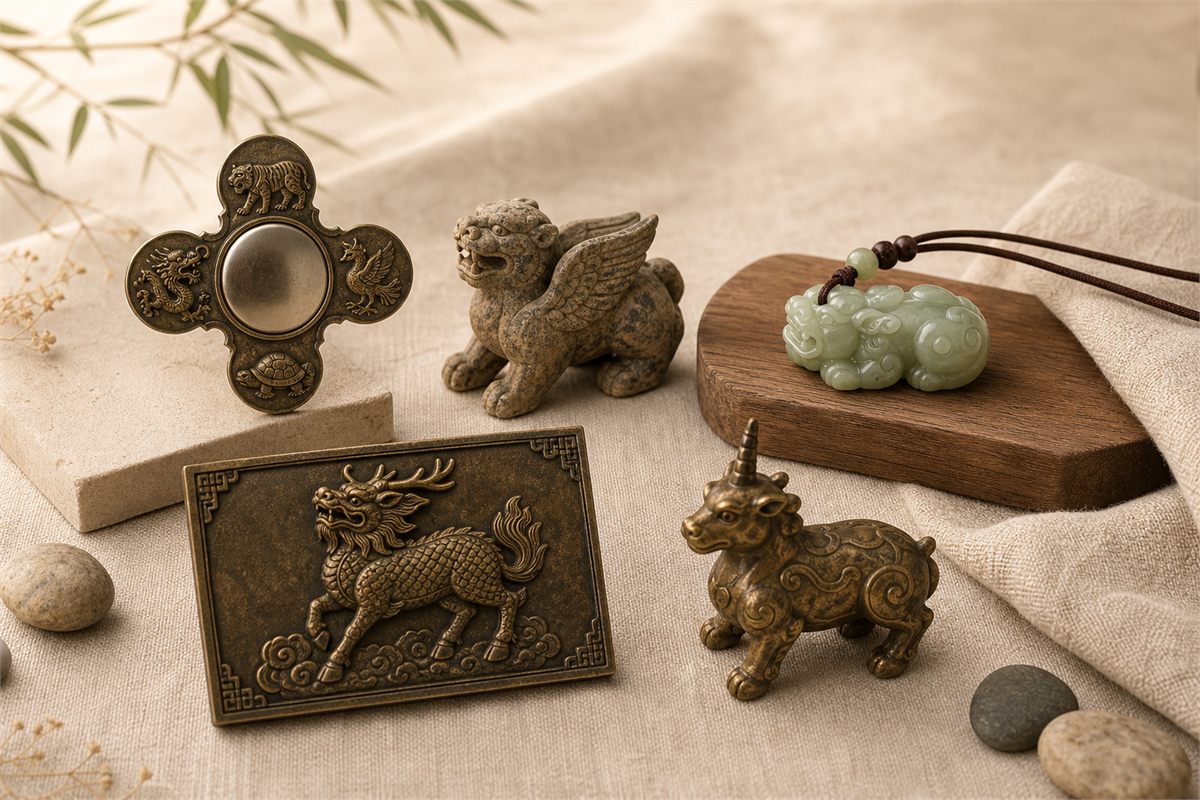
The Four Symbols (四象) are the Azure or Green Dragon of the East, the White Tiger of the West, the Vermilion Bird of the South, and Xuanwu—the Dark Warrior, commonly shown as a tortoise entwined with a snake—of the North. They emerged from ancient Chinese ways of mapping the sky and were used in calendars, cosmology, tombs, mirrors, tiles, paintings, and architectural orientation. A Sui–Tang mirror in The Metropolitan Museum of Art, for example, places the four creatures around the cardinal directions.
| Chinese name | Common English name | Direction | Season | Later Five Phases association |
|---|---|---|---|---|
| Qinglong / Canglong (青龙 / 苍龙) | Azure or Green Dragon | East | Spring | Wood |
| Baihu (白虎) | White Tiger | West | Autumn | Metal |
| Zhuque (朱雀) | Vermilion Bird | South | Summer | Fire |
| Xuanwu (玄武) | Dark Warrior / Tortoise-and-Snake | North | Winter | Water |
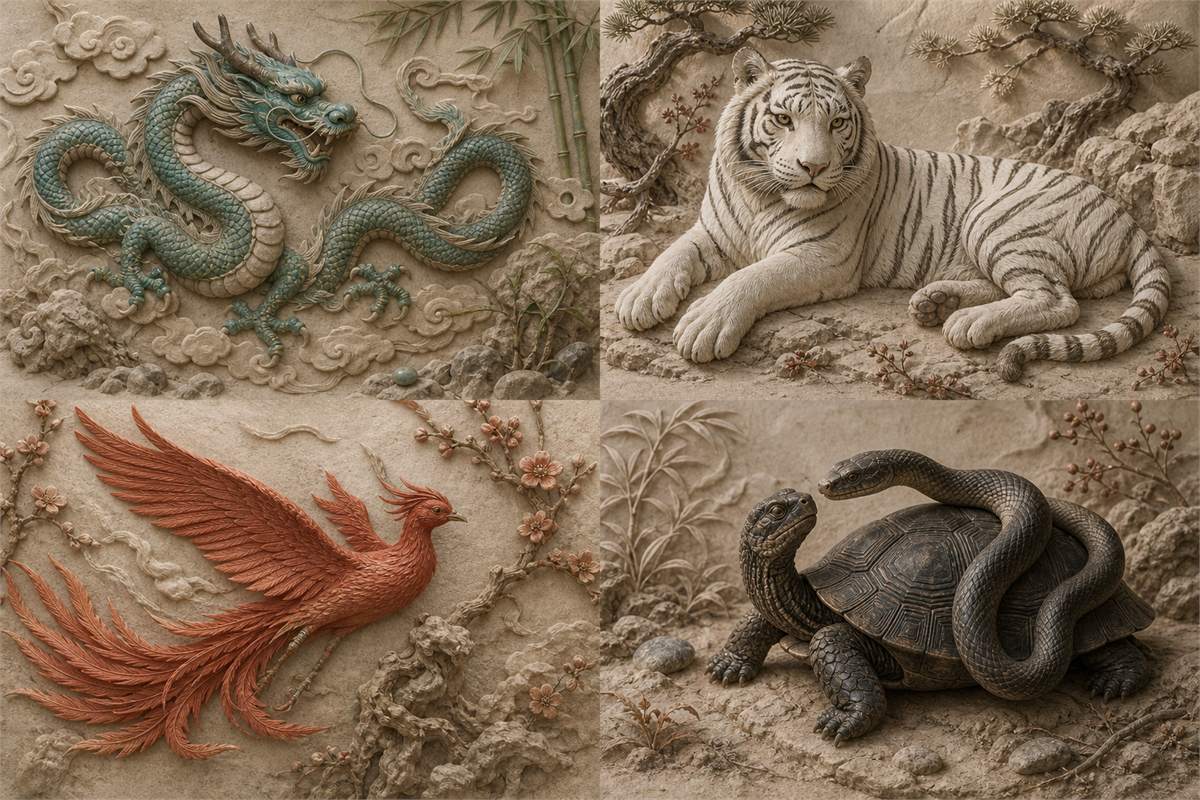
Qinglong, Baihu, Zhuque, and Xuanwu as an ordered sky
Each symbol gathers groups of lunar lodges and gives visual form to a quarter of the heavens. Their appearance in tombs and on objects could situate a person within an intelligible universe: east and renewal, west and completion, south and brightness, north and concealment or endurance. The creatures also accumulated religious and political meanings in later periods, so no single sentence exhausts their history.

The White Tiger’s martial force made it suitable for military and protective imagery, while Xuanwu’s tortoise-and-snake form developed strong associations with northern divinity and longevity. The Azure Dragon became a powerful sign of the east and springtime vitality. The Vermilion Bird represented the southern quarter and should be read first as a celestial directional bird.
Is Zhuque the same as the phoenix?
No. Zhuque and the Chinese phoenix, Fenghuang (凤凰), are both auspicious birds in Chinese art, and later images may share elegant feathers, flames, or southern associations. Their historical identities are nevertheless different. Zhuque belongs to the Four Symbols and the southern sky; Fenghuang has its own mythology of virtue, rulership, harmony, and the realm of birds.
The popular idea that Zhuque or Fenghuang must die in fire and rise from its ashes comes from blending Chinese birds with the Western phoenix. Rebirth can be a valid modern interpretation, but “phoenix rebirth” is not the defining ancient Chinese attribute of Zhuque.
Why the Four Symbols are not personal fortune prescriptions
The Four Symbols are often reduced online to rules such as “place a dragon here for promotion” or “wear a tiger for protection.” That approach misses their original scale. They map cosmic direction and seasonal change; they do not provide a universal formula for grades, helpful patrons, popularity, sleep, or career results. A modern object can honor one quarter of this system, but its meaning is strongest when understood as orientation, balance, and cultural memory.
Are the Four Symbols and the Four Numinous Creatures the Same?
They are not the same set. The Book of Rites describes four numinous creatures—Qilin, Fenghuang, the tortoise, and the dragon. Museum catalogues sometimes translate this group as the Four Numinous Animals, Four Auspicious Animals, or Four Spirits. The Philadelphia Museum of Art identifies the Qilin with the phoenix, tortoise, and dragon in this classical grouping.
By contrast, the directional Four Symbols are the Azure Dragon, White Tiger, Vermilion Bird, and Xuanwu. Dragon and tortoise imagery creates some visual overlap, and modern English labels such as “Four Guardians,” “Four Spirits,” and “Four Sacred Beasts” are often used inconsistently. When the exact set matters, naming all four creatures is clearer than relying on an English group name alone.

Neither set is the Chinese zodiac. The zodiac is a twelve-animal calendrical cycle, explained separately in our Chinese zodiac signs guide. Baize is therefore not a universal “guardian for the Goat zodiac,” and the Four Symbols should not be assigned as personal zodiac guardians without a clearly identified modern system.
Pixiu vs Bixie vs Tianlu: Why the Names Are Complicated
Pixiu (貔貅), Bixie (辟邪), Tianlu or Tianlu/Tianlu written with different historical characters, and older transcriptions such as Taoba or Fuba appear in texts, inscriptions, archaeological catalogues, and modern commerce in ways that do not produce a single family tree. Some writers treat them as names for related winged beasts; others distinguish them by inscription, horn number, function, period, or object type. Modern jewelry sellers often simplify those debates into one market category.

An early textual use of Pixiu does not describe the familiar money-eating figurine. In the Records of the Grand Historian, fierce animal names including Pixiu appear in the account of the Yellow Emperor’s battle. The passage can be read as animals, martial emblems, or poetic names for troops; it does not establish that a modern Pixiu charm is an unchanged prehistoric creature with a fixed anatomy.
The common rule “one horn is Tianlu and two horns are Bixie” is useful when discussing certain catalogued images and tomb sculptures. It is not an infallible identification key. Surviving objects vary, horns may be damaged or stylized, and scholars have used the names differently. The MIHO Museum’s discussion of a mythical winged animal is valuable precisely because it traces inscriptions, older related forms, and Central Asian contact without forcing every example into one modern label.
What belongs to older history—and what belongs to modern Pixiu lore?
- Historically grounded: fierce animal names in early literature; winged quadrupeds in Han and Six Dynasties art; Tianlu and Bixie inscriptions; guardian and status functions in funerary and decorative contexts.
- Common but debated: using horn count as the decisive difference between Tianlu and Bixie; treating Pixiu, Tianlu, and Bixie as exact synonyms.
- Mostly later or modern popular lore: Pixiu as one of the Dragon’s fixed nine sons; a creature that eats only gold and silver; an anatomy with a mouth but no anus; wealth entering but never leaving; a male Tianlu paired with a female Bixie.
Later stories are culturally real because people tell, carve, sell, and wear them. The important distinction is chronology. They should be introduced as popular lore rather than presented as certain facts from remote antiquity. For a focused explanation of the modern wealth symbol, continue with what Pixiu means.

Bixie and Winged Guardian Beasts in Tomb and Stone Art
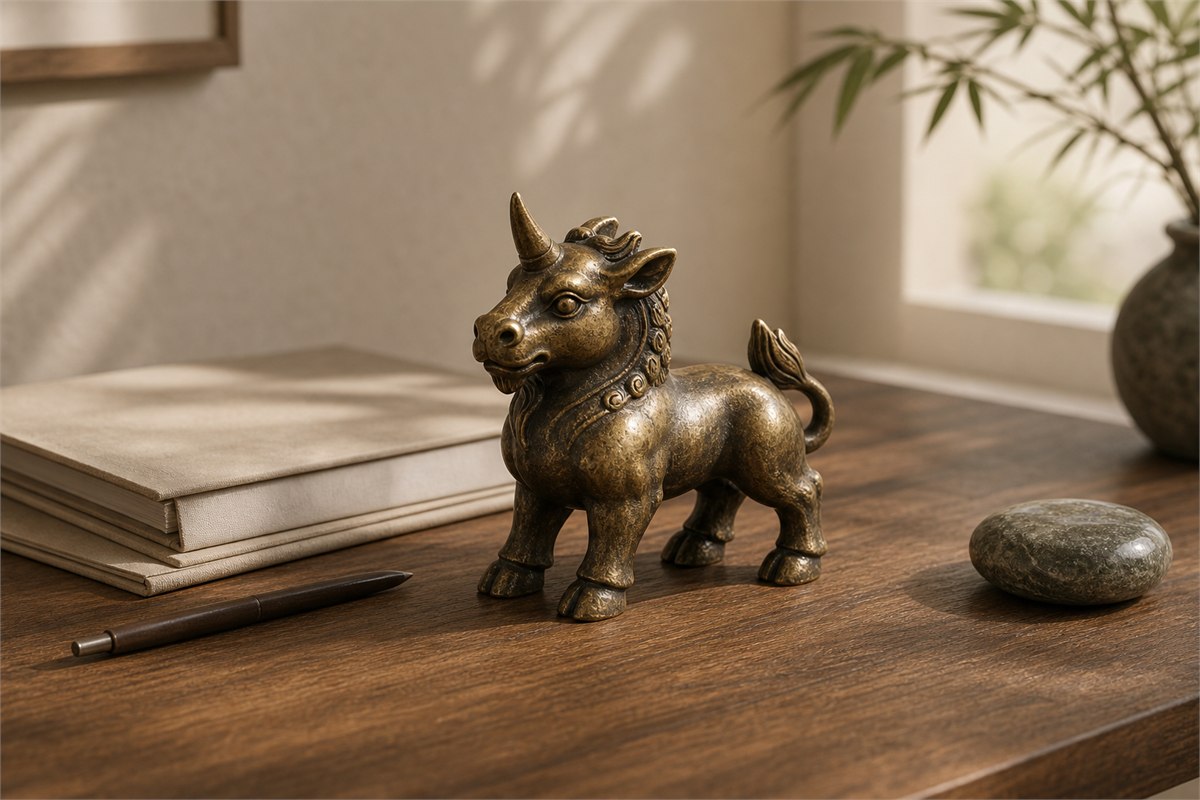
Winged beasts are among the most dramatic forms of Chinese protective art. In Han through Six Dynasties contexts, they appear in stone, ceramic, bronze, jade, and architectural or funerary settings. Large stone animals on spirit roads before elite tombs announced the rank and authority of the deceased while guarding a ceremonial approach. Smaller forms brought the same vocabulary of powerful movement, horns, wings, open jaws, and coiled bodies into intimate objects.
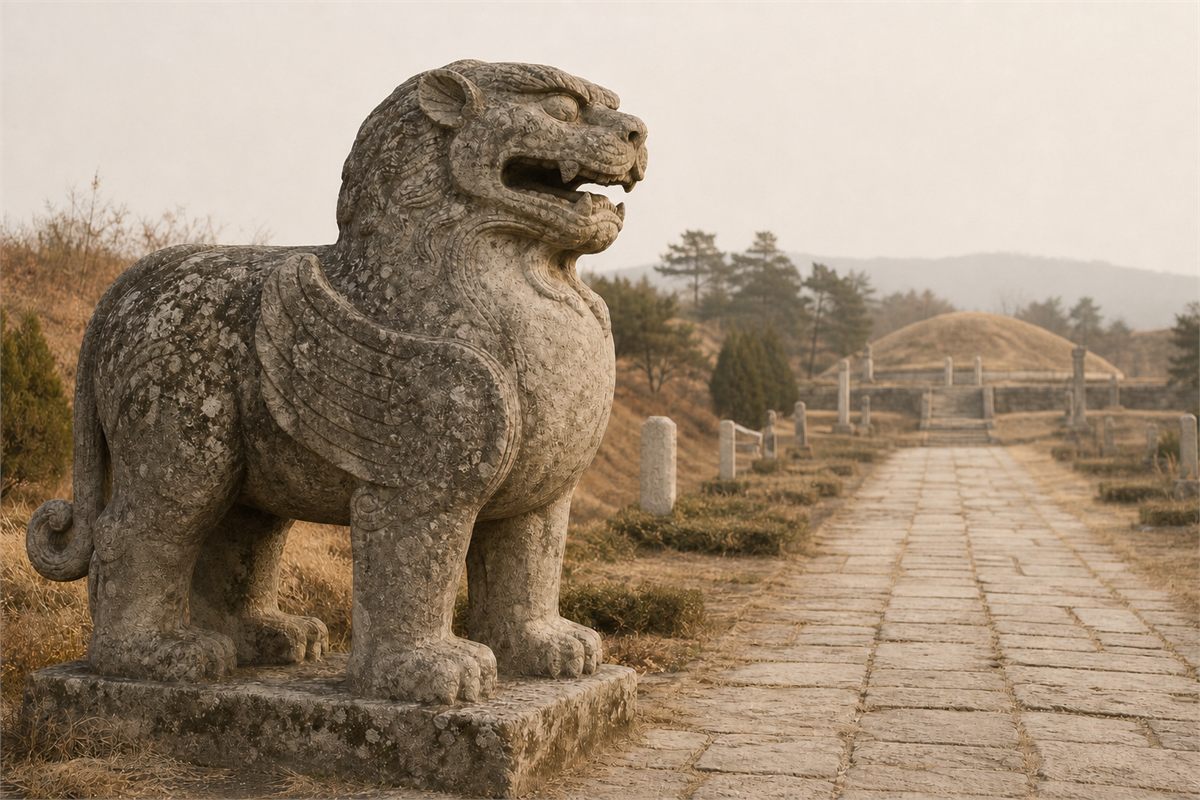
The Henan Museum’s Stone Bixie connects Bixie imagery with tomb sculpture and also notes its use on textiles, banners, belt hooks, seal knobs, and bell knobs. The Cleveland Museum of Art’s Western Jin Bixie-shaped candlestand shows how a guardian-beast form could move from monumental stone into a functional ceramic object.
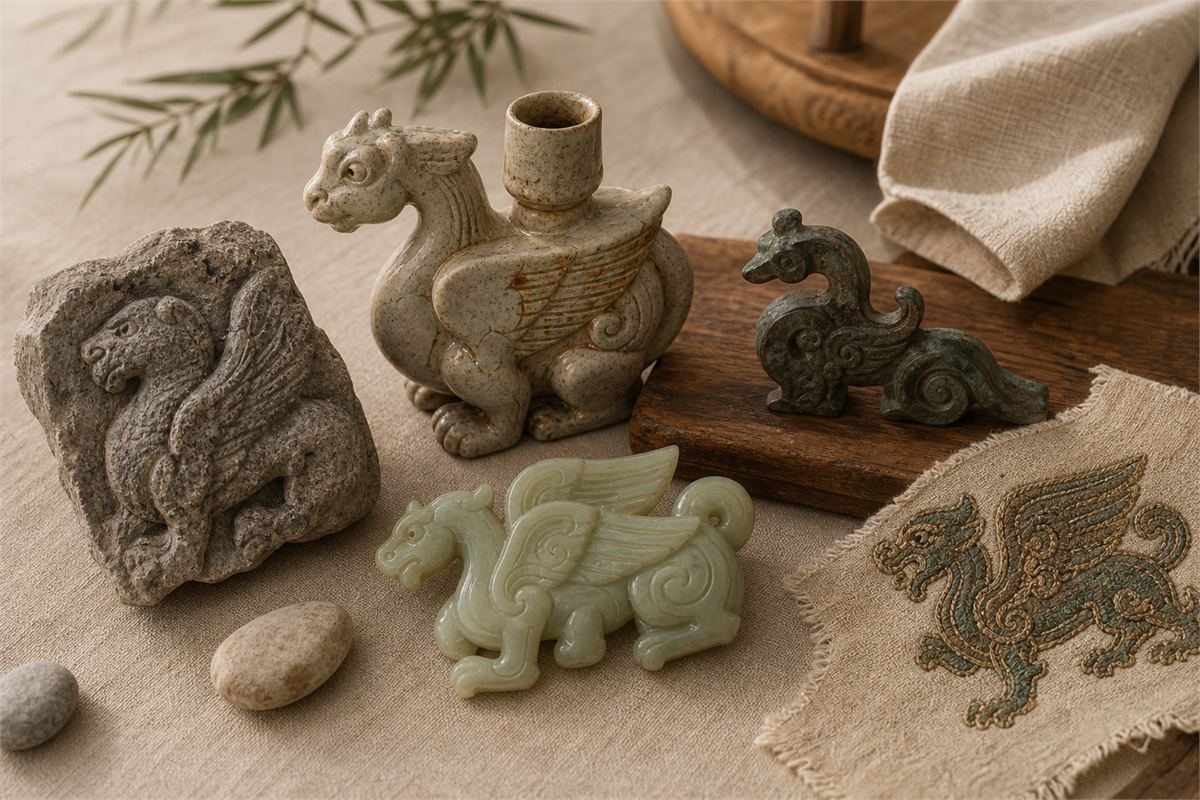
These examples do not share one rigid anatomy. A Bixie may look leonine, feline, bovine, dragon-like, or deliberately hybrid. Wings can be functional-looking, ornamental, or reduced to curling relief. Horns, manes, beards, tails, claws, hooves, and surface patterns change with period, region, material, and workshop. Descriptions such as “dragon head, deer ears, horse body, and eagle wings” may fit a particular sculpture, but they should not be imposed on every Bixie.
The historical function is equally layered. A tomb guardian could mark protection, authority, ceremonial dignity, and the passage between worlds. It should not be reduced to the later idea of a household wealth magnet. Nor should ancient belief be rewritten as a medical claim: a fierce image could embody hopes of repelling disease or calamity, but a carving or pendant does not prevent infection or treat physical or psychological illness.
Qilin Meaning: Auspice, Benevolence, and Later Family Blessing
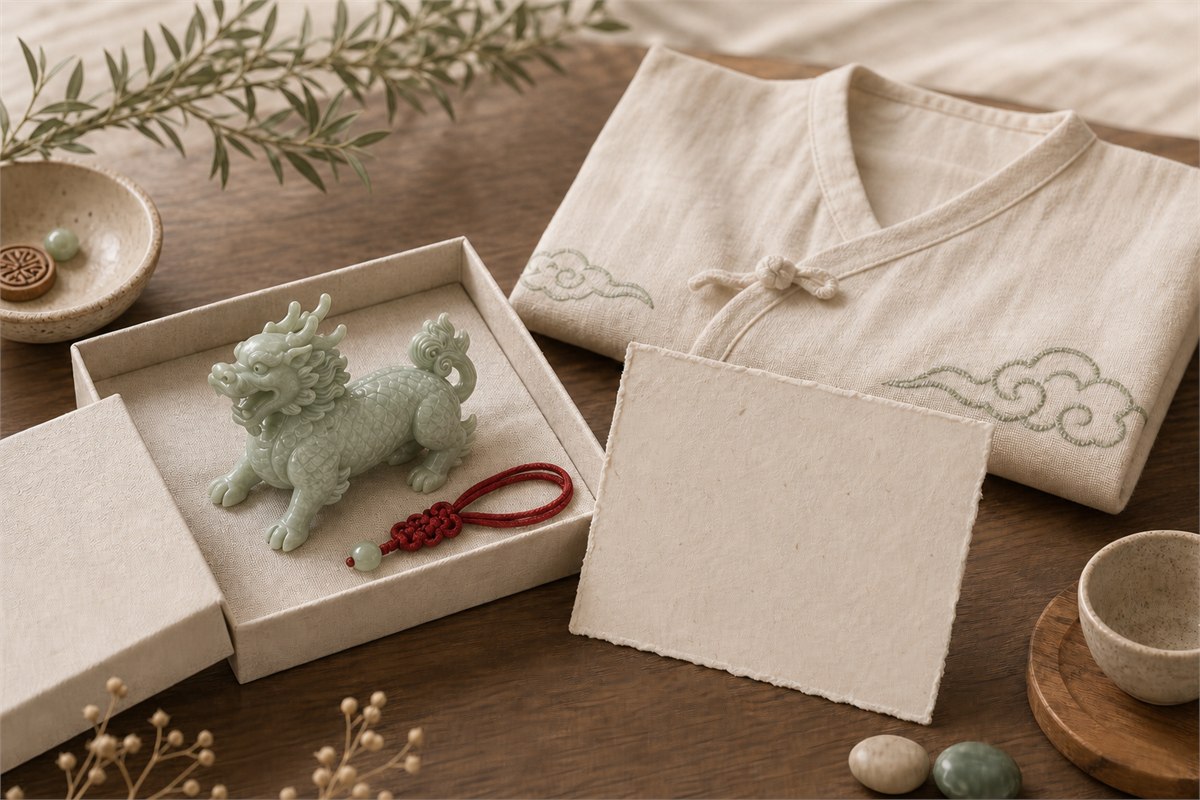
Qilin (麒麟) is one of the most respected auspicious creatures in Chinese tradition. Classical and later literature connects its appearance with humane government, a worthy ruler, or the arrival of a sage. Its body is composite and historically variable: deer-like or hoofed legs, scales, horns or antlers, a dragon-like head, an ox or lion-like tail, and flames or cloud forms may appear in different works.
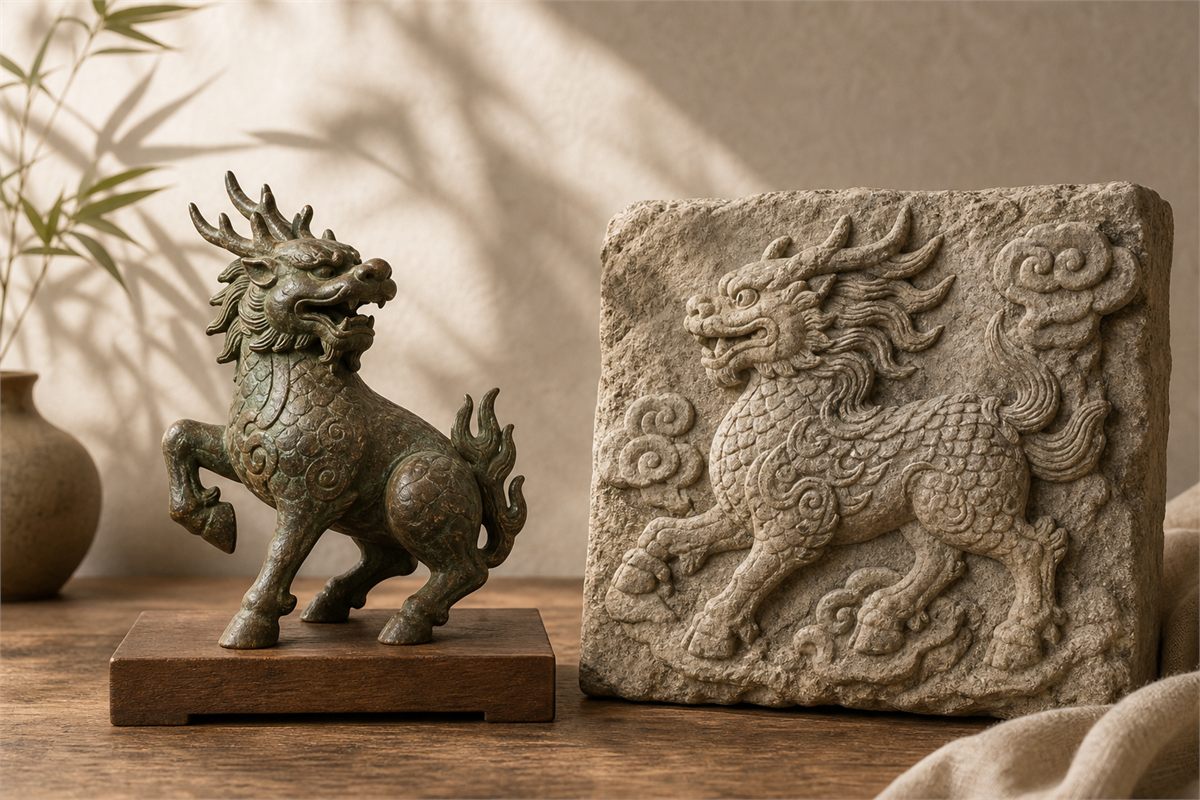
The Qilin is frequently described as a ren shou (仁兽), a benevolent creature. This does not mean every ancient image is gentle in expression. Court and decorative art can give it formidable teeth, claws, and a muscular body. Its moral meaning comes from the auspicious world it announces, not from one standardized face.
Later folk and decorative traditions developed the theme “Qilin Delivers a Child” (麒麟送子). Images of a child riding or accompanied by a Qilin became a blessing for descendants and gifted children, sometimes linked retrospectively to stories surrounding the birth of Confucius. This later family symbolism should be distinguished from the creature’s earlier role as a sign of virtue and sagely rule. A Qilin gift can express affection for a family or child; it is not a promise of conception, safe pregnancy, or a child’s future achievement.
Baize Mythology: Knowledge as Protection
Baize (白泽) represents a different kind of guardianship. Rather than overpowering danger through claws or wings, Baize recognizes and names strange beings. The medieval Baize tradition tells of a creature that met the Yellow Emperor and communicated knowledge about spirits, prodigies, and the means associated with responding to them.
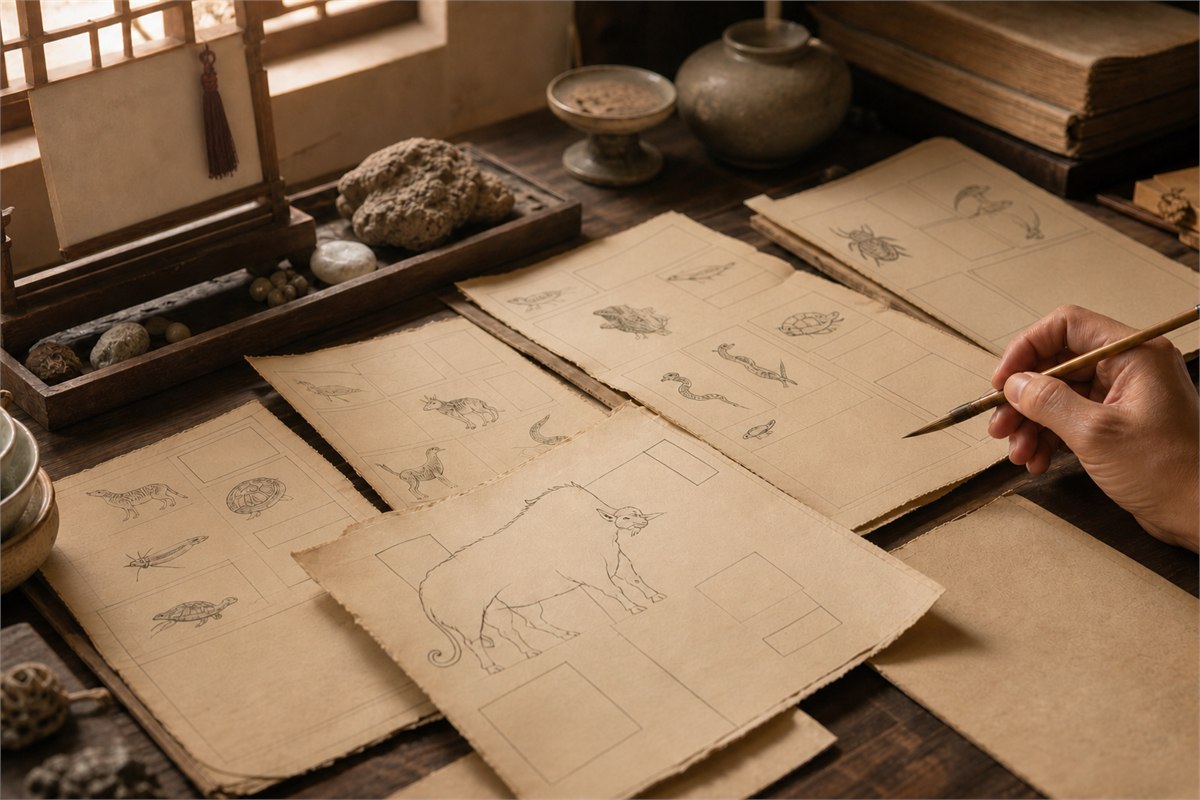
The Baize Tu (白泽图), or Diagrams of Baize, survives through fragments, quotations, and related images rather than one complete, stable ancient book. Dunhuang material is especially important to its study. The British Museum’s White Marsh Diagram to Repel Prodigies explains how the Chinese legend and demonographic knowledge traveled into later Japanese Hakutaku imagery. Its curatorial record also demonstrates that the depicted body and extra eyes belong to a particular transmission, not a universal ancient portrait.
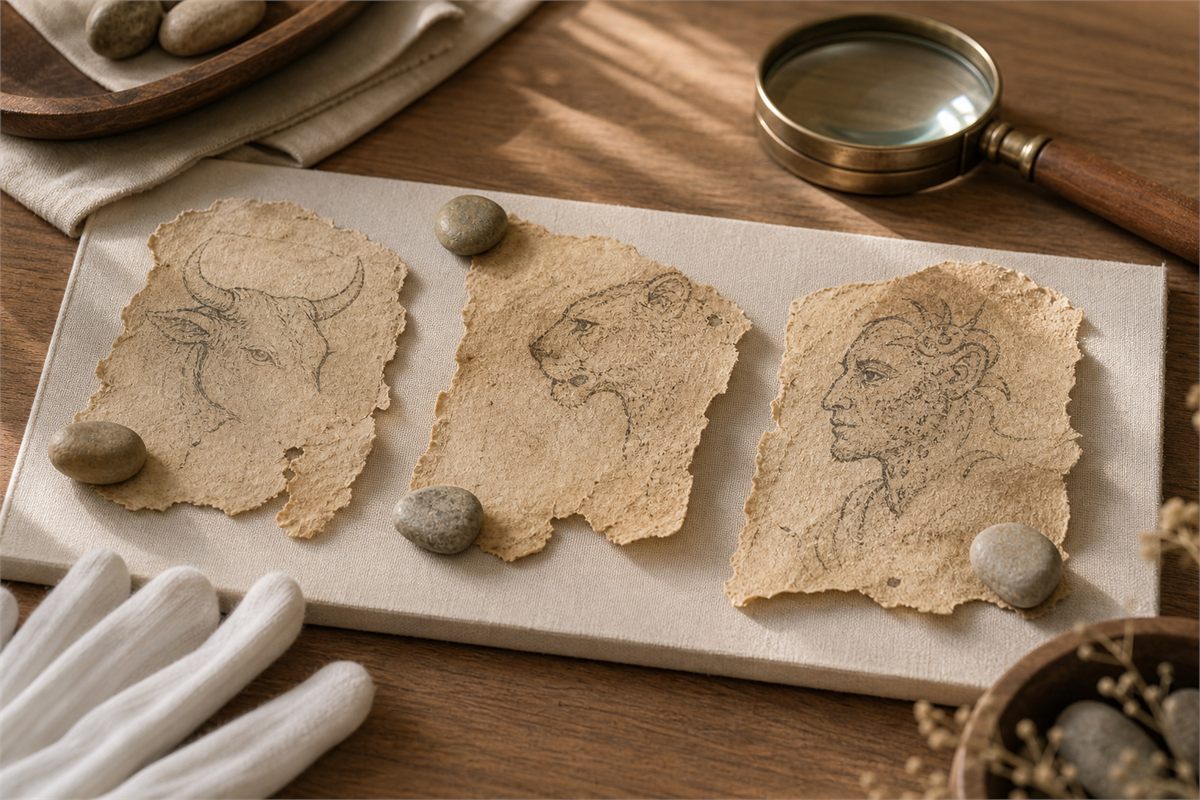
Baize therefore symbolizes knowledge, classification, recognition, and the hope that naming a danger makes it manageable. Artists have shown it with bovine, feline, leonine, caprine, or human-like features. There is no single appearance that must define every Baize, and it is not a fixed protector of people born in the Goat year.
Xiezhi: Why a Mythical Beast Became a Justice Symbol
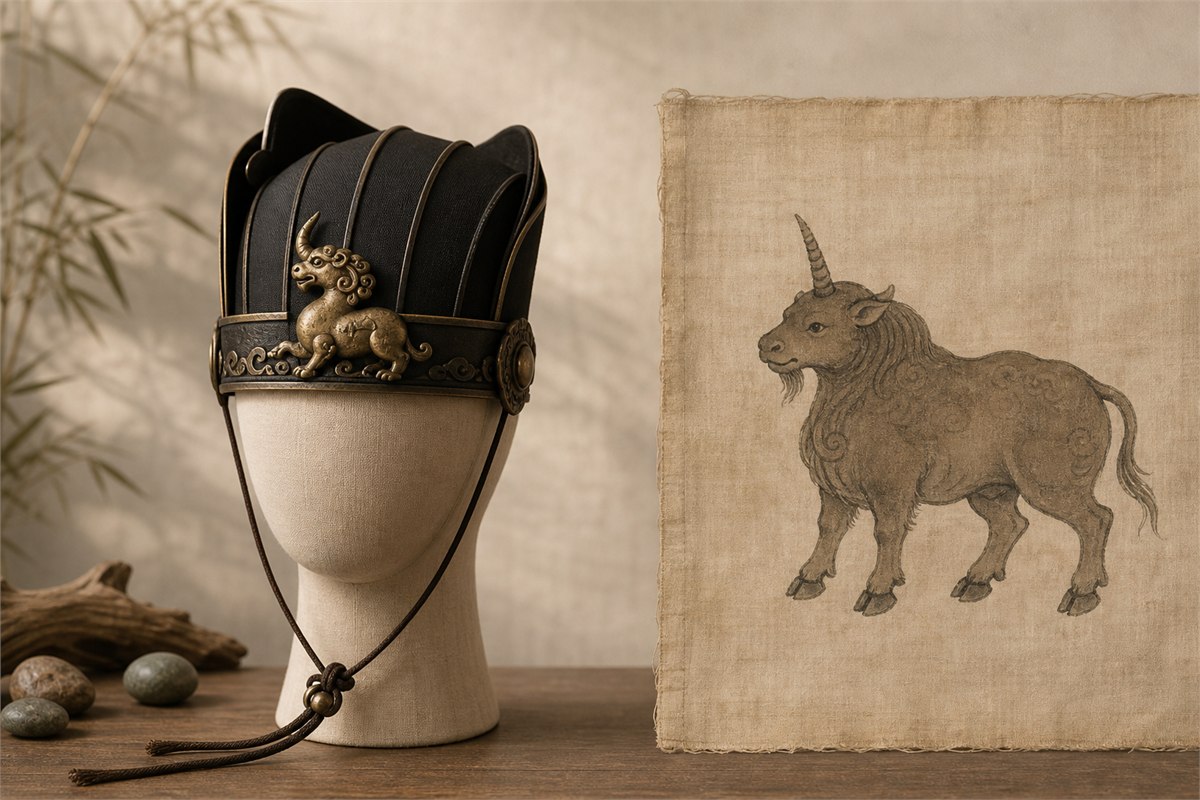
Xiezhi (獬豸) is a one-horned creature associated with the ability to distinguish the upright from the dishonest. Stories say it would confront or strike the party in the wrong during a dispute. That decisive judgment made Xiezhi a durable emblem of law, impartiality, and official responsibility.
The Palace Museum’s Xiezhi entry cites the creature’s ability to identify the unjust and explains that the hats of ancient law officials were called Xiezhi crowns. The crown did not make a judge infallible; it made the wearer’s obligation visible. In later uniforms, badges, carvings, and institutional emblems, Xiezhi continued to express the ideal that power should be guided by discernment.
Xiezhi should not be described as a decoration that every prison or law court placed at its entrance. Its documented strength lies in legend, official dress, and the broad visual culture of justice. A modern Xiezhi object is especially appropriate as a symbolic gift for someone entering law, public service, compliance, mediation, or another profession that values fair judgment.
Protective Creatures Across Architecture, Monuments, Dress, and Childhood
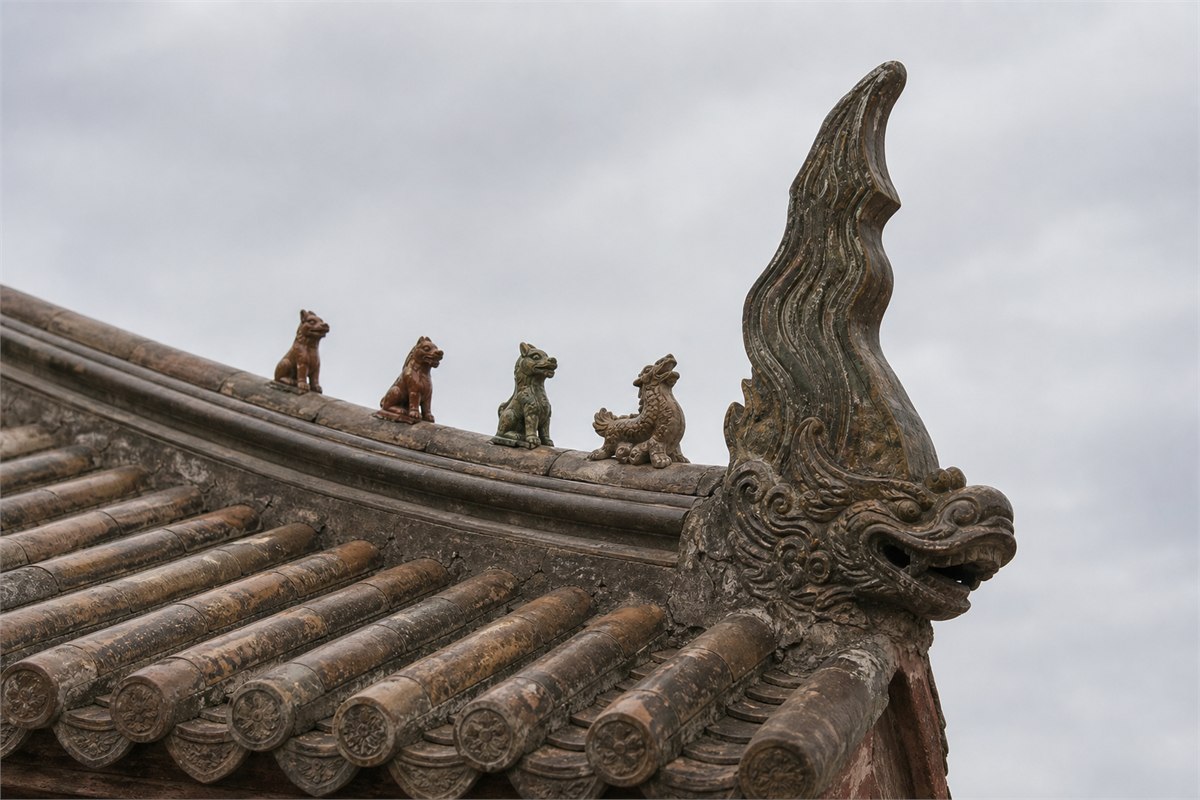
Chinese protective imagery extends well beyond the creatures above. The safest way to understand it is by medium and function rather than calling every fierce animal a Bixie.
- Roof-ridge animals: ranked processions and end ornaments on palaces and temples combine decoration, hierarchy, building symbolism, and protective meaning. Their number and identity depend on architectural context.
- Chiwen or Chiwei (螭吻 / 鸱尾): a roof-end creature associated in later explanation with water and protection from fire. It belongs to architectural form, not the same species as Pixiu.
- Stone lions: paired entrance guardians express authority and vigilance. Their spread and visual conventions have their own history, including the cultural transformation of an animal not native to much of ancient China.
- Bixi (赑屃): the powerful tortoise-like base that carries a stele. Its enduring load supports commemoration and authority; the similar romanization should not be confused with Bixie (辟邪).
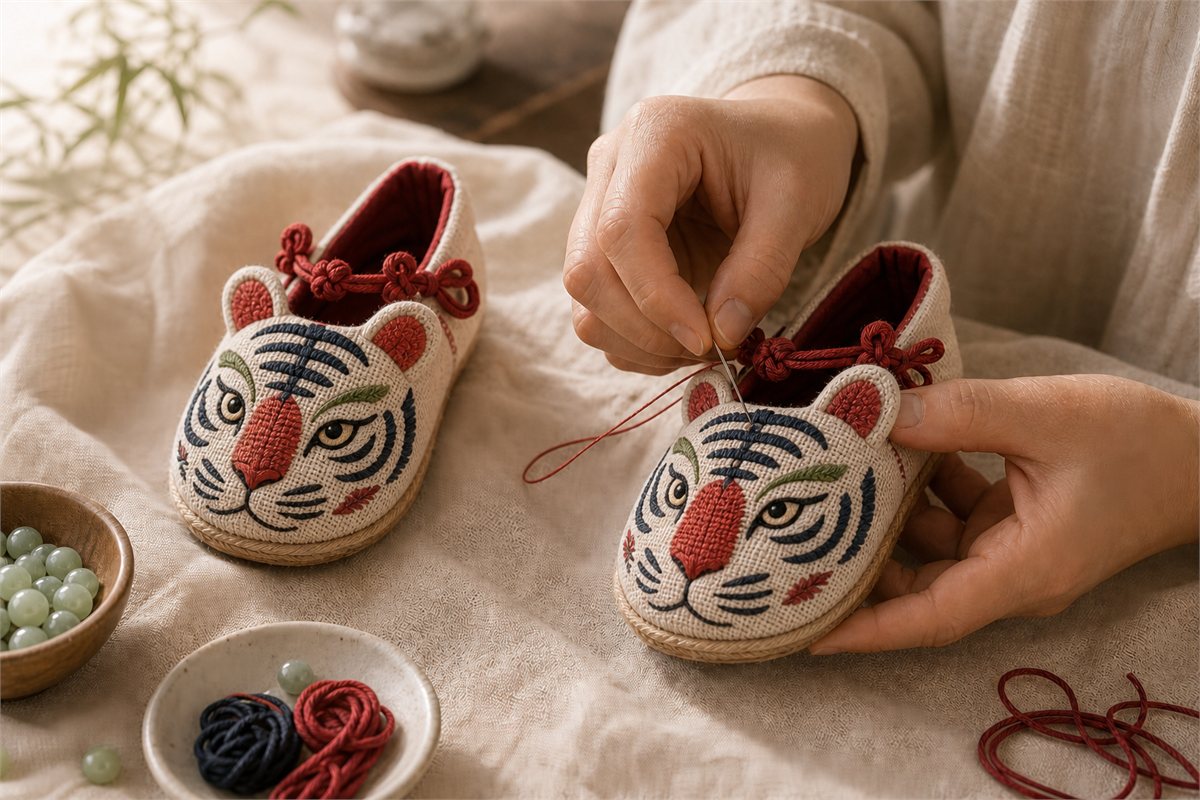
- Tiger-head shoes and hats: children’s textiles use the tiger’s face, color, and bold expression in family traditions of courage and protection. They belong to domestic craft and childhood blessing.
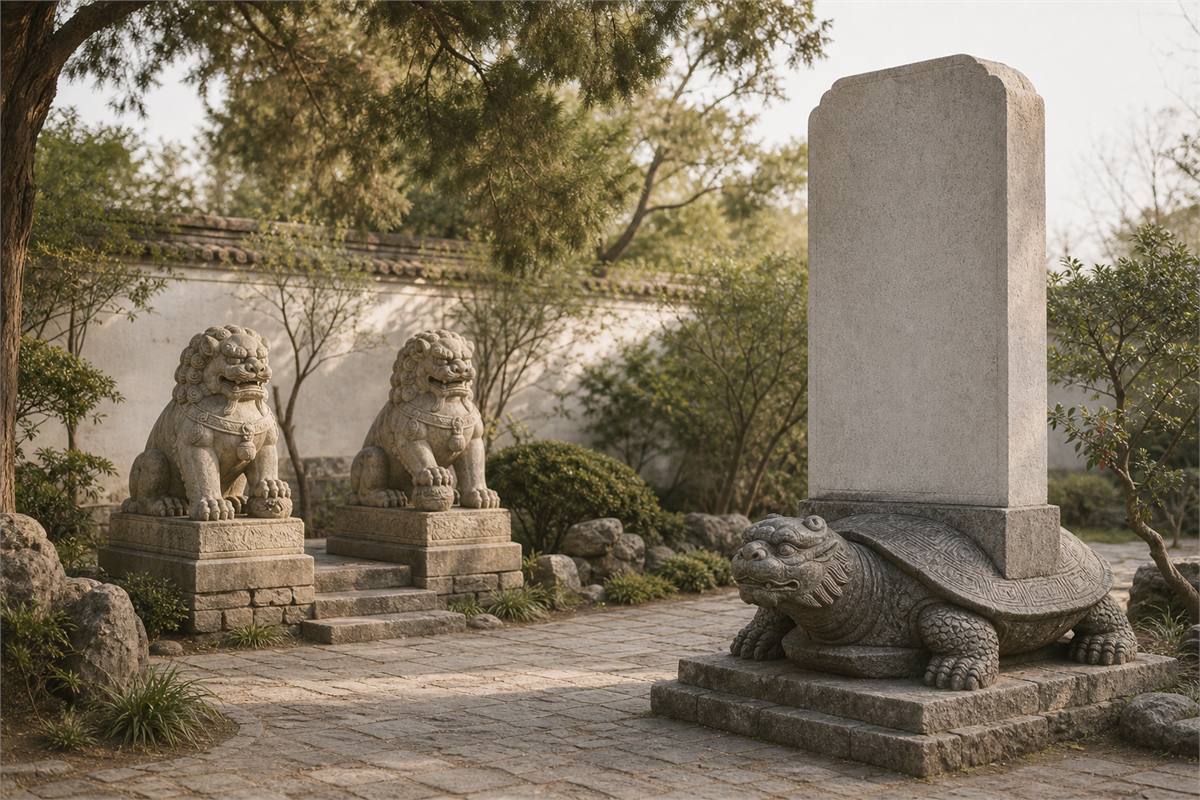
A roof ornament manages a building’s symbolic boundary, a tomb beast guards a funerary approach, a child’s tiger shoe carries family care, and a stele-bearing Bixi supports public memory. Their purposes can resonate without becoming one undifferentiated “beast protection system.”
How to Choose Chinese Guardian Beast Jewelry
Begin with the story you want to carry. Bixie suits boundaries and watchfulness; Xiezhi suits justice and ethical clarity; Qilin suits benevolence and auspicious family wishes; Baize suits knowledge and discernment; the Four Symbols suit direction, season, and cosmic order; modern Pixiu jewelry suits prosperity-minded symbolism and disciplined stewardship.
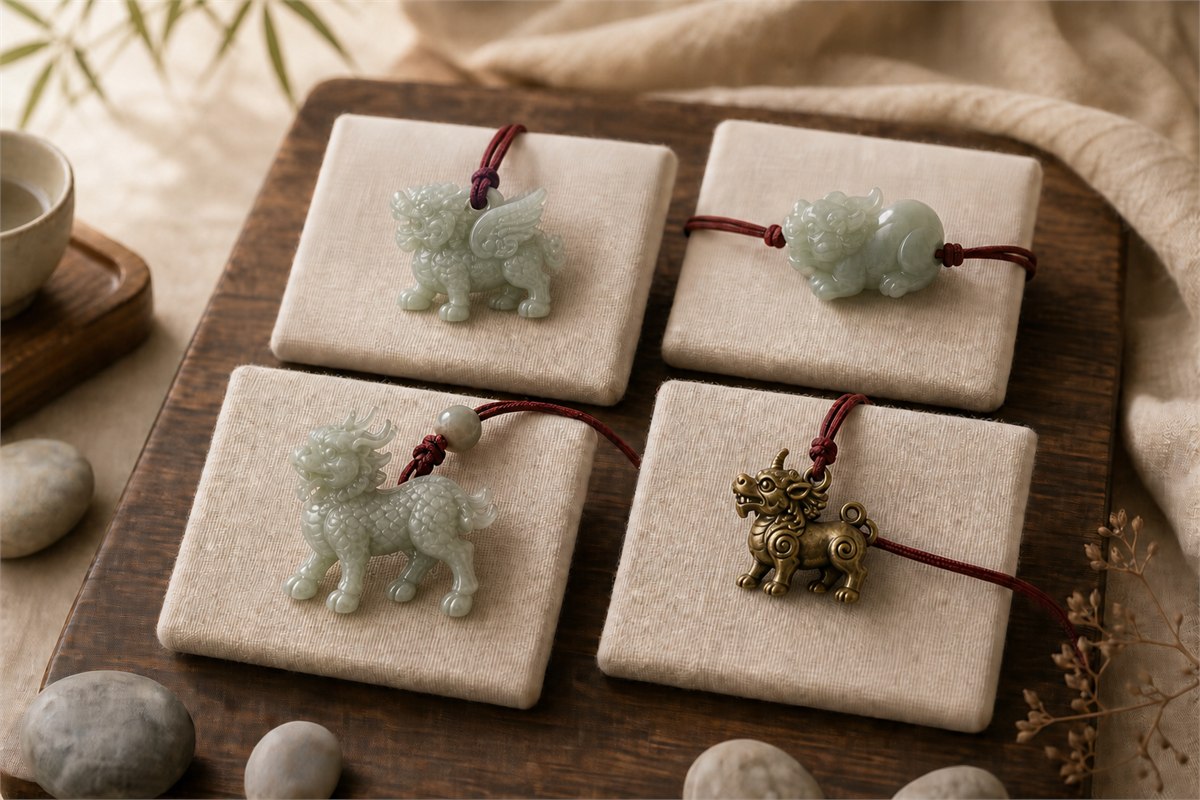
There is no historically universal rule that every Pixiu or Bixie bracelet must be worn on the left hand, point toward the little finger, face a door or window, avoid a mirror, receive a water “eye-opening” ritual, or never have its mouth and eyes touched. These are modern popular rules, household customs, or school-specific practices. If a family, temple, or teacher follows one, the practice can be respected as its own tradition without presenting it as binding on everyone.
Practical checks for pendants and bracelets
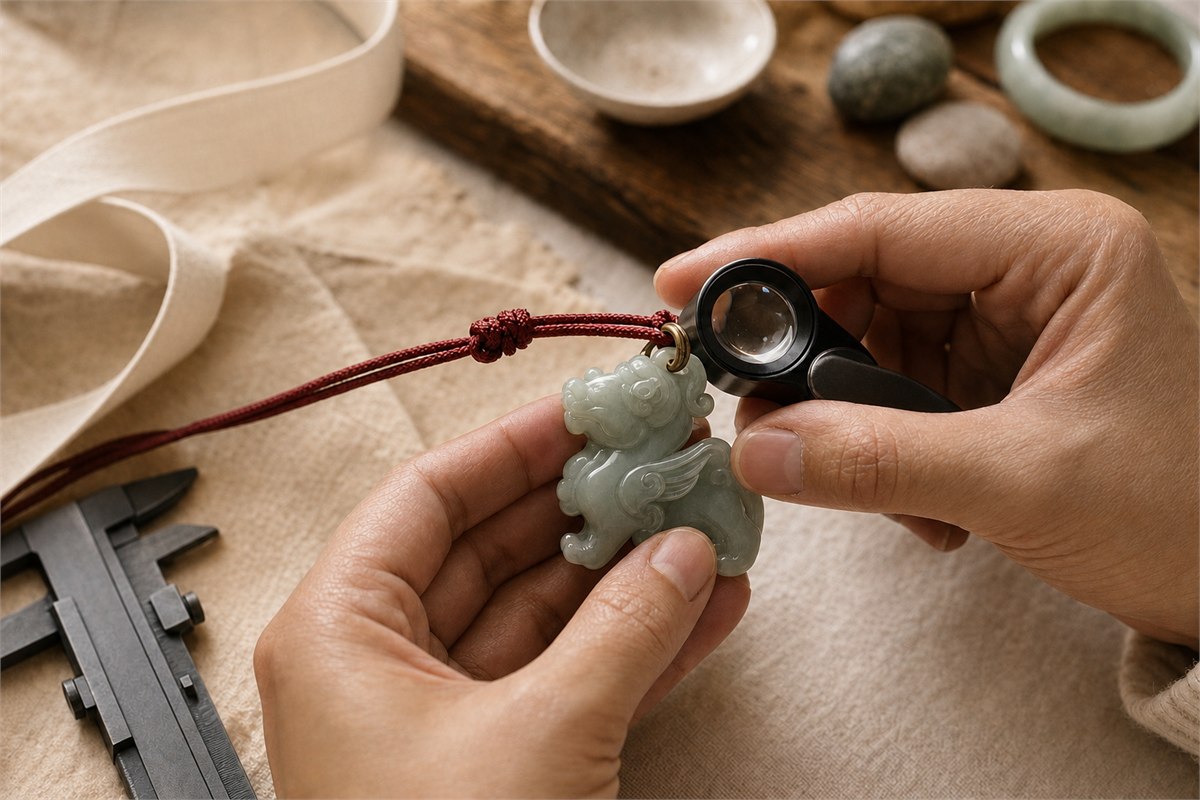
- Confirm which creature the carving is intended to show and whether the visible features support that identification.
- Choose a direction that keeps the carving comfortable, prevents horns or wings from catching, and shows the motif as you prefer.
- Check drilled holes, prongs, jump rings, cord knots, sharp edges, and projecting horns before daily wear.
- Measure bead, charm, and wrist size rather than relying on close-up photographs.
- Ask whether “jade” means nephrite, jadeite, another stone, glass, resin, or a treated composite.
- Remove a piece for activities that expose it to hard impact, strong chemicals, or unsafe snagging.
Material matters as much as symbolism. Our guide to jade meaning in Chinese culture explains why jade carries its own ethical, ritual, and family associations beyond the beast carved into it.
How to Place and Care for a Guardian Beast Display
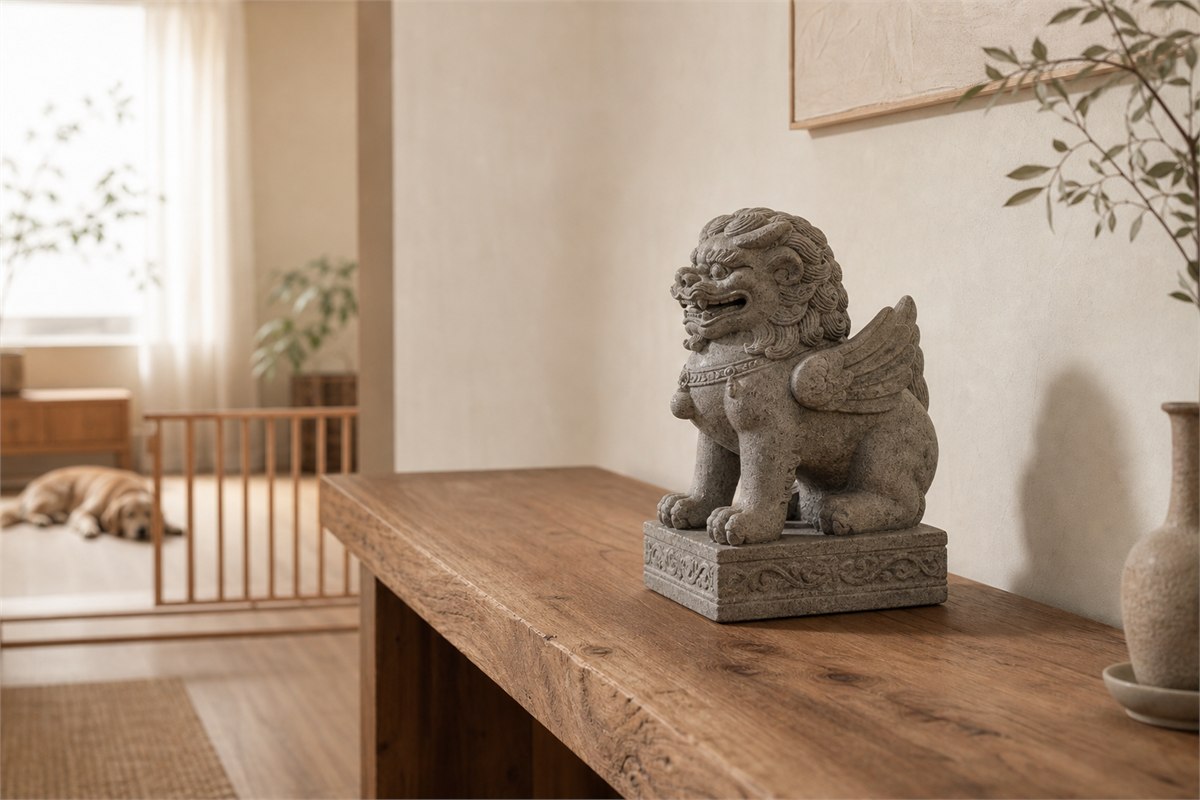
Choose placement first by physical safety and the way the object will be seen. A heavy stone animal needs a level, load-bearing surface. Keep it back from a shelf or desk edge, use museum wax or another suitable restraint when appropriate, and place breakable or sharp forms beyond the reach of children and pets. Pairs should have enough space that wings, horns, or tails do not strike each other during cleaning.
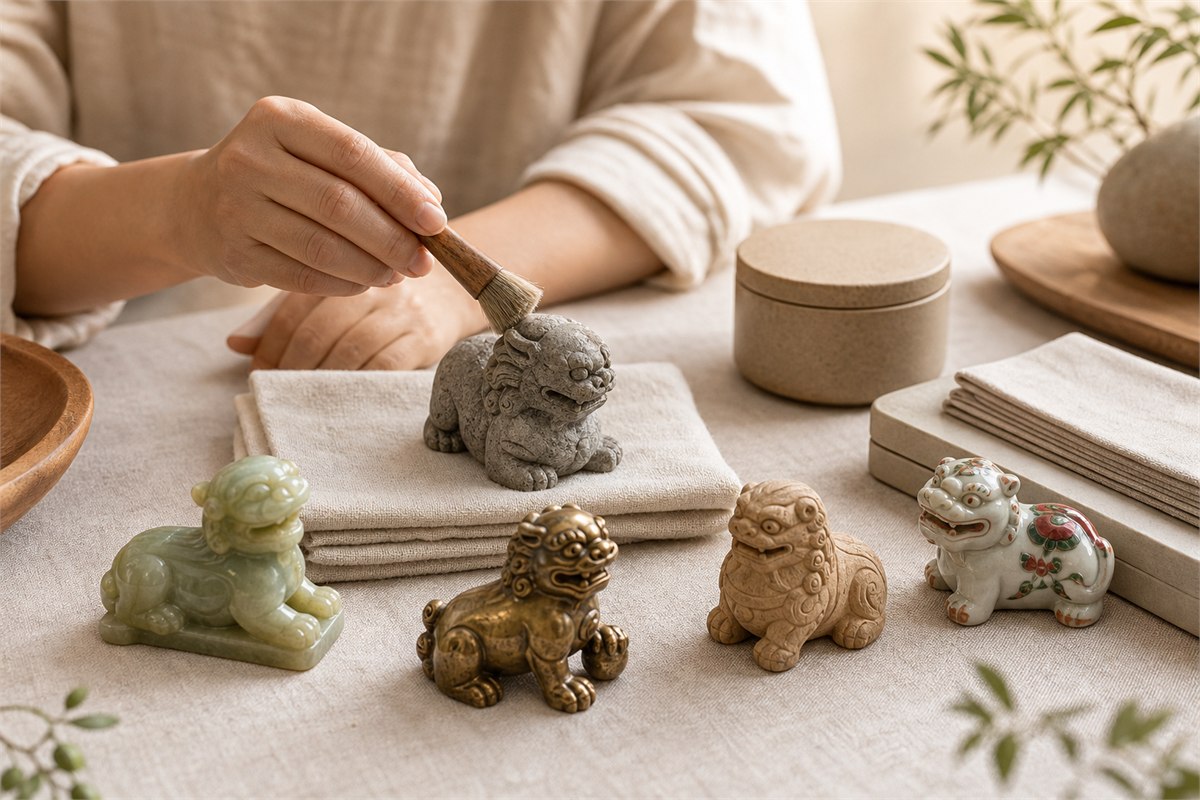
Care follows the actual material. Unsealed wood may react to moisture and sunlight; some pigments fade; porous stone can stain; metals may tarnish or react to cleaners; jade and hardstone can chip at thin carved points. Dust with a soft brush or cloth, avoid soaking assembled objects, and test any cleaner on an inconspicuous area. For broader material-specific advice, use the Eastern Story care guide.
If a doorway orientation or household “wealth position” feels meaningful, use it as a personal design choice after safety is resolved. A symbol placed in a calm, visible location can support attention and intention. It need not be aimed at a toilet, kitchen, mirror, or window according to one universal taboo.
Buying Antique, Vintage, and Modern Guardian Beasts
A label such as “ancient Bixie,” “imperial Qilin,” or “natural jade Pixiu” is a claim that requires evidence. Historical guardian-beast objects vary widely in age, material, quality, rarity, condition, and legal provenance. There is no responsible fixed dollar price for a name alone.
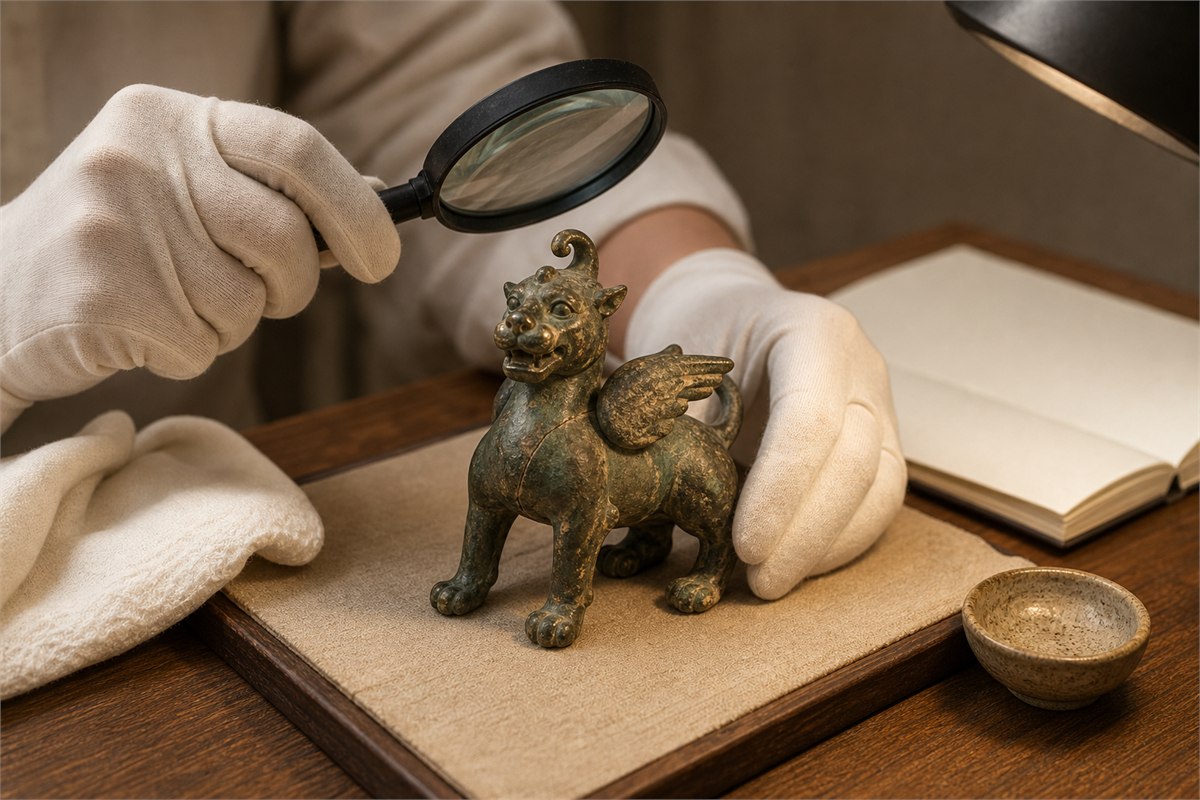
- Identification: ask why the creature is called Bixie, Tianlu, Pixiu, Qilin, Baize, or Xiezhi and which features support the name.
- Date: distinguish a documented period object from a later revival, reproduction, fantasy carving, or deliberately antiqued piece.
- Material: request precise disclosure, including metal composition, stone species, glaze, pigment, coatings, fillings, dyeing, impregnation, or reconstructed material.
- Workmanship: examine proportion, tool marks, polish, casting seams, undercutting, drilled areas, joins, surface wear, and whether aging is consistent.
- Provenance: for older pieces, ask for ownership history, invoices, export documentation when relevant, and previous scholarly or auction references.
- Condition: request disclosure of repairs, replacement parts, cracks, chips, loss, corrosion, overpainting, and restoration.
- Seller protection: check reputation, written guarantees, independent testing for valuable materials, insured shipping, and the return policy.
For a modern decorative object, honest material, good carving, stable construction, and a story that matters to you may be more important than artificial claims of age. For a high-value antique or gemstone, independent expertise is worth obtaining before purchase.
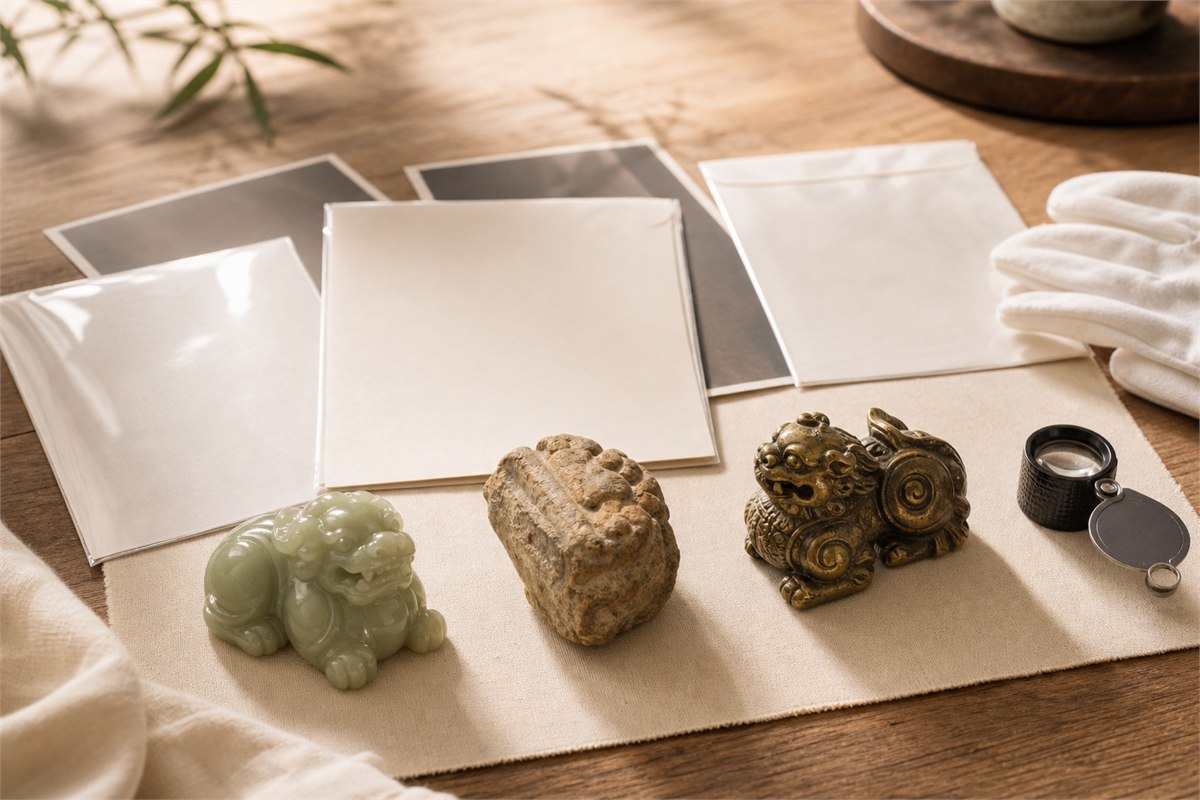
Choosing a Guardian Beast by Meaning
| If you value… | Consider… | Why |
|---|---|---|
| Direction, season, and balanced order | Four Symbols | They map the heavens and the cycles of the year. |
| Watchful protection and strong boundaries | Bixie | Winged guardian imagery carries vigilance and threshold power. |
| Prosperity-minded intention | Pixiu or Tianlu in a clearly identified modern design | Popular culture connects these forms with gathering and safeguarding resources. |
| Benevolence and auspicious leadership | Qilin | Its appearance is associated with virtue, sages, and peaceful rule. |
| Knowledge and recognizing hidden danger | Baize | Its protective role comes through naming and understanding strange beings. |
| Fair judgment and professional integrity | Xiezhi | It became an emblem of law and discerning right from wrong. |
The best guardian-beast object does not need the largest horn, fiercest face, or most extravagant promise. It needs a clear identity, truthful material description, thoughtful workmanship, safe use, and a meaning you can explain. Explore the Eastern Story blessing collection for symbolic objects organized around meanings and intentions.
Frequently Asked Questions
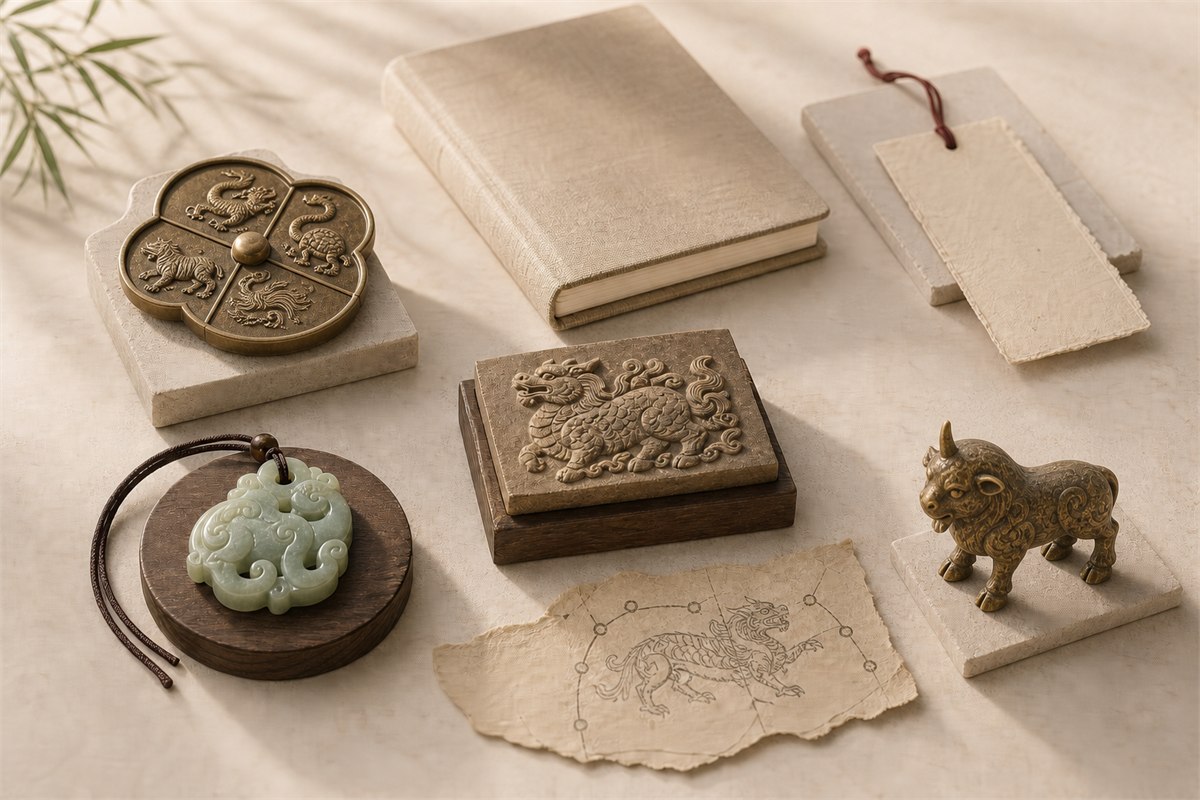
Reading Guardian Beasts with Clarity
Chinese guardian beasts reveal how art can turn order, vigilance, virtue, knowledge, justice, and family hope into visible form. Their histories become richer when the Four Symbols remain a celestial system, Qilin remains an auspice of benevolent rule, Baize protects through knowledge, Xiezhi embodies judgment, and Bixie, Tianlu, and Pixiu are allowed to keep their complex and sometimes disputed relationships.
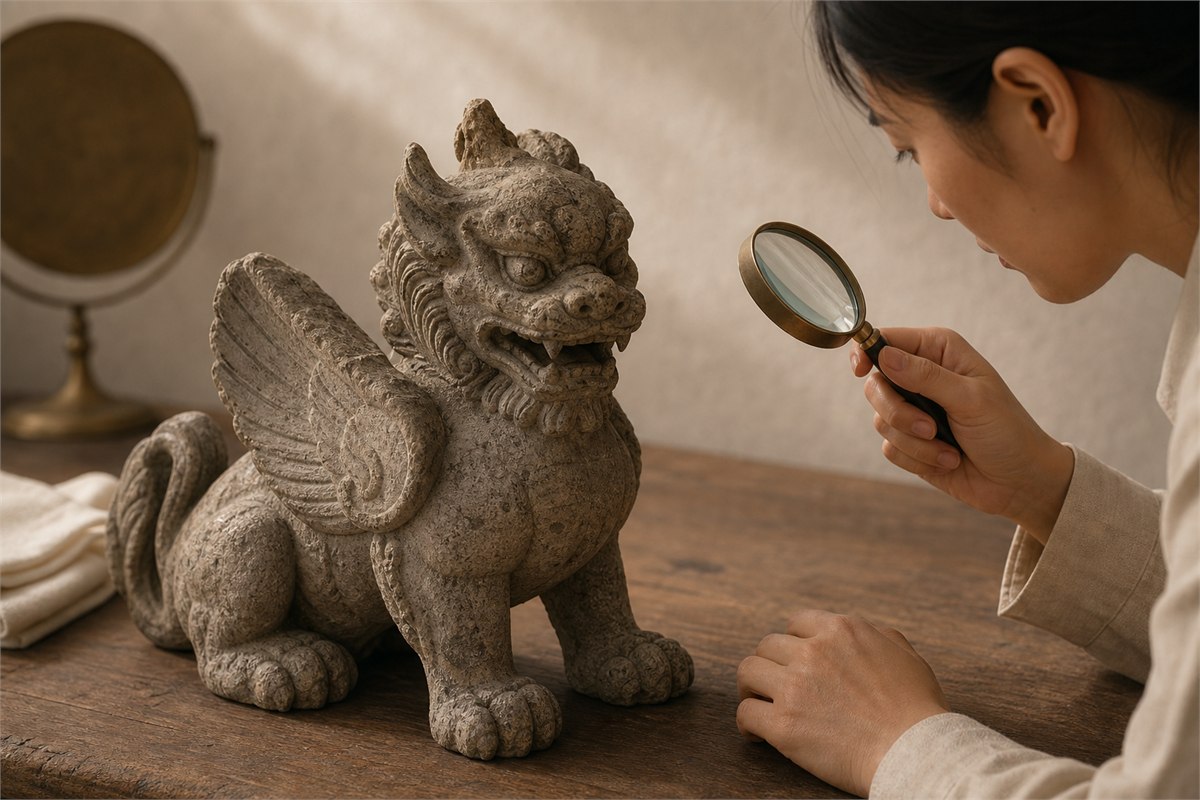
Choose these creatures as cultural symbols, works of craft, and personal reminders. The most durable protection they offer in modern life is the practice of paying attention: to history, material, safe use, honest buying, and the values an object asks you to remember.
Related Posts


2 Comments