
The Azure Dragon, Qinglong (青龙), is the guardian of the east and a beloved symbol of spring, renewal, protection, and auspicious beginnings. In traditional East Asian cosmology, its long celestial body gathers seven eastern lunar mansions into one dragon, linking the morning light, the Wood phase, and the blue-green vitality of growing things. People choose Qinglong imagery to welcome fresh energy, steady progress, helpful friendships, and a peaceful life.

There is something deeply hopeful about a guardian whose season is spring. Qinglong carries the feeling of lifting your head after a difficult winter: the courage to begin again, the patience to grow, and the wish that those you love will flourish. Whether seen on an old roof tile, held in a small carved object, or worn close to the heart, its story joins the vastness of the sky with an intimate blessing for everyday life.
What does Qinglong mean? A dragon of new beginnings
Qinglong is also called Canglong (苍龙). “Azure Dragon,” “Green Dragon,” and “Blue-Green Dragon” reflect the range of qing (青), a color word that can embrace blue, green, and darker blue-green tones. The name evokes both the sky and living vegetation. A painted dragon, a bronze figure, and a jade carving can carry the same story through very different colors and surfaces.

Qinglong belongs to the Four Symbols (四象), the four directional guardians. Its particular gift to this larger picture is the promise of emergence: sunrise after darkness, spring after winter, and possibility after a period of waiting. Four closely connected wishes give the Azure Dragon its lasting appeal.
| Meaning | The wish it carries | A life moment it can accompany |
|---|---|---|
| Renewal and hope | May fresh opportunities open and new life take root. | A graduation, a spring birthday, or a new beginning |
| Courage and progress | May you move forward with confidence and keep growing. | A new course of study, a creative project, or a new venture |
| Protection and peace | May your home and the people you love be held in care. | A housewarming, a reunion, or a gift across distance |
| Nobility and kindness | May strength be joined with generosity and good character. | A personal milestone or a gesture of respect |
In the traditional correspondence system, Wood is associated with growth and with ren (仁), the virtue of benevolence. This gives Qinglong’s strength a gentle dimension. Its energy can be understood as the strength to nurture, encourage, and help life flourish. A gift inspired by Qinglong can wish success for someone while also honoring the kindness with which they find their way.

East, spring, and Wood: Qinglong among the four guardians
The Five Phases, or Wu Xing (五行), connect seasons, directions, colors, and patterns of change. East is the direction of sunrise. Spring is the season of renewed growth. Wood describes the living movement of roots, stems, and branches. Qinglong brings these associations together in an image that feels poised to rise.

| Guardian | Direction | Season | Phase | Traditional color |
|---|---|---|---|---|
| Azure Dragon / Qinglong (青龙) | East | Spring | Wood | Qing: blue-green |
| Vermilion Bird / Zhuque (朱雀) | South | Summer | Fire | Red |
| White Tiger / Baihu (白虎) | West | Autumn | Metal | White |
| Black Tortoise / Xuanwu (玄武), often a tortoise with a snake | North | Winter | Water | Black |
Together, the four guardians offer a vision of a world held in balance. Qinglong and White Tiger form the east–west pair; Vermilion Bird and Xuanwu complete the southern and northern quarters. The central Earth phase belongs to the wider Five Phases system, while these four creatures mark the four directions.
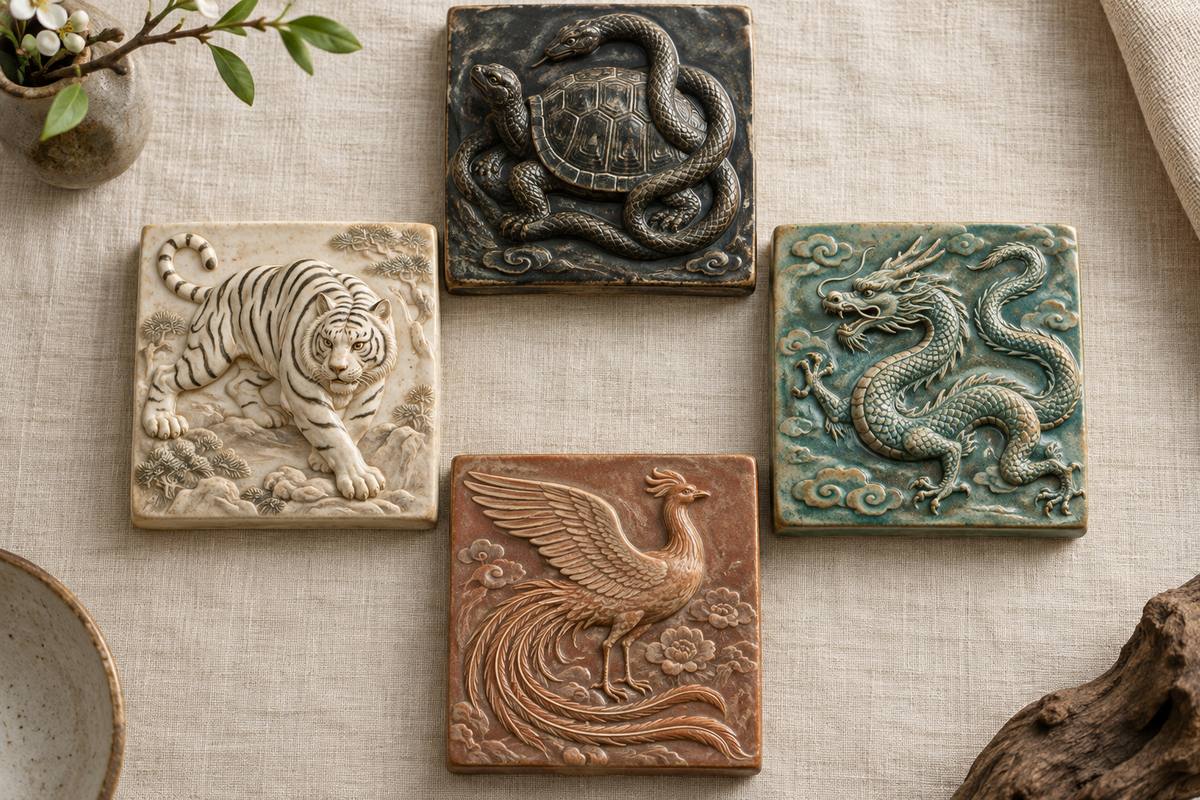
The directional guardians are also called the Four Gods or the Four Celestial Spirits. Another famous “Four Spirits” grouping in the Book of Rites brings together Qilin (麒麟), Fenghuang (凤凰), the Eastern phoenix, tortoise, and dragon. The shared language of auspicious creatures connects these traditions, while each grouping has its own members and meaning.
Wood is a phase of growth in this cultural system, so a Qinglong ornament can be made in jade, bronze, silver, gold, or wood. Its material gives the object its touch and appearance; the eastern dragon gives it its story. Blue-green color can echo that story beautifully, and a warm metal or an uncolored carving can express it just as thoughtfully.
The seven eastern lunar mansions: a dragon written in stars
The Twenty-Eight Lunar Mansions (二十八宿) divide the traditional sky into 28 named regions arranged in four groups of seven. The eastern seven were imagined together as a long dragon. A “mansion” here is a region used in traditional astronomy, rather than a single star. Their sequence allows the viewer to follow the dragon from its horn through its body toward its tail.
| Order | Mansion | Common English name |
|---|---|---|
| 1 | Jiao (角) | Horn |
| 2 | Kang (亢) | Neck |
| 3 | Di (氐) | Root |
| 4 | Fang (房) | Room |
| 5 | Xin (心) | Heart |
| 6 | Wei (尾) | Tail |
| 7 | Ji (箕) | Winnowing Basket |
Read together, these names turn the night sky into a memorable living presence. Horn begins the eastern sequence; Heart gives it a center; Tail and Winnowing Basket complete the group. The names have their own astronomical histories, and the dragon gathers them into an image large enough to hold a whole quarter of the traditional sky.

For communities attentive to the seasons, the changing sky belonged to the rhythm of planting, rain, and harvest. Qinglong’s spring association grew within that intimate relationship between heaven and earth. The stars offered orientation, and the dragon gave that orientation a face: a guardian of the moment when the world becomes green again.
Mengzhang Shenjun: Qinglong as a Daoist guardian
In Daoist tradition, Qinglong is honored as Mengzhang Shenjun (孟章神君), a protective deity associated with the eastern direction. Qinglong and White Tiger appear as guardians of sacred entrances and ritual space, welcoming order and keeping harmful influences at bay. At Tianshi Cave on Mount Qingcheng, the paired guardian shrines identify the dragon as Mengzhang and the tiger as Jianbing.
This sacred role adds a sense of shelter to the dragon’s spring vitality. A guardian at a threshold speaks to a familiar human hope: that the space within will be peaceful, and that those who cross into it will be safe. In a personal keepsake, the same image can carry a wish for protection as someone steps into a new chapter.
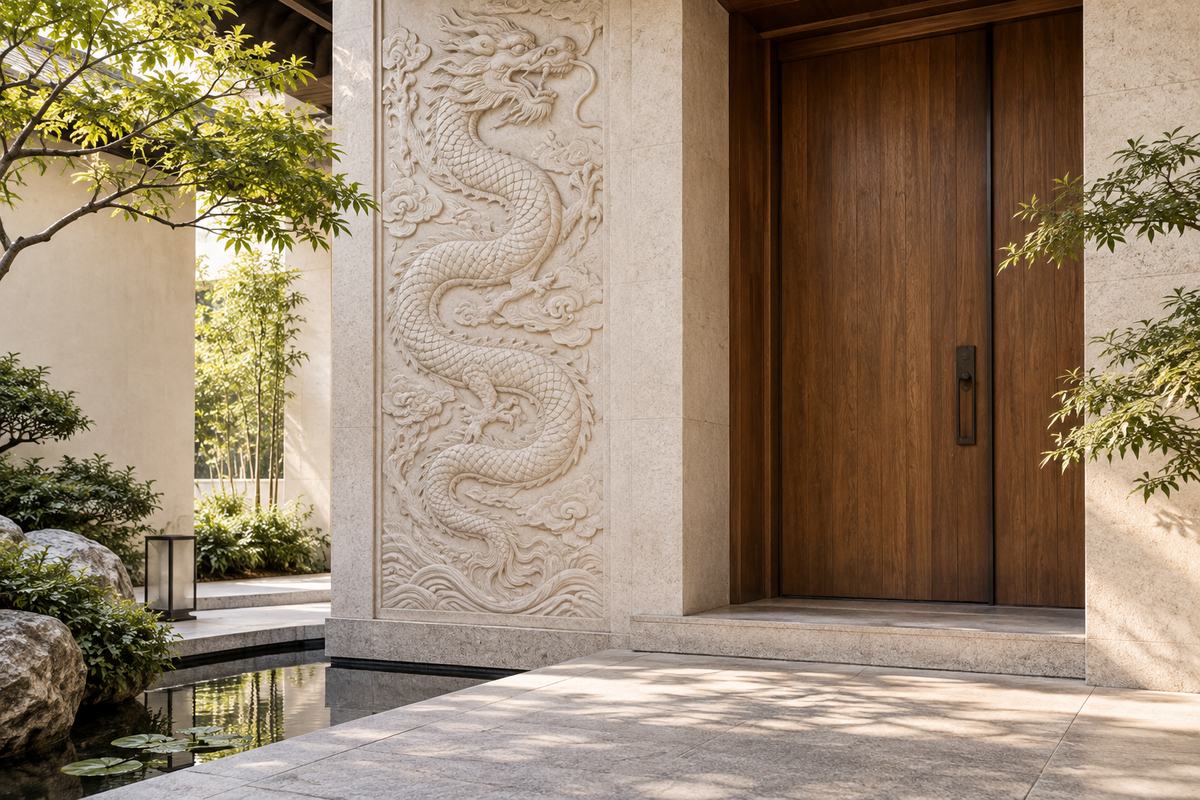
Qinglong also has an old association with nobility. The Huainanzi speaks of its exalted standing among celestial powers. That esteem helps explain the dignity of the image in ceremonial culture, while the four directional guardians are best understood through the work they do together. Qinglong’s distinctive place is the east, with its rising light and renewing life.
Dragon Raises Its Head: the hope of the second lunar month
Longtaitou (龙抬头), “Dragon Raises Its Head,” is celebrated on the second day of the second lunar month. Its familiar image is a dragon lifting its head as spring returns. The festival carries wishes for timely rain, flourishing crops, and a generous year ahead.

The eastern dragon’s Horn mansion is part of the festival’s star lore. The seasonal appearance of the dragon in the evening sky connects naturally with the awakening of the land. The precise rising time shifts with the year, observing location, and long-term changes in the sky; the festival date is a cultural marker of spring’s arrival.
The saying “二月二,龙抬头,大仓满,小仓流” imagines large granaries filled and smaller stores overflowing. It is an abundant, homely picture of good fortune: enough food, a secure household, and the rewards of a growing season. In that spirit, Qinglong can accompany the wish that a new undertaking will take root and that a family will have all it needs.

Recognizing Qinglong in art, buildings, and treasured objects
A lively form with room for artistic variation
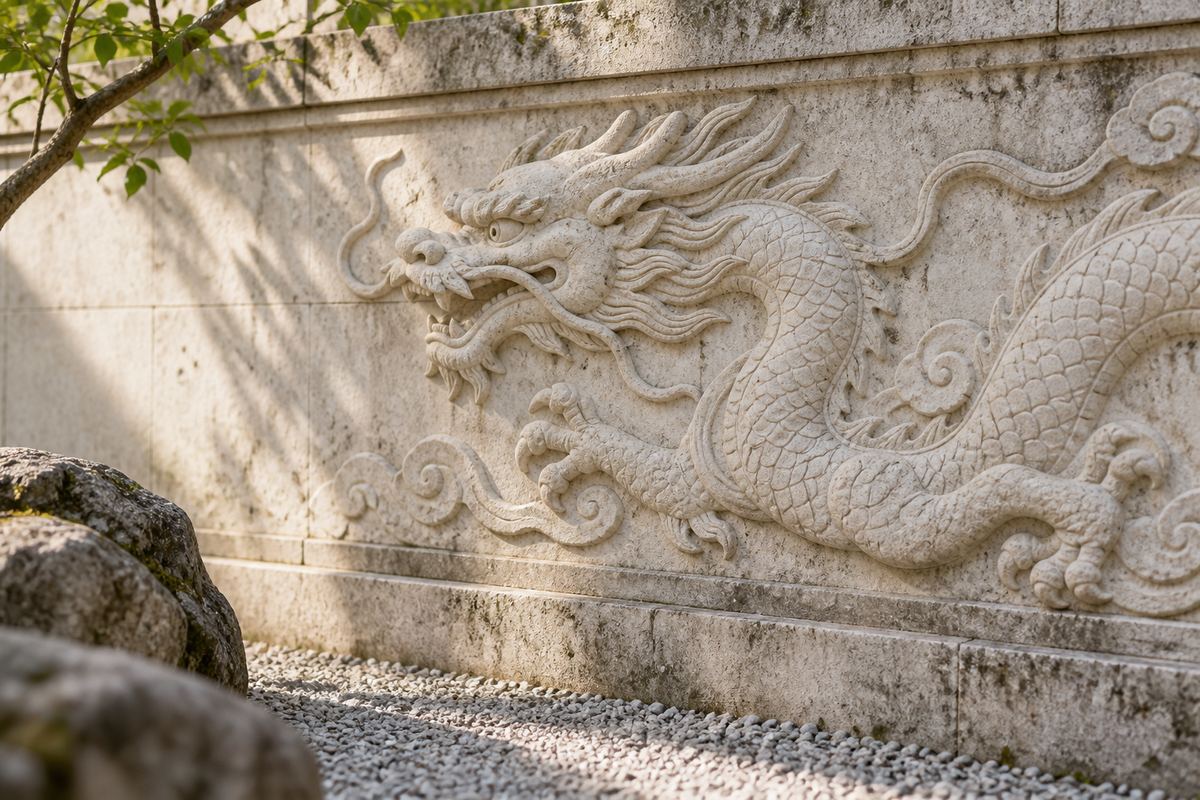
Artists give Qinglong a long, twisting body, scales, horns, whiskers, and strong claws. Its movement may be coiled, rising, leaping, or flowing through cloud forms. These familiar features belong to the wider visual language of the Eastern dragon, or loong (龙). The combination of name, companions, directional position, and setting gives an image its specifically Qinglong identity.

There is no single fixed Qinglong anatomy across all periods. Horn shapes, facial features, claws, and even wings vary. The Palace Museum’s Han-dynasty Qinglong tile, for example, depicts a winged dragon. A count of five claws has significance in particular court traditions, but it does not define Qinglong or establish the identity of every dragon image.
Han roof tiles, bricks, and the wish for protection
The Four Gods roof tiles, or sishen wadang (四神瓦当), bring the guardians to the edge of a building’s roof. A tile end closes the front of a roof tile and also offers a circular space for decoration. Across a group, dragon, tiger, bird, and tortoise turn architecture into a place watched over by auspicious creatures.

One Qinglong tile in the Palace Museum measures 18.5 centimeters in diameter. Around its central raised boss, the dragon opens its mouth, lifts its tail, and presses outward with energetic limbs. That small round surface holds a striking sense of movement. Qinglong relief bricks similarly show how a celestial guardian could become part of the built world.
Bronze mirrors, lacquer objects, textiles, and banners also carry the directional animals. A mirror can gather them around its center, bringing the four quarters into one object. A banner makes a guardian visible in movement. Across these forms, the appeal is both grand and personal: a complete world, and a wish to live securely within it.

Tomb imagery and remembrance
In Han and later funerary art, the four guardians surround the deceased with a protected image of the cosmos. Qinglong belongs to this language of orientation and care. Seen in a tomb painting or relief, the dragon can be understood as part of a family’s hope for peace, shelter, and enduring remembrance.
The emotional meaning is tender beneath the grandeur. To place a guardian around someone is to imagine them accompanied. For a reader encountering these images in a museum, that human wish can remain clear across the distance of centuries.
Courtly dragons and the importance of context
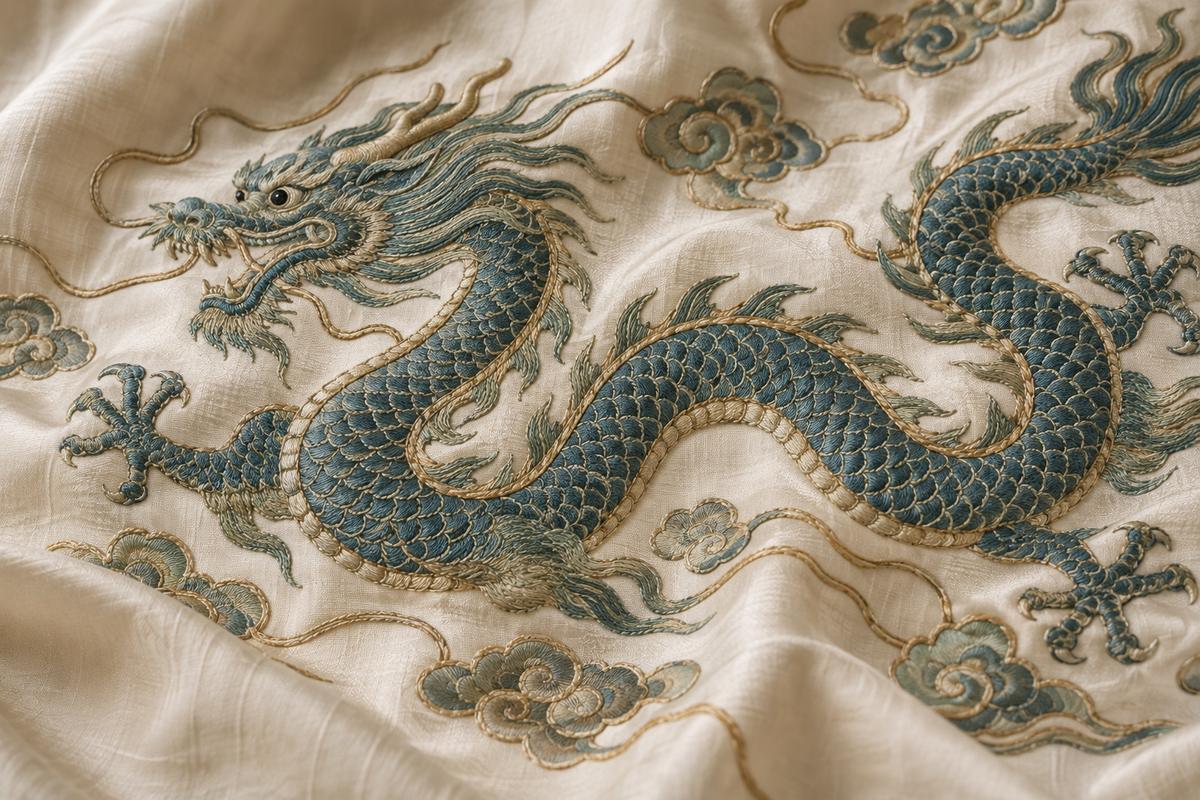
Dragon robes, palace ornament, ceremonial vessels, and porcelain reveal the breadth of dragon imagery in Eastern art. Some emphasize imperial authority; others celebrate rain, vitality, or auspicious power. A dragon on a robe, ridge ornament, column, or blue-and-white vessel takes its meaning from the particular object and composition. Qinglong is most clearly recognized where its eastern or Four Symbols role is present.
When enjoying a historical object, begin with its name and setting, then look at its companions and movement. A group of four guardians, a directional inscription, or a celestial arrangement can bring the dragon’s story into focus. These details make looking more rewarding and help a familiar motif become a specific encounter.
Qinglong in feng shui: a landscape of shelter and harmony
In traditional feng shui (风水), “Azure Dragon on the left, White Tiger on the right” describes a protective relationship around a site. Dragon and tiger forms can be read in surrounding hills, landforms, or features of the built environment. Their imagined embrace carries a wish for a settled home, supportive surroundings, and family harmony.
The word “left” belongs to the orientation of the site or composition being described. Its meaning depends on that frame of reference. The familiar ideal is a setting that feels held and supported, with the dragon side suggesting vitality and an unfolding movement. This is a traditional cultural way of reading a place, shaped by the setting and the practice used.
For a contemporary home, a Qinglong object may express the wish to welcome fresh energy and helpful company. A carving on a study shelf can accompany learning; a small sculpture in a shared room can carry a housewarming blessing. Choose a stable place where the figure can be enjoyed and its story remembered. The feeling to seek is a home that receives you kindly.

Qinglong, Dragon Kings, Yinglong, and Guan Yu
Several dragon traditions meet in art and storytelling. Knowing their particular roles makes each story richer.
| Figure or motif | Its characteristic story |
|---|---|
| Qinglong (青龙) | The eastern celestial guardian, associated with seven mansions, spring, and Wood. |
| The zodiac Dragon (辰龙) | One of the 12 animals in the repeating birth-year cycle. |
| Dragon King / Longwang (龙王) | A water deity associated with seas, rivers, and rain in religious and popular traditions. |
| Yinglong (应龙) | The winged dragon of ancient myth, associated with rain and stories of the Yellow Emperor’s conflict with Chiyou. |
| Imperial and decorative dragons | Images whose authority, auspiciousness, or visual meaning depends on their object and historical setting. |
Qinglong’s spring world readily evokes rain and flourishing life, which gives it a natural affinity with other dragon imagery. Dragon Kings have their own identities and stories; Yinglong has a distinct mythic career. A shared dragon form lets these images resonate with one another while preserving the character of each tradition.

Guan Yu’s Green Dragon Crescent Blade
In Romance of the Three Kingdoms (三国演义), Guan Yu (关羽) carries the Green Dragon Crescent Blade, Qinglong Yanyuedao (青龙偃月刀), also named Lengyanju (冷艳锯). The novel gives its weight as 82 jin. This is the weapon’s stated weight in the literary story, a vivid part of Guan Yu’s heroic image.
The crescent blade and Guan Yu’s familiar green-robed appearance bring the dragon’s force into a story of courage and loyalty. For someone drawn to upright character, the image can carry a wish to stand firm, honor a commitment, and protect what matters. This literary association is one of the ways the name Qinglong reaches beyond its celestial role into the emotional world of storytelling.

Qinglong jewelry and gifts: carrying the wish to flourish
A Qinglong keepsake can be chosen to invite good fortune, protection, and the energy of a fresh start. Its meaning suits a student beginning a new course, a friend opening a business, someone rebuilding confidence, or a loved one making a home. The most thoughtful choice begins with the person’s story and the hope you want to share.
From a complete dragon to a quiet line
A pendant may show the whole dragon curving around an open center; a bracelet charm may concentrate on a lifted head or a coil of the body. More abstract designs can use the rhythm of scales, whiskers, and horns to suggest motion. A small desk sculpture gives the same story a place in everyday surroundings. Each form can hold the feeling of rising, reaching, and finding room to grow.

Jade carving meanings bring another layer to a Qinglong pendant: the warmth of a cherished object, a carefully observed line, and a blessing kept close. Metalwork can express the dragon through filigree (花丝), fine metal-thread work, or Zan Ke (錾刻), chisel work, which gives the surface detail and rhythm. Enamel (珐琅) can introduce blue-green color. The particular maker’s description explains which material and technique a piece uses.
A calm, restrained design may feel intimate; a more animated dragon can feel bold and celebratory. The same symbolism can inspire a personal tattoo, where the movement of the body, blue-green palette, or a star reference can foreground renewal and eastern guardianship. Choose an interpretation that feels connected to the meaning you wish to carry.
Blessings for different beginnings
| Occasion | A message to share |
|---|---|
| Graduation or study | May your curiosity keep growing, and may every new step bring light. |
| A new venture | May this beginning take root, gather good company, and flourish. |
| A housewarming | May your home welcome peace, fresh energy, and joyful days together. |
| A personal turning point | May you lift your head with courage and grow into the life you hope for. |
For a simple blessing, Ping An Ru Yi (平安如意) means a wish for peace and for life to unfold as hoped. Beside a Qinglong gift, it offers a gentle balance of protection and possibility: may you be safe as you begin, and may good things grow along your way.

To keep the object comfortable and easy to cherish, check its material, size, fastening, and weight. For gold jewelry, the stated fineness—such as 18K—describes the alloy; hollow and solid construction affect how a piece feels and should be handled. Follow the maker’s care guidance for the specific stone, metal, and finish. These small practical details help a meaningful object become a welcome companion.
Frequently Asked Questions
A spring blessing to keep close
Qinglong holds a generous image of life: light returning, roots taking hold, and a guardian rising with the season. Its story can accompany the start you are making or the future you wish for someone you love. Explore the Eastern Story Blessing collection to find an object that speaks to that hope, and let the meaning you share become part of its story.

Related Posts


2 Comments