
Obsidian is natural volcanic glass formed when silica-rich lava cools so quickly that large mineral crystals have little time to grow. It is usually black or very dark brown, but flow layers, bubbles, mineral inclusions, and later changes can create gold sheen, silver sheen, rainbow, mahogany, snowflake, greenish, reddish, or translucent brown appearances.
This makes obsidian different from ordinary crystal guides. It is a volcanic rock with a glassy texture, not quartz, and it is not a mineral in the strict crystallographic sense. At the same time, obsidian has long been shaped into blades, arrow points, mirrors, beads, pendants, and symbolic jewelry. A good obsidian guide should hold those layers together: geology, history, archaeology, cultural meaning, jewelry use, authenticity checks, and care.
Obsidian at a Glance

| Question | Direct answer | Why it matters |
|---|---|---|
| What is obsidian? | A naturally occurring volcanic glass, usually rich in silica. | It explains the glassy shine, sharp fracture, and non-crystalline structure. |
| Is obsidian a crystal? | In geology, it is volcanic glass rather than a crystal such as quartz. | Retail language may call it a crystal, but the material fact is different. |
| Is obsidian a rock or mineral? | It is commonly described as an igneous rock or mineraloid. | It forms naturally, yet lacks the regular crystal structure required for a mineral. |
| Why is it sharp? | It breaks with a conchoidal fracture, creating curved and very fine edges. | This property explains ancient tools, blades, and safe-handling advice. |
| What does it mean in jewelry? | Protection, grounding, truth, reflection, boundaries, and calm strength. | These are symbolic and cultural meanings, not medical or financial outcomes. |
How Obsidian Forms
Obsidian forms during volcanic activity when viscous, silica-rich lava reaches the surface or the edge of a lava flow and cools very quickly. Because the temperature drops so fast, atoms are frozen into a disordered glassy arrangement instead of growing into large crystals.
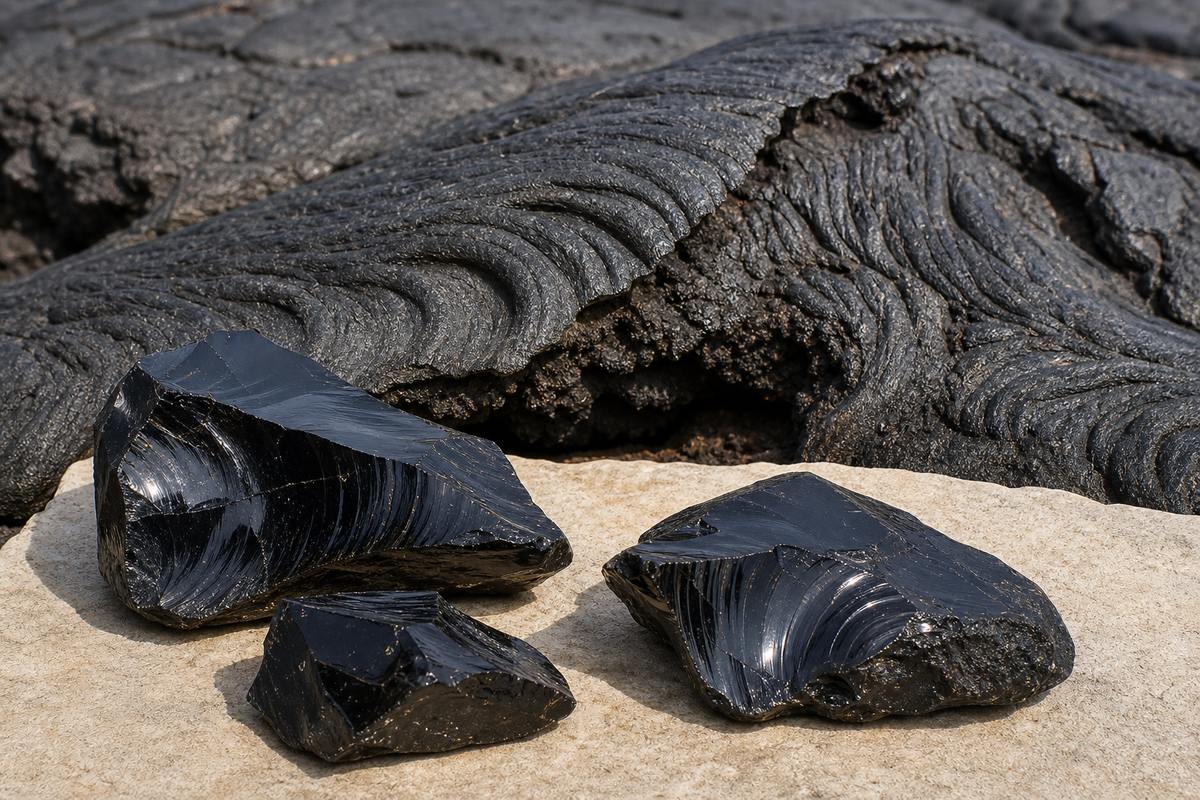
- Volcanic eruption or lava flow: silica-rich magma moves toward the surface, often in rhyolitic volcanic settings.
- Rapid cooling: contact with air, water, ice, or the cooler outside of a lava flow drops the temperature quickly.
- Amorphous glass forms: the material solidifies as glass rather than a visibly crystalline rock.
- Later alteration may occur: over long periods, hydration and devitrification can create new textures, spots, or secondary minerals.
Obsidian commonly occurs with other volcanic glassy or silica-rich materials such as rhyolite, perlite, and pitchstone. Well-known source regions include Mexico, the western United States, Iceland, Japan, and East Asian volcanic areas such as Tibet and the Changbai Mountain region.
Is Obsidian a Rock, Glass, Crystal, or Mineral?
The clearest everyday term is natural volcanic glass. Obsidian is produced by geological processes, so it belongs in the world of rocks. Its texture is glassy because the structure is amorphous, meaning it lacks the ordered crystal lattice found in quartz, jadeite, or feldspar.

In strict mineralogy, a mineral has a definable chemical composition and a crystalline structure. Obsidian is more variable in composition and lacks that regular crystal structure, so it is often described as an igneous rock, volcanic glass, or mineraloid. Jewelry sellers may still use the familiar phrase “obsidian crystal” because many readers search that way, but the more accurate explanation is volcanic glass used in symbolic stone jewelry.
Physical Properties and Fracture
| Property | Typical obsidian description | Practical meaning |
|---|---|---|
| Composition | Mostly silica, often around 70% or more, with smaller amounts of alumina, iron oxides, sodium, potassium, calcium, magnesium, and water. | Chemistry and inclusions influence color, sheen, and source identification. |
| Structure | Amorphous glass rather than large crystals. | Explains the glassy surface and very sharp fracture. |
| Hardness | Usually around Mohs 5 to 5.5, sometimes described in a wider 5 to 6 range. | Softer than quartz; polished jewelry can scratch or chip. |
| Density | Often roughly 2.3 to 2.6 g/cm3, with variation by composition and inclusions. | Natural beads usually feel more substantial than plastic imitations. |
| Refractive index | Commonly around 1.48 to 1.51. | A gemological test can help separate obsidian from some glass imitations. |
| Fracture | Conchoidal, producing curved surfaces and thin edges. | Useful for blades and tools, but fresh chips can cut skin. |
Freshly broken obsidian should be handled carefully. It can produce extremely fine cutting edges and tiny flakes. A polished bracelet or pendant is much safer for daily wear, but chips around bead holes or sharp broken edges still deserve attention.

Common Types of Obsidian
Many names used in jewelry describe appearance rather than separate mineral species. The mineralogical name remains obsidian or obsidian rock, while retail names help buyers understand color, sheen, and pattern.

| Type | Appearance | What creates the look | Jewelry note |
|---|---|---|---|
| Black obsidian | Deep black to very dark brown, often glossy. | Iron-bearing glass and thickness make it look nearly opaque. | Classic for bracelets, pendants, and protective-symbol jewelry. |
| Gold sheen obsidian | Black base with golden reflective areas. | Tiny bubbles or inclusions reflect light in a gold tone. | Popular for bold beads and prosperity-themed symbolism. |
| Silver sheen obsidian | Black base with silvery gray reflection. | Fine internal structures scatter light. | Works well in minimal, monochrome, and modern designs. |
| Rainbow obsidian | Subtle bands of green, purple, blue, gold, or red under strong light. | Microscopic structures and layers create iridescent reflection. | Quality depends on visible, natural-looking color movement. |
| Snowflake obsidian | Black ground with gray or white snowflake-like spots. | Cristobalite or devitrified patches form pale radial patterns. | A softer visual style for grounding and balance meanings. |
| Mahogany obsidian | Black and reddish-brown patches. | Iron-rich areas produce warm brown or red tones. | Good for earthy designs and strength symbolism. |
| Translucent or smoky obsidian | Brown, gray, greenish, or pale edges when held to light. | Thin sections reveal the natural glass body color. | Useful in authenticity checks, but transparency varies. |
Tools, Mirrors, Trade, and Archaeology
Obsidian mattered to ancient people because it could be shaped into very sharp, predictable edges. Archaeological finds across many regions include blades, scrapers, arrowheads, projectile points, knives, ritual objects, mirrors, and ornaments. Its cutting quality made it useful; its glossy dark surface also gave it visual and symbolic force.

Mesoamerican civilizations are especially known for sophisticated obsidian use, including prismatic blades and weapons set with obsidian edges. In other regions, obsidian mirrors and polished objects show how the material moved from practical toolstone into reflective and ceremonial use. Modern surgical blade research is sometimes mentioned because obsidian can produce a very fine edge, but the jewelry article only needs that fact as a material note, not as an industrial topic.
Obsidian is also important in archaeology because its chemical signature can often be matched to a volcanic source. Trace elements such as rubidium, strontium, zirconium, niobium, and barium help researchers study ancient movement, trade routes, resource access, and cultural exchange. A blade found far from its source can reveal a network of travel, exchange, or migration.
Obsidian in East Asian Archaeology
East Asian archaeology adds another important layer to the obsidian story. In the northeastern Eastern region around Jilin and Changbai Mountain, obsidian-rich archaeological contexts include late Paleolithic and other prehistoric stone tool sites. Finds from this region show that obsidian was an important raw material for sharp stone tools and that its distribution can help reconstruct ancient technical skill and movement.

The broader East Asian record also connects obsidian with exchange networks across the Changbai Mountain region, the Korean peninsula, Japan, and the Russian Far East. Because obsidian sources are limited and chemically distinctive, archaeologists can use it to study how communities obtained material from mountains, moved it across long distances, and shared tool-making traditions.
In jewelry writing, this East Asian background is useful because it prevents obsidian from becoming only a modern trend stone. It has a long human history as a material of cutting, reflection, trade, and transformation before it became a bead bracelet, pendant, or symbolic gift.
Modern Obsidian Meaning and Symbolism
In modern crystal culture and symbolic jewelry, black obsidian is often associated with protection, grounding, reflection, boundaries, truth, and inner steadiness. The dark reflective surface makes it an intuitive symbol for looking inward, clearing mental clutter, and choosing what to keep close or let go.

| Modern meaning | Better jewelry-language framing | Good use case |
|---|---|---|
| Protection | A symbolic shield, a reminder of boundaries, and a quiet blessing for safe movement. | Daily bracelet, travel gift, or meaningful object for a difficult season. |
| Grounding | A visual anchor for calm, presence, and returning to the body after stress. | Work desk, meditation corner, or simple black bead bracelet. |
| Truth and reflection | A mirror-like stone that invites honest self-observation. | Journaling, personal transition, or gift for a new chapter. |
| Courage and strength | Dark, polished material that feels steady and direct. | Unisex bracelet, pendant, or minimal stack. |
| Prosperity and abundance | Gold sheen obsidian can express a wish for steady growth and disciplined effort. | Career gift or business-opening blessing language. |
| Love and loyalty | A grounded gift that can symbolize commitment, steadiness, and care. | Partner gift when the tone is calm rather than romantic fantasy. |
Stronger claims around absorbing negative energy, sleep, physical vitality, illness, wealth, or fate are better translated into wellness and gift language. For example, an obsidian bracelet can be described as a calming personal reminder, a protective symbol in folk-style jewelry, or a gift for strength during change. That keeps the meaning alive while respecting the difference between symbolism and material fact.
Obsidian Jewelry and Design
Obsidian works well in jewelry because it has visual depth without needing bright color. A polished black obsidian bracelet can feel minimal, modern, and unisex. Gold sheen and silver sheen obsidian add movement under light, rainbow obsidian feels more expressive, and snowflake obsidian has a softer patterned look.

- Bracelets: bead size, polish, drilling, cord strength, and bead matching matter more than dramatic claims.
- Pendants: good for a single protective or reflective symbol worn close to the chest.
- Rings: visually strong, but more exposed to knocks and chips than bracelets or pendants.
- Layering: black obsidian pairs well with red string, jade, tiger eye, silver, wood, and warm gold accents.
- Gifting: best framed as protection, calm strength, grounding, commitment, or a blessing for a new chapter.
For Eastern Story, obsidian belongs naturally near blessing, protection, strength, and grounding themes. Readers who want symbolic pieces can browse the Blessing collection, while general stone-care habits are covered in the Eastern Story care guide.
How to Distinguish Obsidian from Manufactured Glass
Obsidian and manufactured glass can look similar because both are glassy materials. The goal is not to rely on one quick trick, but to combine appearance, light behavior, internal features, weight, seller disclosure, and gemological testing when value matters.

| Check | Natural obsidian may show | Manufactured glass or imitation may show |
|---|---|---|
| Light test | Thin edges often transmit smoky brown, tea-brown, gray, or greenish-brown light. | Some black glass may transmit blue, purple, red, or an unnaturally uniform color. |
| Internal texture | Flow bands, small natural inclusions, irregular veils, sheen, or snowflake structures. | Round bubbles, overly regular lines, or a very clean manufactured look. |
| Color variation | Natural color can shift subtly with thickness, layers, and inclusions. | Uniform dyed or molded color across every bead. |
| Weight and feel | Cool at first touch and reasonably substantial for its size. | Plastic and resin feel warmer or lighter; glass varies. |
| Professional testing | Refractive index, magnification, and source information can support identification. | Unclear results require a gemologist for higher-value pieces. |
Be careful with absolute online rules. Some genuine obsidian can be very dark, and some manufactured glass can be heavy and convincing. For expensive jewelry, unusual colors, or rare-source claims, ask for clear seller information or a reputable gemological report.
How to Clean and Store Obsidian
Obsidian is chemically stable enough for normal jewelry use, but it is brittle and can chip. Care should protect the polish, bead holes, stringing material, and any metal fittings.

| Care situation | Recommended handling |
|---|---|
| Daily wipe | Use a soft dry cloth after wearing to remove dust, skin oil, and light moisture. |
| Deeper cleaning | Use clean water and a soft cloth or very soft brush, then dry completely. Use mild soap only when needed. |
| Avoid | Harsh chemicals, perfume, alcohol, bleach, strong acids or alkalis, ultrasonic cleaners, high heat, and hard impact. |
| Water exposure | Brief water contact is usually manageable for the stone, but elastic, cord, glue, and metal parts may suffer. |
| Storage | Keep separately in a pouch or lined jewelry box so harder stones or metal do not scratch or chip it. |
| Symbolic cleansing | Moonlight, incense smoke, or quiet intention rituals can be used as personal practice; physical care remains simple and gentle. |
Obsidian Buying Checklist
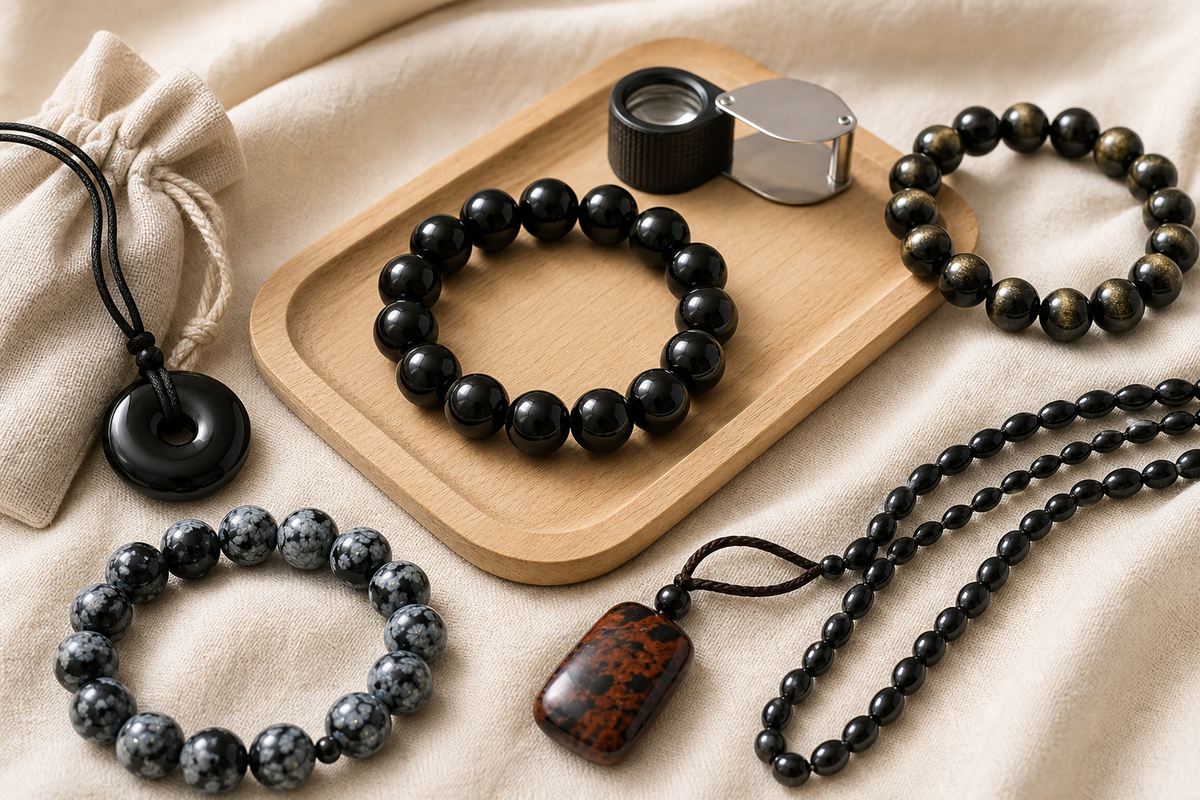
- Clarify the type: black, gold sheen, silver sheen, rainbow, snowflake, mahogany, or another named appearance.
- Check the surface: look for smooth polish, clean drilling, and no sharp chips around bead holes.
- Inspect the light effect: sheen or rainbow color should move naturally under light rather than look painted on.
- Ask about treatment: unusual colors and very uniform beads deserve clear disclosure.
- Match meaning to use: choose black obsidian for grounding and protection, gold sheen for steady prosperity language, snowflake for balance, or rainbow for more expressive personal symbolism.
- Choose honest language: good obsidian jewelry should feel meaningful without depending on dramatic promises.
Frequently Asked Questions
Conclusion
Obsidian is powerful as a subject because it is not only a black stone. It is volcanic glass, a tool material, an archaeological clue, a mirror-like object, and a modern symbol of protection and grounded reflection. Its sharp fracture explains ancient tools; its glassy darkness explains its visual and symbolic appeal.
When choosing obsidian jewelry, look for clear material information, clean polish, honest naming, comfortable design, and symbolism that feels calm rather than exaggerated. Worn this way, obsidian becomes a quiet object of strength: geological in origin, historical in use, and personal in meaning.
Related Posts


