
In Eastern symbolism, the pine symbolizes resilience, noble integrity, longevity, evergreen vitality, family continuity, loyal friendship, and auspicious blessing. It is honored as the chief of trees Bai Mu Zhi Zhang (百木之长) because it remains green through winter, roots itself in difficult places, and carries a straight, dignified spirit. A pine motif can bless an elder with long life, praise a person of principle, steady a home or business, and speak of friendship that stays green through changing seasons.
This is why pine tree symbolism appears so often in poetry, painting, temple and tomb landscapes, ceramic decoration, embroidery, architecture, jade carving, and modern Eastern blessing jewelry. The pine is not only a tree in the background. It is a moral figure, a longevity sign, a scholar's companion, a household blessing, and a refined gift language.
What Does the Pine Tree Mean in Eastern Culture?
The pine is one of the most complete symbols in Eastern culture because its natural form already reads like a philosophy. It is evergreen, so it speaks of life that continues. It grows on mountains, rocks, poor soil, and exposed slopes, so it speaks of endurance. Its trunk can twist with age without losing structure, so it speaks of strength with depth. Its needles remain sharp and gathered, so it suggests alertness, discipline, and a clear inner line.

Classical writers often used pine and cypress together to show character under pressure. In the Analects, Confucius says, “When the year turns cold, we know that pine and cypress are the last to wither.” The line gives pine its famous ethical meaning: a person's worth becomes visible when conditions are harsh. Li Bai's wish, “May you learn from the tall pine, and be careful not to become peach and plum,” turns the pine into advice against easy charm without lasting roots. Fan Yun's line, “In fierce wind one knows firm joints; under snow one sees a loyal heart,” makes the winter pine a picture of integrity.
In folk blessing, the same tree becomes warmer and more domestic. Evergreen branches suggest the household's fortune stays green. Deep roots suggest a stable foundation. Tall posture suggests a family, teacher, elder, leader, or business can remain dignified over time. Pine branches decorating a doorway, pine patterns on porcelain or embroidery, and pine carvings on beams or screens all turn the tree into a sign of auspicious protection and lasting vitality.
Quick Symbol Map: Resilience, Integrity, Longevity, Friendship, and Blessing
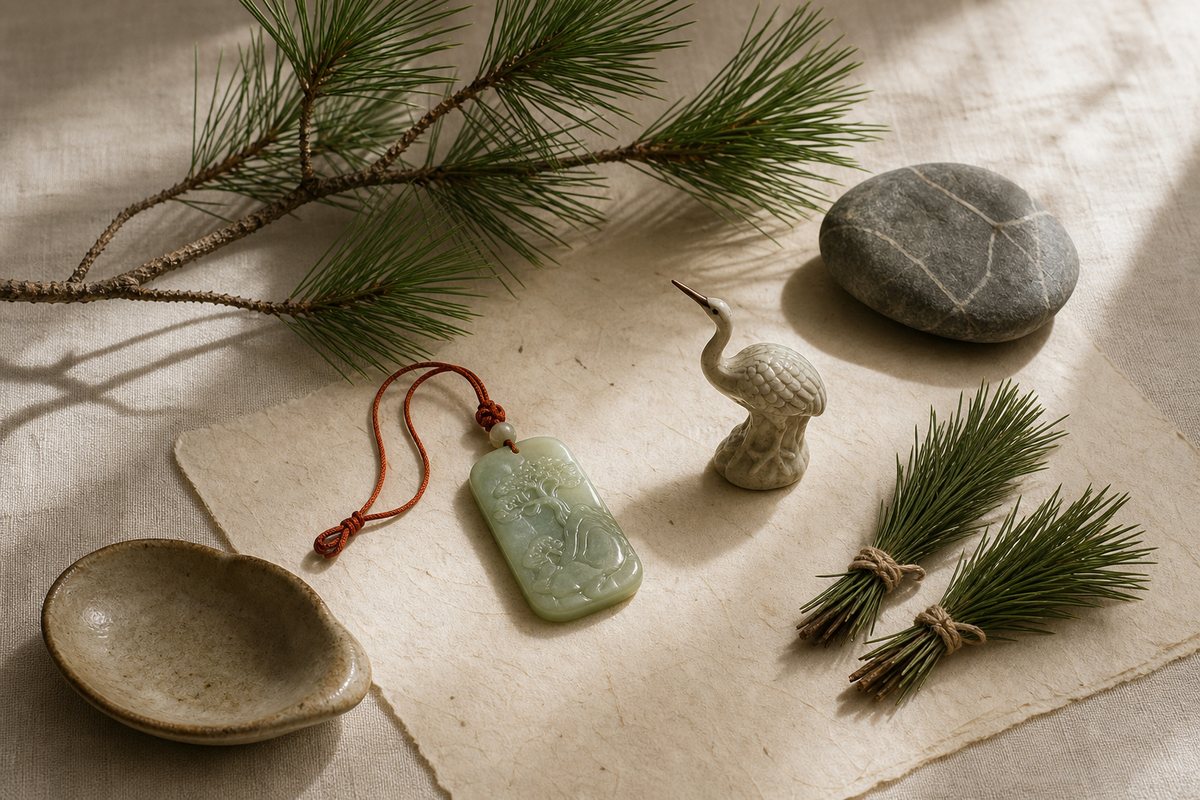
| Pine meaning | Eastern term or motif | How it reads in gifts, art, and jewelry |
|---|---|---|
| Resilience | Later-withering pine and cypress | A blessing for endurance through cold seasons, pressure, and difficult work. |
| Noble integrity | Gentleman spirit of pine | Upright character, principled conduct, and calm dignity. |
| Longevity | Pine and Crane Extend the Years Song He Yan Nian (松鹤延年) | A birthday and elder-gift wish for long life and steady health. |
| Evergreen vitality | Four-season green pine | Youthful spirit, continuing energy, and blessing that does not fade. |
| Family continuity | “As flourishing as pine and cypress” from the Book of Songs | Descendants, family roots, and virtues passed forward. |
| Loyal friendship | Pine-and-cypress friendship Songbai Zhi Yi (松柏之谊) | Companionship that remains true in hardship. |
| Quiet retreat | Pine, chrysanthemum, tea, qin, and mountain studio | Hermit culture, self-cultivation, and living in harmony with nature. |
| Home and business blessing | Rooted pine, tower pine, welcoming pine | Stable household, lasting enterprise, and noble welcome. |
Resilience and Noble Integrity: The Gentleman Spirit of Pine
The pine's strongest moral meaning is resilience joined with noble integrity. It does not only survive winter; it keeps its color and structure when other plants retreat. This is why pine became a natural emblem for the gentleman spirit: the person who does not bend toward convenience, panic, or shallow praise.

Three Friends of Winter Suihan Sanyou (岁寒三友), the group of pine, bamboo, and plum, turns this moral idea into a visual trio. Pine gives endurance, bamboo gives upright flexibility, and plum gives the courage to flower in cold air. Together they became a favorite theme in literati painting, scholar objects, porcelain, embroidery, and desk displays. A pine in this group is rarely decorative alone; it is a statement about character.
Later poetry continued the same reading. Chen Yi's poem Green Pine Qing Song (青松) says heavy snow presses on the green pine, yet the pine remains tall and straight; to know its noble purity, wait until the snow melts. The image is direct, almost severe: real dignity does not need to announce itself. It becomes clear when pressure passes.
This is also why pine motifs suit leadership gifts, graduation gifts, teacher gifts, and professional jewelry. They praise the recipient without flattery. A pine carving says: stay rooted, stand straight, keep your inner line, and let time reveal your strength.
Longevity, Evergreen Vitality, and Family Continuity
Pine is one of the clearest longevity symbols in Eastern folk tradition. The reason begins with nature: pine stays green through winter and many pines live for centuries. The familiar birthday wish compares long life to the ageless pine of the southern mountain. In art and gift language, that wish becomes visible through pine branches, old trunks, mountain rocks, cranes, deer, peaches, and auspicious clouds.

Pine and Crane Extend the Years Song He Yan Nian (松鹤延年) is the classic longevity pairing. The pine gives evergreen life and enduring roots; the crane gives refined long life and an immortal air. Pine and Crane Longevity He Shou Song Ling (鹤寿松龄) reverses the emphasis but keeps the same blessing: crane-like years and pine-like age.
Family continuity is another important layer. The Book of Songs uses the image “as flourishing as pine and cypress” to express growth, inheritance, and ongoing virtue. In modern gift language, this makes pine suitable for housewarming, family celebration, business opening, and heirloom-style jewelry. A pine does not only say one person will live long; it can say the family root, household fortune, and good name should continue.
Evergreen vitality also carries a youthful emotional meaning. Pine flower language includes firmness, chastity, longevity, faithful waiting, unique love, hope, renewal, joy, and peace. In a modern context, these meanings work well for a small pine pendant, a desk bonsai, a pine-scented object, or a gift note that wishes someone a steady and fresh beginning.
Hermit Culture, Quiet Strength, and the Literati Ideal
Pine also belongs to the world of hermits, scholars, mountain studios, and quiet self-cultivation. Tao Yuanming's Return Home Gui Qu Lai Xi Ci (归去来兮辞) includes the line that the three paths have grown wild, yet pine and chrysanthemum remain. Pine and chrysanthemum become companions of a person leaving noise behind and keeping an inner standard.

In painting and literature, the pine often appears beside a scholar playing the qin, drinking tea, receiving a friend, reading below a cliff, or walking through a mountain path. The sound of pine wind suggests a conversation with nature. The scene is not empty leisure; it is the ideal of harmony between human being and the natural order, often described as Tian Ren He Yi (天人合一), the unity of heaven and humanity.
This hermit layer gives pine-themed jewelry and jade pieces a quieter use. A pine-under-scholar pendant, a landscape plaque, or a small jade hand piece can feel less like a birthday symbol and more like a daily reminder to slow down, preserve judgment, and keep a clean inner space. For people who enjoy tea, calligraphy, incense, reading, or Wenwan hand play, pine is especially natural.
Pine as Friendship: Evergreen Companionship Through Seasons
Pine is also a friendship symbol, and the seasonal logic is easy to understand. It remains green in spring, summer, autumn, and winter. It does not withdraw when the weather turns cold. For friendship, that means companionship beyond mood, distance, advantage, and convenience.

The classical phrase pine-and-cypress friendship Songbai Zhi Yi (松柏之谊) describes deep friendship that stays firm and long lasting. Another elegant phrase, pine-hearted bond Song Xin Qi (松心契), points to a friendship joined by a pine-like heart: reliable, old, and difficult to break. These phrases are useful when a gift should feel more refined than simply saying “best friends.”
A pine gift for a friend can be a small bonsai, a jade pendant, a tea cup with Three Friends of Winter, a desk ornament, or a pine-scented creative object. For a friend starting a business, a pine bonsai can say that the roots should grow deep. For an old friend, a pine-and-cypress motif can say the friendship has already passed its winter tests.
Classic Pine Motif Combinations
Pine often becomes most expressive when paired with another symbol. These combinations are like short visual sentences. They tell the viewer whether the pine is speaking about longevity, friendship, rank, spring vitality, family continuity, or the scholar's spirit.

| Motif | Chinese term | Main blessing |
|---|---|---|
| Pine, bamboo, and plum | Three Friends of Winter Suihan Sanyou (岁寒三友) | Integrity, endurance, and refined strength in difficult seasons. |
| Pine and crane | Pine and Crane Extend the Years Song He Yan Nian (松鹤延年) | Long life, birthday blessing, elder respect, and immortal elegance. |
| Crane age and pine years | Pine and Crane Longevity He Shou Song Ling (鹤寿松龄) | A formal longevity wish for elders and ceremonial gifts. |
| Pine and deer | Pine and Deer Share Spring Song Lu Tong Chun (松鹿同春) | Longevity plus Lu (禄), meaning rank, prosperity, and spring blessing. |
| Pine and cypress | Pine-and-cypress friendship Songbai Zhi Yi (松柏之谊) | Loyal friendship, long-lasting virtue, and solemn continuity. |
| Pine and cypress shining together | Song Bai Tong Hui (松柏同辉) | Everlasting presence, dignity, ancestral memory, and shared endurance. |
| Pine and immortals | Many Immortals Offer Longevity Qun Xian Gong Shou (群仙拱寿) | A ceremonial birthday image of gathered immortals and long-life blessing. |
| Welcoming pine | Ying Ke Song (迎客松) | Hospitality, noble welcome, strong roots, and auspicious arrival. |
These motifs also help buyers choose. Pine and crane is most natural for elder birthdays. Pine and deer suits career, prosperity, and spring vitality. Three Friends of Winter suits teachers, scholars, graduates, and people who value inner character. Welcoming pine suits a business, office, or new home.
Pine in Art and Visual Design: Trunk, Needles, Space, Color, and Composition
A good pine image begins with structure. In painting, carving, photography, or landscape design, the trunk is the skeleton. It should feel strong, aged, and alive, often with a twisted or rugged line rather than a smooth decorative curve. Branches need rhythm: open enough to breathe, dense enough to hold force.

Pine needles work best in groups. Traditional visual logic gathers needles into fan-like or wheel-like clusters, then uses dense and sparse areas to create depth. The same rule appears in carving and jewelry: a designer does not need to show every needle. The better design shows the spirit of the needles through grouped rhythm.
Negative space matters. Empty space around an old pine lets the tree stand like a character in a quiet scene. In ink painting, pale mountains, mist, and distant water create high depth. In photography, morning or evening light can reveal the layers of a pine forest, while a white wall and a single shaped pine create a clean, refined composition.
Color logic often uses a cool base and a warm focus. Deep green pine, blue water, gray rock, and ink-black lines can support a warmer human figure, flower, gold accent, or red seal. The result is cold supporting warm, quiet supporting bright. In one sentence, strong pine design has a powerful skeleton, ordered density, intentional empty space, and clear layers.
Pine in Jade Carving and Jewelry
Pine is a classic subject in jade carving because its meaning fits the nature of jade. Jade already suggests refinement, virtue, lasting beauty, and a warm relationship with the body. Pine adds resilience, long life, roots, and gentlemanly character. Together they make a piece feel both wearable and cultural.

Common pine jade forms include pine and crane pendants, pine and deer plaques, welcoming pine scenes, pine-under-scholar landscapes, mountain-water plaques, Three Friends of Winter hand plaques, small desk ornaments, and hand pieces for Wenwan play. A pine carving can be formal enough for elder gifts, restrained enough for men's daily wear, and quiet enough for tea-room or study display.
Material changes the mood. Hetian jade (和田玉) works well when sugar-white jade uses its brown sugar color for old trunk, rock, or dry bark, while the pale white area becomes mist, mountain, or open sky. Green nephrite or spinach-green jade can show pine needles with a deep, oily color. Jadeite Feicui (翡翠) can make the pine feel fresh and clear; with 18K gold and diamond accents, it can become a contemporary brooch or pendant. Xiuyan jade Xiu Yu (岫玉), including 501 or patterned material, can be carved into small pine desk pieces or tea-table ornaments with a more niche, natural mood.
| Jewelry or carving form | Best symbolic use | Good recipient |
|---|---|---|
| Pine and crane pendant | Longevity, health blessing, birthday respect | Elders, parents, grandparents, mentors. |
| Pine and deer plaque | Long life plus Lu prosperity and career movement | Leaders, clients, business owners, professionals. |
| Welcoming pine carving | Hospitality, noble welcome, stable backing | New home, new office, shop opening, partner gift. |
| Pine-under-scholar landscape | Quiet strength, self-cultivation, cultured restraint | Teachers, readers, tea lovers, calligraphy lovers. |
| Three Friends of Winter hand plaque | Integrity through difficult seasons | Graduates, colleagues, friends, people in demanding work. |
| Small pine hand piece | Wenwan play, calming touch, inner steadiness | Collectors, fast-paced workers, people who enjoy mindful objects. |
Pine Gifts and Wearing Guide
Pine-themed gifts are strong because they can be formal, poetic, or practical. The key is to choose the right motif for the relationship. A pine gift for an elder should lead with longevity. A pine gift for a leader or client should lead with stable roots and noble character. A pine gift for a friend should lead with evergreen companionship.

| Occasion | Recommended pine form | Message carried |
|---|---|---|
| Elder birthday, Spring Festival, Double Ninth Festival | Pine and crane jade, pine-crane painting, pine bonsai | Long life, health, respect, and blessing that stays green. |
| Leader or client gift | Five-needle pine bonsai, tower pine, pine and deer jade plaque | Stable enterprise, deep roots, calm authority, and refined taste. |
| Housewarming or opening | Welcoming pine, tower pine, shaped bonsai, pine ornament | Household stability, rooted fortune, steady customers, lasting growth. |
| Teacher or graduate | Three Friends of Winter, pine-under-scholar, pine landscape plaque | Academic continuity, upright character, gratitude, and future strength. |
| Friend or colleague | Small pine plant, pine pendant, pine tea object, pine scent | Evergreen friendship, calm companionship, and relaxed daily rhythm. |
| Professional men's wear | Low-relief pine landscape plaque, dark cord jade pendant | Reserved dignity, resilience, and gentlemanly bearing. |
| Wenwan and quiet practice | Three-dimensional pine hand piece, pine-bamboo-plum hand plaque | Mindful handling, inner quiet, and self-cultivation. |
Modern gift language also uses a light sound association: song (松) can echo qing song (轻松), meaning ease or relaxation. A small desktop pine, pine-shaped diffuser, or pine-scented object can therefore wish someone a smoother, less anxious daily pace while still carrying the deeper evergreen symbolism.
How to Choose and Care for Pine-Themed Jade or Jewelry
When choosing pine-themed jade or jewelry, begin with the line. The trunk should have strength, not stiffness. Branches should be clear and rhythmic, not crowded into a flat texture. Pine needles should be grouped with intention. If the design includes crane, deer, scholar, mountain, or bamboo, the secondary motif should support the pine rather than make the piece visually noisy.

- Choose pine and crane when the main message is longevity and elder respect.
- Choose pine and deer when the message includes rank, prosperity, business, or career growth.
- Choose Three Friends of Winter when the message is character, learning, friendship, or resilience.
- Choose welcoming pine when the message is hospitality, home stability, or business opening.
- Choose Hetian jade for a warm, traditional, understated feeling; choose jadeite for a brighter and more modern feeling; choose Xiuyan jade for desk pieces and softer natural atmosphere.
- For daily wear, check protruding branches, thin openwork, sharp edges, cord strength, and whether the pendant sits comfortably against clothing.
Care is simple but important. Protect jade from collision, especially along thin pine branches, crane legs, deer antlers, and openwork areas. Keep jade away from oil smoke, perfume, strong detergent, and harsh cleaning chemicals. After heavy sweat, rinse gently with clean water and dry with a soft cloth. For long storage, avoid extreme dryness and keep a moderate level of humidity. Do not mix jade in the same pouch with diamonds or other very hard stones that can scratch its surface.
Frequently Asked Questions
Conclusion
Pine tree symbolism is powerful because it joins nature, ethics, longevity, friendship, and gift language in one image. As the chief of trees Bai Mu Zhi Zhang (百木之长), the pine stands for a life that stays green, roots that hold firm, a character that winter reveals, and a blessing that can pass from one generation to the next.
For related Eastern blessing symbols, continue through the Eastern Story Blessing collection, crane symbolism, jade carving pattern meanings, jade meaning in Eastern culture, Hetian jade guide, auspicious cloud meaning, lingzhi meaning, and deer symbolism.
Related Posts


One Comment