
Tibetan bone jewelry is not one single tradition or one kind of object. The label may refer to animal-bone jewelry made or worn in Tibetan cultural regions, bone ornaments represented in Himalayan Buddhist art, specialized ritual objects, or modern “Tibetan-style” products made for tourism and export. Each belongs to a different context. A thoughtful reading begins with the object’s actual material, function, origin, and relationship to the people or practice it claims to represent.

For many wearers, a well-documented contemporary animal-bone piece can carry a quiet wish for resilience, remembrance, gratitude, or steadiness. These meanings feel strongest when they grow from an honest material story. They should not be built on invented regional customs, miraculous powers, or a sensational story about human remains.
Four contexts hidden inside the label “Tibetan bone jewelry”
| Context | What it may include | How to approach it |
|---|---|---|
| Dress and personal adornment | Jewelry or dress components used by people in particular Tibetan cultural regions, periods, families, or occasions | Look for a museum, maker, family, or regional record; do not turn one example into a rule for all Tibetan people |
| Himalayan Buddhist imagery and ritual | Bone ornament sets shown on particular tantric figures, ritual aprons, beads, or instruments | Identify the figure, lineage, object type, and ritual setting before interpreting individual parts |
| Modern Tibetan-style market goods | Skull beads, carved pendants, bracelets, resin replicas, or mixed-material jewelry | Treat “Tibetan-style” as a design or market label until origin and material are documented |
| Ordinary animal-bone jewelry | Yak, cattle, camel, or unspecified animal bone made into beads and carvings | Evaluate it as animal material and jewelry construction; geography or sacred status cannot be inferred from appearance |
This separation protects both cultural meaning and the buyer. A carved bone bracelet does not become a religious object merely because it carries a skull, vajra, mantra-like script, turquoise-colored inlay, or a marketplace description using the word “Tibetan.” Conversely, an object documented within a religious collection should not be reduced to a fashion accessory.
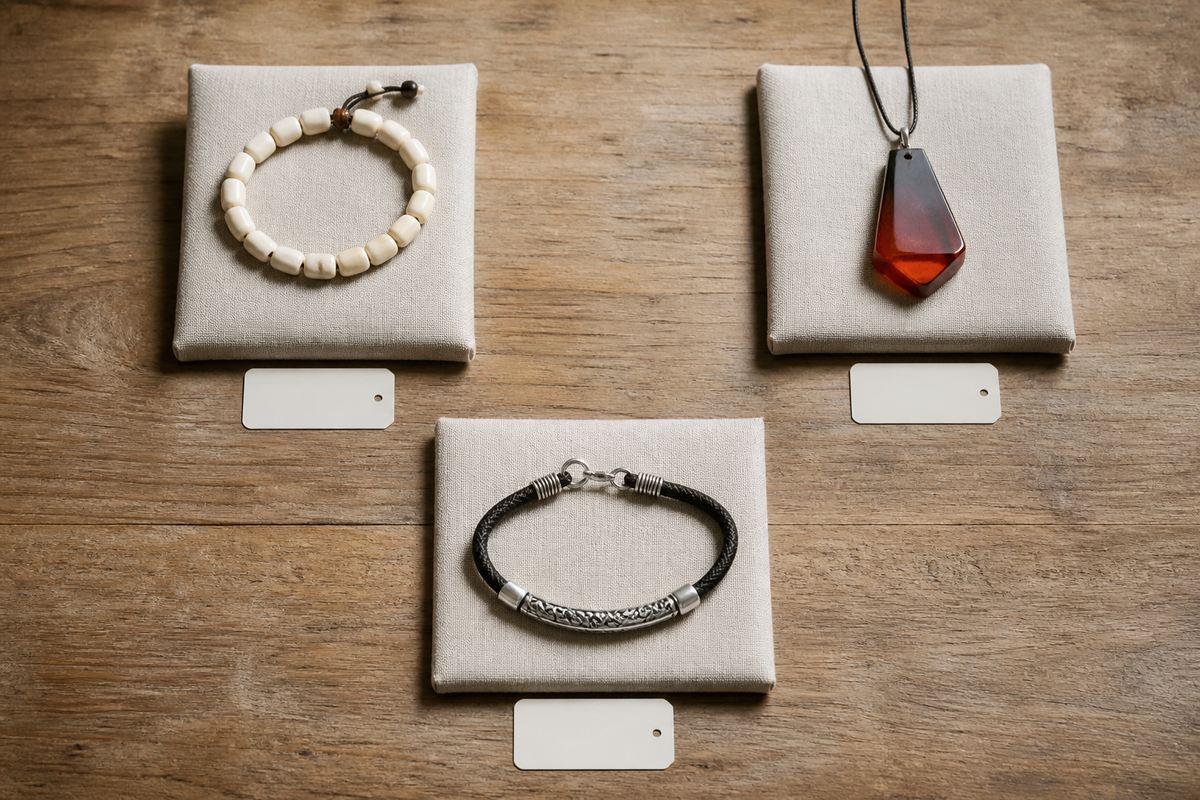
The broader introduction to Tibetan Buddhism explains why school, teacher, text, practice, and community matter. This page stays with bone jewelry and ornaments rather than trying to summarize Tibetan religion or dress as a whole.
Meaning in Himalayan Buddhist art and ritual
Bone imagery can make mortality visible. In some tantric images and ritual settings, it participates in a language of charnel grounds, impermanence, transformation, and freedom from attachment. Wrathful forms may express the forceful transformation of destructive states within a disciplined religious system. The imagery is neither generic decoration nor evidence that every person wearing animal-bone jewelry follows the same practice.
Historical objects show the material complexity of this field. The Metropolitan Museum of Art catalogues a sixteenth-century bone plaque from a Tibetan tantric ritual apron. The Rubin Museum catalogues eighteenth- or nineteenth-century human-bone prayer beads as a ritual object. These records support two careful conclusions: bone was used in specific historical religious contexts, and a prayer-bead strand is not the same object as a body ornament or apron.

Why fixed “six ornaments” charts are risky
Lists of bone ornaments vary with deity, iconographic program, text, and practice. Crowns, earrings, necklaces, chest or shoulder elements, girdles or aprons, bracelets, and anklets may appear, but they should be read as part of the complete image: posture, faces, hands, implements, consort, setting, and lineage all matter. Online charts that force every part into one universal six-perfections table often combine distinct traditions or repeat unsupported correspondences.
The same caution applies to a five-skull crown, sets described as six ornaments or six seals, and groups associated with charnel-ground imagery. They are related areas of tantric visual language, not interchangeable labels. When an authoritative museum record or iconographic source cannot confirm the figure and attribute, it is better to describe what is visibly present than to guess.

Prayer beads, kapāla, kangling, and Gawu are different objects
Precise names matter. Kapāla is a Sanskrit word for a skull or skull vessel; it is not a generic name for an ordinary bone bead. Kangling names a ritual trumpet traditionally associated with a human thighbone or a substitute made in another material. A Gawu is a portable religious shrine or amulet case, not an ordinary jewelry box. These terms describe different forms, histories, and uses.

Prayer beads are counting and devotional tools. They may be made from bone, seed, wood, stone, shell, or other materials. Readers interested in counting practice can use the mala meditation guide. The wider category of wrist malas and meditation bracelets remains separate from tantric bone ornaments.
Inscriptions deserve their own check. Tibetan, Sanskrit, Chinese, and stylized decorative marks can be misread when carved around a small bead or photographed in reverse. If a mantra or one of the Eight Auspicious Symbols is not clearly legible, do not display a guessed transcription or invented translation. The prayer wheel guide offers a useful comparison: sacred text, object structure, and intended use must be read together.
Materials: what a seller’s label can and cannot prove
Animal bone can be shaped into beads, rings, buttons, pendants, plaques, and carved fittings. Yak or cattle bone may be a by-product of food or pastoral economies, but that history must be documented for the individual product. A pale carved surface cannot prove yak, cattle, camel, species, region, age, or ethical sourcing. Camel bone likewise does not become Tibetan, antique, or sacred through appearance.

| Market description | What it may mean | What remains unproven without records |
|---|---|---|
| Yak bone | Animal bone claimed to come from yak | Species, Tibetan origin, by-product status, age, workshop, or cultural use |
| Camel bone | Animal bone claimed to come from camel | Species, source country, age, density grade, Tibetan connection, or religious meaning |
| Mammoth bone | A frequently confused or misused label | Whether the object is bone at all; mammoth ivory is tusk dentine, not bone |
| Tibetan bone | A cultural, geographic, material, or style claim | Which of those meanings the seller intends |
| Resin, composite, or imitation | A modern molded or fabricated material | Durability, pigments, fillers, and whether the design copies a restricted object |
The dedicated yak bone jewelry guide covers that claimed species and its material story. The camel bone material guide and camel bone bracelet guide handle camel bone without treating it as a shortcut to Tibetan authenticity. The Bodhi guide is useful when a hard, pale bead is actually seed rather than bone.

Ivory, coral, shell, and protected wildlife
Mammoth ivory is tusk material, not “mammoth bone.” Its trade rules differ by jurisdiction, and similar-looking materials can complicate enforcement. The current CITES identification guide for ivory and ivory substitutes explains why species-level identification matters. Elephant ivory faces severe international and domestic restrictions; the U.S. Fish and Wildlife Service, for example, notes that international commercial trade is prohibited under CITES and that imports, exports, state rules, age, species, and documentation can all affect legality.
Modern coral, giant-clam shell, other protected shells, tiger material, and wildlife derivatives require the same discipline: check the current CITES appendices, customs rules, and local law before any transfer. Historical use in jewelry does not make modern trade lawful. If the material cannot be identified and documented, do not buy it and do not accept a story that reframes a protected material as “old bone,” “fish bone,” or “traditional shell.”

Human remains: a firm boundary for ordinary consumers
Any object suspected of containing human bone should leave the ordinary jewelry market. Do not buy it, wear it, give it, request an appraisal, attempt home identification, or seek to increase its collectible value. Do not repeat sales stories about a monk voluntarily donating brow bone or finger bone, millions of recitations, secret temple release, or guaranteed lineage unless a qualified institution can document the exact object—and even then, the issue is stewardship rather than shopping.
Human-remains law varies widely. Consent, excavation, export, public display, cultural property, Indigenous or religious patrimony, and repatriation may be governed by different rules in different places. The deeper standard is human dignity. The Smithsonian’s current policy treats human remains as parts of once-living people, sharply restricts acquisition and display, and centers documented consent, descendants, descendant communities, and return. That institutional approach is a better guide to the seriousness of the material than a retailer’s provenance tale.

If an inherited or found object may contain human remains, stop handling it unnecessarily and keep all existing records. Contact an appropriate museum, law-enforcement or customs authority, cultural-heritage office, or professionally authorized institution. Do not post close-up images for crowdsourced identification when doing so could expose sensitive human material or encourage trade.
A practical, non-destructive sourcing check
No home test can turn an uncertain bone object into a documented Tibetan artifact. Destructive household tests, improvised light or sound tricks, color grading, translucency, and patina formulas are unreliable and may permanently damage the object. Surface pores may help a conservator distinguish broad material families, but they do not prove species, age, geography, or whether bone is human or animal.
- Ask for the material name in writing, including the species when the seller claims one.
- Ask where and when the object was made, who made it, and whether it is contemporary, vintage, antique, ritual, or simply Tibetan-style.
- Keep the invoice, prior ownership history, and any export or import permits that actually apply.
- Check whether every added material—metal, coral, shell, ivory-like component, stone, pigment, glue, or textile—has its own disclosure.
- For an older cultural object, consult a museum or qualified specialist before cleaning, transporting, displaying, or transferring it.
- When the seller cannot explain the material and lawful source consistently, walk away.
A document is useful only when it records facts that can be checked. Spiritual claims and seller-created grades cannot substitute for provenance, species identification, lawful transfer records, or institutional expertise.

Inspect the jewelry as a wearable object
Meaning cannot compensate for unsafe construction. Examine bead holes for sharp edges and radiating cracks. Flex the strand gently and look for frayed cord where it enters each hole. Check knots, elastic fatigue, clasp security, metal burrs, exposed wire, unstable inlay, lifting paint, and failed adhesive. Heavy pendants and pointed skull carvings can strike the chest, catch clothing, or scratch neighboring beads.

Skin contact, metal, weight, and small parts
If a seller calls metal “hypoallergenic,” ask for the actual alloy, plating, ear-post, and clasp materials. Nickel or another sensitizing metal may be present in findings even when the carved component is bone. Earrings need smooth posts, secure backs, balanced weight, and no sharp carving near the neck. A pendant or bracelet should not pinch, rotate into the skin, or strain a weakened hole.

Loose beads, bells, caps, inlays, and charms are choking or swallowing hazards for children and pets. Store broken pieces immediately and repair them before wear. Choose wrist, side, or styling by comfort and personal relationship to the object—not by invented gender, left-hand, right-hand, or energy rules.
Wearing, displaying, and gifting with respect
A contemporary, clearly documented animal-bone or imitation piece can be worn as meaningful jewelry when the wearer understands what it is. Its wish might be resilience through change, gratitude for a material used carefully, remembrance of life’s brevity, or companionship on a difficult path. The object carries that wish through honest story and personal intention.

Religious imagery changes the decision. Consider whether the symbol is accurately identified, whether the wearer has a respectful relationship to it, and whether the maker intended ordinary wear. A Gawu, consecrated object, historical ritual piece, or lineage-linked object may require guidance from its source community or custodian. Do not turn thangkas, prayer flags, butter lamps, incense burners, or ritual objects into a generic “Tibetan aesthetic” backdrop.
For a gift, disclose the material and story before the recipient opens it. Some people find skull or mortality imagery grounding; others find it painful or inappropriate. Choose a different gift when the person has not expressed comfort with the imagery, when the inscription cannot be read, or when provenance is uncertain. Human remains are never gifts.

Gentle care for bone jewelry
For ordinary, stable animal-bone jewelry, begin with clean, dry hands and the least intervention. Wipe smooth surfaces with a dry, soft cloth; use a soft brush around carving and bead holes. Avoid soaking, high heat, direct sun, rapid humidity changes, perfume, skin cream, household cleaners, alcohol, bleach, peroxide, ultrasonic machines, and steam. Do not oil or wax the surface to manufacture color or patina.

The Canadian Conservation Institute’s care guidance for bone, ivory, horn, and antler explains that identification and condition matter, that rapid temperature or humidity change can cause damage, and that light dusting with a soft brush is often sufficient. It also warns against soaking and refers cracked, porous, stained, or damaged objects to a conservator.
- Store each piece separately so hard metal or stone cannot chip the bone.
- Use soft cushioning and breathable or conservation-appropriate materials; avoid pressure on thin carvings and projecting parts.
- Remove jewelry before bathing, swimming, strenuous exercise, cleaning, or applying fragrance and cosmetics.
- If a strand becomes wet, blot it gently and allow it to stabilize away from heat; do not use a hair dryer or direct sun.
- Re-string when cord shows fuzzing, flattening, discoloration, or cuts at bead holes.
- Ask a professional conservator about painted, inlaid, glued, antique, ritual, or high-value objects.
The general Eastern Story Care Guide can help with mixed-material jewelry, but the most fragile component sets the care limit. A bone bead joined to coral, painted wood, soft cord, plated metal, or old adhesive needs a plan that protects the whole construction.

Carry the story without carrying a false claim
Tibetan bone jewelry can open a thoughtful conversation about resilience, mortality, transformation, craft, and the many ways people give meaning to material objects. That conversation becomes richer when its boundaries stay clear: Tibetan people and regions are diverse; tantric bone imagery belongs to specific religious contexts; modern Tibetan-style goods are a market category; ordinary animal-bone jewelry needs honest sourcing; and human remains demand dignity rather than commerce.
Choose a piece whose material and history can be explained in plain language. Check its structure, preserve its records, care for it gently, and let its wish accompany real life without borrowing a story that the object cannot truthfully carry.

Frequently Asked Questions
Related Posts


