
Yak bone jewelry carries a wish for resilience, gratitude, peace, and the wise use of what life provides. For people drawn to objects with a story, a bone bead, bracelet, or pendant can become a quiet companion through a new beginning, a difficult season, or a meaningful gift. Its warmth comes not from spectacle, but from the relationship between highland life, careful handwork, and the hope of moving forward with patience.
At the same time, “yak bone” should be a real material description, not a vague style label. A respectful piece is supported by clear information about species, source, processing, surface treatments, added materials, and the people who made it. This guide explains that material truth while keeping the human meaning at the heart of the story.

Why the yak can carry a wish for strength and gratitude
Domestic yaks have long accompanied communities across the high plateaus of Asia, supporting pastoral life with transport, fiber, milk, fuel, and food. That close relationship makes the yak an understandable image of endurance, patience, and dependable presence. In jewelry, these qualities can be carried forward as a personal wish: steadiness when the path is demanding, gratitude for daily support, and respect for resources already given.

A yak bone bracelet may be chosen before a journey, a pendant may mark recovery from a difficult chapter, and a simple bead may be given to someone beginning a new home or vocation. The object can invite ping an ru yi (平安如意)—peace and the hope that life unfolds as wished. It can also express “all things as you wish,” not as a rigid formula, but as a tender way to say: may you meet change with courage and remain close to what matters.
What yak bone jewelry is actually made from
Yak bone jewelry is made from cleaned and processed bone attributed to domestic yak. Like mammalian bone generally, it is an organic–mineral composite whose mineral phase is largely hydroxyapatite and whose organic matrix includes collagen. Finished pieces vary because bone structure, cleaning, drying, carving, dye, fill, coating, polishing, and years of handling can all change appearance.
Color alone cannot establish species or origin. Cream, pale yellow, brown, darkened carving, and mottled surfaces may reflect the original material, age, dirt, oxidation, dye, bleaching, coating, or other treatment. Fine pores or channels may support an identification as bone, but they do not prove that the animal was a yak. For an important or high-value object, maker records and professional materials analysis offer firmer answers than household tests.

Yak bone, other bone, horn, resin, and plant ivory
| Material | What it is | What a buyer should confirm |
|---|---|---|
| Yak bone | Processed bone from domestic yak | Species basis, source region, by-product or recovered-material claim, and treatments |
| Other animal bone | Cattle, sheep, camel, or another disclosed species | Exact species and whether the listing uses “yak” only as a style term |
| Horn | Keratin material that may show layers or fibrous growth and translucency at thin edges | Animal source, stabilization, dye, and care needs |
| Resin or plastic | Molded or cast synthetic material | Honest composition; repeated patterns, bubbles, or seams can be clues but are not conclusive alone |
| Plant ivory (tagua) | Hard endosperm from palm seeds | Botanical material disclosure; it is neither bone nor animal ivory |
| Protected animal material | Ivory, horn, tooth, coral, shell, or wildlife material regulated by species and jurisdiction | Do not rely on resemblance or a seller’s informal label; check current official rules before purchase or travel |
Do not burn, heat, cut, soak, strike, or expose jewelry to chemicals in an attempt to identify it. These tests can damage the piece, release harmful fumes, and still fail to determine species. A qualified appraiser, conservator, or laboratory is the right boundary when visual inspection and documentation are insufficient.

Respectful sourcing, ethics, and cross-border rules
Yak bone may enter craft supply through livestock and meat by-products, recovered material, or another lawful supply chain. A seller should not assume that every piece came from an animal that died naturally, a monastery, a sacred site, or a particular plateau community. Those are specific claims that require specific evidence.
- Ask which species the maker believes the bone comes from and what supports that identification.
- Ask the country or region of origin and whether it was a livestock by-product or another form of recovered material.
- Request disclosure of dye, bleach, pigment, resin fill, stabilizer, coating, adhesive, and metal components.
- Ask who carved and assembled the piece and whether it can be restrung or repaired.
- Before ordering internationally or carrying the item across a border, check current customs, wildlife, animal-product, and marketplace rules for both locations.
Transparent domestic-yak bone is materially different from elephant ivory, rhinoceros horn, protected coral, regulated shell, or unidentified wildlife bone and tooth. Eastern Story does not encourage those protected materials as decorative companions. Clear sourcing allows gratitude and resourcefulness to remain part of the object’s meaning rather than being replaced by uncertainty.

Common forms and how they are crafted
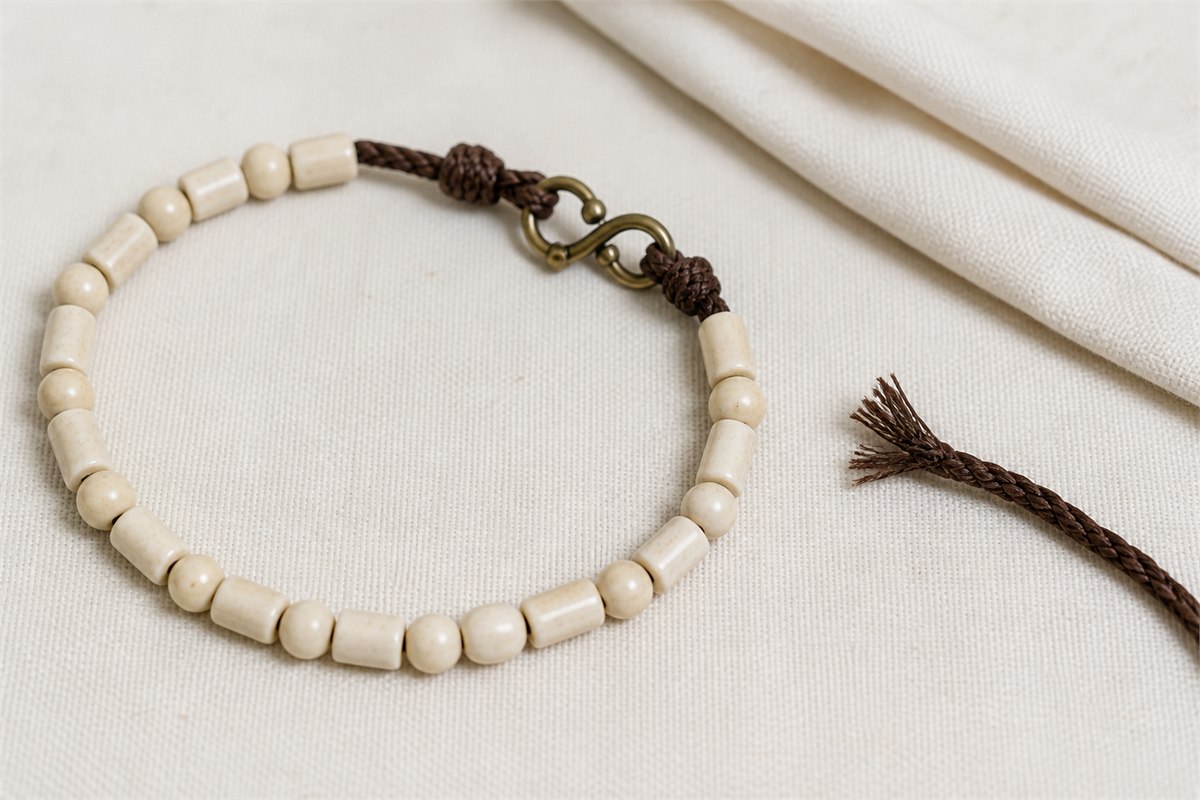
Yak bone may appear as round or tubular beads, carved pendants, bracelet components, decorative trade beads, inlay, or mala-style strands. A mala can have religious meaning in a defined tradition, while a mala-style necklace may simply borrow the long-strand form. Bead count and structure vary by tradition, intended use, and modern design; a seller should describe the particular object rather than present one arrangement as universal.

At a high level, professional preparation may include cleaning, degreasing, stable drying, cutting, shaping, carving, drilling, polishing, disclosed coloring or filling, and assembly. These stages belong with makers who have suitable safety equipment and materials knowledge. Hand finishing can leave gentle asymmetry, while machine production can create greater uniformity; neither feature alone proves authenticity or quality.

Choosing a piece for yourself or someone important
Begin with the wish and relationship. A restrained bracelet can accompany daily routines as a reminder of patient strength. A pendant can rest close to the heart during travel or transition. A bead given between friends may carry thanks for dependable support; a family gift may welcome peace, health, harmony, and long companionship. These objects express a wish—a medium through which people hope to bring about wealth, health, virtue, longevity, or a specific outcome in life.

Check comfort and structure
- Run a soft cloth around carved edges to reveal snags or sharp points.
- Inspect bead holes, pendant holes, cord, elastic, knots, clasps, settings, and inlay for cracks or movement.
- Choose a fit that leaves comfortable space without letting heavy components strike the wrist or chest.
- Keep small beads and loose components away from children and anyone at risk of swallowing them.
Read added materials separately
Turquoise, lapis lazuli, agate, amber, glass, resin, dyed stone, and metal each have their own identity and care needs. “Turquoise-colored” or “coral-colored” is not the same as a verified natural material. For metal terminology, see the Tibetan silver material guide; for settings and symbolic rings, use the Tibetan ring guide.
Cultural and religious boundaries
Everyday jewelry, decorative trade beads, prayer beads, and specialized ritual objects are not interchangeable categories. Bone materials can carry reflections on impermanence, gratitude, memory, or the careful use of life’s resources in particular cultural and religious settings. Yet a generic yak bone bracelet should not be presented as a consecrated object or confused with specialized ritual objects made from other materials.
When a carving includes a Buddhist figure, mantra, script, ritual implement, or sacred emblem, accurate identification and context matter. Avoid combining unrelated motifs into a generalized “Tibetan” story. The introduction to Tibetan Buddhism offers a respectful starting point for understanding the difference between doctrine, devotion, ritual material, and commercial ornament.

How to care for yak bone jewelry
Because bone combines organic and mineral components, finished pieces respond differently according to processing and surface treatment. After wear, wipe gently with a clean, dry, soft cloth. Avoid prolonged water exposure, steam, ultrasonic cleaning, strong cleaners, perfume and cosmetic residue, direct sun, high heat, sudden temperature changes, and impact.
Store the piece on its own in a soft pouch or box in a dry, ventilated place. Check periodically for enlarging cracks, worn cord, rough drill holes, loose clasps, lifting inlay, or flaking surface treatment. Oils, waxes, airtight sealing, and repeated handling can change color or trap dirt and moisture, so apply a treatment only when the original finish is known and a seller or professional conservator recommends it.
If the jewelry develops a persistent odor, mold-like spots, tackiness, coating loss, or a widening crack, stop wearing it and consult the seller or a qualified repair professional. The broader Care Guide can help when bone is combined with cord, stone, resin, or metal.

A story of steadiness to carry forward
The most meaningful yak bone jewelry brings material honesty and emotional warmth together. It remembers the yak as a patient highland companion, honors skilled hands, values responsible use, and carries a wish for resilience, gratitude, peace, and a life lived with care. Chosen thoughtfully, it can become a small promise to yourself or someone you love: meet the road steadily, cherish what supports you, and welcome all things as you wish.
Frequently Asked Questions
Related Posts


