
Jade carving meanings are read through motif, shape, material, carving technique, line detail, inscription, and gift context. In Eastern jade culture, jade must have craft, craft must have meaning, and meaning must be auspicious (玉必有工,工必有意,意必吉祥). A Pixiu, lotus, bamboo, bat, dragon, phoenix, jade bi, or plain Wu Shi Pai can turn a jade piece into a blessing for safety, wealth, love, study, longevity, or personal virtue.
This is why jade carving meanings (玉雕图案寓意) are never only decoration. Every image must have meaning, and every meaning must be auspicious (图必有意,意必吉祥). A line can show movement, a skin-color edge can become a cloud or flower, a small inscription can name the blessing, and a gift card can help the receiver understand why this motif was chosen.
Quick Meaning Map: Motif, Symbol, Best Gift Use, Common Jade Form

| Motif or form | Main blessing | Best gift use | Common jade form |
|---|---|---|---|
| Pi Xiu (貔貅) | Wealth gathering, guarding fortune, blocking harmful energy | Career people, business owners, people starting a new money goal | Pendant, bracelet charm, desk object |
| Dragon and phoenix / Long Feng (龙凤) | Power with harmony, auspicious union, paired happiness | Partners, wedding gifts, engagement gifts | Paired plaques, round pendants, relief plaques |
| Qilin (麒麟) | Auspicious arrival, noble children, peaceful rule | Family blessings, new home, child-related gifts | Pendant, small display carving |
| Jade cicada / Yu Chan (玉蝉) | A sudden breakthrough, study success, clear voice | Students, exams, career launches | Pendant, small charm |
| Bamboo joint / Zhu Jie (竹节) | Rising step by step, integrity, smooth progress | Career gifts, promotion gifts, students | Pendant, bracelet segment |
| Gourd / Hu Lu (葫芦) | Fu and Lu blessings, family continuity, many descendants | Elders, family gifts, home decor | Pendant, small hanging, display piece |
| Cabbage / Bai Cai (白菜) | Hundred wealth, clean family tradition | Business, wealth, housewarming | Display carving, pendant |
| Four-season bean / Si Ji Dou (四季豆) | Four seasons of peace, Fu-Lu-Shou blessing | Elders, family, general blessing | Pendant, charm |
| Ping An Kou (平安扣) | Peace, wholeness, smooth daily life | All ages, travel, family gifts | Round pendant |
| Wu Shi Pai (无事牌) | No ornament, no trouble; peaceful simplicity | Minimalist personal gift, general blessing | Plain plaque |
The Core Rule: “Jade Must Have Craft, Craft Must Have Meaning” (玉必有工,工必有意,意必吉祥)
The core rule of Eastern jade carving is simple and demanding: jade must have craft, craft must have meaning, and meaning must be auspicious (玉必有工,工必有意,意必吉祥). It means a jade object should respect the stone, use craft with intention, and carry a blessing that can be read. The related saying every image must have meaning, and every meaning must be auspicious (图必有意,意必吉祥) explains why so many small motifs become cultural shorthand.

Jade also belongs to a moral tradition. The idea gentleman compared with jade / Jun Zi Bi De Yu Yu (君子比德于玉) links jade with cultivated character. The language of jade virtues / Yu De (玉德), the Five Virtues of jade (五德), and the Eleven Virtues of jade (十一德) describes qualities such as warmth, firmness, clarity, loyalty, restraint, and moral presence. A carved jade gift can therefore be a blessing, a personal reminder, an heirloom, and a symbol of virtue at the same time.
For broader material culture, the Eastern Story guide to jade meaning in Eastern culture explains why jade is valued as more than a gemstone. This page focuses on how carved motifs, surfaces, lines, and inscriptions turn that material language into readable blessings.
Auspicious Beast Motifs: Pixiu, Dragon, Phoenix, Qilin, Cicada, and Guardian Symbols
Pi Xiu (貔貅) is one of the strongest wealth motifs. In folk tradition, it eats gold and treasure and keeps what it gathers, so it became a symbol of attracting and holding wealth. A Pi Xiu carving often uses strong shoulders, an open mouth, alert eyes, and powerful claws to show movement and appetite.

The dragon is a symbol of authority, noble presence, ascent, and command. The phoenix brings auspicious beauty, grace, and refined harmony. Dragon and phoenix / Long Feng (龙凤) together create the classic blessing of Long Feng Cheng Xiang (龙凤呈祥), often read as an image of harmonious partnership, elegant union, and good fortune.
Qilin (麒麟) is a benevolent auspicious beast linked with peace, noble birth, and the phrase Qilin Song Zi (麒麟送子), a blessing for virtuous children. Jade cicada / Yu Chan (玉蝉) is smaller but highly expressive: after hidden growth underground, the cicada rises and sings, so it carries the blessing Yi Ming Jing Ren (一鸣惊人), a sudden impressive success.
Guardian symbols include dragon patterns, phoenix patterns, Taotie pattern (饕餮纹), Chi-dragon pattern / Chi Wen (螭纹), and the wider idea of Long Sheng Jiu Zi (龙生九子), the dragon's nine sons. On old-style plaques, beasts can act as protectors, status signs, and visual anchors. For related pages, see Pixiu meaning, Eastern dragon meaning, phoenix symbolism, and guardian lion symbolism.
Plant, Fruit, and Harvest Motifs: Bamboo, Gourd, Cabbage, Beans, Lotus, Carp, Plum, and Magpie
Bamboo joint / Zhu Jie (竹节) rises section by section, so it carries the blessing of Jie Jie Gao Sheng (节节高升), steady advancement. It also suggests uprightness and resilience. Gourd / Hu Lu (葫芦) sounds like Fu Lu (福禄), blessing and official prosperity; its many seeds add family continuity and many-descendant symbolism.
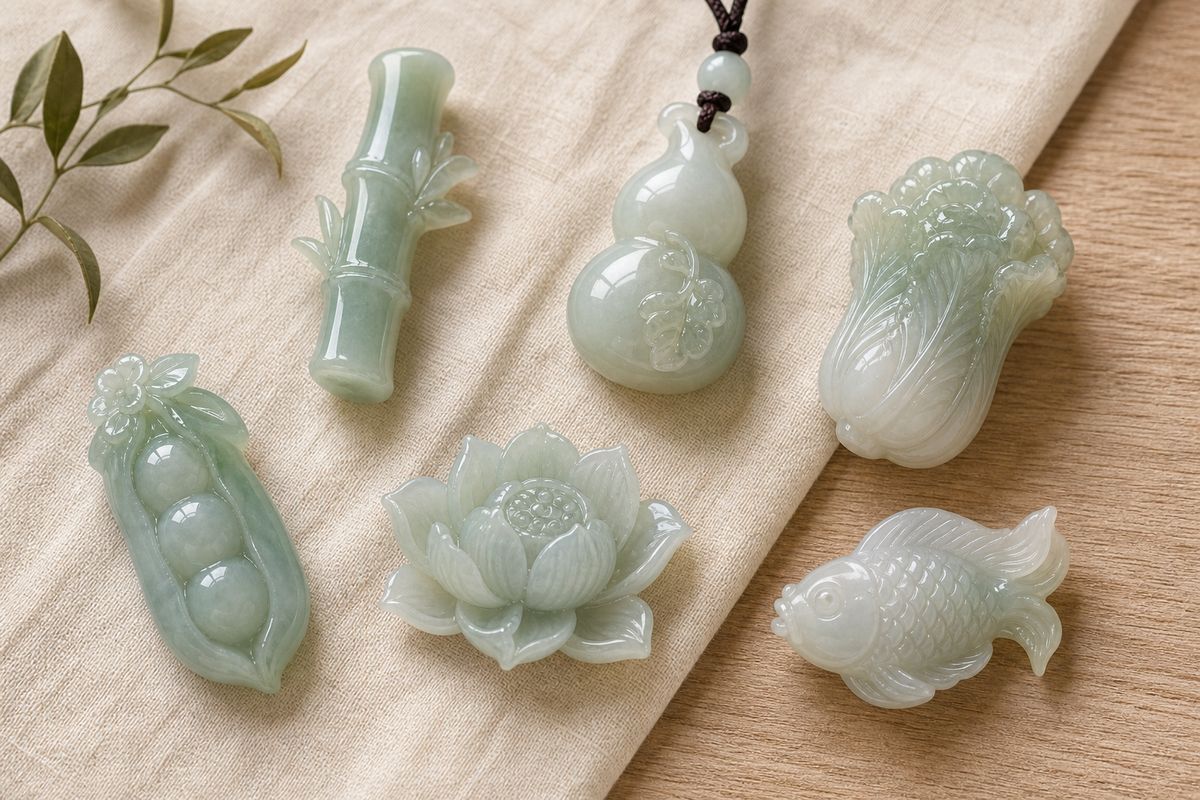
Cabbage / Bai Cai (白菜) sounds like Bai Cai (百财), hundred wealth, while its pale ribs and green leaves can also suggest clean family tradition. Four-season bean / Si Ji Dou (四季豆) often has three or four beans, connecting it with four seasons of peace and the Fu-Lu-Shou (福禄寿) blessing set.
The phrase lotus and carp / Lian Nian You Yu (连年有余) combines lotus Lian (莲), continuous Lian (连), and fish Yu (鱼), surplus Yu (余), to bless a life of yearly abundance. The phrase magpie and plum / Xi Shang Mei Shao (喜上眉梢) shows a magpie on a plum branch, making joy rise to the brow. Bat and coin blessing / Fu Zai Yan Qian (福在眼前) turns bat Fu (蝠), blessing Fu (福), and coin shape into the phrase fortune before the eyes. Explore related symbolism through lotus meaning, auspicious Chinese characters, bat symbolism, and Lingzhi meaning.
Human Figures and Classic Forms: Guanyin, Buddha, Wu Shi Pai, Ping An Kou, Jade Bi, and Jade Cong
Guanyin (观音) and Buddha pendant / Fo Gong (佛公) belong to devotional and folk gift language. The saying men wear Guanyin and women wear Buddha / Nan Dai Guanyin Nv Dai Fo (男戴观音女戴佛) is a folk phrase, not a rigid rule. Guanyin expresses compassion, calm rescue, and graceful protection; Fo Gong often shows a smiling belly and relaxed heart, expressing generosity and open-minded joy.

Wu Shi Pai (无事牌) is a plain no-thing plaque. Its power lies in restraint: no ornament becomes no trouble, so the plaque carries the wish Ping An Wu Shi (平安无事), peaceful and free of trouble. Ping An Kou (平安扣) uses a round outer edge and round center opening to speak of completeness, safety, and smoothness.
The jade bi / Yu Bi (玉璧) and jade cong / Yu Cong (玉琮) are classic ritual jade forms. The saying blue-green bi offered to Heaven and yellow cong offered to Earth / Cang Bi Li Tian, Huang Cong Li Di (苍璧礼天,黄琮礼地) places the round bi with heaven and the square-outside, round-inside cong with earth. Together they echo round Heaven and square Earth / Tian Yuan Di Fang (天圆地方), identity, ritual authority, and cosmic order. Related Eastern Story pages include Ping An Kou meaning, jade seal meaning, and the blessing collection.
Combination Motifs and Wordplay: Fu, Lu, Cai, Yu, Xi, and Layered Blessings
Many jade carving meanings depend on sound. Fu (福) means blessing; Lu (禄) can mean salary, rank, and good livelihood; Cai (财) means wealth; Yu (余) means surplus; Xi (喜) means joy. When these sounds are embedded into animals, plants, or objects, a small carving becomes a compact blessing sentence.

| Combination | How to read it | Blessing |
|---|---|---|
| Bat + coin | Bat Fu (蝠) echoes blessing Fu (福); coin sits before the eye | Bat and coin blessing / Fu Zai Yan Qian (福在眼前), fortune before your eyes |
| Lotus + carp | Lotus Lian (莲) echoes continuous Lian (连); fish Yu (鱼) echoes surplus Yu (余) | Lotus and carp / Lian Nian You Yu (连年有余), abundance every year |
| Magpie + plum | Magpie Xi Que (喜鹊) carries joy; plum branch Mei Shao (梅梢) sounds like brow tip Mei Shao (眉梢) | Magpie and plum / Xi Shang Mei Shao (喜上眉梢), joy arriving soon |
| Gourd | Hu Lu (葫芦) echoes Fu Lu (福禄) | Blessing and prosperity |
| Cabbage | Bai Cai (白菜) echoes Bai Cai (百财) | Hundred wealth and clean family tradition |
How to Read Jade Carving Details Up Close: Lines, Relief, Openwork, Qiaose, Polish, and Spirit
Close reading begins with line quality. Intaglio / Yin Diao (阴雕) sinks the line into the jade surface, creating a quiet calligraphic effect. Raised carving and relief / Fu Diao (浮雕) lift the motif above the ground, making petals, scales, robes, and beast muscles feel more present. Strong raised ridges can give fish backs, flower petals, or garment folds a dynamic line that makes the stone feel alive.

Relief depth changes the mood. Low relief can be only a few millimeters deep and works well for literati landscapes, water ripples, and compressed space. Medium and high relief bring the image closer to round carving and suit powerful beasts or figures. Openwork / Lou Diao (镂雕) removes material so light passes through; chain carving can even make connected loops from one piece of stone.
Clever-color carving / Qiao Se Qiao Diao (俏色巧雕) uses natural skin, color bands, inclusions, or transition zones as part of the design. A red skin area may become a phoenix crown or flower; white body may become cloud; dark skin may become a monkey, branch, or shadow. The strongest clever-color work has clear color boundaries, natural transition, and the feeling that the artisan followed the material rather than forcing it.
Polish completes the reading. A progression from rough to fine abrasives, such as 600 grit to 3000 grit, removes burrs and tool marks. Soft luster suits Hetian jade and turquoise because it keeps warmth and hand feeling; bright polish suits jadeite because it highlights translucency and water-like clarity. The best pieces often use matte and high-gloss zones together, so eyes, beads, scales, or ridges catch light without flattening the whole carving.
Jade “Contour Lines”: Natural Skin, Relief Depth, CNC Traces, and Machine-Carving Marks
Jade contour lines are not a fixed traditional term, but the phrase is useful in three settings. First, in modern design, it can describe the natural edge, skin-color transition, or layered landscape lines of a freeform carving. In follow-shape carving and skin-retaining carving, the artisan may keep natural borders so the jade looks like a small terrain map.

Second, in 3D modeling and CNC carving, contour lines describe height data. A digital model uses layers of depth to tell the machine where the tool should rise and fall. This can produce clean, regular, efficient forms for contemporary jewelry and batch production.
Third, in buying and inspection, contour-like lines can be a warning sign. Low-end machine carving, ultrasonic work, or molded pressing can leave parallel ripples, stair-step marks, or a stiff repeated surface. Use a 10x to 20x loupe and white light to look at the bottom of the lines. Hand carving often has changing width, a rounded bottom, and lively starts and stops; mechanical marks often look too even, too flat, or sharply repetitive.
Inscriptions and Signatures: Poems, Auspicious Words, Studio Names, and Master Marks
An inscription / Ming Wen (铭文), signature / Kuan Shi (款识), carved poem, studio name, leisure seal, or auspicious words / Ji Yu (吉语) can add a second voice to the jade. Before the Ming dynasty, maker signatures were uncommon on jade because many works served elites and the artisan's social position was lower. The Ming master Lu Zigang helped make signatures more visible through the Zi Gang plaque / Zi Gang Pai (子冈牌) tradition.

Modern inscriptions may include a name, studio title, poem, blessing, year, recipient, or short philosophical phrase. Common auspicious words / Ji Yu (吉语) include Yi Zi Sun (宜子孙), Chang Le (长乐), Yan Shou Wan Nian (延寿万年), Yi Lu Shun Feng (一路顺风), Bai Nian Hao He (百年好合), and Peng Cheng Wan Li (鹏程万里). Phrases such as Liang Wang (两忘) or Lan Ke Ren (烂柯人) add literati taste and private reflection.
Layout matters. The principle old text, newer signature / Wen Gu Kuan Jin (文古款今) means the signature should harmonize with but not overpower the main writing. A signature that is too large can dominate the piece. A poor space may need a short name-only mark, while a large plaque may support a long inscription or paired dedication. Famous signatures should be judged through material, carving quality, layout, and style together.
Jade Culture in History: Ritual Jade, Gentleman Virtue, Literati Taste, and Modern Heritage
Jade carving history moves from ritual power to personal ornament, scholar taste, and modern heritage. Prehistoric Hongshan jade dragons and Liangzhu jade cong show jade as a sacred medium connected with ancestors, sky, earth, and social authority. In the Xia, Shang, and Zhou ritual world, the six ritual jades / Liu Qi (六器) included bi, cong, gui, zhang, hu, and huang, connecting jade with rank and ceremony.

During the Spring and Autumn and Warring States periods, the moral language of gentleman compared with jade / Jun Zi Bi De Yu Yu (君子比德于玉) became central. Qin and Han jade culture included burial jade such as jade suits sewn with gold thread / Jin Lu Yu Yi (金缕玉衣). Tang and Song periods brought more secular taste, flowers, birds, fish, insects, and personal ornaments. Ming and Qing jade carving reached high refinement through Lu Zigang, scholar plaques, court workshops, and monumental works such as the Great Yu Controls the Waters jade mountain / Da Yu Zhi Shui Tu Yu Shan (大禹治水图玉山).
In 2008, jade carving intangible cultural heritage (玉雕非遗) was listed in the second batch of national intangible cultural heritage in China. Today, jade carving continues through studio craft, contemporary jewelry, museum-style collecting, cultural gifts, tea desk objects, and modern design.
Core Jade Carving Techniques: Line Carving, Relief, Round Carving, Intaglio, Openwork, Qiaose, Hollowing, and Bo Yi Diao
Core jade carving techniques include line carving, relief / Fu Diao (浮雕), round carving, intaglio / Yin Diao (阴雕), openwork / Lou Diao (镂雕), clever-color carving / Qiao Se Qiao Diao (俏色巧雕), hollowing, and thin-meaning carving / Bo Yi Diao (薄意雕). Line carving uses changing depth and width to draw with the tool. Round carving makes a 360-degree object, often for figures and animals. Hollowing is used for vessels and requires even walls and clean inner space.

Ancient tool flavor also matters. The method lowering ground and raising lines / Jian Di Qi Yang (减地起阳), associated with Shang-style raised-line effects, removes the ground so raised bands stand out with strong tension. The method one-sided slope carving / Yi Mian Po (一面坡), known from Western Zhou style discussions, cuts one wall more vertical and the other as a sloped plane, giving shallow relief a crisp three-dimensional feel.
The process begins with reading the jade, or Xiang Yu (相玉): examining cracks, color, skin, texture, and usable shape. Then the artisan roughs out the body, refines details, repairs curves and lines, and polishes. Work level may be described as master work, named-artist work, fine work, ordinary work, or apprentice work. A useful aesthetic formula is Yi, Miao, Qiao, Jing, Qi (意、妙、俏、精、奇): meaning, subtle design, clever color, precise craft, and unusual originality.
How to Choose Jade Carving Gifts by Recipient: Elders, Partners, Career People, Students, and General Blessings
| Recipient | Good motif | Message to write on a gift card |
|---|---|---|
| Elders | Longevity peach, four-season bean / Si Ji Dou (四季豆), pine and crane, gourd / Hu Lu (葫芦) | May health, peace, and long happiness stay with you. |
| Partners | Dragon and phoenix / Long Feng (龙凤), paired plaques, concentric rings, magnolia | May our hearts stay in harmony and our days grow together. |
| Career people | Pi Xiu (貔貅), bamboo joint / Zhu Jie (竹节), cabbage / Bai Cai (白菜), dragon plaque | May work rise step by step and good fortune gather steadily. |
| Students | Jade cicada / Yu Chan (玉蝉), leaf, carp, bamboo | May study open quickly and your voice be heard at the right moment. |
| General blessing | Ping An Kou (平安扣), Wu Shi Pai (无事牌), Guanyin (观音), Buddha pendant / Fo Gong (佛公) | May peace stay close and daily life move smoothly. |
A handwritten card is useful because many jade blessings are compact. Explaining the motif turns the gift from a pretty object into a personal message. Eastern Story's blessing collection is built around this same idea: choose the form, then make the blessing readable.

Modern Uses of Jade Carving: New Chinese Jewelry, Tea Desk Objects, Home Decor, Art, and Social Gifts
Modern jade carving has moved into daily life. New Chinese jewelry combines Ping An Kou (平安扣), Wu Shi Pai (无事牌), bamboo, or small beast motifs with K-gold, silver, silk cord, and beadwork. Men's pendants often use Pi Xiu (貔貅), dragon plaques, guardian beasts, or plain no-thing plaques for a restrained, powerful style.

Jade carving also appears on tea desks and in study rooms: tea pets, incense holders, tea scoops, brush pots, paperweights, brush washers, jade seals, and tiny landscapes. Home decor uses Qilin (麒麟), Ruyi, Ping An Kou, or carved plaques for harmony, blessing, and visual warmth. Contemporary artists and designers also use jade in installation, architectural screens, wall panels, metal inlay, and creative micro-landscapes.
Socially, jade remains a serious gift language: wedding pairs, engagement tokens, birthday longevity pieces, student exam blessings, business wealth motifs, and festival gifts. The modern trend is lighter, more wearable, and easier to explain, but the older logic remains the same: craft carries meaning, and meaning becomes a blessing.
Frequently Asked Questions
Conclusion
To read jade carving meanings, begin with the motif, then look at shape, material, technique, line detail, inscription, and gift context. A Pi Xiu (貔貅) differs from a bamboo joint / Zhu Jie (竹节), a plain Wu Shi Pai (无事牌) differs from an openwork beast plaque, and a poem or signature can change the mood of the whole piece.
The deeper rule is still jade must have craft, craft must have meaning, and meaning must be auspicious (玉必有工,工必有意,意必吉祥). Whether you choose a peace form, wealth beast, scholar plaque, ritual-inspired jade bi, or modern pendant, the best jade carving lets the stone, the craft, and the blessing speak together.
Related Posts


One Comment