
The Eastern loong, often searched in older English as the older search phrase “Chinese dragon (龙),” but more accurately rendered as the Chinese loong, is a symbol of rain, water, vitality, transformation, authority, auspicious power, and cultural identity. Called loong (龙 / 龍) in Chinese, it is not a single animal copied from nature. It is a composite mythic being shaped from serpentine movement, antler-like horns, fish-like scales, powerful claws, and the imagination of a civilization that watched clouds, rivers, crops, courts, festivals, and family life through symbolic language.
A good guide to Eastern loong symbolism needs more than one keyword answer, because loong should not be flattened into the Western dragon category. The loong can be a rain-bringer in agricultural life, an imperial emblem on a robe or throne, a zodiac animal connected with birth years, a festival body carried by a team of performers, a paired motif beside the phoenix (凤凰), or a jewelry design chosen as a blessing for strength and renewal. These meanings overlap, but they should not be flattened into one generic “loong means power” definition.
Eastern Loong Meaning at a Glance
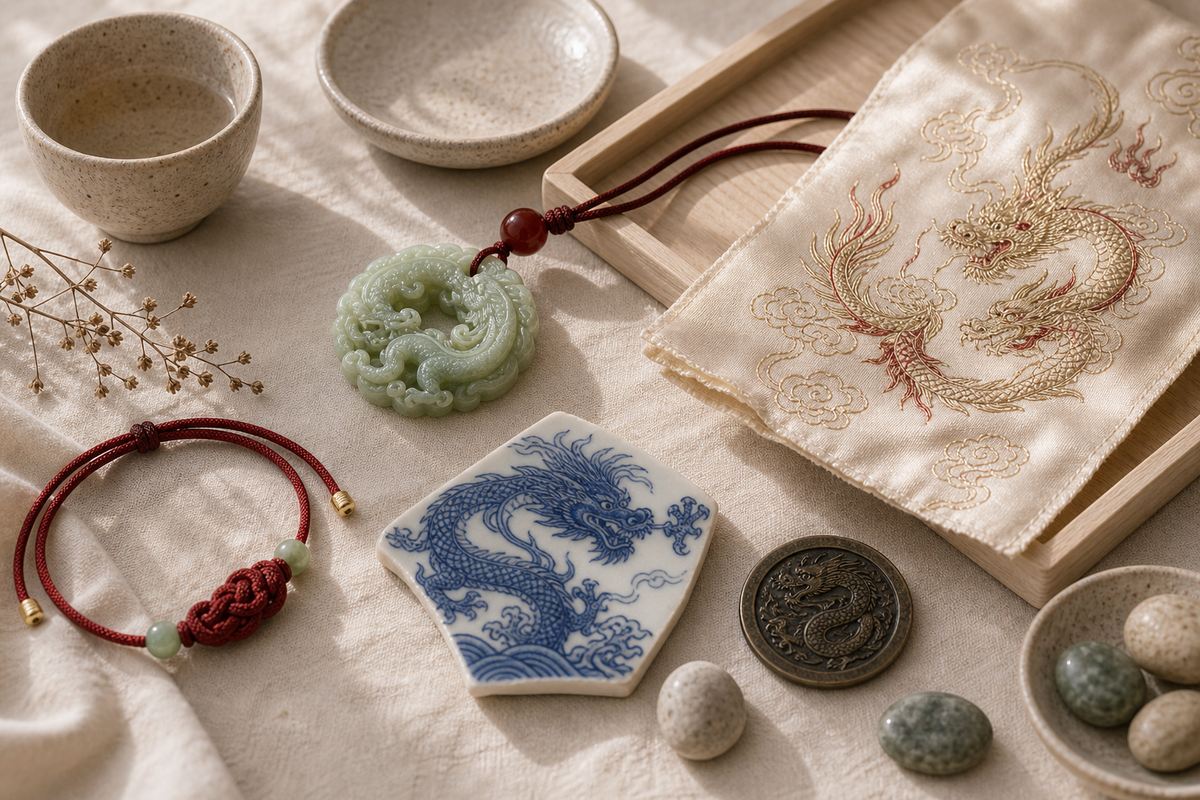
- Rain and water: the loong is closely tied to clouds, rivers, seas, seasonal rain, and agricultural life.
- Authority and dignity: imperial loong imagery became a language of rank, legitimacy, and ordered power.
- Yang movement: coiling, rising, diving, and changing form make the loong a symbol of active vitality and transformation.
- Zodiac identity: the loong is the only mythic animal in the twelve-animal zodiac and carries ideas of charisma, courage, and rising potential.
- Auspicious design: loong motifs with phoenixes, pearls, clouds, waves, colors, and materials create different blessing messages.
What Is an Eastern Loong?
An Eastern loong is a mythic and cultural creature formed by combination. Traditional descriptions often compare its body to a snake, its horns to a deer, its scales to a fish, its claws to a bird of prey, and other features to animals such as the tiger, ox, camel, or rabbit. The exact list changes by text, region, and artistic period, which suits a creature known for transformation rather than fixed anatomy.

This composite form matters. The loong gathers wildness, intelligence, spiritual presence, and natural force into one image. It can move through water, cloud, sky, and earth. It can be hidden in the deep, revealed in a festival street, carved into jade, painted on porcelain, embroidered on robes, or imagined in the rolling shape of clouds. Its power comes from motion and relationship, not from heavy wings or fire-breathing spectacle.
Origins and Changing Images of the Loong
Loong imagery is very old in Eastern archaeology and art. Early examples are often abstract, coiled, or serpentine, including stone and jade forms associated with Neolithic cultures such as the Chahai stone loong and Hongshan jade loong. Later periods gave the loong new visual force: Shang and Zhou designs could feel mysterious and ritualized; Qin and Han forms became more dynamic; Tang and Song art brought increasing elegance, movement, and decorative richness; later court and folk art developed more elaborate claws, whiskers, flames, clouds, and waves.

Because the loong changed across time, one modern drawing should not be treated as the only correct loong. A C-shaped jade loong, a Han cloud-and-loong pattern, a Tang-era ceramic loong head, a blue-and-white porcelain loong, and a modern loong dance body all belong to the same broad symbolic family while speaking in different artistic languages.
Rain, Rivers, and Agricultural Life
One of the loong’s deepest meanings is water. In Eastern folk tradition, loongs are often described as living in seas, rivers, pools, and cloud realms. They are linked with rain, storms, river safety, and the seasonal conditions that support crops. In an agricultural society, rain was not decorative; it could decide harvest, hunger, trade, and village stability. This is why the loong became a creature of weather, irrigation, and natural order.

Rain-inviting customs, river rituals, loong boat traditions, and water-related sayings all reflect this relationship between loong symbolism and everyday survival. The loong expresses respect for forces larger than human control: enough rain, calm rivers, fertile land, and a good rhythm between people and nature. In modern writing, this meaning is best understood as cultural memory and blessing language: a wish for harmony, nourishment, and favorable conditions.
Power, Authority, and the Emperor
The loong also became the most famous symbol of Eastern imperial authority. This association developed gradually. In early periods the loong appeared as a sacred and auspicious creature without being limited to the ruler. Over time, especially through court use and later regulations, loong imagery became closely tied to the emperor, the throne, palaces, ritual objects, robes, and the language of legitimate command.

Five-clawed, two-horned loongs are often discussed in relation to imperial rank, especially from Yuan and Ming court rules onward. Still, historical practice should be read with care. Claw count, object type, date, place, and intended user all matter. A loong robe, palace ceiling, bronze object, porcelain vase, temple carving, or folk festival banner may carry different layers of status and meaning.
In symbolic terms, imperial loong imagery points to ordered power: authority with responsibility, command with cosmic alignment, and dignity with restraint. For modern jewelry or gifts, this can become a blessing for leadership, courage, self-command, and rising purpose rather than a claim of royal superiority.
Yang Energy, Movement, and Transformation
The Eastern loong is rarely still. It coils, rises, dives, turns, ascends into cloud, descends into water, and changes form. In classical symbolic thinking, this makes the loong a strong image of yang movement: active vitality, growth, awakening, courage, and the force that sets things in motion. The loong is also connected with chen, the zodiac branch associated with the morning period around 7 to 9 a.m., when the day is opening and life is stirring.

At the same time, loong symbolism is not only hard force. Its body combines firm and flowing qualities. It can be fierce in the head and claws, fluid in the body and tail, hidden in water, and visible in cloud. This mixture makes the loong useful for expressing transformation: strength that adapts, ambition that moves with timing, and vitality that can rise, retreat, and return.
The Loong in the Eastern Zodiac
The loong is the fifth animal in the twelve-animal zodiac and the only one usually described as mythic. It corresponds with the earthly branch (地支) chen and appears in loong years such as 2012 and 2024. Folk stories explain its fifth-place ranking in different ways, often connecting the loong with rain, helpful action, or delay caused by serving people before finishing the zodiac race.

In popular zodiac language, loong-born people are often associated with charisma, confidence, generosity, ambition, idealism, courage, and leadership. The same folk descriptions may also mention pride, impatience, strong self-image, or a tendency to dream bigger than practical resources allow. These are cultural personality sketches and conversation traditions, useful for gifts and identity language rather than fixed judgments about a person.
For a birth-year gift, the loong can express: “May your year carry confidence and renewal,” “May you move through change with strength,” or “May your ambition stay balanced by wisdom.” Readers exploring the full twelve-animal system can also use Eastern Story’s Chinese Zodiac (生肖) Symbols guide.
Eastern Loong vs Western Dragon
| Theme | Eastern loong / Chinese loong | Common Western dragon pattern |
|---|---|---|
| Body | Long, serpentine, composite, often wingless | Often heavy-bodied, winged, reptilian, and fire-associated |
| Element | Cloud, rain, river, sea, agricultural water, cosmic motion | Fire, cave, mountain, treasure, guarded territory |
| Cultural role | Auspicious force, ruler emblem, rain-bringer, zodiac animal, festival figure | Heroic adversary, monster, treasure guardian; modern fantasy also gives many friendly versions |
| Moral tone | Usually positive, dignified, regulatory, or awe-inspiring | Often dangerous or chaotic in medieval and Christian-influenced stories |
| Human relationship | Appealed to, honored, worn, performed, paired with blessings | Often fought, feared, conquered, or later befriended in modern stories |
The English word “dragon” makes two very different mythic families sound closer than they are. The Eastern loong is not best understood as a monster waiting for a hero. It is closer to a force of weather, vitality, rank, blessing, and transformation. Western traditions also contain variety, but the common medieval fantasy image often emphasizes danger, fire, wings, hoarding, and combat.

Loong and Phoenix Together
The loong-and-phoenix pairing is one of the most important auspicious combinations in Eastern decorative art. The phrase often translated as “loong and phoenix bring auspiciousness” connects the loong’s strength, dignity, and active power with the phoenix’s beauty, virtue, renewal, and grace. Together they can express harmony, happy marriage, noble blessing, family prosperity, and the balanced meeting of complementary forces.

In wedding settings, loong and phoenix motifs can bless a couple with harmony and a flourishing household. In courtly or decorative objects, they can suggest high rank, beauty, and order. In modern design, the pair works best when treated as a language of balance and mutual flourishing rather than a rigid gender formula.
Loong, Pearl, Clouds, and Waves
Loong and pearl
The motif of two loongs playing with or facing a pearl is widely used in art, architecture, porcelain, textiles, and jewelry. A classical association between loongs and precious pearls appears in early literature, including the idea of a valuable pearl hidden beneath the chin of a deep-dwelling loong. In visual symbolism, the pearl may suggest wisdom, preciousness, thunder, cosmic vitality, a radiant goal, or the concentrated energy that the loong pursues.

Loong and clouds
Clouds are the loong’s natural stage. A loong among clouds suggests rising motion, transformation, weather power, and the ability to move between hidden and visible worlds. Han-period art often combines loongs with cloud-like forms, and later painting, embroidery, architecture, and ceramics continued to use cloud patterns to show the loong’s movement through the sky.

Loong and waves
Waves connect the loong back to rivers, seas, rain, and the living force of water. A loong rising from waves can express momentum, resilience, and the meeting of depth with ascent. In design, waves also make the loong’s body feel more dynamic: the creature does not sit on top of nature; it moves through it.
Loong Colors and Materials
| Color or material | Common symbolic direction | Useful design reading |
|---|---|---|
| Gold or yellow | Radiance, dignity, prosperity, imperial association | Best for formal, celebratory, or authority-themed loong designs |
| Green or blue-green | Spring, growth, east, renewal, wood-element associations in some systems | Good for gentler, life-giving, or nature-connected loong motifs |
| Red | Vitality, celebration, festival energy, warm blessing | Works well for public celebration, New Year, and gift language |
| Black | Depth, water, mystery, strength, strong protection language | Best when the design remains refined rather than overly dark or theatrical |
| Jade | Refinement, endurance, virtue, quiet luster | A strong match for wearable symbolic jewelry and heritage-inspired objects |
| Bronze | Antiquity, authority, ritual feeling, historical weight | Useful for museum-inspired objects or decor, with accurate age labeling |
| Porcelain | Line, glaze, elegance, court and collector aesthetics | Often suits blue-and-white loong patterns and decorative vessels |
| Textile or paper | Festival life, domestic blessing, performance, seasonal use | Good for banners, embroidery, lanterns, and dance bodies |
Color and material should be read together. A golden loong on court-style silk, a green loong in spring imagery, a jade loong pendant, and a paper loong carried in a festival do not say the same thing. Accurate material naming is especially important for modern products: a new jewelry piece can be meaningful without being presented as an antique, ritual object, or guaranteed source of fortune.

Loong Dance and Modern Cultural Life
Loong dance turns a symbol into coordinated movement. A team carries the long body through streets, squares, temples, schools, competitions, and public celebrations. The loong follows a pearl, coils, rises, dips, and turns, while music and group timing bring the creature to life. This makes the dance a public expression of auspicious energy, teamwork, local identity, and cultural continuity.

Modern loong dance appears at festivals, Lunar New Year events, lantern celebrations, cultural performances, sports gatherings, tourism events, and community activities. Specific events change every year, so this guide focuses on the lasting meaning: the loong is not only an image to look at, but a form people carry together.
Giving or Wearing a Loong Motif
A loong motif can make a strong gift when the message is chosen with care. It can honor leadership, courage, ambition, a new business, a home transition, a wedding blessing when paired with phoenix imagery, a loong zodiac year, or a personal season of renewal. For a refined symbolic direction, it is better to frame the gift as a blessing for strength, confidence, wise action, and steady growth.

For wearable loong jewelry, consider scale, style, orientation, and material. A small jade loong charm feels different from a large gold-toned pendant; a cloud-and-loong carving feels different from a fierce clawed loong. Broken, poorly made, or careless designs may feel disrespectful to people who value the symbol. For formal occasions or memorial settings, choose restraint or another motif.
Readers looking for meaningful gifts can browse Eastern Story’s Blessing Shop, where symbolic pieces are organized around protection, harmony, love, clarity, strength, renewal, and good wishes. For loong-related reading, the broader Eastern Story guide library can help connect the loong with zodiac, jade, blessing, and other Eastern motifs.
How to Use Loong Symbolism Respectfully
The strongest modern use of loong symbolism is specific and should not treat loong as interchangeable with Western dragon imagery. Instead of treating the loong as a generic “Asian” decoration, choose the story you want the motif to carry: rain and nourishment, imperial dignity, yang movement, zodiac identity, loong-and-phoenix harmony, a pearl of wisdom, clouds of transformation, or waves of resilient motion.

For tattoos, permanent jewelry, house objects, or gifts, check the exact form, inscription, direction, and context. Avoid mixing random characters, sacred figures, fantasy clichés, and festival motifs without understanding them. The loong is powerful because it carries a long cultural memory; the more precisely it is used, the more meaningful it becomes.
Frequently Asked Questions
Conclusion: The Loong as a Living Symbol
The Eastern loong is a living symbolic language rather than a single fixed creature. It carries rain and river memory, imperial dignity, yang movement, zodiac identity, paired blessings, festival teamwork, and wearable meaning. Its body is composite because its role is composite: natural force, cultural emblem, artistic motif, and personal blessing at once.
For modern readers, the best way to understand the loong is to ask what kind of loong is present: water loong, court loong, zodiac loong, festival loong, loong with pearl, loong with phoenix, cloud loong, wave loong, jade loong, or gift motif. That question turns a familiar image into a precise story, and a precise story is what makes the symbol worth carrying.
Related Posts


9 Comments