
Jade meaning in Chinese culture reaches far beyond beauty or monetary value. For more than 8,000 years, jade has carried ideas of moral character, ritual authority, protection, good fortune, family continuity, and refined taste. It has appeared in prehistoric ceremonial objects, imperial seals, burial traditions, scholars' collections, wedding gifts, children's pendants, bangles, and modern jewelry.
Jade became a material language through which Chinese people expressed what was difficult to make visible: a ruler's legitimacy, a gentleman's virtue, a family's blessing, a promise between loved ones, or the hope that something precious would endure. This is why jade is often described as one of the clearest material expressions of Chinese civilization.
The Chinese word yu (玉) historically covered several valued hardstones. Modern gemology uses jade for two mineral aggregates: nephrite and jadeite. Both are genuine jade, but their mineral composition, visual character, historical use, color, origin, treatment, and value must be considered separately from their cultural symbolism.
Jade Meaning at a Glance
- Core meaning: Virtue, refinement, protection, blessing, status, remembrance, and continuity.
- Moral symbolism: Benevolence, wisdom, righteousness, propriety, courage, integrity, and purity.
- Historical role: Ritual object, political emblem, burial material, scholarly art, gift, and personal ornament.
- Protective tradition: Jade is worn and given with wishes for peace, safety, health, longevity, and good fortune.
- Two main jade materials: Nephrite and jadeite.
- Famous colors: White, green, blue-green, yellow, brown, black, lavender, red-orange, and multicolored combinations.
- Gift message: “May you be safe, honorable, steady, and accompanied by lasting good wishes.”

Why Is Jade So Important in Chinese Culture?
Jade occupies a rare position between nature, art, morality, religion, family life, and political history. Its dense structure allows it to be polished into a soft, restrained luster rather than a sharp glitter. It is hard to shape, yet remarkably tough once finished. Ancient makers had to grind jade patiently with abrasives, turning every object into a record of time, discipline, and skilled labor.

These physical qualities matched an enduring Chinese ideal: strength should be controlled, beauty should carry substance, and refinement should reveal itself gradually. The quiet luster of nephrite suited an aesthetic that valued inward depth over immediate display. Jade could be firm without appearing aggressive, precious without appearing loud, and enduring without losing warmth.
Jade also connected heaven, earth, ancestors, rulers, and living families. A ritual bi (璧) disc, a burial object, an imperial seal, a scholar's carving, and a grandmother's bangle served different functions, yet all drew on jade's ability to preserve meaning across time. Gold could display wealth; jade could express wealth, virtue, legitimacy, memory, and blessing at once. This cultural depth lies behind the saying “gold has a price, but jade is priceless.”
How Chinese Jade Culture Developed Over 8,000 Years
Prehistoric Jade: A Bridge Between People and the Sacred
China's jade tradition reaches back to Neolithic communities. Jade earrings and ornaments from the Xinglongwa culture date to approximately 8,000 years ago. Later, the Hongshan culture produced coiled jade dragons (龙) and animal forms, while the Liangzhu culture created monumental cong (琮) tubes, bi discs, and objects carved with powerful human-and-animal mask imagery.

These early jades were more than decoration. Their labor-intensive production and ceremonial contexts show that jade already carried authority and sacred significance. Objects made from stone gathered from the landscape became instruments for communicating with ancestors, spirits, heaven, and earth.
Xia, Shang, and Zhou: Jade Becomes a Ritual System
During the early dynastic periods, jade became deeply integrated into court ritual and social rank. The Rites of Zhou (周礼) describes the Six Ritual Jades: the blue-green bi disc for heaven, yellow cong for earth, green gui (圭) for the east, red zhang (璋) for the south, white hu for the west, and dark huang pendant (璜) for the north. Together they placed political order within a larger cosmological order.
Jade forms also indicated status. Different ranks carried different tablets and insignia, while sets of pendants made a controlled sound as a person walked. The ideal wearer moved with composure because the jade at the body encouraged measured posture, speech, and conduct. The classical phrase “a gentleman does not part with jade without reason” expresses this union of ornament and self-discipline.
Qin and Han: Imperial Power, Burial, and Personal Protection
Under the Qin and Han empires, jade became inseparable from sovereignty. Imperial seals transformed jade into the physical sign of state authority, and the legendary Heirloom Seal came to represent the Mandate of Heaven and dynastic legitimacy.
Han burial culture also gave jade an extraordinary role. Jade suits sewn with gold, silver, or other wire covered elite bodies in the hope of preserving the deceased. Smaller plugs, discs, pendants, sword fittings, and guardian-animal carvings joined ideas of immortality, status, protection, and the afterlife. At the same time, personal jade ornaments spread beyond the narrowest ritual sphere and became part of a broader culture of auspicious adornment.
Song to Qing: Connoisseurship, Craftsmanship, and Imperial Collections
From the Song through the Qing dynasty, jade culture flourished through antiquarian study, court collecting, new carving techniques, and expanding access to raw material. Scholars admired ancient forms and inscriptions; artisans transformed jade into vessels, brush rests, belt hooks, plaques, animals, flowers, mountains, and intimate objects for daily appreciation.
Qing imperial patronage brought jade carving to a monumental scale. Imperial seals, ceremonial objects, and large carved vessels joined political symbolism with extraordinary craftsmanship. Yet jade was never confined to the palace. Pendants, hair ornaments, bangles, beads, and auspicious carvings also carried family affection and personal wishes into everyday life.
Jade Today: A Living Cultural Inheritance
Modern jade jewelry still connects people with moral ideals, family memory, regional identity, and good wishes. A contemporary bangle may be chosen for its translucency and color, inherited from a parent, worn during a major life transition, or paired with red cord in a new design. Its form may change, but its ability to carry relationship and remembrance remains central.
What Virtues Does Jade Symbolize?
Confucian thinkers turned jade into a model of cultivated character. The most famous discussion appears in the “Pin Yi” chapter of the Book of Rites (礼记), where jade's visible and audible qualities are compared with the virtues of a gentleman. Other texts organize jade virtue differently: the Guanzi (管子) speaks of nine virtues, Xunzi (荀子) presents seven, and Xu Shen's Shuowen Jiezi summarizes five. These lists differ in number, but they share the same central idea: a person should refine character as patiently as an artisan polishes jade.

| Quality of jade | Virtue | Cultural meaning |
|---|---|---|
| Warm, smooth, and lustrous | Benevolence | A cultivated person treats others with kindness, breadth, and warmth. |
| Dense and finely structured | Wisdom | Depth, careful thought, and an orderly inner life support sound judgment. |
| Angular without cutting the hand | Righteousness | A person may be principled and upright without becoming cruel or abrasive. |
| Hanging naturally downward | Propriety | Composure, humility, and respect guide conduct. |
| Clear, resonant sound when struck | Harmony and learning | Good influence travels outward like a pure musical tone. |
| Firm and difficult to bend | Courage | Integrity remains steady under pressure. |
| Translucent qualities reveal the interior | Sincerity | Outer conduct and inner intention should correspond. |
| Beauty remains visible around natural variation | Purity and self-command | Character is revealed through restraint, honesty, and continued refinement. |
This is the deeper meaning of expressions such as “gentle and refined like jade” and “a gentleman compares his virtue to jade.” Jade was not simply admired; it was worn as a daily reminder that character requires patience, balance, discipline, and care.
Jade as a Symbol of Ritual, Power, and Status
Jade's moral meaning developed alongside its political role. Ritual jades placed rulers within a sacred order, rank-specific objects distinguished members of the court, and seals made authority tangible. Because fine jade required rare material, specialized labor, and access to long-distance exchange, it naturally became a marker of prestige.

Imperial jade was therefore more than luxury. It expressed the belief that power should be legitimate, ordered, and connected with heaven. Even outside the court, wearing jade could communicate education, family standing, personal taste, or respect for classical ideals. Modern jade still carries an echo of that dignity, especially in formal bangles, pendants, plaques, seals, and heirloom-quality carvings.
Jadeite and Nephrite: Both Are Jade
Modern gemology recognizes two materials as jade. Nephrite is an interlocking aggregate of amphibole minerals, principally tremolite and actinolite. It is exceptionally tough and often has a smooth, oily, or waxy luster. Nephrite forms the foundation of China's earliest and classical jade traditions, including the material broadly associated with Hetian jade (和田玉).

Jadeite is a pyroxene aggregate. It can show intense green, lavender, white, yellow, red-orange, gray, or black colors and may possess striking translucency. Jadeite entered Chinese elite taste much later than nephrite and became especially prominent during the Qing dynasty.
| Feature | Nephrite | Jadeite |
|---|---|---|
| Mineral family | Amphibole aggregate, mainly tremolite-actinolite | Pyroxene aggregate, mainly jadeite |
| Chinese historical role | Central to prehistoric, classical, and Hetian jade traditions | Especially influential in later imperial and modern jewelry culture |
| Typical visual character | Dense, smooth, softly lustrous, exceptionally tough | Can be bright, translucent, glassy, and intensely colored |
| Common colors | White, cream, blue-green, green, yellow-brown, brown, gray, and black | Green, lavender, white, yellow, red-orange, gray, and black |
| Cultural meaning | Develops through color, object, carving, historical period, giver, wearer, and use | Develops through color, object, carving, historical period, giver, wearer, and use |
For a focused explanation of nephrite, regional naming, grading, and common buying questions, read What Is Hetian Jade?.
Why Does Hetian Jade Appear in Different Colors?
Hetian jade is mainly nephrite, whose mineral structure is dominated by tremolite and may grade toward iron-bearing actinolite. Pure tremolite is pale, while iron and other trace elements, mineral inclusions, oxidation, weathering, and contact with surrounding rocks produce a wide spectrum of color. Some colors form as the jade itself develops; others appear later through surface weathering or mineral staining.
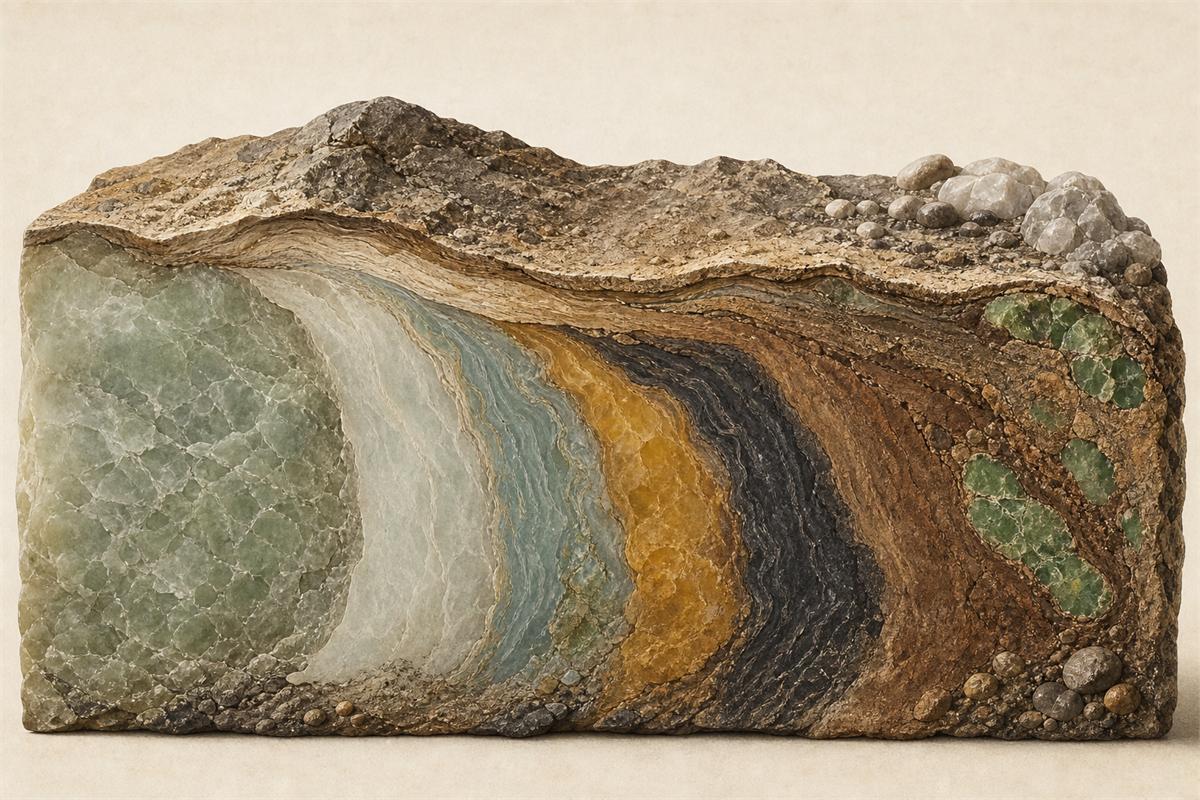
| Nephrite color family | Typical appearance | Common mineralogical influence |
|---|---|---|
| White jade | White, ivory, cream, or pale gray; fine “mutton-fat” material is softly luminous | High tremolite content and relatively low iron |
| Blue-green and blue-white jade | Pale gray-green through deep blue-green; white jade with a cool green cast | Increasing iron within the tremolite-actinolite series |
| Jasper or biyu (碧玉) | Apple green, spinach green, dark green, sometimes with black inclusions | Iron-rich amphiboles and, in some deposits, chromium-bearing components |
| Yellow jade | Pale wheat, honey, or deeper yellow-brown | Iron-bearing minerals and oxidation within or around the stone |
| Black jade | Gray-black to dense black | Fine graphite and other dark mineral inclusions, sometimes with iron-rich components |
| Sugar jade | Caramel, reddish brown, or “brown sugar” zones beside lighter nephrite | Secondary iron-oxide staining during weathering and alteration |
| Cuiqing (翠青) jade | Bright green bands or patches across a white or pale base | Localized chromium-related green coloration in certain nephrite deposits |
This color range explains why Chinese nephrite aesthetics cannot be reduced to pure white alone. Collectors may value creamy uniformity, deep spinach green, ink-like black, landscape-like black-and-white “qinghua (青花),” a warm sugar-colored skin, or the dramatic contrast of green cuiqing against white jade.
What Do Different Jade Colors Mean?
Jade color meaning grows from Chinese color symbolism, historical taste, the natural character of the stone, carving subjects, family custom, and modern jewelry design. Color gives the object an emotional tone, while the complete message comes from the material, motif, giver, and occasion.

Green Jade: Life, Harmony, and Flourishing Fortune
Green jade represents life, renewal, growth, vitality, and harmony. Light green feels youthful and fresh; rich emerald or spinach green carries maturity, abundance, and dignity. In jadeite culture, vivid green is also associated with rarity, status, and prosperity. Green bangles and pendants are popular gifts for new beginnings because the color evokes a life that continues to grow.
White Jade: Purity, Refinement, and Noble Character
White jade, especially fine nephrite, symbolizes purity, calm, restraint, elegance, and moral clarity. Its soft luster embodies the ideal of being substantial without being showy. A white jade gift praises the recipient's character and expresses a wish for a peaceful, honorable life.
Yellow, Brown, and Red-Orange Jade: Dignity, Warmth, and Celebration
Yellow has long carried associations with the center, earth, authority, and imperial dignity. Yellow jade and yellow jadeite therefore suggest stability, honor, prosperity, and warm fortune. Brown “sugar” nephrite feels grounded and comforting, while red-orange jadeite draws on the Chinese symbolism of red: celebration, courage, vitality, and auspicious joy.
Black Jade: Protection, Depth, and Steady Strength
Black nephrite and dark jadeite carry a solemn, protective character. Their visual depth suits guardian animals, talismans, bold beads, seals, and restrained modern jewelry. Black-and-white qinghua nephrite is especially admired because its natural pattern resembles an ink landscape, joining jade with the spirit of Chinese painting.
Lavender, Blue, and Multicolored Jade: Grace, Serenity, and Abundant Blessings
Lavender jadeite expresses grace, quiet nobility, tenderness, and serenity. Blue or blue-gray jade feels clear, contemplative, and composed. Multicolored pieces are prized for the way several auspicious ideas meet in one object. Green, lavender, and yellow jadeite is often described through the “fortune, prosperity, and longevity” triad, while mixed-color nephrite may be carved as a landscape that turns natural variation into art.
Why Do Chinese People Love Jade?
- An inward aesthetic: Jade's beauty is soft, dense, and gradual. It rewards close attention rather than demanding it.
- A moral companion: Wearing jade keeps the ideals of benevolence, wisdom, courage, integrity, and self-cultivation close to the body.
- A family memory: Jade survives long enough to move from one generation to another, gathering stories through touch and wear.
- A blessing made tangible: Safety, health, longevity, prosperity, love, and peace become embodied in a pendant, bangle, bead, or carving.
- A connection between humanity and nature: Jade transforms stone formed within mountains and rivers into an object shaped by patience and intention.
For many wearers, jade feels less like a temporary accessory and more like a quiet companion. It becomes familiar through body warmth, daily movement, family stories, and the memory of who gave it. This long relationship between person and object gives jade an emotional value beyond fashion.

Is Jade a Symbol of Luck or Protection?
Yes. In Chinese tradition, jade carries both auspicious and protective meaning. People wear jade with wishes for peace, health, longevity, smooth progress, and protection from misfortune. Parents choose jade pendants for children, elders pass bangles to younger relatives, and travelers wear familiar pieces as a blessing from home.

Chinese folk belief also preserves the saying that when a jade piece breaks unexpectedly, it has “taken the misfortune” in place of its wearer. This story gives emotional meaning to a painful loss: the object that accompanied and protected someone has completed its role. The broken piece may then be wrapped and stored respectfully, repaired when practical, or retired as part of the family's memory.
Jade's sense of protection is strongest when it carries relationship. A bangle inherited from a mother, a pendant selected for a child, or a piece worn through an important stage of life gathers the wishes of the people who chose, blessed, protected, and passed it on. The feeling of reassurance comes from that continuity as much as from the stone itself.
What Do Common Jade Carvings Symbolize?

| Jade motif | Traditional meaning | Suitable occasion |
|---|---|---|
| Ruyi (如意) | “As you wish,” smooth progress, and wishes fulfilled | Career milestones, new beginnings, encouragement |
| Gourd (葫芦) or hulu | Blessing, continuity of descendants, health, and longevity | Family gifts, elders, weddings, new homes |
| Pixiu (貔貅) | Gathering wealth, guarding resources, confidence, and enterprise | Business, career, and prosperity-focused gifts |
| Cabbage or baicai | A wordplay on “hundred wealth,” abundance, and honest prosperity | New business, office, housewarming |
| Guanyin (观音) | Compassion, mercy, peace, and spiritual protection | Personal devotion, family blessing, difficult transitions |
| Buddha | Joy, generosity, contentment, and an open heart | Daily wear, friendship, encouragement |
| Dragon and phoenix (凤凰) (龙凤呈祥) | Auspicious power, harmony, noble union, and flourishing partnership | Wedding and anniversary gifts |
| Turtle, crane, peach, or lingzhi | Long life, wisdom, resilience, and enduring vitality | Birthdays and gifts for elders |
| Safety buckle or ping'an kou | Peace, completeness, protection, and safe return | Children, travelers, graduates, everyday wear |
What Does It Mean to Give Jade as a Gift?
Giving jade expresses respect, affection, blessing, and the hope that a relationship will endure. Because jade is connected with both noble character and lasting protection, the gift praises who the recipient is while blessing the road ahead.

- For a partner: Enduring love, fidelity, mutual respect, and a bond intended to grow through time.
- For a child: Peace, healthy growth, family protection, guidance, and a connection with previous generations.
- For parents or grandparents: Health, longevity, gratitude, and recognition of the family's inheritance.
- For a friend: Steadiness, encouragement, remembrance, and wishes for a smooth new chapter.
- For a graduate or professional: Wisdom, integrity, courage, honorable achievement, and prosperous progress.
- For someone in business: A Pixiu, ruyi, cabbage, or coin motif carries wishes for opportunity and flourishing enterprise.
Choose the motif and color for the person rather than price alone. A small safety buckle with a thoughtful card can carry more meaning than an expensive piece selected without context. Explain why you chose the form: “This ruyi is for smooth progress,” “This white jade reflects your calm strength,” or “This bangle carries our family's wish for your safety.”
Jade in Contemporary Jewelry
Modern jade jewelry brings ancient material symbolism into contemporary life. Some designs retain traditional bangles, plaques, safety buckles, beads, and guardian motifs. Others combine jade with gold, silver, red cord, carved charms, or additional stones. A new design can carry an old blessing while speaking in a modern visual language.

Eastern Story's Harmonized Fortune bracelet combines jade, red stone, and auspicious charm details. The Red Thread of Intention bracelet pairs jade beads with red cord, bringing together two enduring Chinese symbols of blessing, continuity, good fortune, and protection.
How to Choose Jade Meaningfully

- Begin with the purpose. Decide whether the piece is for daily wear, family inheritance, a wedding, protection, moral encouragement, longevity, or a business milestone.
- Choose the motif. A safety buckle, ruyi, gourd, Pixiu, Guanyin, dragon-phoenix pair, or longevity symbol carries a more precise message than color alone.
- Select a color that suits the wearer. Green feels flourishing, white refined, yellow dignified, black protective, lavender graceful, and sugar-colored nephrite warm and grounded.
- Confirm the material. Ask whether the piece is nephrite, jadeite, another hardstone, or an imitation, and whether it has been dyed, bleached, impregnated, coated, or otherwise treated.
- Look at craftsmanship. Proportion, polish, carving, drilling, setting, cord quality, comfort, and finishing determine how well the object carries its meaning into daily life.
- Use clear photographs and dimensions. Jade color changes under different lighting and screens, so compare multiple views and check actual measurements.
How to Care for Jade Jewelry
Jade is famous for toughness, but a finished bangle, pendant, bead, or carving can still chip at an edge, crack after a hard impact, lose a stone from its setting, or suffer surface damage from careless cleaning.

- Avoid hard impact: Remove jade before vigorous exercise, heavy housework, or activities where a bangle may strike metal, tile, or stone.
- Keep it away from harsh chemicals: Apply perfume, hairspray, cosmetics, and cleaning products before putting on the jewelry.
- Clean gently: Use lukewarm water, a soft cloth, and a small amount of mild soap when appropriate. Use a soft brush only around durable, accessible crevices.
- Skip aggressive cleaning: Steam and ultrasonic cleaners are unsuitable when treatment, filling, setting security, or material identity is uncertain.
- Dry it carefully: Pat the piece dry with a clean soft cloth and allow cords and drilled holes to dry before storage.
- Store separately: Wrap jade in soft cloth or place it in its own pouch so harder gemstones, metal edges, and other jewelry cannot scratch or strike it.
- Inspect cords and settings: Check frequently worn pendants and bracelets for worn thread, loose knots, bent findings, or movement around a setting.
Jade varieties, assembled jewelry, treated stones, porous materials sold under broad trade names, and antique objects can require different care. When a piece has uncertain treatment or construction, use the gentlest cleaning method and consult a qualified jeweler or conservator. See the Care Guide and Material Guide for more practical information.
Frequently Asked Questions

Jade as Material, Moral Language, and Family Memory
Jade meaning in Chinese culture cannot be reduced to a single word such as luck. Jade is simultaneously a natural material, a ritual inheritance, a moral metaphor, a political symbol, a protective object, a work of art, and a vessel for family memory.

Its deepest appeal comes from the way these layers remain connected. The stone formed within the earth, the artisan gave it shape, classical culture gave it virtue, and a family or wearer gave it personal history. A jade object can therefore be touched in the present while carrying the language of the past and a blessing for the future.
Continue with the Hetian jade guide, explore the meaning of the red string bracelet, or browse more cultural research in Story.
Related Posts


35 Comments