The Pan Chang knot (盘长结) carries a wish for blessings, relationships, and good fortune to continue without interruption. Its balanced interlacing suggests that life is made through connection: one meeting leads to another, care passes through a family, friendship survives distance, and each step opens into the next. In Buddhist art, a closely related endless knot belongs to the Eight Auspicious Symbols. In Chinese decorative knotting, Pan Chang Jie is also a beloved cord structure and ornament used with red thread, tassels, jade, jewelry, textiles, and meaningful gifts.

This is why the knot feels at home in both sacred settings and ordinary life. People wear, keep, or give it to welcome enduring love, harmonious relationships, a long and healthy life, continuing prosperity, and the feeling that good wishes can travel with someone. It is a visual way to say 百事如意—may every part of life unfold as wished.
Pan Chang knot meaning at a glance
| Meaning | What the form expresses | A life moment it can accompany |
|---|---|---|
| Continuity | A route that appears to keep flowing | Graduation, a new home, or a new chapter |
| Connection | Every crossing gains meaning through the others | Friendship, family, partnership, and reunion |
| Enduring blessing | Good wishes extending through time | Birthdays, festivals, and gifts for elders |
| Harmony and fulfillment | Many turns held within one balanced design | Weddings, anniversaries, and family celebrations |
| Interdependence | No part of the pattern stands alone | Buddhist reflection and culturally respectful gifts |
These meanings are related, yet they are not a rigid code. The same knot may carry a wish for love in an anniversary gift, long friendship in a graduation keepsake, or peace and continuity in a home object. Its warmth comes from matching the symbol to the person and moment.

How to recognize a Pan Chang knot
A Pan Chang design usually has a square, rectangular, or diamond-like body made from repeated interlacing turns. It is often symmetrical, with a calm sense of order even when the route is complex. Cord versions may have loops or “ears” around the body, plus a top loop, beads, a pendant, or a lower tassel. Carved, cast, woven, and printed versions preserve the over-and-under appearance as a flat motif.

The central field generally creates the visual impression of an endless line, but an actual tied object still has working ends and its construction varies by knot form. “One cord throughout,” a particular over-under sequence, a fixed number of ears, or a named number of turns can describe a specific tutorial; none of them is a universal authenticity rule for every Pan Chang object. To identify the motif, look for a coherent interlaced route and balanced repetition rather than one required color, cord size, or ear count.
Pan Chang knot, Pan Chang motif, and Buddhist endless knot
Several related names are often placed together online, but they describe different contexts. A Pan Chang knot is a cord structure within Chinese knotting. A Pan Chang motif or Pan Chang pattern (盘长纹) is its interlaced visual form on a carved, cast, woven, painted, or printed surface. The endless knot is also a recognized symbol within Tibetan Buddhist presentations of the Eight Auspicious Symbols. These forms share a family resemblance and overlapping ideas of continuity, yet the object, region, and setting still matter.

There is also a narrower Chinese knot commonly called the auspicious knot or good-luck knot (吉祥结). It is a named knot form in its own right, so “auspicious knot” should not automatically replace Pan Chang Jie in a technical description. Likewise, a double-coin knot, flat knot, button knot, double-connection knot, or diamond knot should be named for its own structure rather than treated as another Pan Chang knot.
For the wider world of forms, colors, tassels, and blessing traditions, visit the Chinese knot meaning guide. This page stays with the distinctive Pan Chang route and the wishes it carries.
The Buddhist endless knot among the Eight Auspicious Symbols
In Tibetan Buddhist art, the endless knot may express interdependence, the continuity of the teachings, and the joining of wisdom with compassionate method. Its crossings make relationship visible: each section takes its place through every other section. The full group also includes the parasol, golden fish, treasure vase, lotus, conch, victory banner, and Dharma wheel, although order and presentation can vary by tradition and artwork.

This context deserves its own name. The endless knot is an auspicious symbol and decorative emblem in religious culture, rather than a general label for every Buddhist object or a stand-alone ritual implement. On a temple textile, thangka border, or devotional object, read it within the surrounding tradition. On an uninscribed contemporary bracelet, it may instead be chosen as a culturally inspired wish for connection, balance, and a good path ahead.
The Chinese blessing of long days and lasting relationships
Within Chinese decorative arts, the Pan Chang knot turns the idea of “long and unbroken” into a form people can touch. Its route can stand for family affection carried across generations, a partnership that grows through change, friendship that keeps its warmth, or good fortune that continues from one season of life to the next. They express a wish—a medium through which people hope to bring about wealth, health, virtue, longevity, or a specific outcome in life.

Red cord gives the design a festive, joyful presence. Jade adds a quiet language of refinement, harmony, and enduring character. Gold- or silver-colored metal can make the crossing pattern crisp, while wood, textile, ceramic, paper cutting, and embroidery bring it into the home. The material changes the mood; the continuing route holds the central wish.
From cord knot to carved and printed Pan Chang pattern
A tied knot makes continuity tangible
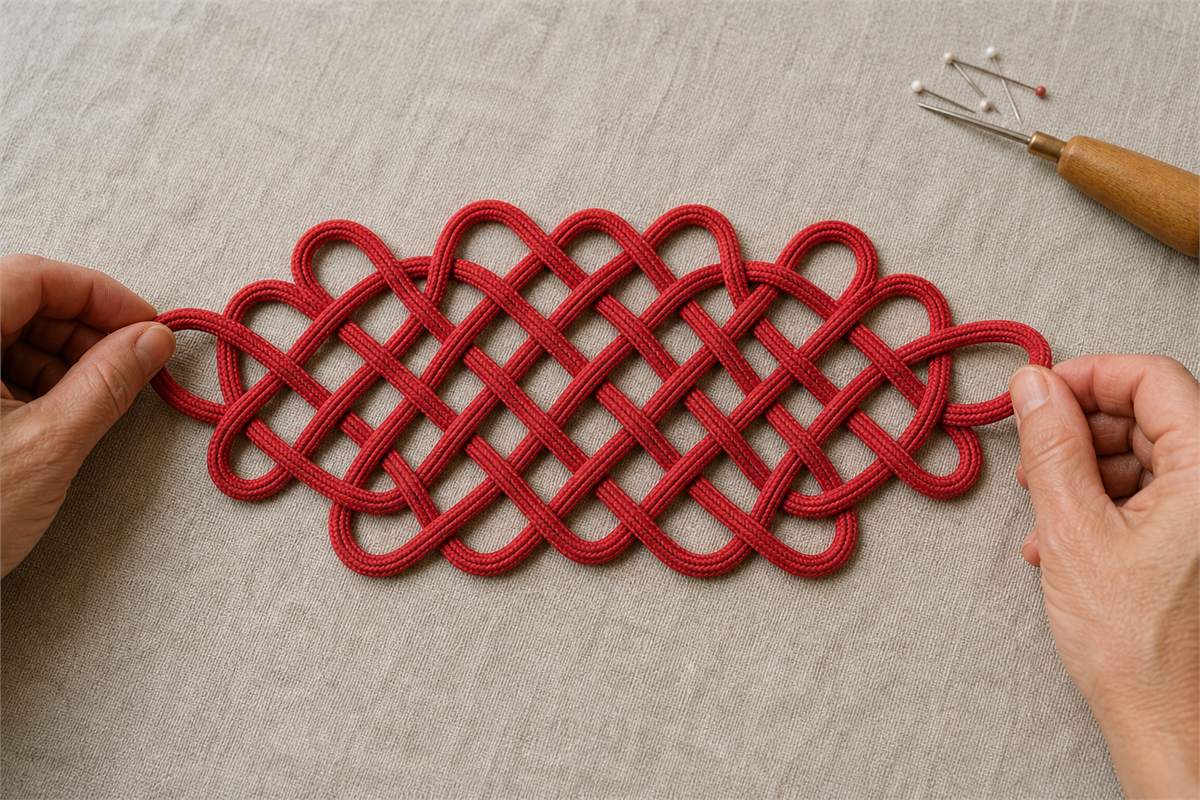
In a hand-tied piece, the maker lays out a route, crosses the cord, and then patiently distributes tension until the shape becomes balanced. Different Pan Chang forms use different cord lengths, gauges, ear arrangements, and working sequences, so instructions should be followed for the chosen pattern rather than converted into one universal measurement. The slow adjustment is part of the gift: attention is worked into the object turn by turn.
Carving and metalwork preserve the interlaced image
Wood, jade, stone, gold, silver, brass, and other metals can show the Pan Chang pattern in relief, engraving, openwork, or casting. A maker may pair it with clouds, scrollwork, a peace buckle, a gourd, or another blessing element. Each companion motif adds its own story; it does not change every Pan Chang object into the same religious or folk symbol.

Textiles and graphics carry the motif into modern design
Weaving, brocade, embroidery, paper cutting, ceramics, stationery, packaging, and digital graphics can all use Pan Chang interlace as a flat pattern. China Unicom’s official emblem is a well-known modern example derived from the ancient Pan Chang design. In a printed form, “Pan Chang motif” is the clearest description because the line depicts a knot rather than functioning as one.

Pan Chang jewelry: red cord, jade, and metal
A Pan Chang bracelet or pendant can be worn as a quiet companion for continuity and connection. A red-cord version feels warm and celebratory; readers who want the broader color story can explore the red string bracelet meaning guide. A jade pendant beneath the knot can join the wish for a long, connected path with jade’s associations of cultivated character and harmony. The jade meaning guide explains that larger cultural language.

Choose by intention and proportion rather than a fixed formula. A fine cord can suit a small pendant; a broader knot can support a larger hanging or make the interlacing easier to see. Look for comfortable edges, secure attachment points, balanced tension, and enough open space for the route to remain legible. Machine-made and synthetic-fiber pieces can be excellent choices when their color, finish, and construction suit the way the object will be used.
A blessing for weddings, friendship, graduation, and family
| Moment | Wish carried by the knot | Message for a card |
|---|---|---|
| Wedding or anniversary | Love that stays connected through every turn | May your days be joined in harmony and 一切如意. |
| Friendship | A bond that remains warm across distance | For a friendship that keeps finding its way home. |
| Graduation | Learning, opportunity, and a path that continues | May every step open beautifully into the next. |
| Parents or grandparents | Health, longevity, peace, and family affection | Wishing you 福寿绵长 and 平安如意. |
| New home or new chapter | Harmony, welcome, and good conditions ahead | May this home hold warm connections and 事事如意. |
The form is not limited by gender. Choose it for the relationship, wish, aesthetic, and life stage. A bracelet may suit someone who likes a symbol kept close; a small framed textile, decorative knot, box, or desk object may better suit someone who does not wear jewelry. The Eastern Story Blessing collection offers more ways to choose an object by the wish it carries.

How to choose a well-made Pan Chang piece
- Follow the route: crossings should read clearly and the repeated pattern should feel coherent.
- Look for balance: handmade work may carry gentle variation, while the overall body should still sit comfortably and intentionally.
- Check the connections: inspect loops, drilled holes, bails, clasps, tassel joins, and narrow openwork bridges.
- Match material to use: soft cord suits wearable pieces; firmer cord can hold a hanging shape; metal, wood, and stone each bring different weight and care needs.
- Choose a readable scale: a very small pattern can lose the graceful over-and-under route that gives the design its meaning.
- Respect the setting: sacred writing or explicitly devotional imagery calls for more context than a simple contemporary knot motif.

Care for cord, jade, metal, and wood
Care for the most delicate part of the piece. Keep cord away from repeated pulling, hooks, perfumes, detergents, and long damp storage; check for fuzzing or loosened crossings. Protect jade and carved stone from hard knocks and abrasive jewelry. Wipe metal gently after wear, follow its finish-specific instructions, and watch narrow bridges or soldered joins. Keep wood away from soaking and sudden changes in heat or humidity.

Store mixed-material pieces separately in a soft pouch or compartment so beads, metal, and carved surfaces do not rub against one another. Check attachment points from time to time and retire a damaged hanging cord before it releases the object. For a fuller routine, use the Eastern Story jewelry care guide.
A beautiful life, connected turn by turn
The Pan Chang knot remains compelling because it gives a visible shape to something people deeply want: for love to endure, family care to continue, friendship to remain, wisdom to grow, and good fortune to meet the next part of life. One line turns many times, yet the whole design holds together.
Worn, treasured, or given, it can carry a simple and generous wish—may the road ahead stay connected to kindness, may blessings continue, and may the person receiving it meet each new season with harmony and fulfillment.
Frequently Asked Questions
Related Posts


