For most garden paths, patios, and courtyards, the product people call “garden quartz tile” is best treated as an outdoor porcelain paver with a quartz- or stone-inspired surface—not as natural quartzite or an engineered quartz countertop slab. Choose it by the exact material, intended outdoor use, wet-surface performance, installation system, and the way you want the garden to feel. A well-planned surface does more than withstand weather: it gives family meals, quiet tea, children’s play, and the walk home a calm and welcoming ground.

Names vary by market, so confirm the product category before comparing colors or prices. “PC brick” often means a precast concrete paving product and should not automatically be treated as another name for porcelain. Natural quartzite, granite, engineered quartz slab, concrete paver, and porcelain paver can share a similar visual language while requiring very different installation and care.
What is garden quartz tile?
In many supplier catalogues, garden quartz tile describes a thick, stone-look porcelain paving tile made for exterior floors. It may imitate quartzite, granite, terrazzo, or other mineral textures. The phrase is a sales name rather than one universal material definition, so the quotation should identify whether the item is porcelain, natural stone, engineered quartz, or concrete.
| Product category | What it is | Best first question |
|---|---|---|
| Outdoor porcelain paver | A fired ceramic body, often with a printed or textured stone look | Is this exact size, thickness, and finish intended for the proposed exterior installation? |
| Natural quartzite | A quarried metamorphic stone rich in quartz | How does this stone, finish, and batch perform in the local climate? |
| Engineered quartz slab | Quartz aggregate bound with resin and pigments | Is this particular formulation approved for exterior UV and temperature exposure? |
| PC brick or concrete paver | A precast cement-based paving unit in many markets | What base, drainage, joint, and load system does the maker specify? |
| Natural granite | A quarried igneous stone available in many exterior finishes | Which finish, thickness, sealing, and installation details suit the site? |
Do not rely on broad claims such as a universal percentage of quartz, a particular press size, firing temperature, or “zero absorption.” Those figures can describe one factory or product line without defining every outdoor paver. The exact product and its intended system matter more than a dramatic headline number.
Begin with the life you want in the garden
Picture the finished space before choosing the surface. A path to the front door can be chosen to welcome ping an ru yi (平安如意)—a wish for peace and all things going as hoped. A shaded tea court may call for a gentle texture underfoot, while a family dining terrace needs a surface that is comfortable to walk on and practical after shared meals. A water garden, driveway, raised terrace, and stepping path each ask something different of the paving.
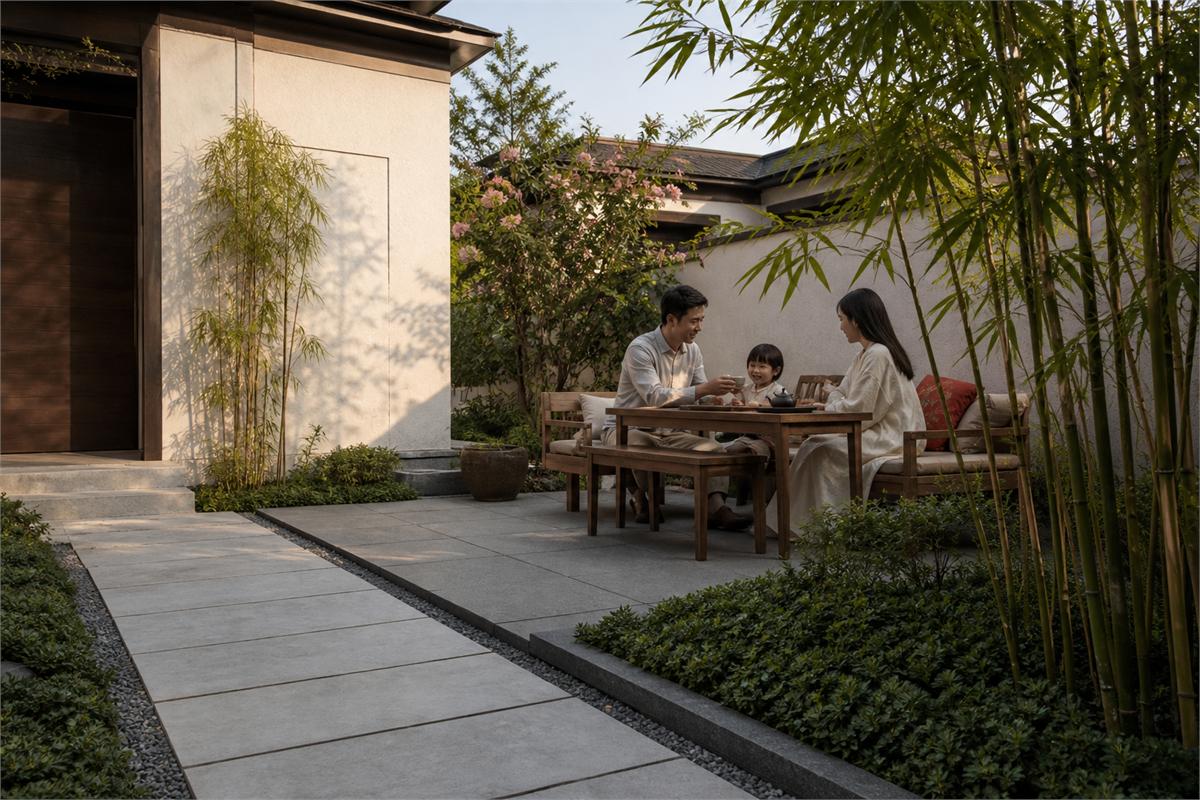
| Garden setting | What matters most | Design feeling |
|---|---|---|
| Entrance path | Wet traction, drainage, even transitions, visible edges | A clear, welcoming route home |
| Tea or dining patio | Chair stability, cleanability, comfortable texture, stain response | Calm conversation and togetherness |
| Pool or water feature | Wet barefoot conditions, drainage, chemical exposure | A relaxed edge that still feels secure |
| Steps and raised planters | Edge detail, cut appearance, nosing, contrast and lighting | Orderly layers and thoughtful craftsmanship |
| Driveway or parking area | Vehicle-approved assembly, base, support and edge restraint | A durable arrival court without visual heaviness |
| Balcony or roof terrace | Structure, waterproofing, drainage, wind and system weight | An elevated retreat with dependable detailing |
Choose the right surface and slip performance
Outdoor paving needs traction appropriate to how it will actually be used. R ratings such as R9–R13 come from a particular ramp-test family and should not be converted directly into wet dynamic-coefficient values or another national system. A higher number is not a universal answer: pool surrounds may need a test intended for wet barefoot use, while a garden slope, restaurant terrace, or icy entrance may be governed by different rules.

Ask which method was used, whether the surface was tested wet or dry, and whether the result belongs to the exact finish you are buying. Then consider slope, footwear, bare feet, shade, algae, fallen leaves, pool water, winter ice, and the cleaning routine. Local requirements and professional site judgment should guide the final choice.
Litchi, flamed, dry-granule, and textured finishes
Finish names are not always used consistently across stone and porcelain. A true flamed finish is traditionally associated with heat-textured natural stone; a porcelain tile described as “flamed-look” may instead use a molded or granular surface. Likewise, a litchi or bush-hammered look can refer to a deeply stippled texture rather than the same production process used on natural stone.

- Fine textured or dry-granule surfaces can balance grip with a refined appearance, but closely spaced particles may hold soil or grout residue.
- Litchi-look or strongly structured surfaces can suit steps, slopes, and wet zones when the applicable test supports the use. Their roughness may feel less comfortable to bare feet and can require more attentive cleaning.
- Flamed-look or softly pitted surfaces create a natural, quiet character. Confirm how the particular tile was made and how it performs rather than judging from the name.
- Polished or glossy surfaces are generally a poor starting point for exposed garden floors because rain, soil, and glare change the walking experience.
Thickness, format, and support must be chosen together
Thickness alone does not guarantee a load capacity or service life. A porcelain paver fully bonded to a stable slab works differently from one set on pedestals or laid over a prepared aggregate bed. Format, flexural properties, span, voids, edge support, base movement, concentrated loads, climate, and the manufacturer’s complete system all affect performance.

Thicker outdoor porcelain—often around 20 mm in many paver ranges—may offer installation options that thinner indoor-style tile does not, but that number should never be treated as automatic approval for vehicles. Driveways and fire-access routes require a system designed for the actual axle loads, turning forces, substrate, drainage, and edge restraint, with input from an experienced installer or engineer where appropriate.
Large formats such as 600 × 1200 mm can make a spacious court feel calm and continuous. A smaller garden may benefit from 600 × 600 mm units, mixed modules, or a border that reduces awkward cuts. Lay several pieces outdoors before ordering: morning light, tree shadows, and repeating printed faces can change the effect. A multi-face design often feels more natural, but a deliberate repeated pattern can also suit a formal courtyard.
Full-body and through-body porcelain: what the terms mean
“Full-body” and “through-body” are sometimes used loosely. In a true through-body porcelain product, the body composition or color continues through the tile, so chips and exposed edges may be less visually obvious. A glazed or digitally printed tile may have a decorated surface over a differently colored body. Neither structure is automatically better for every garden.

Through-body color is especially useful where stair edges, planter caps, miters, or cut sides remain visible. For a flat field with protected edges, a well-specified surface-decorated porcelain paver may be entirely appropriate. Examine an actual cut edge and corner rather than accepting “full-body” as a vague quality label.

Water, drainage, and freeze-thaw conditions
Low water absorption can support outdoor durability, particularly for porcelain in cold climates, but it is only one part of the assembly. Water also moves through joints, around edges, under pavers, into setting beds, and toward walls or drains. Standing water, blocked outlets, saturated bases, and trapped moisture can undermine an otherwise suitable surface.
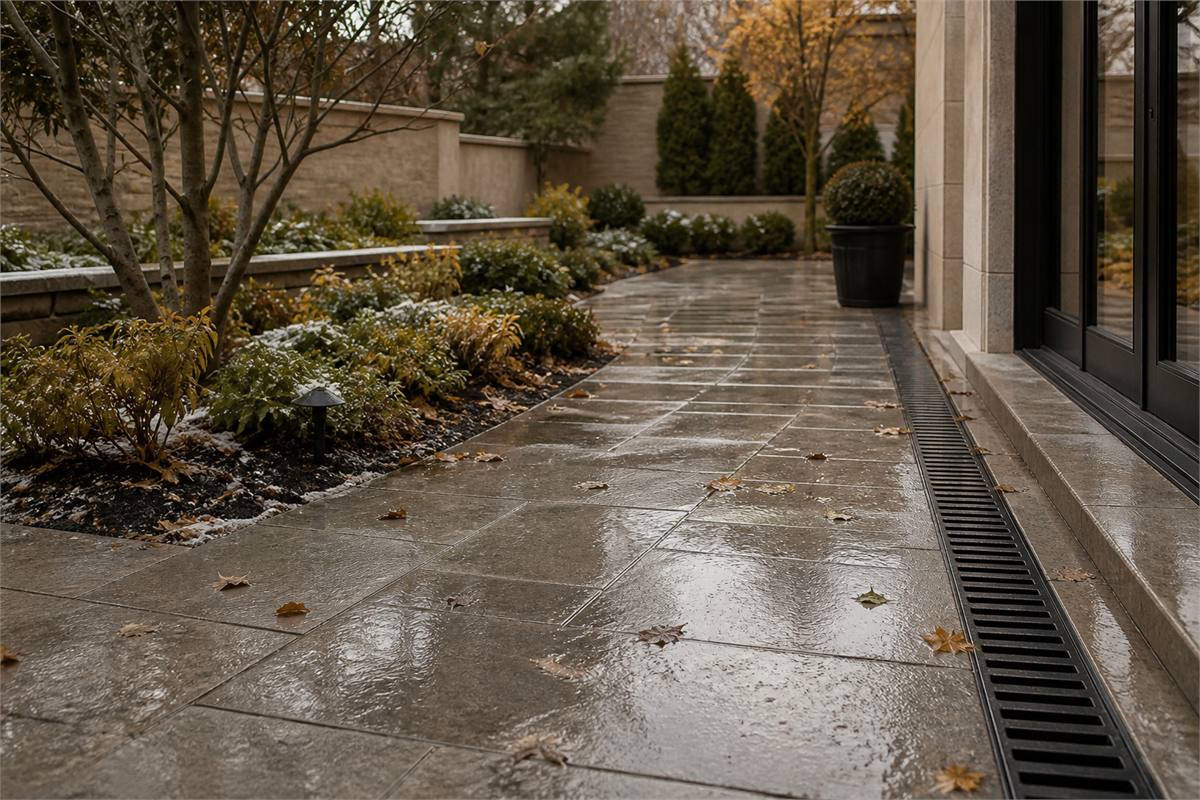
Plan positive drainage away from buildings and toward suitable collection points. The required slope and build-up depend on the product system, rainfall, soil, climate, accessibility needs, waterproofing, structure, and local rules. Freeze-thaw resistance should be assessed with the applicable method for the exact product and installation—not by assuming that one absorption figure or a claimed number of cycles predicts every garden.
Installation details that protect the finished garden
A beautiful paver needs a base that suits the soil and load. Depending on the system, that might be a reinforced slab, a bonded exterior tile assembly, a prepared aggregate bed, or a pedestal structure. Base depth, concrete strength, drainage layers, waterproofing, adhesive coverage, and reinforcement should be set for the site by the product system and qualified professionals rather than copied as one universal recipe.

Joints, edges, and grout
Joint width should accommodate tile size variation, movement, drainage, surface texture, and the selected installation method. Movement and expansion joints must continue where the assembly and structure require them; grout should not bridge a joint designed to move. Outdoor grout may be cementitious, resin-based, polymeric, or another system-specific material. Choose one compatible with the paver, joint geometry, climate, drainage, and cleaning method. Epoxy is useful in some settings but is not automatically the best answer for every porous surface, climate, or installer.

Safe cutting and edge finishing
Thick porcelain requires equipment and diamond tooling suited to the product and cut. Wet cutting or effective dust collection helps control fine silica-containing dust; eye, hearing, and respiratory protection should follow local occupational-safety requirements and the equipment instructions. Complex miters, stair edges, large formats, and visible cuts are best prepared by an experienced fabricator or installer. Ordinary stone-cutting equipment is not automatically unsuitable, but the machine, blade, speed, support, cooling, and dust controls must all match the material.

Color and layout for a peaceful Eastern-inspired courtyard
Warm gray, sand, charcoal, and muted stone tones sit quietly beside bamboo, timber, water, and planting. Pale surfaces can brighten a shaded courtyard; deeper tones can frame greenery and give a larger garden visual weight. Rather than choosing by a fixed style rule, observe the home’s walls, roof, doors, and natural light.

In a Chinese courtyard paving composition, the path is part of the garden’s rhythm. Broad slabs can slow the eye, narrow bands can guide movement, and a simple threshold can mark the transition from the busy world to a place of rest. New Chinese garden style often pairs clean contemporary lines with restrained references to stone, moon gates, water, and planted shadows. The result can carry a wish for harmony, welcome, and shi shi ru yi (事事如意)—may everything unfold as hoped—without turning the garden into a themed display.
Budget in US dollars without comparing unlike projects
Prices vary too widely by country, freight route, format, finish, quantity, and installation system for one universal dollar-per-square-foot figure to be honest. Build the budget in US dollars from separate lines: pavers, freight and delivery access, breakage and cutting allowance, base preparation, drainage, waterproofing where relevant, setting or support materials, edge pieces, labor, cleaning, and future spare stock.

Compare quotations with the same scope. A lower material price may still lead to a higher installed total if the format creates heavy cutting loss or requires additional lifting and base correction. Keep several matching pieces after completion so a future repair does not depend on finding the same shade years later.
A practical sample and ordering checklist
- Confirm the exact category: porcelain paver, natural quartzite, granite, engineered quartz, or concrete paver.
- Match size, thickness, finish, edge, and installation method to the intended area.
- View several pieces outdoors in wet and dry conditions, morning and afternoon.
- Check the applicable slip method for the exact finish and real use environment.
- Assess cleaning on a spare sample with mud, leaf tannin, food, pool water, or de-icing residue relevant to the garden.
- Review drainage, movement joints, edge support, thresholds, and transitions with the installer.
- Make a small mock-up that includes the proposed joint and cut edge before approving the whole order.
- Confirm maintenance instructions for pressure washing, cleaning products, sealing, and winter care for the exact surface.
A five-minute water-drop test, tapping sound, or scratch with a key cannot establish identity or outdoor suitability. A thoughtful sample trial and a complete installation conversation reveal far more while avoiding damage.

Care for the surface through the seasons
Sweep leaves and soil before they remain wet for long periods, clear drains, and wash spills promptly. Begin with water, a soft brush, and the cleaner recommended for the product. Strong acids, strong alkalis, sealers, protective coatings, and high-pressure washing can affect surfaces, joints, edges, and nearby planting differently, so follow the specific maintenance guidance and test an inconspicuous area first.

Natural stone may need a different sealing and stain-care routine from porcelain. Concrete pavers can weather and develop their own patina. Wood and wood-plastic decking offer warmth underfoot but have different heat, movement, cleaning, and replacement needs. These are not inferior choices; the best material is the one whose character and care fit the household and garden.
Choose a surface that supports beautiful everyday life
The most satisfying garden paving decision begins with clarity about the material and ends with the life the space will hold. Select a suitable surface, design the base and drainage as one system, and let color, scale, and texture create a calm foundation for welcome, companionship, and rest. Then the garden becomes more than a finished project: it becomes a place where good wishes are renewed in ordinary days.

For more ways to bring meaningful wishes into the home and garden, explore Eastern Story’s Blessing collection. If your search is about mineral specimens rather than paving, our garden quartz and lodolite guide keeps that story distinct.
Frequently Asked Questions
Related Posts