The Wan symbol (卯 or 卍), known in English as a swastika, is an ancient auspicious mark that has carried wishes for well-being, blessing, continuity, and long life across Buddhist and Asian cultures. In Chinese decorative art it is read wàn (万), the word for ten thousand, so a single sign can suggest abundance while a continuous Wan pattern (万字纹) lets that blessing appear to extend without end.

Its meaning is never determined by silhouette alone. A Buddhist sculpture, a Qing birthday textile, a carved window lattice, and a Nazi banner may use related geometry while belonging to profoundly different histories. Date, place, surrounding imagery, color system, maker, object type, and intended audience all matter. Reading those clues together protects the symbol’s older and living religious meanings while taking the twentieth-century history of antisemitism, racist violence, and genocide with full seriousness.
What does the Wan symbol mean?
The Sanskrit word svastika is associated with well-being or good fortune. Related hooked-cross forms appear in many regions and periods, but a similar shape does not by itself prove one shared origin, one meaning, or a continuous line of transmission. Early examples must be interpreted within their own archaeological and cultural settings rather than assigned a universal story about the sun, fire, the seasons, or the cycle of life.
In Chinese, Buddhist, and decorative contexts, the sign became closely connected with auspiciousness. Its Chinese reading wàn also allows artists to use it as a visual and verbal play on “ten thousand,” a number that conveys vastness and fullness. This is why the motif fits so naturally into wishes for abundant blessings and enduring life.

| Form or name | What it usually describes | How to read it well |
|---|---|---|
| Svastika | The Sanskrit-derived English name for the hooked-cross sign | Use the specific religious, historical, or artistic context |
| Wan (万) symbol, 卯 or 卍 | The sign as read and interpreted in Chinese culture | Look for Buddhist imagery, blessing language, or decorative use |
| Wan pattern (万字纹) | The sign used as a motif or repeating geometric unit | Notice whether it forms a border, field, lattice, or isolated emblem |
| Wan characters without end (万字不到头) | A continuous design made from linked Wan units | Read the repetition as a wish for blessings or prosperity to continue |
| Śrīvatsa | A distinct Sanskrit term and auspicious concept with varied visual forms | Do not automatically treat it as the Sanskrit name for every 卯 or 卍 |
The Wan mark in Buddhist art
Within Buddhism, the sign can mark auspicious presence and the extraordinary qualities of a Buddha. It appears in Buddhist art on the chest and, in some traditions and images, on the hands or feet. Textual lists of the Buddha’s bodily marks vary across languages and traditions, so it is more accurate to call it an auspicious mark in Buddhist iconography than to claim that every Buddhist school gives it an identical place among the thirty-two major marks.
The sign also appears on textiles, ritual and devotional objects, architectural decoration, and maps marking Buddhist temples. Its orientation is not governed by one global Buddhist rule. Different textual, regional, artistic, and production traditions use both 卯 and 卍, and an image may be reversed through molds, rubbings, printing, photography, or textile construction.

Svastika and śrīvatsa are not interchangeable terms
Svastika names the hooked-cross sign. Śrīvatsa has its own history as an auspicious term and emblem in South Asian religious traditions, and its depicted form is not always a swastika. Chinese Buddhist sources and later dictionaries use several descriptions and translations for auspicious marks; phrases such as “a gathering place of auspicious virtues” are helpful interpretive language, but they should not be presented as the single literal translation of every term.
A well-known later Chinese account associates the reading wàn with the reign of Empress Wu Zetian in 693. That tradition helps explain why the graph became legible in China as both an auspicious Buddhist sign and a visual echo of 万, “ten thousand.” Claims about which individual translator rendered the mark as “virtue” or “ten thousand” differ across modern retellings, so those names do not need to carry the public story.
Do left- and right-facing forms have different meanings?
Direction can be meaningful within a particular religious or artistic tradition, but it is not a universal decoding key. Both 卯 and 卍 have long histories in Asian religion and art. Neither orientation, nor a square or diagonal placement, can identify an object’s belief system or political meaning by itself.
Yungdrung Bön is a distinct Tibetan religious tradition, not a branch of Tibetan Buddhism. The Tibetan term yungdrung is associated with permanence and indestructibility, and its emblem is central to Bön identity. Tibetan Buddhist and Bön practices should be described on their own terms rather than collapsed into a single rule about orientation or ritual movement. Hindu traditions likewise contain varied uses of right- and left-facing forms; a simple “masculine versus feminine” formula cannot represent all of them.

How Wan became a Chinese pattern of continuity
When the Wan sign enters secular decorative art, it can work as a single blessing, a repeating background, or the structural unit of a lattice. Artisans can extend its arms into neighboring units so that the eye follows a continuous path across cloth, ceramic, wood, metal, or stone. This linked design is called Wan characters without end (wànzì bù dào tóu, 万字不到头). The Palace Museum describes it as a pattern made from countless connected Wan forms and associates it with prosperity without end.

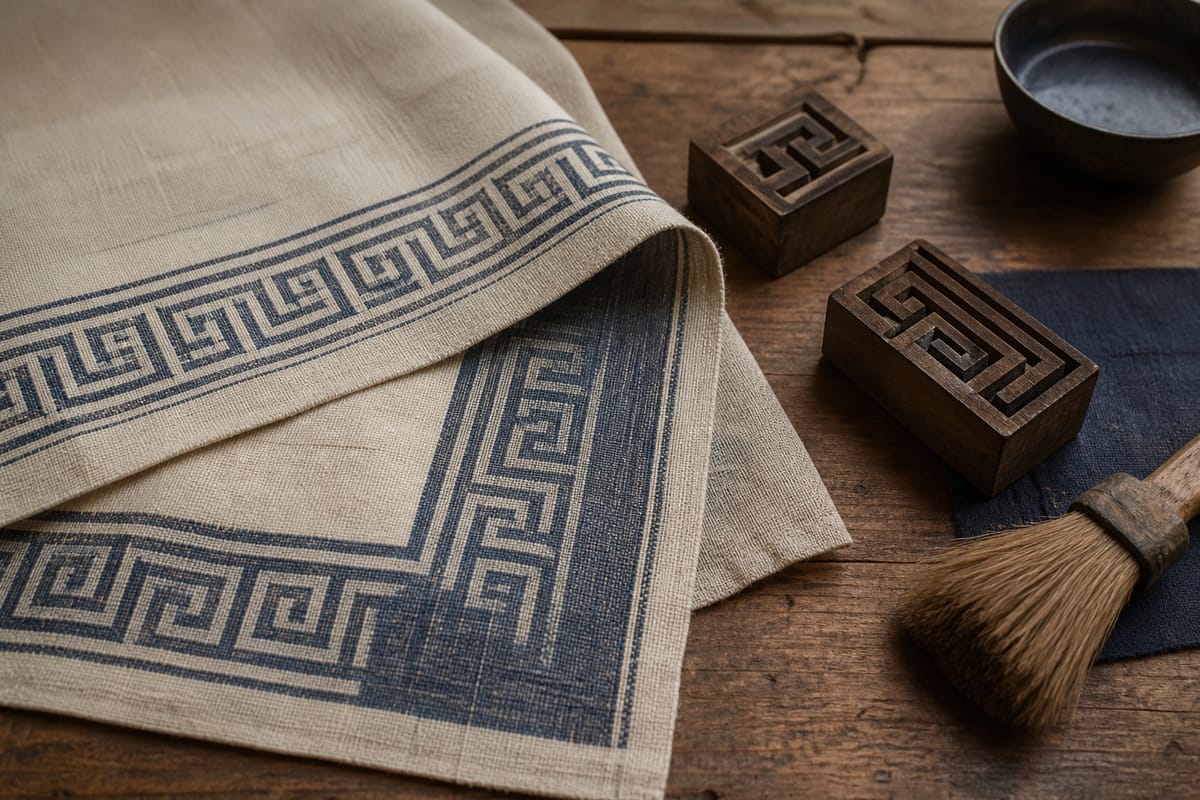
Wan pattern is not the same as the angular key fret commonly called huiwen (回纹), even though both can form continuous geometric borders. Huiwen turns through squared or meandering paths without requiring the hooked-cross unit. Museum catalogues may also use terms such as Wan fret, swastika fret, key fret, or meander according to the collection and language. The safest identification follows the actual structure rather than treating every angular repeat as one pattern family.
Wan, Shou, bats, and other blessing motifs
Wan is especially at home beside the longevity character Shou (寿 / 壽). Wan suggests “ten thousand” and Shou means long life, so their pairing carries the expansive birthday wish of ten thousand years of longevity.
Real objects show how meaning grows from a complete composition. A late Qing design preserved by the Palace Museum places round Shou characters with bats and blue Wan motifs, creating a documented wish for blessing and longevity. On other works, lotus flowers may strengthen a Buddhist setting, while peaches, cranes, or deer may support a birthday theme. These combinations should be named from the whole object and its record; simply adding two motifs together does not create a fixed traditional title.

Where the Wan pattern appears
The motif’s clear geometry adapts easily to different materials. Woven silk can alternate individual signs across a field or build them into repeating bands. Embroidery can place Wan above or around Shou on birthday garments. Porcelain painters use it as a border, ground, or companion to lotus, bats, and longevity characters. Wooden window lattices, furniture panels, screens, and architectural railings translate the repeat into openwork, while paving and tile designs carry its rhythm across a surface.

- Textiles: woven or embroidered grounds, borders, robe details, hangings, and furnishing fabrics.
- Ceramics: painted, gilded, carved, or molded motifs used alone or within a documented auspicious composition.
- Architecture and furniture: lattices, screens, railings, panels, and borders whose repeated geometry balances openness with order.
- Jewelry and small objects: pendants, carved plaques, metalwork, boxes, and contemporary keepsakes chosen for Buddhist identity, blessing, continuity, or longevity.
Names such as “Wan flowing-water pattern,” “Wan curved-water pattern,” and “Wan longevity brocade” occur in modern descriptions, but they are not automatically synonyms for every linked Wan design. The object’s collection record, region, period, and construction should lead the terminology.

How the traditional Wan symbol differs from the Nazi emblem
The Nazi Party formally adopted the swastika, called Hakenkreuz in German, as its symbol in 1920. Adolf Hitler’s flag combined a black swastika with a white disk and red field. Under Nazism, that emblem became inseparable from the party’s racist and antisemitic ideology, dictatorship, persecution, war, and the genocide of European Jews and other victims.
Angle and orientation are not absolute tests. Historical religious and decorative forms can also be diagonal, and traditional and Nazi forms can overlap geometrically. The reliable distinction comes from the full visual and historical system: era, place, palette, supporting symbols, object type, author or organization, intended message, and documented use.

| Question to ask | Traditional religious or decorative context | Nazi political context |
|---|---|---|
| When and where was it made? | Temple, household, workshop, historic textile, ceramic, sculpture, or living religious setting | Nazi Party, state, military, propaganda, extremist, or commemorative setting |
| What surrounds the sign? | Lotus, Shou, bats, repeated fret, deity image, inscription, or regional ornament | Red-white-black party system, eagles, uniforms, slogans, flags, or other Nazi insignia |
| What does the record say? | Museum catalogue, religious institution, maker statement, family history, or object documentation | Political organization, propaganda purpose, period record, or extremist use |
| What response is appropriate? | Explain the specific living or historical tradition with care | Recognize and address its history of hatred, terror, and genocide |
Because recognition differs among people and places, a traditional use may still cause pain or alarm, especially when displayed without context. Laws also differ by jurisdiction and purpose, with rules and exceptions that can change. For travel, public display, or commercial use, check current official guidance for the specific country and explain the cultural setting clearly.

Using the Wan pattern in modern design
Modern designers can preserve the motif’s warmth by making its cultural story visible. A continuous textile ground may carry a wish for blessings that keep unfolding; a Wan-and-Shou composition can welcome long life at a birthday; a Buddhist piece may express devotion or spiritual identity. They express a wish—a medium through which people hope to bring about wealth, health, virtue, longevity, or a specific outcome in life.

For a pendant, scarf, ceramic, or gift, provide the motif’s name, cultural setting, and intended blessing. Show the entire design rather than an isolated crop, and consider how it will be understood in the recipient’s community. A short note explaining Wan (万), continuity, and the surrounding Shou or lotus motif can turn a potentially unfamiliar sign into a thoughtful cultural conversation.

For screens, railings, furniture, or lighting, aesthetics share space with safety. Openings and connections should suit the setting; child-accessible designs need attention to entrapment and climbing risks; suspended lighting needs appropriate weight support, heat management, electrical approval, and maintenance access. No single material or joinery method is automatically best—the structure should be designed and installed for its actual load and environment.
When the Wan symbol makes a meaningful gift
A Wan-pattern gift can suit a recipient who values Buddhist art, Chinese decorative tradition, family textiles, or symbols of long life and continuity. Choose by the wish, relationship, aesthetic, religious identity, comfort, and setting rather than by gender or age. A birthday textile combining Wan and Shou may carry a wish for abundant years; a continuous fret on a home object may welcome harmony and blessings into everyday life.
In a cross-cultural setting, conversation is part of the gift. If the recipient may first recognize the Nazi association, explain the piece before giving it, include its cultural name, and make room for their response. When another symbol would communicate more comfortably, Shou, lotus, Ruyi, peach, crane, or the endless knot can carry related wishes. The auspicious characters overview offers more ways written blessings take form, while the Eastern Story blessing collection brings those wishes into meaningful objects for modern life.

Frequently Asked Questions
Related Posts


0 Comments