
Dulong jade is a green, quartz-rich aggregate sold under a regional or commercial name associated with Dulongjiang and Gongshan in Yunnan, China. In laboratory-style mineral naming, applicable material is generally described as quartzite jade or a quartz-rich aggregate rather than jadeite or nephrite. The name is useful in the jewelry market, but it is not a single globally standardized gem species.
Its appeal comes from cool green color, a polished glassy to slightly greasy luster, and patterns that can resemble floating green forms in translucent jadeite. That visual similarity explains market phrases such as “jadeite alternative” or “sister jade.” They describe positioning and appearance, not mineral identity. This guide explains what Dulong jade is, its properties and value, how it differs from jadeite, nephrite and Xiuyan jade, how to identify buying risks, and how to care for it safely.

What Is Dulong Jade?
Dulong jade, also written Dulongjiang jade or Dulong Yu (独龙玉), is best understood as a trade or locality-linked name. It is commonly connected with Gongshan County and the Dulongjiang area of Nujiang Prefecture in Yunnan. Jewelry labels may use the name for green quartzite-jade material associated with that region, while the mineral name centers on what testing finds in the particular piece.
A published study of samples sold as “Dulong Yu” found a fine- to medium-grained metamorphic aggregate dominated by alpha quartz, with quartz above 90% in those samples and about 5%–10% sericite. The green color in the tested material was linked to chromium- and iron-colored green sericite distributed between quartz grains. Those results are valuable evidence for the sampled material, not a rule that every object sold under the name has exactly the same percentages or accessory minerals.
This distinction matters because natural aggregates vary. One piece may be relatively even and pale; another may show darker green clouds, white areas, gray-blue tones, veins, fractures or mineral inclusions. Some specimens may contain metallic-looking grains or other accessory minerals, but yellow “gold dust,” pyrite, chlorite, chromian mica or black spots are not mandatory features of all Dulong jade. Selenium should not be presented as the source of a gold-dust appearance.
Where the Name Comes From
The commercial story links the material to Dulongjiang, the Dulong River valley, and nearby Gongshan in northwestern Yunnan, where the Dulong people live. That geographic association explains the name in modern trade. It does not by itself establish that every item carrying the label was mined at a precisely documented location, so origin and mineral identity should be treated as separate questions when comparing listings.

Respectful cultural description also requires restraint. Dulong jade can be discussed as a contemporary regional material and as jewelry made in familiar Eastern forms. Claims that it was an ancient Dulong sacred gift, ritual medium, inherited talisman or symbol of political authority need specific ethnographic evidence. Modern sellers may attach ideas such as resilience, harmony or closeness to nature to the stone; these are present-day interpretations, not automatically ancient Dulong customs.
“African green jade” or Feizhou Cui is another unstable market label. It may refer to green quartz-rich materials from different sources and should not be treated as an automatic synonym for Yunnan-associated Dulong jade. Similar chemistry at a broad level does not establish the same origin, texture, accessory minerals or commercial history.
Dulong Jade Properties
Because Dulong jade is usually quartz-rich, its practical properties tend to resemble those of quartzite jade. Commonly cited figures include a refractive index around 1.54, a Mohs hardness of about 6.5–7, and density around 2.6–2.8 g/cm³. These are useful comparison ranges for applicable quartz-rich samples, not guaranteed readings for every commercial object. Grain size, accessory minerals, porosity, fractures and treatments can shift measured behavior.

| Property | Typical description for applicable Dulong jade material | Why it matters |
|---|---|---|
| Main mineral identity | Quartz-rich aggregate or quartzite jade; studied samples contained more than 90% quartz | Separates the material from jadeite and nephrite |
| Structure | Interlocking granular aggregate, sometimes fine to medium grained | Influences texture, translucency and polish |
| Mohs hardness | About 6.5–7 | Offers reasonable scratch resistance, although edges can still chip |
| Density | About 2.6–2.8 g/cm³ | Usually lower than jadeite; not a stand-alone home test |
| Refractive index | Approximately 1.54 | Consistent with quartz-rich material when measured properly |
| Luster | Glassy to slightly greasy after polishing | Varies with texture, surface finish and treatment |
| Transparency | Opaque to translucent; selected material can be notably translucent | Affects appearance and price within a specific product type |
Hardness is not toughness. A polished quartz-rich bangle can resist ordinary surface wear yet break when dropped onto tile or struck at a thin edge. Fractures, drilled holes and sharp carving details create additional weak points. This is why a Dulong jade bracelet should not be treated as impact-proof simply because quartz is relatively hard.
Colors, Patterns, and Possible Inclusions
Green is the best-known color, ranging from light gray-green and blue-green to deeper forest or ink green. White, yellowish, gray and darker areas may occur in the same piece. Translucent pale ground with irregular green patches is especially popular because it can evoke the “floating flower” look marketed in jadeite jewelry.
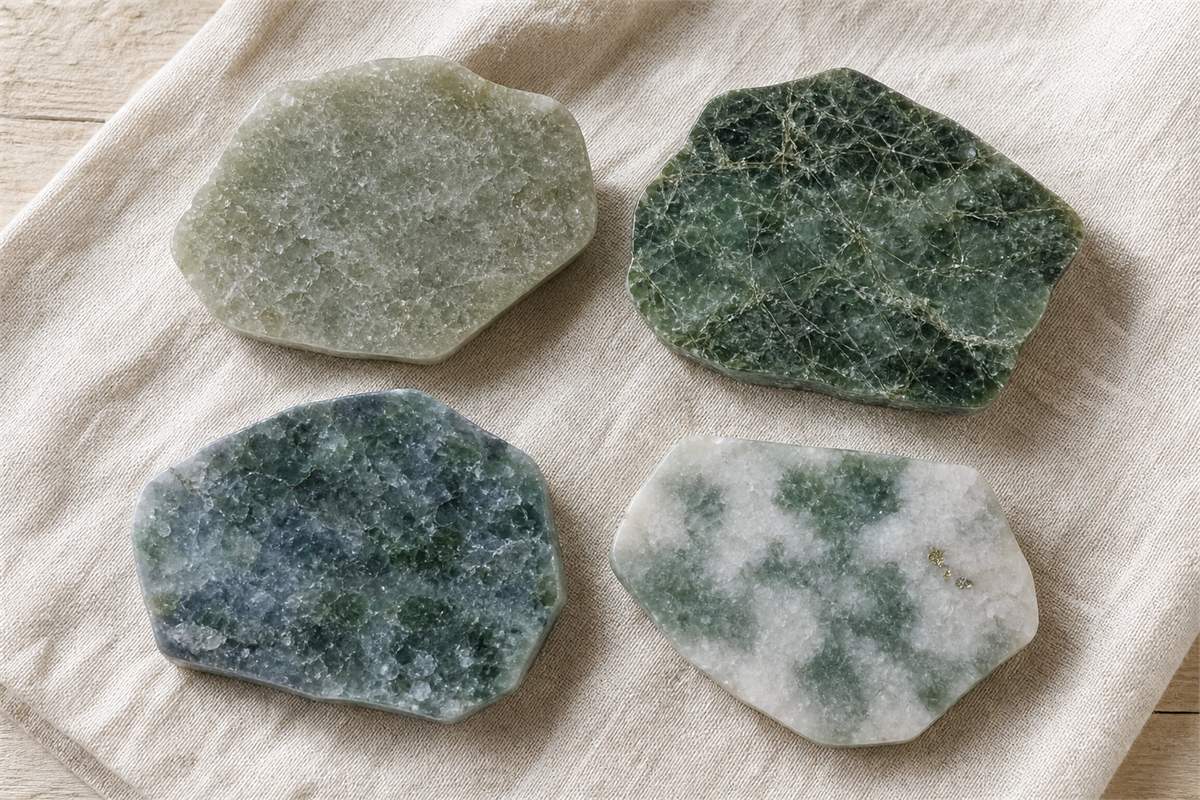
In studied Dulong Yu samples, fine green sericite occurred as threadlike or flaky material between quartz grains, and chromium and iron contributed to the color. Other commercial specimens may have a different accessory-mineral mix. Natural variation can appear as clouds, streaks, granular zones, veins or uneven translucency. No single pattern proves a piece is natural, untreated or from Dulongjiang.
Small dark or metallic points may occur in some pieces, but they are not an identity stamp. A piece without “gold dust” can still be quartzite jade, and a piece with sparkling grains is not automatically Dulong jade. Likewise, bright color, black dots, cool touch, visible granularity or a particular type of green patch cannot determine the material by itself.

Dulong Jade vs Jadeite, Nephrite, and Xiuyan Jade
The clearest comparison begins with mineral composition and structure. Jadeite is a pyroxene-rich aggregate; nephrite, including much material sold as Hetian jade, is mainly a tightly interwoven tremolite-actinolite aggregate; Xiuyan jade commonly refers to serpentine-rich jade from the Xiuyan tradition; Dulong jade is generally quartz-rich. These are different materials that can overlap in color or jewelry form.

| Material | Typical mineral and structure | Approximate density | Mohs hardness | Common visual character |
|---|---|---|---|---|
| Dulong jade | Quartz-rich granular aggregate | 2.6–2.8 g/cm³ | 6.5–7 | Glassy to slightly greasy; green clouds, grains or streaks may occur |
| Jadeite | Jadeite-rich interlocking pyroxene aggregate | About 3.34 g/cm³ | 6.5–7 | Glassy to greasy; broad color range and variable translucency |
| Nephrite / Hetian-type jade | Tremolite-actinolite with felted or fibrous intergrowth | About 2.95 g/cm³ | 6–6.5 | Often softly greasy or waxy, with notable toughness |
| Xiuyan jade | Commonly serpentine-rich aggregate | Often lower than nephrite and jadeite | Commonly about 4.5–5.5 | Waxy to greasy, often soft green and translucent |
Dulong jade and jadeite can share green-and-white patterns, but appearance alone cannot bridge their mineral difference. Jadeite is usually denser, yet hand weight depends on dimensions and setting, so “heft” is not a reliable one-step identification method. Jadeite does not always display an obvious color root or reflective “fly-wing” texture, and the absence of those features does not identify Dulong jade.
Nephrite is slightly softer on the Mohs scale but is celebrated for a dense, tough intergrowth that supports durable carving. Xiuyan jade is generally softer and can take a waxier luster. For deeper nephrite context, Eastern Story’s Hetian jade guide focuses on that material rather than using Dulong jade as a substitute topic.
Dulong Jade Value and Market Position
Dulong jade is usually positioned as accessible decorative jewelry, especially for shoppers who enjoy the visual language of translucent green bangles. Value should be discussed within a defined product: a plain bangle, bead bracelet, small pendant, detailed carving or large display piece. Size, usable yield from the rough, color distribution, translucency, fractures, finish, carving labor, treatment and selling market all affect the asking price.

There is no responsible universal price rule for the name alone. A small polished pendant and a thick, evenly cut bangle do not belong in the same comparison, while retail presentation and return terms can also change a listing price. The supplied market notes used broad Chinese expressions such as “hundreds,” “thousands,” and “ten-thousand level” without explicit figures, so they are not converted into dollar amounts here.
Terms such as “high ice,” “floating flower” and “jadeite alternative” are sales vocabulary. They can help describe appearance, but they do not change quartzite into jadeite or create a fixed valuation tier. Compare like with like: same jewelry form, similar dimensions, comparable translucency, similar fracture condition, equivalent craftsmanship and equally clear treatment disclosure.
Common Dulong Jade Jewelry Shapes
Bangles are the signature form because a broad polished surface displays color zones and translucency. Round bangles have a fully rounded cross-section; flat-inner or wider styles place more material across the wrist; slim bangles feel lighter and visually delicate. Wearing multiple hard bangles together increases impact and abrasion risk, so slim pieces are safer worn separately or beside soft cord rather than knocked against other stone bracelets.

Pendants, beads and small carvings make use of patterned areas that may not suit a full bangle. Leaf, bamboo, landscape, cloud, coin and round bi-inspired forms can carry familiar contemporary Eastern design language. Animal and auspicious motifs may express a gift wish through their established design symbolism. Religious figures deserve respectful handling and description; the carving should not be marketed as a guaranteed source of protection or assigned by gender.

Larger blocks may become ornamental carvings or display objects, where composition and craftsmanship can matter more than maximum translucency. In all forms, skilled cutters work with natural color differences, avoid unstable fractures where possible, and polish the quartz-rich surface to reveal depth without disguising structural weaknesses.

How to Identify Dulong Jade and Screen Buying Risks
Home observation can screen for inconsistencies, but it cannot establish a definitive mineral identity or treatment history. Begin with the listing language. The material should be sold clearly as Dulong jade, quartzite jade or quartz-rich jade material—not represented as jadeite. Ask for exact dimensions, weight, natural-light photographs, close views of any fractures, and a plain explanation of known treatments and return conditions.

- Compare color in several lighting conditions. Uneven or vivid color may be natural or treated; photographs with consistent white balance are more useful than one highly saturated image.
- Inspect openings and surface recesses. Dye may concentrate in fractures or porous zones, while fillers or coatings may alter luster. These observations flag questions but are not conclusive by themselves.
- Check structural condition. Look for cracks crossing the wall of a bangle, chips at edges, pits, repaired areas and uneven thickness. A structural fracture matters even when the color is attractive.
- Judge workmanship separately from material. Smooth inner edges, even proportions, clean drilling and consistent polish add practical value.
- Treat extraordinary sales claims as separate claims. Origin, rarity, mineral identity and treatment are different issues; one appealing name does not establish all four.
Quartz-rich jade materials can be dyed, impregnated or coated, and wax may be used as a surface finish. The presence or absence of ultraviolet fluorescence cannot classify a piece on its own: some fillers may fluoresce weakly or not at all, and natural minerals or surface materials can also respond. Sound, coolness, hand weight, bubbles, black dots, metallic specks, “color roots” and floating-pattern shape are equally unsuitable as single-answer tests.
Avoid destructive experiments. Knife scratching can damage both the jewelry and the tool, while alcohol rubbing may affect surface finishes without revealing the full material history. When a purchase decision depends on exact mineral identity or treatment, professional gemological testing uses several observations and instruments together.

How to Choose a Dulong Jade Bangle or Carving
For a bangle, start with fit and structure rather than color. Confirm inner diameter, width and thickness in millimeters. Compare those measurements with a bangle that already passes over the hand comfortably. A beautiful but undersized rigid bangle is unusable, while an oversized one can strike furniture and slip from the wrist.

Next, examine color distribution and translucency in relation to the form. A broad bangle can showcase a landscape-like green patch; a pendant may benefit from one concentrated area of color; a detailed carving needs enough structural integrity to support thin features. Decide whether you prefer quiet, even color or dramatic contrast rather than accepting “more green” as an automatic quality rule.

Finally, compare finish and disclosure. Good polish should be even, with no sharp inner rim, visible polishing lines or poorly finished drill holes. Understand whether the piece has surface wax, dye, impregnation, coating or repairs, and evaluate the price in that context. Eastern Story’s jewelry material guide provides a broader framework for comparing materials without collapsing them into one jade category.
Scientific Care for Dulong Jade
Clean Dulong jade with lukewarm water, a soft cloth, and—when needed—a soft brush with a small amount of mild soap. Rinse away residue and dry the piece, including drilled holes and setting crevices. There is no mineralogical need to “feed” quartzite with oil, replenish it with bottled water, or soak it on a fixed schedule.

- Avoid hard knocks, drops, abrasive surfaces and stacking against hard stone or metal jewelry.
- Keep the piece away from extreme temperature changes, sustained high heat, and strong acids or alkalis.
- Remove bangles for impact-heavy work, sports, bathing or tasks involving strong cleaners.
- Store pieces separately in a lined compartment or soft pouch so edges do not strike each other.
- For mounted jewelry, consider the metal, adhesive and setting construction before cleaning; avoid soaking when the assembly may trap moisture or use sensitive adhesive.
Ordinary wearing will not reliably transform the internal mineral structure or make a stone permanently more translucent. Gentle cleaning and protection preserve the polish that creates much of the visible luster. For other jewelry materials and mixed settings, consult Eastern Story’s jewelry care guide.

Frequently Asked Questions
Related Posts


