
Ancient Egyptian jewelry was more than decoration, but it was never one fixed system. Across more than three millennia, Egyptians wore and used ornaments to display status, reward service, seal property, take part in ritual, and prepare the dead for burial. Gold, silver, electrum, copper alloys, colored stones, Egyptian faience, and glass each carried practical and cultural associations that changed with period, object type, and owner.
The safest way to understand ancient Egyptian jewelry is to begin with the object itself: what it is made from, how it was constructed, where it was found, who could have used it, and whether it was made for life, administration, temple ritual, burial, or more than one of those settings. Symbolic meanings matter, but they should not be treated as modern promises of healing, wealth, or supernatural protection.
Why Ancient Egyptian Jewelry Matters
- Personal adornment: necklaces, bracelets, anklets, rings, and earrings could mark taste, age, gender presentation, household wealth, and social position.
- Office and reward: some seals served administration, while particular gold necklaces could be royal rewards.
- Ritual and belief: materials, inscriptions, deities, and amulet forms connected jewelry with temple practice and ideas about divine or funerary protection.
- Burial: some ornaments had been worn in life, some were adapted for burial, and others were produced specifically for the dead.
- Historical evidence: jewelry records trade, metallurgy, glass and faience technology, workshop practice, and contact with neighboring cultures.

Four Contexts: Wearing, Ritual, Administration, and Burial
A broad collar shown on a tomb wall, a scarab impressed into clay, a menat shaken in a ceremony, and a heart scarab placed with a mummy are related to jewelry history, but they did different work. A single object could also move between contexts. A seal could be worn as an ornament; an amulet used by a living person might later enter a burial; a necklace could be both valuable property and a visible sign of office.

| Context | What to look for | What not to assume |
|---|---|---|
| Daily or formal wear | Wear marks, suspension systems, portraits, burials with personal possessions | Every depicted ornament was affordable or worn by everyone |
| Temple or court ritual | Royal names, divine imagery, presentation scenes, instruments such as the menat | All ritual ornaments were ordinary necklaces |
| Administration | Engraved seal surfaces, names or titles, clay sealings, secure cords and containers | Every scarab or ring was an official seal |
| Burial | Find position on the body, funerary texts, purpose-made beadwork or amulets | Every grave ornament had been worn in life, or every fragile piece was only display |

Metals: Gold, Silver, Electrum, and Copper Alloys
Gold
Gold objects survive from Egypt as early as the fourth millennium BCE. Egyptian sources associated gold with the sun, divine bodies, permanence, and elite display, while its physical properties made it exceptionally useful to craftspeople. It resists corrosion and can be hammered into sheet, wrapped over a core, drawn or twisted into wire, joined, and polished. Many surviving gold objects are therefore sheet constructions rather than heavy pieces cast from solid metal.
Gold resources were strongly connected with royal control, mining expeditions, the Eastern Desert, and Nubia. Yet it is inaccurate to say that only kings owned gold. Nonroyal burials, including that of the Middle Kingdom official Wah, preserve gold ornaments. Access was unequal, but ownership was more complex than an absolute royal monopoly.
Silver and electrum
Silver was rarer than gold in many periods of Egyptian history, especially in the earlier record. Egypt has no securely documented ancient silver-mining industry comparable to its gold production, so silver was probably obtained largely through exchange. It should not be described as routinely mixed with gold because it was “too soft.” Ancient silver objects and naturally silver-bearing gold require object-by-object analysis.
Electrum means a gold-silver alloy. It can occur naturally because Egyptian gold often contains silver, and alloys could also be adjusted by craftspeople. Its color ranges from yellow to pale or greenish tones depending on composition. Egyptians used electrum for jewelry and ritual objects, but the label should be based on material study rather than color alone.

Copper and copper alloys
Copper was a major working metal for tools, fittings, mirrors, and ornaments. Arsenical copper occurs early, while tin bronze became more common from the New Kingdom without replacing copper. Museum catalogues often use “copper alloy” when the exact composition is uncertain. These materials could be cast, hammered, engraved, gilded, or combined with beads and inlays. Their presence does not automatically identify a low-status owner: object type, workmanship, and archaeological context remain essential.

Colored Stones: Lapis Lazuli, Turquoise, Carnelian, and More
Egyptian jewelry used color deliberately, but color was not a rigid code in which every blue, green, or red object always meant the same thing. Language, divine imagery, period, and object type shaped the reading. Craftspeople also combined natural stones with faience and glass, sometimes to create a planned palette rather than imitate a single gemstone.
Lapis lazuli and long-distance exchange
Lapis lazuli appears in Egypt by the Predynastic period and remained prized for beads, inlays, and amulets. The nearest major ancient sources known today lie in what is now Afghanistan. The stone therefore reached Egypt through long-distance exchange, although its exact route and the source of every object cannot be reconstructed with certainty. Deep blue lapis could participate in celestial and divine color schemes, but context matters more than a modern one-line meaning.

Turquoise, carnelian, and other stones
Turquoise was obtained in Sinai, where mining landscapes and cult activity connected the material with Hathor, “Mistress of Turquoise.” Carnelian ranges from orange to deep red and was widely used for beads and inlays. Green feldspar, jasper, garnet, amethyst, quartz, and other stones appear in different periods and assemblages. Malachite was both a copper ore and a green mineral used in Egyptian material culture; it should not be merged with turquoise, feldspar, or green faience simply because all can look green. Readers interested in the mineral itself can continue with Eastern Story’s malachite guide.

Egyptian Faience and Glass Are Not the Same Material
Egyptian faience is a quartz-rich, non-clay material with a vitreous glaze. Finely ground quartz or sand was mixed with small amounts of alkali and lime, shaped by hand or in molds, then glazed through methods that could include efflorescence, direct application, or cementation. Copper compounds often produced blue-green surfaces, but other colors were possible. Faience was used for beads, amulets, vessels, tiles, and figures across a wide social range; it was not merely a cheap “fake gemstone” reserved for people who could not afford stone.
Glass, by contrast, has a fused vitreous body rather than a quartz-particle core beneath a glaze. Glass became especially important in Egypt during the New Kingdom for beads, vessels, and inlays. Its colors could be controlled with mineral colorants, and opaque glass could sit beside stone or faience in the same ornament.

| Material | Basic structure | Common jewelry use |
|---|---|---|
| Egyptian faience | Quartz-rich body with a vitreous glaze | Beads, amulets, rings, pendants, inlays |
| Glass | Fused soda-lime-silica material | Beads, earrings, inlays, vessel ornaments |
| Glazed stone | Natural stone with an applied glaze | Beads, amulets, small objects |
| Egyptian blue | Synthetic blue pigment, not a synonym for faience | Primarily pigment; its technology is related to other vitreous materials but the product is different |
A gold object divided into cells and filled with cut pieces of stone, faience, or glass is best described as cloisonné inlay or cell inlay when the construction supports that term. It is not automatically cloisonné enamel. True enamel involves glass fused onto metal, and that should not be assumed for pharaonic jewelry without specific technical evidence.

How Ancient Egyptian Jewelry Was Made
Hammered sheet, gilding, and cast elements
Hammering exploited gold’s malleability to make sheet for beads, plaques, settings, and coverings over wood, plaster, or another metal. Relief could be raised by working sheet from the back and refined from the front. Small solid elements were also cast, and larger constructions could combine hammered plates with cast details. It is safer to identify casting generally unless an object study specifically demonstrates a lost-wax process.

Wire, joining, and surface detail
Wire could be twisted, braided, woven, or used to connect parts. Gold strips and rods were worked into rounded wire before modern drawplates became standard. Soldering joined components with an alloy that melted at a lower temperature than the parts being connected. Middle Kingdom granulation used tiny gold spheres for relief and pattern, while wire and granules could be attached by technically controlled joining methods. “Filigree” is appropriate only when wirework actually forms the decorative structure, not as a label for every fine gold line.

Inlay, beads, and flexible construction
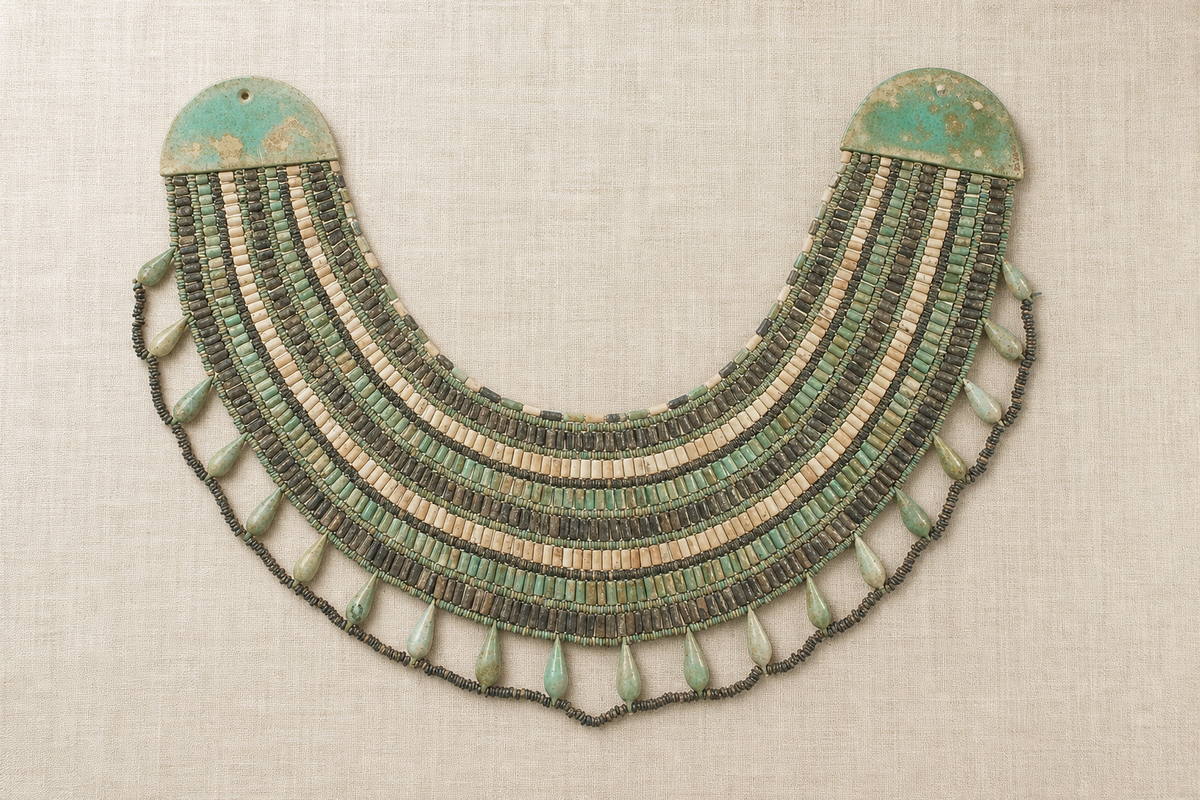
For cell inlay, thin gold partitions formed compartments on a backing plate. Carefully cut stones or vitreous pieces were fitted into those cells, sometimes held with a bedding material. Beaded collars and necklaces depended on drilled beads, stringing order, terminals, clasps, spacer bars, and counterweights. The visual surface may dominate a museum photograph, but the hidden connections determined whether the ornament could flex, lie flat, or carry weight.

Major Jewelry Types and How They Were Used
Wesekh broad collars
The wesekh, also written usekh, was a broad collar made from rows of beads, pendants, or metal elements that spread across the shoulders and upper chest. It is common in elite representation and survives in funerary assemblages, but a painted collar and an excavated collar are different kinds of evidence. Terminals and counterpoises helped distribute and secure its weight.
Shebyu “gold of honor”
The shebyu, also written shebiu, is associated especially with New Kingdom scenes in which the king rewards officials and valued people. Typical examples use rows of lentoid beads, and they could be worn at the neck or as arm ornaments. Faience versions are also known. A shebyu is therefore not simply another name for every gold collar.

Menat necklaces
A menat was a ritual necklace with multiple strands of beads and a distinctive counterpoise. It was closely associated with Hathor and could be worn, carried, or shaken so that the beads produced sound in ceremony. The word can also refer to the counterpoise itself or to amuletic versions of it. Menats had a practical balancing component, but they should not be used as a generic explanation for every heavy Egyptian collar.

Pectorals, bracelets, rings, and earrings
Pectorals were worn or placed on the chest and often framed dense royal or divine imagery. Bracelets, armlets, anklets, and girdles could be made from metal, beads, stone, shell, faience, or mixed materials. Rings included plain bands, bezel rings, swivel-mounted scarabs, and signet forms. Earrings became more visible in the archaeological and artistic record during the Second Intermediate Period and early New Kingdom, perhaps partly through contact with Nubia and other neighboring regions. That does not make earrings a single “last invention,” nor did every pharaoh wear the same oversized form.

Amulets and Symbols: Meaning Depends on the Object
Ancient Egyptian amulets could be worn by the living, placed with the dead, attached to larger ornaments, or deposited as offerings. Their expected efficacy belonged to ancient religious belief; it should not be presented as a modern medical or protective guarantee. Shape, material, inscription, and placement all contributed to meaning.
- Scarab: beetle-shaped amulets and seals developed into many forms. Some have inscribed bases; others do not. For the symbol’s history beyond jewelry, see Eastern Story’s published scarab meaning guide.
- Heart scarab: a distinct funerary type, often made from stone or faience. Examples can carry Spell 30B of the Book of the Dead, asking the heart not to testify against its owner during judgment and the weighing of the heart.
- Wedjat, or Eye of Horus: a widely used amulet form associated with restoration and protection in Egyptian religious thought. It should not be reduced to a universal badge of kingship.
- Ankh: the hieroglyph for “life,” used in divine and royal imagery and as an amulet form.
- Djed pillar: a sign of stability with strong associations with Osiris.
- Tiyet, or Isis knot: a funerary amulet associated with Isis; interpretations should follow specific texts and contexts rather than modern energy claims.
- Uraeus: an upright rearing cobra on royal and divine regalia, associated particularly with Wadjet and with royal authority and divine protection. Not every snake-shaped ornament is a uraeus or a royal emblem.

Other amulets depict deities and protective beings, including Taweret in hippopotamus form and composite creatures. A serpent biting its tail occurs in particular Egyptian funerary images, especially from the New Kingdom onward, but its later label ouroboros and the broad modern meaning “infinity” should not be projected onto every Egyptian snake motif.

Scarabs, Seal Rings, and Administrative Work
Seals protected containers, doors, storerooms, documents, and other controlled goods by impressing designs into clay or mud sealings. Early Egypt used cylinder seals, while stamp-seal forms became important later. Scarab-shaped seals were especially widespread from the late First Intermediate Period and Middle Kingdom. Their flat bases might carry names, titles, geometric patterns, or images.

A scarab could be drilled and worn, mounted to swivel in a ring, or used independently. A scaraboid has a seal-like or amuletic form without the fully modeled beetle back. A heart scarab belongs to funerary practice and is not simply an office seal. These categories overlap at their edges, but “all scarabs were rings” and “all rings were mobile official stamps” are both incorrect.

Who Wore Jewelry in Ancient Egypt?
Men, women, and children appear with ornaments, and excavated burials preserve jewelry for people of different ages and ranks. Elite objects dominate museum displays because precious metals survive, wealthy tombs attracted excavation, and many ordinary burials were disturbed or poorly preserved. Art also follows conventions: what a tomb owner chose to depict is not a census of daily wear.

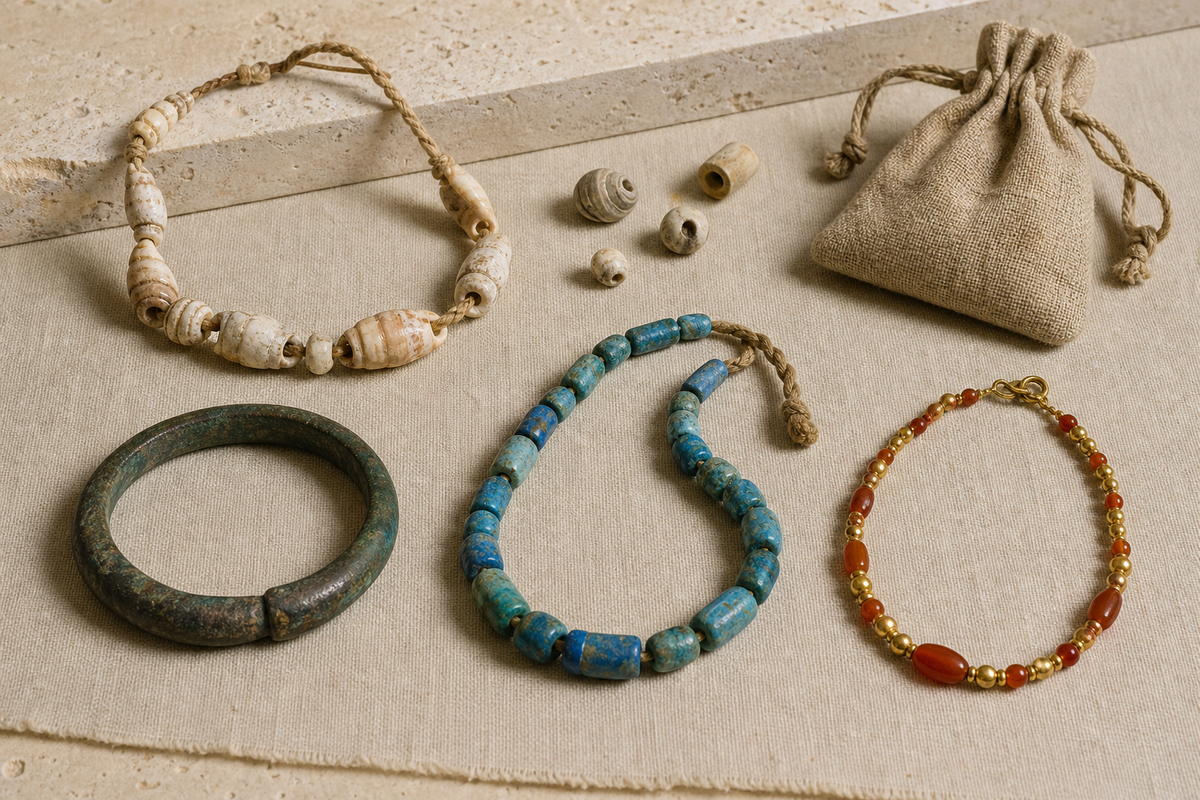
Material and workmanship could communicate status, but the evidence does not support claims that every woman owned gold bracelets or that nonelite people could wear only inexpensive substitutes. Simple bead strings, shells, copper-alloy ornaments, faience, and stone could still carry aesthetic, social, economic, and religious value. Jewelry choices also shifted across regions and periods as trade, fashion, and political connections changed.
Jewelry for the Living and Jewelry for the Dead
Some burial jewelry shows wear or resembles objects used in life. Other pieces were purpose-made for funerary equipment, including bead nets, mummy ornaments, and amulets prescribed by funerary texts. New Kingdom workshops also produced faience pectorals and amulets specifically for burials. The dividing line is therefore not “strong enough to wear” versus “too weak to wear.” Findspot, construction, inscription, and wear traces must be considered together.

Funerary jewelry helped create an ideal, ritually complete body and linked the deceased with gods, royal imagery, rebirth, and the ordered afterlife envisioned in Egyptian religion. Gold masks belonged to a wider set of burial practices; their meaning depends on the period and the individual burial. It is too simple to say that a mask automatically “turned the dead person into a god.”
Jewelry and amulets could be stored in boxes, but a tomb’s containers should be described individually. Wood species, ivory, gilding, paint, and inlay vary from box to box. Not every chest in Tutankhamun’s tomb was an elaborate jewelry cabinet.

Three Museum Cases That Show the Range
Sithathoryunet’s pectoral and necklace
The jewelry of Princess Sithathoryunet was excavated at Lahun and dates to Dynasty 12, around 1887–1878 BCE. The Metropolitan Museum of Art’s pectoral and necklace, object 16.1.3a,b, combine gold with carnelian, lapis lazuli, turquoise, garnet, and green feldspar. The pectoral uses hammered gold cells and precisely fitted inlays. It is a major Middle Kingdom achievement, but one exceptional assemblage does not prove that this period was the only “peak” of Egyptian jewelry.

A menat from Malqata
A menat necklace excavated by the Met at Malqata dates to the reign of Amenhotep III, around 1390–1352 BCE. Its surviving materials include faience, copper alloy, glass, agate, carnelian, lapis lazuli, and turquoise. Found in a private house near the royal palace rather than a tomb, it shows why the menat cannot be understood only as funerary jewelry.

Tutankhamun’s jewelry in KV62
Howard Carter’s team uncovered the stairway to Tutankhamun’s tomb on November 4, 1922, peered into the antechamber on November 26, and opened the burial chamber on February 16, 1923. The tomb is numbered KV62. Its jewelry includes collars, pectorals, bracelets, rings, earrings, amulets, and ornaments made from gold, electrum, stones, faience, and glass. Individual pieces must be identified by their excavation records rather than treated as one uniform treasure.
For example, one pectoral has a central pale yellow scarab-shaped element identified by non-destructive analysis as silica-rich Libyan Desert Glass. Other winged scarab pectorals use different materials, including lapis lazuli. “Tutankhamun’s desert-glass scarab” is therefore a description of a specific object, not a label for every scarab in the tomb. Claims about a fixed total of objects or amulets also depend on how excavation entries, nested components, and separate finds are counted, so unsupported round numbers should not replace the object records.

Egyptian Revival and Modern Design
Ancient Egyptian forms entered European and American decorative arts in several waves, often called Egyptian Revival or Egyptomania. Nineteenth-century archaeology and imperial display encouraged earlier revivals; the discovery of Tutankhamun’s tomb in 1922 intensified Egyptian motifs within Art Deco. Modern makers used scarabs, lotus forms, falcons, hieroglyph-like borders, strong color contrasts, and geometric settings, sometimes with little connection to an ancient object’s original use.

Documented examples are better than broad brand claims. Cartier’s own collection records a 1924 scarab brooch made with ancient Egyptian faience wings, alongside gold, platinum, diamonds, emeralds, smoky quartz, and enamel. That is firm evidence for one historical revival piece; it does not prove that every serpent jewel, geometric necklace, or current collection directly descends from Cleopatra or ancient Egypt.

How to Choose a Responsible Modern Replica
A modern Egyptian-inspired jewel can be enjoyed without being represented as an antiquity. Look for clear disclosure of date, maker, materials, manufacturing method, and whether the design is a loose inspiration, a reconstruction, or an authorized museum replica. “Faience-style ceramic,” glass, resin, and dyed stone should be named accurately rather than marketed as excavated material.

- Prefer transparent modern production: a reputable seller states that the object is new and describes its materials.
- For museum replicas, verify authorization: Egypt’s Supreme Council of Antiquities produces or licenses replicas; official examples may carry a certificate and authentication stamp.
- Do not buy an “ancient” object on story alone: ask for documented provenance, legal ownership history, invoices, and any applicable export records.
- Avoid recently surfaced artifacts: Egyptian antiquities are protected by current law, and illicit export and trade harm archaeological context.
- Respect the original function: identify a heart scarab, royal uraeus, or funerary formula accurately instead of turning it into a claim of guaranteed luck, healing, or wealth.
Responsible replicas keep the distinction visible: ancient artifacts belong to cultural heritage and documented collections; modern jewelry belongs to present-day design and ownership. Good labeling allows both to be appreciated without inventing provenance or religious promises.

Frequently Asked Questions
Related Posts


2 Comments