
Yi Lu You Ni is a modern Chinese wordplay used for deer jewelry and gifts. The everyday phrase Yi Lu You Ni (一路有你) means “having you with me all the way.” Replacing road Lu (路) with deer Lu (鹿) creates Yi Lu You Ni (一鹿有你), a visual pun that lets a deer, antler, or paired-deer design express companionship.
It is best understood as contemporary gift language, not the name of an ancient idiom or one historic pattern. A deer jewel may carry this message when its title, engraving, packaging, or gift note makes the connection clear. A deer shape by itself can have other meanings.
Yi Lu You Ni meaning at a glance
| Expression or design | Literal idea | How to read it |
|---|---|---|
| Yi Lu You Ni (一路有你) | Having you along the way | An ordinary emotional phrase for gratitude and companionship |
| Yi Lu You Ni (一鹿有你) | One deer, with you | A modern visual and sound pun used in product names, jewelry, cards, and gifts |
| Deer Lu (鹿) and emolument Lu (禄) | Deer and official salary or rank | A traditional layer of auspicious wordplay, separate from the modern road-and-deer pun |
| Two deer | A paired animal composition | May suggest companionship, but it is not automatically a Yi Lu You Ni design |
| Lu Lu Tong (路路通) | Open passage on every road | A sliding or rotating tube-like bead structure with its own modern gift meaning |
The phrase is warm without belonging only to romance. It can thank a partner, friend, parent, mentor, or relative for being present through a shared period of life. The relationship and the accompanying note decide the tone more reliably than the animal motif alone.

Yi Lu You Ni, Yi Lu You Ni, and deer Lu: what is the difference?
Yi Lu You Ni (一路有你) is the everyday phrase
Written with 路, Yi Lu You Ni says that someone has been with you “along the road” or throughout a journey. In natural English, it can mean “thank you for being with me all the way.” It works in spoken gratitude, a card, a graduation message, or an anniversary note without referring to jewelry at all.
Yi Lu You Ni (一鹿有你) is the modern deer pun
Written with 鹿, the same-sounding Lu turns the phrase into an image. Designers can represent it with a whole deer, a deer head, antlers, tracks, or a small deer charm. This usage is common as a contemporary product title and gift concept. It should not be backdated into antiquity or presented as the formal name of every traditional deer motif.
Deer Lu (鹿) and emolument Lu (禄) belong to an older symbolic layer
Traditional deer imagery also participates in the sound relationship between deer Lu (鹿) and emolument Lu (禄), a word associated historically with an official salary or rank. That background helps explain why deer became part of auspicious visual language. It is not the same wordplay as road Lu (路), and neither reading turns a jewel into an objective source of wealth, status, or luck.
For the wider history of deer Lu, longevity imagery, jade deer, and classical references, see Eastern Story’s guide to deer meaning in Chinese culture. This page stays with the modern phrase, jewelry decisions, and gift use.

Deer, antlers, paired deer, and Lu Lu Tong designs
| Design | Visual character | When Yi Lu You Ni is an accurate reading | Practical check |
|---|---|---|---|
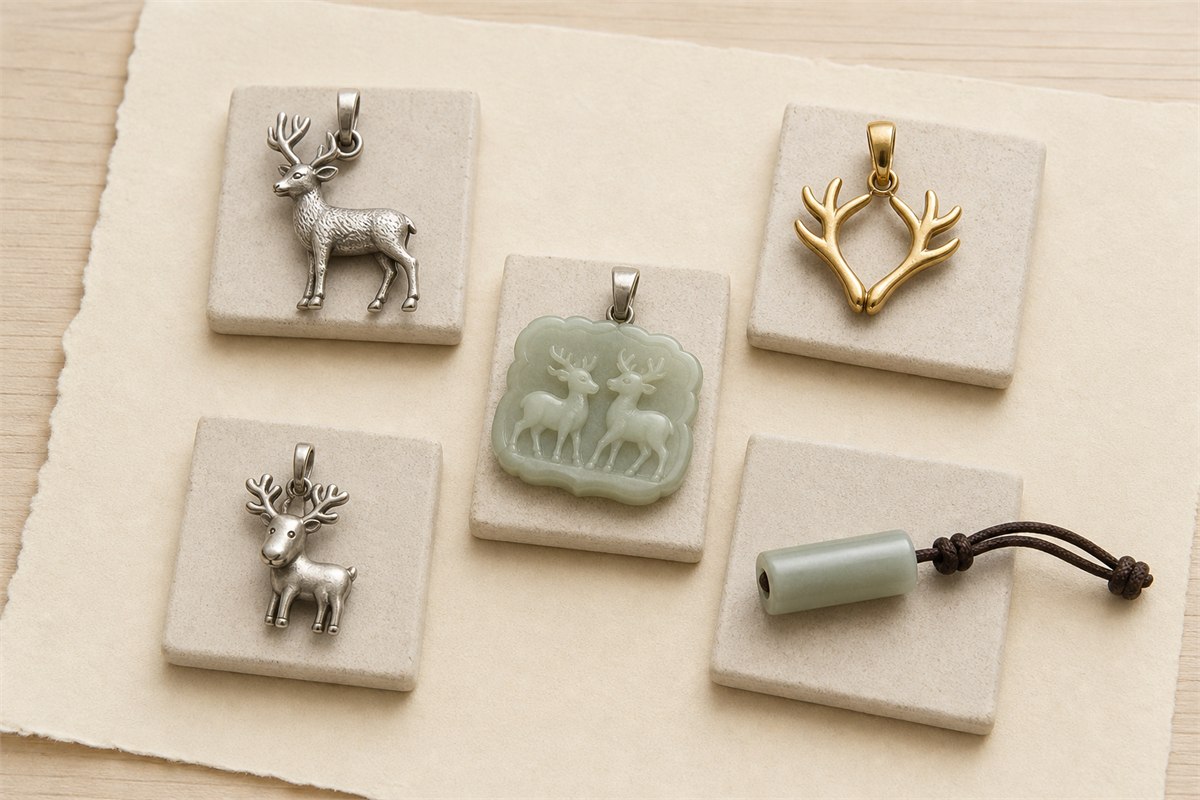
| Full deer pendant | Recognizable body and posture | When the product or gift message explicitly uses the phrase | Inspect legs, antlers, bail, balance, and snag points |
| Antler jewelry | Abstract, light, or branching | When the antlers are intentionally tied to deer-road wordplay | Feel every tip; check clothing clearance and soldered joints |
| Paired deer | Two animals facing, following, or resting together | When the giver chooses companionship as the modern interpretation | Check whether both forms remain legible at jewelry scale |
| Paired or split pendants | Two pieces that echo or complete one another | When both recipients understand the shared design | Compare each piece independently for comfort and durability |
| Lu Lu Tong bead | A tube or cylinder that can slide or rotate on a cord | Only when a deer motif or Yi Lu You Ni wording is deliberately added | Check the bore, cord wear, end stops, and free movement |

A double-deer carving is not automatically “Yi Lu You Ni,” and a Lu Lu Tong bead is not automatically deer jewelry. Likewise, a white deer, elk, reindeer, or giraffe design should keep its own identity unless the maker deliberately builds the Chinese pun into the piece. Accurate naming makes a gift feel more thoughtful, not less romantic.

Materials for Yi Lu You Ni jewelry
Material affects color, weight, edge detail, setting options, maintenance, and price. It does not determine the emotional meaning. Compare the exact description of the piece rather than assuming that a gold-colored deer is solid gold or that every pale carved stone is Hetian jade.
Fine gold, 22K gold, and 18K gold
Fine-gold and “24K” language describes very high gold content, while karat gold combines gold with other metals. In the 24-part karat system, 22K is theoretically 22 parts gold out of 24, or about 91.7%, and 18K is 18 parts out of 24, or 75%. The actual item description and quality mark determine what a particular jewel contains.
Higher-purity gold is generally softer. A fine-gold antler can bend if it is thin or exposed, so purity should not be mistaken for resistance to deformation. An 18K or 22K alloy may allow finer edges or stone settings, but durability still depends on the alloy, thickness, joints, setting, and how the piece is worn.
Sterling silver, plated jewelry, and gold-filled construction
Sterling silver is commonly marked 925, meaning 925 parts per thousand are silver. It can tarnish and may need occasional polishing. Gold plating is a surface layer that can wear with friction and time. Gold-filled, rolled-gold, and vermeil descriptions refer to different layered constructions, so they should not be used as interchangeable synonyms for solid karat gold.

Diamonds and colored stones
A deer or antler design can use natural diamonds, laboratory-grown diamonds, colored gemstones, glass, or other decorative materials. “Diamond” should not be inferred from sparkle alone. For daily wear, inspect whether prongs sit smoothly, stones are secure, and the setting leaves enough metal around narrow antler branches.
Jadeite, nephrite, Hetian jade, and other carving stones
Jade is an umbrella term that includes jadeite and nephrite. “Hetian jade” belongs to a more specific nephrite context; it is not a generic name for every white jade-like stone. Jadeite is often discussed through color, transparency, texture, and carving, while nephrite is valued for its own texture, luster, color, and carving qualities. One grading vocabulary should not be copied mechanically onto the other.
For a carved deer, look at proportion, polished edges, undercut areas, drill holes, and the thickness of antlers and legs. A pleasing carving can make deliberate use of color variation, but multicolored material or hand carving does not automatically make a piece rare, unique, or collectible.

Wood, agarwood, and fragrance-treated materials
Ordinary wood, naturally resinous agarwood, and scented or treated material are not the same. Wood jewelry varies in density, grain, finish, moisture response, and fragrance. “Kynam” or “kyara” should not be treated as a casual name for any dark aromatic bead, nor should aroma be turned into a health or protective claim.

How to inspect craftsmanship and wearing safety
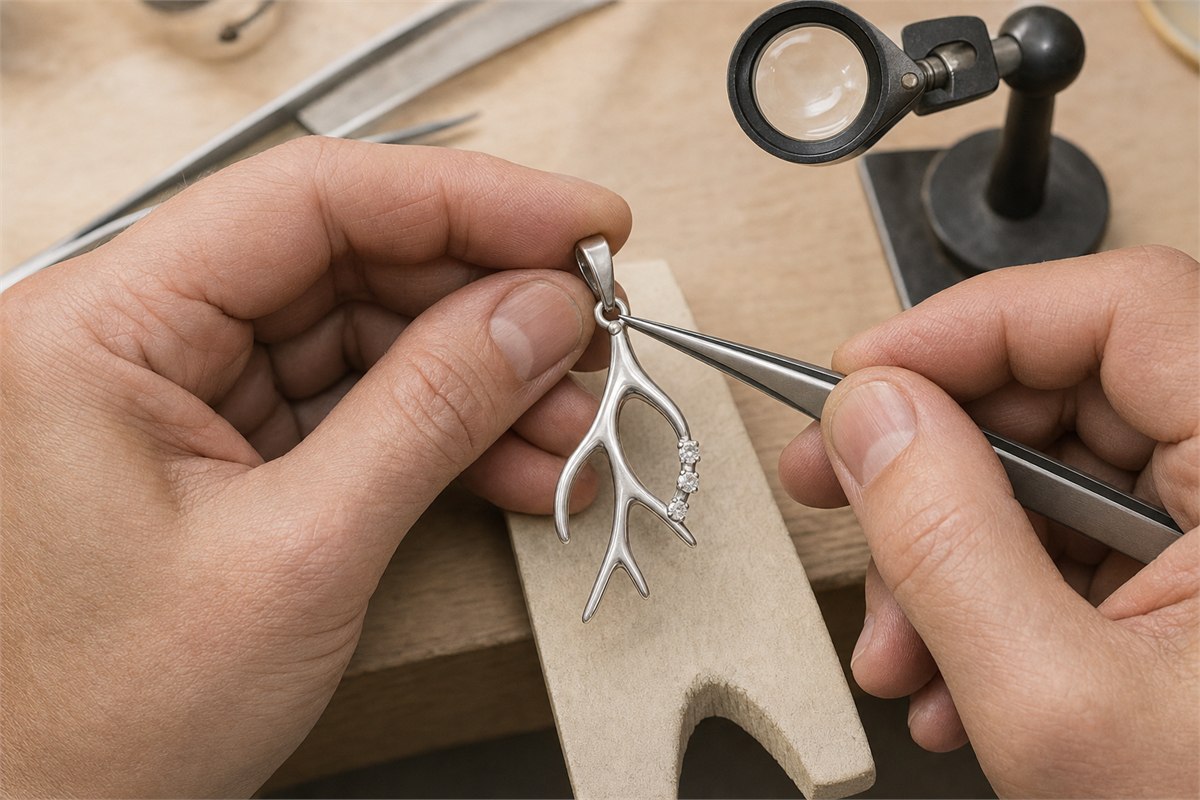
- Run a fingertip around the silhouette. Antler tips, ears, legs, and cutouts should feel smooth. Test the pendant against knitwear to see whether it catches.
- Inspect every connection. Look closely at the bail, jump ring, chain ends, clasp, soldered joints, and any moving parts. A chain name alone does not prove strength; wire thickness, link construction, soldering, and clasp quality matter.
- Check the setting. Prongs should be even and should not lift fibers. Pavé or small stones near narrow branches need enough surrounding metal and should not rattle.
- Test the balance. A pendant should face forward rather than continually flipping or pulling the chain to one side. Confirm that the bail opening fits the chain and moves without grinding.
- Treat open rings cautiously. An adjustable gap can help with fit, but repeated bending can distort the shank, loosen a setting, or pinch skin. It is not automatically suitable for every hand.
- Keep pointed designs away from young children. Small charms, detachable stones, cords, chains, and sharp antler forms require close supervision and are not suitable as toys.
Projection pendants, micro-engraved “I love you” lenses, NFC features, and light-up components should be evaluated as specific products rather than promoted as a standard deer-jewelry category. Check legibility, viewing angle, optical clarity, battery or electronic construction, skin-contact surfaces, water limits, data behavior, and repair options before buying.

How to choose a gift by relationship and occasion
Partner or spouse
Choose the phrase when shared experience is the point: an anniversary, a move, a reunion after time apart, or a personal milestone. A single deer pendant can feel intimate without requiring matched pieces. Paired jewelry works best when both people genuinely enjoy wearing the design rather than when gendered “his and hers” styling is imposed on them.
Friend, sibling, parent, or mentor
Keep the message focused on gratitude. “Thank you for being with me through this chapter” suits friendship, family, graduation, and mentorship. The same phrase can be affectionate without sounding romantic when the card names the relationship and the shared memory.
Wedding party, graduation, or farewell
For a group occasion, decide whether the deer pun is meaningful to everyone or only decorative. Consistent small charms may suit a wedding party, while an individually chosen pendant or bracelet usually feels more personal for graduation or farewell. Comfort, sizing, and the recipient’s normal metal color matter more than assigning a material by age or occupation.

Engraving and original card messages
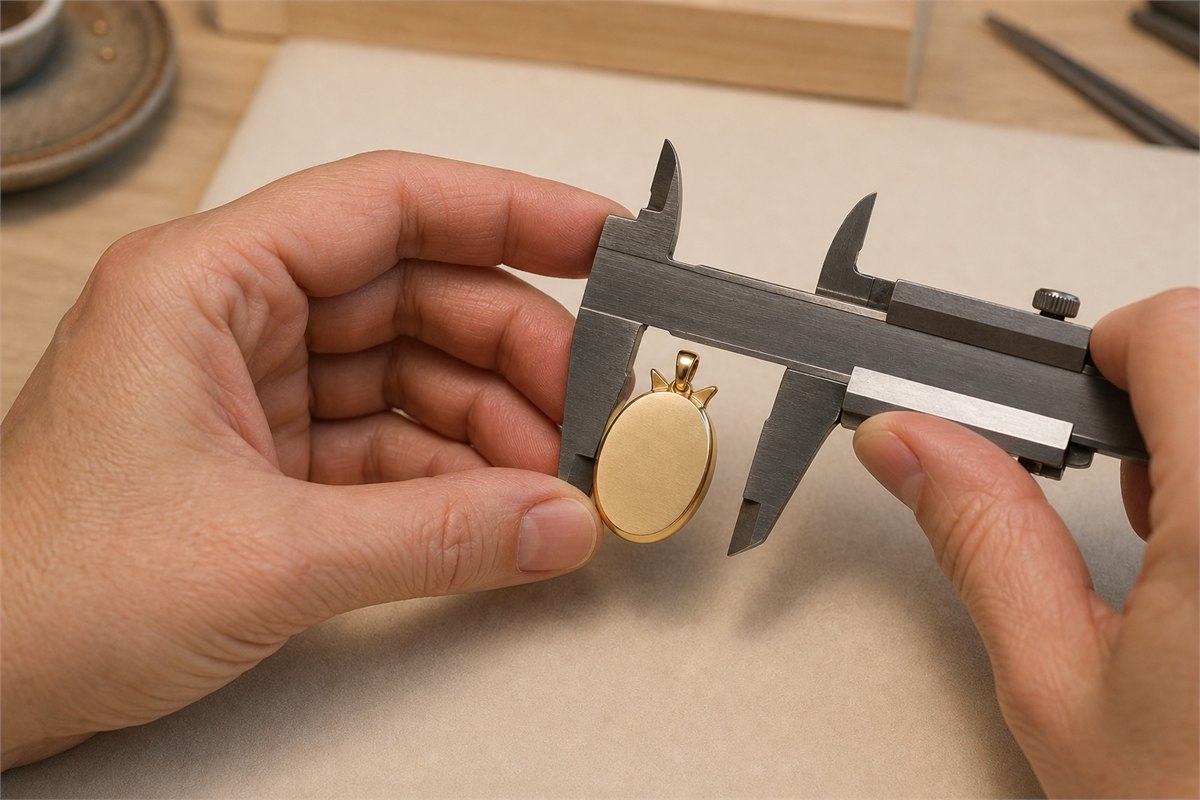
Before engraving, confirm the usable area, font, character limit, line count, surface curvature, coating, and the seller’s policy for customized items. A limit that works for one ring or pendant cannot be treated as an industry rule. Very fine lettering may lose clarity on textured metal, curved backs, small bails, or plated surfaces.
- For a partner: “For every road we have shared—and the next one too.”
- For a friend: “Thank you for walking beside me through this chapter.”
- For family: “Wherever the road turns, your care travels with me.”
- Short engraving: “Along the way” or two initials chosen by the recipients.
These lines are intentionally simple and original. A private nickname, place, or short memory often carries more meaning than a borrowed lyric, a misattributed poem, or an oversized promise that the wearer would not naturally say.
Budget and what determines the price
The attachment did not provide a current, directly verifiable USD price that was necessary to explain this theme, so a price range would add false precision. Instead, compare the components that actually build the total: metal weight and current metal price, alloy and construction, stone type and quality, carving or setting labor, finishing, customization, brand markup, packaging, and return or repair service.

Gold, jade, and agarwood should not be described as automatically “holding value.” Resale depends on material, weight, condition, treatment, workmanship, demand, fees, brand premium, and the market available when the owner sells. Ancient-style finishing, enamel, filigree, chasing, hand carving, or clever use of color can add labor and visual interest without automatically making an object heritage craft, one of a kind, or a better store of value.
Care for deer and antler jewelry
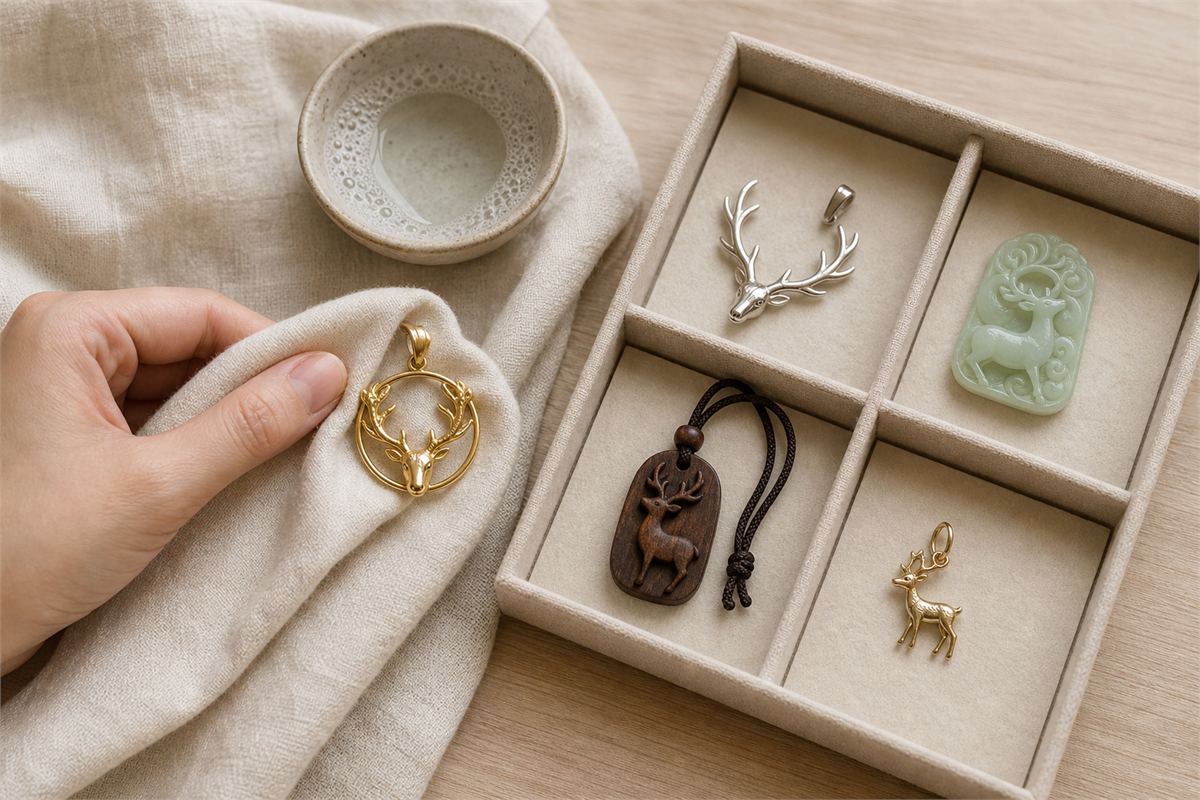
- Gold and karat gold: store pieces separately, avoid crushing thin antlers, and have loosened joints or settings checked before further wear.
- Sterling silver: keep it dry when stored and polish gently with a suitable cloth; aggressive rubbing can remove intentional oxidation or surface detail.
- Plated surfaces: reduce exposure to perfume, lotions, sweat, water, and abrasion; clean without harsh polishing.
- Jadeite and nephrite: use warm soapy water and a soft cloth as a conservative routine, especially when treatment history or attached metalwork is unknown. Protect carved projections from knocks.
- Wood: avoid soaking, high heat, and rapid humidity changes. Follow the maker’s guidance for any finish or adhesive.
- Cords and sliding beads: inspect the cord where it passes through the bead and replace it when fuzzing, thinning, or stiffness appears.
Common Yi Lu You Ni jewelry mistakes
- Calling Yi Lu You Ni an ancient fixed idiom, traditional pattern name, or single historic design.
- Blending road Lu (路), deer Lu (鹿), and emolument Lu (禄) into one supposed ancient origin.
- Renaming every deer, antler, reindeer, giraffe, paired-deer, or Lu Lu Tong jewel as Yi Lu You Ni.
- Using an unattributed internet line as an ancient poem or copying lyrics and film material into a jewelry guide.
- Assuming a product number identifies a series, metal purity, stone type, or brand collection.
- Calling every white carving Hetian jade or judging nephrite with jadeite-only language.
- Promising wealth, health, protection, romance, or career outcomes from a material or motif.
- Choosing a sharp antler silhouette for appearance before checking comfort, snagging, joints, and child safety.
For a broader visual vocabulary beyond deer, Eastern Story’s bracelet symbols and meanings guide compares animals, wordplay, peace forms, nature motifs, and pattern combinations. Readers ready to browse symbolic objects can also explore the Blessing collection.
Frequently Asked Questions
Related Posts


