
Pantao (蟠桃) is the Chinese name used for flat peaches and, in a different cultural register, for the legendary peaches of immortality. The real fruit is a flattened form of peach, Prunus persica, sold in English as a flat, donut, doughnut, Saturn, or saucer peach. The mythic pantao belongs to stories of longevity, Xiwangmu, and celestial banquets. Keeping those two meanings separate makes the fruit, the literature, and the art much easier to understand.
What is a pantao peach?
A real pantao is not a separate botanical species. It is a group of flat-fruited cultivars within the peach species Prunus persica, in the rose family. Its fruit is compressed from top to bottom, with a central dimple and a broad, rounded shoulder. English produce labels vary, so “flat peach,” “donut peach,” and “Saturn peach” may describe similar fruit rather than one universal cultivar.

| Term | What it describes | Useful distinction |
|---|---|---|
| Pantao / flat peach | A flattened peach type | May be fuzzy or smooth-skinned, white- or yellow-fleshed |
| Ordinary round peach | Round cultivars of the same species | Shape differs; flavor and texture still depend on cultivar and ripeness |
| Flat nectarine / oil pantao | A smooth-skinned flat peach type | “Oil pantao” (油蟠桃) means the nectarine-like, fuzzless form |
| Shoutao | A longevity peach image or peach-shaped birthday food | May mean a symbolic fresh peach, motif, or steamed longevity bun |
| Mythic pantao | A literary and religious-cultural peach of extraordinary longevity | Its supernatural effects belong to stories, not horticulture |
Fuzzy, smooth, white, yellow, crisp, or melting
Flat shape does not determine every other trait. Some pantao cultivars have the familiar peach fuzz; smooth-skinned types are flat nectarines and are often called youpantao (油蟠桃) in China. Flesh may be white or yellow. Depending on cultivar and harvest stage, it may be firm and crisp, tender and melting, or somewhere between the two. Sweetness, acidity, aroma, stone adhesion, and juiciness likewise vary.

This is why a single description such as “always white, soft, and extremely sweet” is unreliable. When buying, use the cultivar name and the grower’s harvest information if available, then judge the individual fruit by aroma, background color, firmness, and condition.
Cultivars, growing regions, and season
Pantao is a category with early-, mid-, and late-season cultivars, not a fruit confined to one July–August window. Climate, orchard management, and the same cultivar’s location can shift harvest dates. Chinese breeding and production also use similar-looking names, so cultivar, breeder, place, and maturity date should not be merged without a specific source.

- Yulu pantao (玉露蟠桃) is historically associated with Lüxiang in Jinshan, Shanghai. Local reporting places its concentrated maturity around late July.
- Jinxia youpantao (金霞油蟠桃) is a smooth-skinned flat-peach cultivar bred by the Jiangsu Academy of Agricultural Sciences; it is not another name for every oil pantao.
- Zhongyoupan 11 (中油蟠11号) and Hupan 2 (沪蟠2号) have been evaluated alongside Jinxia youpantao for suitability in Jinshan. Their names should not be collapsed into Yulu pantao.
- Ruipan 101 (瑞蟠101号) is described by Beijing agricultural authorities as a late-ripening, yellow-fleshed flat peach that can reach the Mid-Autumn market window.
- Youpantao 7-7 (油蟠桃7-7) appears in production sequences after earlier cultivars in some Henan orchards, where picking may continue into September.
Mengyin in Shandong and Jinshan in Shanghai are both known for peach production, but a place name is not automatically a cultivar name. Likewise, Zhongpan 101, Zhongpan 104, Zhongpan 11, Ruipan, and locally branded peaches need their own breeding or regional documentation before precise fruit weight, soluble-solids readings, or harvest dates are quoted.
Flavor, ripeness, and how to eat pantao
A good flat peach should smell fresh and peach-like, feel heavy for its size, and be free from leaking, deep bruises, splits, or mold. Look at the background color rather than the red blush: green undertones usually signal immaturity, while cream or yellow background color is a better sign of readiness. Red color alone may reflect the cultivar and sunlight.

For eating soon, choose fruit that yields slightly to gentle pressure near the shoulder without feeling mushy. Firmer cultivars can be pleasantly crisp, so softness is not the only definition of quality. Wash under running water just before eating. Cut around the stone, twist or lift the sections if the cultivar allows, and discard the hard pit.
Ripening and storage
Keep firm, not-yet-ripe peaches at room temperature in a single layer, out of direct sun. A paper bag can concentrate naturally produced ethylene and speed softening; adding a ripe banana or apple accelerates the process further, so check the fruit frequently. This is useful for sound, mature fruit, not for peaches that are damaged, moldy, or harvested too immature to develop good flavor.

Once ripe, refrigerate the peaches to slow deterioration. Utah State University Extension advises storing fresh ripe peaches in a plastic bag in the refrigerator for about three to five days. Let chilled fruit warm briefly before eating if you want a fuller aroma. Refrigerate cut peach promptly in a covered container; use clean utensils and discard pieces that develop mold, fermentation odors, or a slimy surface.
Nutrition and practical safety boundaries
Like other fresh peaches, pantao supplies water, carbohydrate, fiber, and modest amounts of vitamins and minerals. The exact profile varies with cultivar, size, and ripeness. It is best treated as fruit within an overall diet, not as a source of mythical longevity or a treatment for anemia or any disease.

People with peach allergy should avoid the fruit and seek individualized medical guidance. Anyone managing carbohydrate intake can consider portion size as they would with other fruit. For young children or people with swallowing difficulties, serve appropriately sized soft pieces under suitable supervision. The stone is a choking hazard and should not be chewed or eaten.
From real fruit to the peach of longevity
The peach acquired associations with long life and extraordinary vitality across different periods of Chinese culture. These associations did not begin as one fixed story. Early ideas about special peaches, immortals, distant sacred realms, and longevity accumulated over time; later narratives connected the fruit more explicitly with Xiwangmu (西王母), the Queen Mother of the West.

Texts such as the later religious and anomaly-tale tradition surrounding the Biography of Emperor Wu of Han (Han Wudi Neizhuan, 汉武帝内传) tell of Xiwangmu presenting peaches to Emperor Wu. Details such as the emperor saving the pits and being told that ordinary soil could not grow them belong to that literary encounter. They are not records of an agricultural event in the historical Han court.
Other story layers include Dongfang Shuo stealing immortal peaches, Magu (麻姑) presenting longevity, and popular tales of Sun Bin offering peaches to his mother. Their dates, genres, and regional transmission differ. Together they helped make the peach a compact visual language for birthday wishes, filial respect, and long life.
Xiwangmu and the Pantao banquet
Xiwangmu’s identity is much broader than the peach. In later visual and literary traditions, however, her western paradise, attendants, immortals, and peach banquet form one of the best-known settings for pantao. The banquet can symbolize celestial order, rare ripening, gathering, and the wish for enduring life.

Festival practice is more varied than the story. The third day of the third lunar month, the sixth day of the sixth month, Shangsi observances, Xiwangmu birthdays, and events called pantao hui may appear in particular regional, temple, opera, or modern community traditions. They are not one nationwide calendar with a single origin, and individual Daoist temples do not all follow the same arrangement.
The three kinds of pantao in Journey to the West
The famous numerical orchard belongs specifically to the Ming-dynasty novel Journey to the West (西游记). In the novel, Sun Wukong is assigned to oversee the peach garden. Its 3,600 trees are divided into three groups of 1,200: peaches ripening every 3,000, 6,000, and 9,000 years. The text assigns increasingly extraordinary effects to the three groups, culminating in longevity equal to Heaven and Earth.
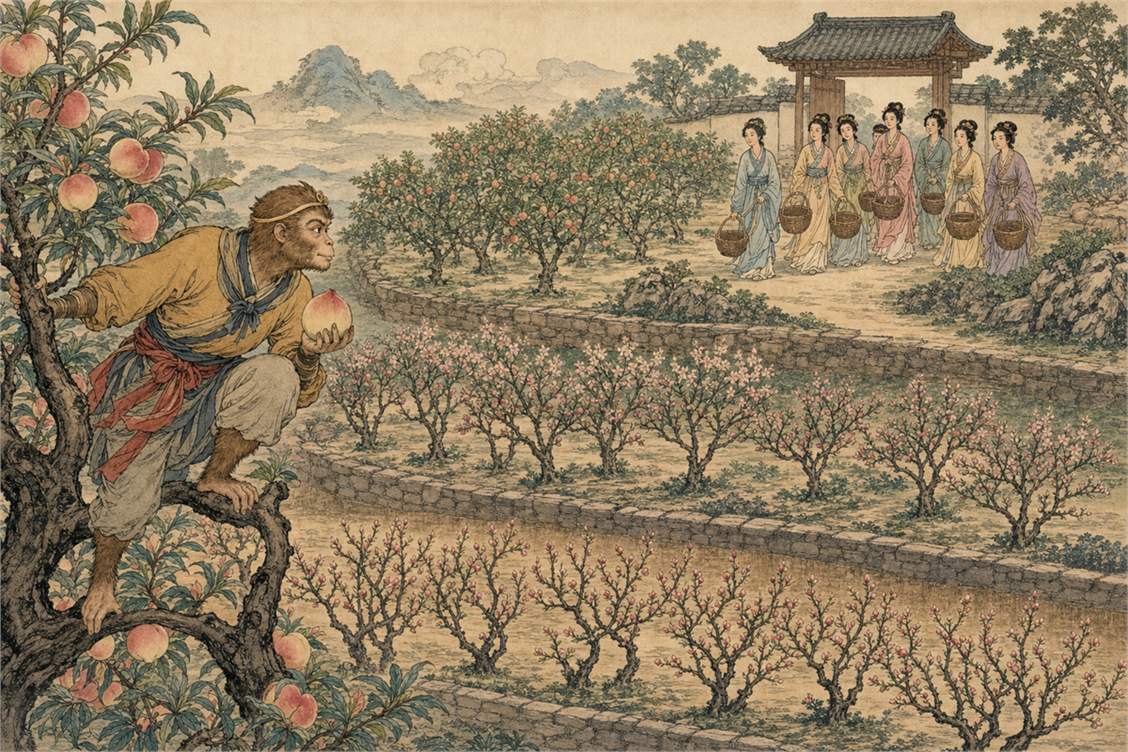
Sun Wukong eats ripe peaches while managing the garden. When seven fairy maidens arrive to gather fruit for Xiwangmu’s banquet and reveal that he has not been invited, he immobilizes them, goes to the banquet site, consumes food and immortal wine, and later eats Laozi’s elixir pills. These linked episodes drive the novel’s comic celestial rebellion. The tree counts, ripening cycles, and supernatural results are the novel’s imaginative setting—not early mythology, horticultural data, or a uniform Daoist teaching.
Pantao, shoutao, and longevity buns
Pantao and shoutao overlap, but they are not interchangeable in every context. Pantao names the flat fruit and the immortal peach of story. Shoutao (寿桃), literally “longevity peach,” can mean a peach offered as a birthday symbol, a peach image in decoration, or a peach-shaped steamed bun—also called a longevity bun or peach bun—served for celebratory occasions.

A pointed peach outline is a visual convention, not proof of a horticultural cultivar. Nor is there one universal rule requiring nine peaches or a pair for every birthday. Numbers, arrangements, and foods vary by family, locality, event, and artistic composition.
Peach motifs in art and gifts
An artwork may show pantao, an ordinary peach, a longevity peach, or a more general peach-fruit pattern (桃实纹). Context supplies the reading. Peaches with bats combine longevity with blessings through the homophone between bat, fu (蝠), and blessing, fu (福). Cranes, pine, lingzhi, clouds, and the longevity character Shou (寿) can expand the long-life theme. A Buddha’s-hand citron, peach, and pomegranate form the “three abundances” motif—blessings, longevity, and many descendants—which is distinct from the classical phrase “the three wishes at Hua” (华封三祝), even when later decorative explanations bring the ideas together.

For jewelry, jade carving, peach-pit carving, or a decorative gift, evaluate the actual object: material, dimensions, weight, carving depth, surface finish, cord or setting construction, comfort, and whether the peach is visually legible. Choose it for cultural meaning and the recipient’s taste. Peachwood’s apotropaic reputation and peach-pit amulets belong to particular historical beliefs and modern folk or commercial language; they should be described as symbolism, not as instructions for placement or promises of health, protection, or wealth.

A pantao gift is especially fitting for a birthday, an elder, a parent, or someone who enjoys classical literature and auspicious art. A short message such as “a peach-shaped wish for a long and flourishing life” is often clearer than claiming a fixed ritual rule. Readers looking for other symbolic gift ideas can explore Eastern Story’s Blessing collection.
Common pantao misunderstandings
- Real pantao is not an immortal fruit. It is a cultivated flat peach type; supernatural properties belong to myth and literature.
- Not every flat peach is fuzzy, white-fleshed, or soft. Smooth oil pantao, yellow-fleshed cultivars, and firm-textured fruit all exist.
- There is no single nationwide harvest month. Cultivar and region determine the market window.
- The 3,600-tree orchard is not an ancient agricultural account. It is a setting in the Ming novel Journey to the West.
- A longevity bun is not a peach cultivar. It is a peach-shaped celebratory food.
- Peach symbolism is not one frozen code. Meaning changes with companions, medium, inscription, period, and occasion.

Frequently Asked Questions
Related Posts


0 Comments