
Lost-wax Liuli casting turns a carefully shaped wax model into a glass artwork: a heat-resistant mold captures the wax, the wax is removed, and glass fills the space in a kiln before controlled cooling and finishing. In a luminous flower or a softly colored keepsake, that patient transformation gives a wish something beautiful to inhabit. Light travels through the finished form, bringing its curves, colors, and quiet details into view.

Liuli (琉璃) has a special place in Eastern glass art, where a piece may be chosen to welcome peace, renewal, or a hopeful new beginning. Understanding its making brings you closer to the person behind it: the sculptor who refines a petal, the maker who places a shade of amber, and the hands that reveal the final surface.
What lost-wax Liuli casting means
The lost-wax method, shilafa (失蜡法), also called dewaxing or tuola (脱蜡), uses a temporary model to create a permanent form. The wax is a positive: it occupies the shape intended for the casting. The surrounding refractory mold holds the negative, the empty space left when the wax goes. Glass later takes that place. In metalworking, the related process is commonly called investment casting; “investment” means the material enclosing the model.
In modern art, Liuli is glass. Its name carries cultural associations, while the particular glass formula determines physical properties. It can be transparent, translucent, or opaque, softly frosted or brightly polished. Some makers use lead-containing crystal glass; others use different casting glasses. The name alone does not specify a lead content, density, or recipe. Crystal glass is manufactured glass, whereas natural quartz has a crystalline structure.
Ancient lead-barium glass belongs to the history of glassmaking; it is not the formula of every modern Liuli artwork. Nor does an object’s origin in Taiwan identify it as resin. Contemporary Taiwanese studios have contributed greatly to Liuli glass art. A material description should identify glass, resin, and any coatings or fittings clearly, allowing the artwork’s color and story to be appreciated on their own terms.

How a wish takes shape before the kiln
The artistic beginning is often a feeling: a flower opening after a difficult season, a gentle curve suggesting ease, or a small object that keeps a loved one close. A lotus (莲花), associated with purity and renewal, can carry encouragement for a fresh start. Its meaning becomes tangible through the posture of its petals and the way light gathers at their edges.
The original model: proportion, expression, and detail
A maker may sculpt an original in modeling clay or wax, carve another suitable material, or develop a digital model and a printed prototype. The original establishes the silhouette, expression, surface texture, and relationship between delicate and substantial areas. A blossom needs more than individual petals: the spaces between them and the balance of the whole form matter just as much.
Model planning also anticipates the casting. Undercuts—recesses tucked behind projecting parts—help give sculpture depth. They are possible with lost-wax work, but require suitable mold divisions, flexible release, and careful removal of the final investment. The maker considers changes in dimension through modeling, wax reproduction, and firing for the actual materials and form, rather than applying one universal shrinkage allowance.

The flexible mold: preserving the design
When the artist wants to reproduce the original in wax, a flexible silicone mold can record its surface. A rigid outer support, sometimes called a mother mold, helps the flexible part hold its shape. Planned cuts or divisions allow the wax copy to be released around folds and projections. Silicone belongs to this model-making stage; the refractory investment does the kiln work.
An original can be preserved, and a sound silicone mold can produce multiple wax copies. Some artists instead carve the wax directly, omitting this intermediate mold. These are different studio routes to the same lost-wax principle. Modern silicone molds, digital prototypes, and printed patterns are contemporary tools, not a fixed account of how ancient craftspeople worked.

The wax positive: a form finished by hand
Once released, the wax is examined closely. A maker repairs small voids, softens or removes unwanted mold seams, adjusts edges, and refines details. A line that looks insignificant in wax may become conspicuous when glass catches the light. This is why wax finishing deserves as much attention as the initial sculpture.

Additional wax forms can establish a feed opening, reservoir, or vent where the design needs one. Their arrangement anticipates how glass will reach narrow areas and how air can escape. The wax therefore represents both the visible artwork and parts of the casting arrangement that will later be removed. Beeswax and formulated modeling waxes offer different handling properties; no single wax blend defines all Liuli.

The refractory mold holds the space the wax leaves
The wax is enclosed in a refractory investment: a material designed to withstand the relevant firing conditions. Glass-casting investments often combine a plaster binder with a refractory component such as silica, sometimes with modifiers or reinforcement. Ordinary decorating plaster is not interchangeable with a tested glass-casting investment. A mold can be built in layers or formed as a larger mass, depending on the studio’s method and the sculpture.
The surface next to the wax must pick up detail without unwanted gaps; the surrounding material must support the form through heating, glass filling, and cooling. Strength, permeability, mold thickness, and thermal behavior all matter. The aim is a mold suited to the glass and the firing, rather than a simple claim that mold and glass must have an identical expansion coefficient.

Dewaxing removes the temporary positive. Steam is one established approach; other systems use controlled heating and burnout appropriate to their materials. The remaining cavity must be prepared and dried according to the investment system. Wax residue, excess moisture, or a damaged mold can compromise the casting. The process takes place in a properly equipped workshop, where ventilation, dust control, and protection from heat support the craft.

Placing glass is also composing color
Glass may be supplied as billets, chunks, sheet pieces, or frit—crushed glass in graded particle sizes. The maker plans the quantity for the cavity and its feeding arrangement using the glass’s actual density. Adequate feed material helps the shape fill; uncontrolled excess can overflow. Clean material and a clean mold help keep unwanted inclusions out of the finished artwork.

Color is arranged with the sculpture in mind. A pale petal can deepen toward its center; a ribbon of amber can follow a flowing curve; a transparent area can open a view into a more opaque form. The starting positions matter, but the glass moves during firing. Gravity, viscosity, particle size, and the duration of heating influence how those regions finally meet.
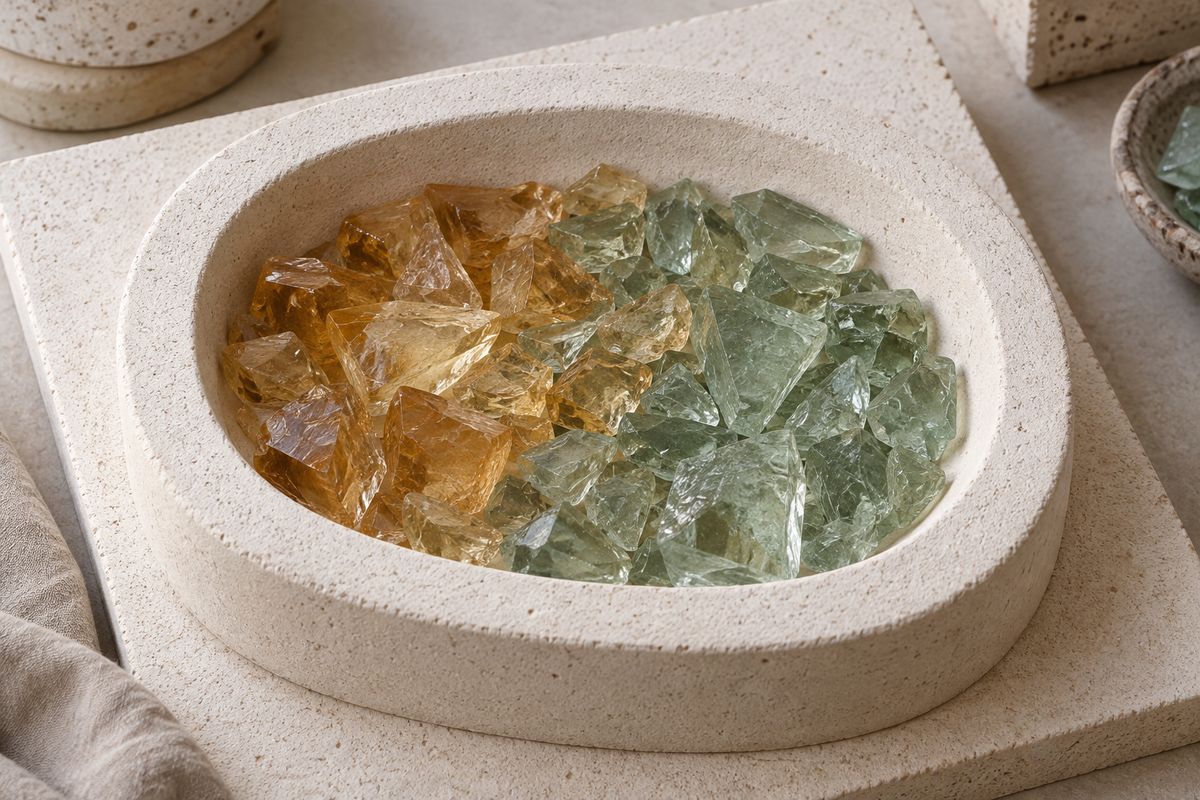
Fine particles introduce more interfaces and can retain many small bubbles, giving a softer or milkier effect. Larger pieces can offer a clearer view into the sculpture. Neither appearance is automatically preferable: a misty flower and a clear, light-filled form can express different moods. Thickness also changes how deeply a color appears, so a broad center may look darker than a thin edge made from the same glass.

Glasses combined in one firing need demonstrated compatibility. Matching a stated coefficient of expansion, or COE, alone does not establish that they will work together: viscosity and the firing history matter too. Makers select and test their combinations so that the color relationships can survive cooling as well as look beautiful when hot.
Inside the kiln: flow, patience, and annealing
Glass fills through heat and gravity
In lost-wax kilncasting, the prepared glass heats with the mold and gradually becomes fluid enough to enter its cavity. Material may sit in the mold’s own reservoir or feed from a suitable vessel above it. The maker balances flow into the details with the risks of distortion, unwanted surface changes, and trapped bubbles. A kiln provides time and a controlled thermal environment for that movement.
This differs from pouring molten bronze into a prepared mold. Glass becomes progressively softer across a temperature range; it has no single universal casting temperature. The appropriate peak and holding time depend on the glass, the form, and the equipment. A metal-casting temperature or a firing program for another glass cannot simply be transferred to Liuli.

Annealing gives the whole form time to settle
Annealing reduces internal stress through an appropriate hold and controlled cooling. The outside of a thick casting can cool ahead of its center, and uneven sections complicate the process further. The maker gives temperatures within the object time to become sufficiently even, then controls cooling as the glass becomes rigid. A glossy surface alone cannot show whether that work was done successfully.
Glass is amorphous: its structure lacks the long-range order of a crystal. Its annealing behavior is therefore different from a quartz crystal changing form. Quartz in an investment mold has its own thermal behavior, which the mold and firing design must accommodate separately. Thickness, geometry, glass composition, and the kiln’s temperature distribution govern the cooling plan; even below the main annealing range, a large temperature difference can damage a piece.
The finished casting stays protected in the kiln until it has cooled appropriately for removal. Thick work can need a long cycle, while a smaller form has its own requirements. Waiting is part of giving the sculpture its best chance to emerge intact—not an empty interval between the “real” stages.

How long does lost-wax Liuli take?
Time includes far more than the hours when glass is hot. Design development, mold preparation, drying, wax finishing, firing, cooling, and cold work each have their own pace. As a specific studio example, LIULI describes its process as 12 stages and says a work can require up to 8 months of craftsmanship. That describes the studio’s production, not a timetable for every cast-glass object.
A complex new design may need trials and revisions before the artist is satisfied. A familiar design made in a small edition follows a different path. The useful expression of that effort is the work itself: a resolved shape, considered color, and details that reward a closer look.
Releasing the casting and revealing its surface
After cooling, the investment is carefully broken or removed to release the glass. Projecting details require particular care. The fresh casting can carry mold residue, a feed attachment, or areas that need further finishing. Its final appearance is still emerging.

Cold working means shaping and finishing glass after the hot-forming stage. Diamond tools and other suitable abrasives can remove feed remnants, refine a base, and smooth edges. Successive abrasive stages remove the marks left by the previous stage; polishing then develops the intended luster. Makers manage pressure, heat, and dust with equipment and controls suited to each operation.
Not every surface is polished to transparency. A frosted petal beside a clear edge can make a flower seem to gather light; a satin body can give a sculpture a quiet, inward glow. Engraving and controlled abrasive finishing offer further textures. Professional chemical treatments also exist, but their hazards require specialist facilities. They are not part of caring for an artwork at home.

If a piece includes metal fittings, stone, or other decoration, the attachment method must suit those materials. Glass is not automatically fused directly to any metal setting. The maker also finishes suspension holes, contact points, and the base so the object can be handled or displayed as intended.
One mold, one casting—and a design that can live on
The phrase one mold, one work, yi mo yi pin (一模一品), describes the expendable investment used for an individual casting. The wax positive is lost, and the refractory mold is normally sacrificed to free the glass. The original design, master, or silicone mold can remain, making a series possible through fresh waxes and fresh investments.
That leaves room for both an artist’s unique work and a thoughtfully made edition. Related castings may share a silhouette while differing in color movement, bubble placement, and hand finishing. Those variations give each piece its own presence without requiring the design to vanish forever.

A keepsake can become singular in another way: through the person who gives it and the moment it remembers. A luminous object chosen for a new home or a fresh chapter can carry the wish peace and fulfillment, Ping An Ru Yi (平安如意). The care invested in making it becomes part of the care expressed in giving it.

An older idea in bronze, renewed in glass
The broader lost-wax principle has a long history in metalwork. A wax pattern is enclosed, removed, and replaced by molten metal; the cooled casting is then released and finished. Piece-mold casting follows another route, using sections of a mold assembled around the intended form. Both belong to the remarkable ingenuity of ancient bronze makers. Lost wax offers freedom for intricate forms, while actual results still depend on design, materials, and finishing.

The zun-and-pan ensemble of Marquis Yi of Zeng (曾侯乙尊盘), in Hubei Provincial Museum, brings that ingenuity vividly to mind. Excavated in 1978, it consists of 2 vessels, a zun and a pan, with richly interlaced openwork. The zun stands 30.1 cm high, and the pan has a mouth diameter of 58 cm. The appeal is immediate: solid bronze seems almost to dissolve into circling creatures and cloudlike forms.
Henan Museum’s cloud-pattern bronze jin (云纹铜禁), a stand for wine vessels from the late Spring and Autumn period, has 12 dragonlike creatures attached around it and 12 more supporting it below. The museum associates its intricate body with lost-wax casting; the attached and supporting creatures are separate components joined to the stand. Its layered openwork shows how much movement a maker can draw from a seemingly solid material.
These bronzes enrich the background of the lost-wax idea; contemporary Liuli has its own materials and studio practices. In modern metalworking, investment casting serves sculpture, jewelry, and selected precision components, including turbine parts. In glass, the same idea of a disappearing pattern becomes a different encounter with light, color, and time.
Lost-wax casting, glassblowing, and lampworking
Glass artists have several ways to give form to an idea. Their methods can overlap within one object, and each allows a wide artistic range.
| Method | How the form develops | What to notice |
|---|---|---|
| Lost-wax kilncasting | Glass fills a refractory cavity made around an expendable wax model. | Modeled detail, relief, sculptural depth, and color arranged through the form. |
| Glassblowing | Air expands hot glass, which is shaped with tools and often reheated during working. | The relationship between enclosed space, silhouette, surface, and light. |
| Lampworking or flameworking | A torch locally softens glass rods or tubes for shaping, joining, or blowing. | Fine applied detail, drawn lines, sculpted forms, and carefully placed color. |
| Pressed glass | Pressure shapes hot glass in a mold, commonly reusable. | Repeated forms and the design of their molded surfaces. |
| Pâte de verre | Glass particles are arranged in a mold and fused; the term means “paste of glass.” | Particle-based color placement and textured or translucent surfaces. |
Lost wax describes how a mold cavity is made; pâte de verre describes an approach to placing and fusing glass particles. They can be used together, but not every lost-wax casting is pâte de verre. Similarly, lampworking may use a bench-mounted torch and can create hollow as well as solid forms. Blown glass can incorporate substantial sculptural details. Size, wall thickness, transparency, and artistic value do not fall into rigid categories by method.

Enjoying hand-made character and caring for the piece
Look first at the work as a whole: its expression, the movement of its color, and what draws you back to it. Then look more closely at the finished details. The following distinctions help you enjoy individual character while recognizing damage that needs attention.
| Feature | A useful way to look at it |
|---|---|
| Bubbles and color movement | Fine enclosed bubbles and flowing color may be intentional or accepted studio features. Their presence alone does not identify a technique. |
| Transparency and texture | Clear, opaque, cloudy, satin, and polished effects can all be deliberate. An absence of bubbles is not evidence that the work is resin or machine-made. |
| Edges and details | Look for complete forms, clean contact points, and edges finished for their purpose. Distinguish a designed recess from a sharp chip or broken projection. |
| Cracks, open cavities, and repairs | A crack, sharp opening, unstable repair, or damaged suspension point needs a clear description and appropriate attention. Do not dismiss it as a handmade signature. |
| Weight and sound | Weight varies with composition and shape. Do not tap or strike a fragile object to test it; sound and heaviness are not reliable identification methods. |
When choosing a piece, useful questions concern its maker, glass material, actual forming method, dimensions, edition, and any repairs or surface treatments. Close photographs help show both the artistic finish and the object’s condition. These details make room for a confident connection with the artwork and its story.
Support a sculpture from its substantial body or base rather than a projecting petal. Set it on a stable surface away from edges and sudden temperature changes. A soft dry or lightly damp cloth suits many finished glass objects; decorated, bonded, or mixed-material pieces need the maker’s care directions. Avoid abrasive cleaners and harsh chemicals, and cushion pieces separately for storage or transport. The Eastern Story care guide offers broader advice for keeping meaningful objects close over time.

Decorative Liuli is not automatically suitable for food, tea, or hot liquids. Use a vessel that way only when the maker explicitly identifies it for the intended food-contact and temperature conditions. For pieces that combine glass with other materials, the Eastern Story material guide introduces the stories and associations of natural materials.
Light, color, and a blessing to keep
The wax is temporary, but the gesture it holds can endure: an opening petal, a gentle line, a form made to welcome light. Lost-wax Liuli brings imagination and patient handwork together in an object that can accompany an ordinary day or remember an extraordinary one.

If you are drawn to a smaller keepsake, explore Liuli bracelet meanings for the stories carried by color and light. Or visit the Eastern Story blessing collection to find a piece that speaks to the peace, renewal, or beautiful beginning you hope to welcome.
Frequently Asked Questions
Related Posts


