
Bo Yi Diao (薄意雕) is an extremely shallow form of relief carving that brings the atmosphere of a painting to stone. Closely associated with the Shoushan stone tradition of Fuzhou, it turns a few delicate rises, flowing lines, and natural colors into mountains, birds, flowers, and moments of quiet companionship. A small landscape can hold a wish for a peaceful life; an orchid can honor a friendship; bamboo can welcome steady growth.

The name explains its character: bo means thin, yi means artistic conception or expressive intent, and diao means carving. You may encounter “Boyi,” “Bo Yi carving,” and “thin-relief carving” as English descriptions. In contemporary jade carving, Bo Yi also describes work with this light, painterly appearance. Its best-known historical home, however, is the softly colored seal stone of the Shoushan region.
A little scene with room for a beautiful life
Imagine a traveler approaching a pavilion beside water. The figure is tiny, the shore barely raised, and much of the stone remains open. Yet the scene feels spacious enough to enter. It invites the viewer to imagine arriving, meeting a friend, or setting down the demands of the day.
This intimacy belongs to the tradition of the scholar’s studio. A seal or small ornament can share a desk with books, a brush, and a cup of tea, offering a place for the eye to rest. Bo Yi gives that companion a story. The pleasure lies in noticing how a curve becomes a hillside or how a single branch changes the mood of the whole stone.

For a gift, begin with that feeling. A scene of friends beneath trees suits a lasting bond. A plum branch speaks to someone finding a new beginning after difficulty. Pine and crane imagery carries a generous wish for long life. The subject makes the blessing personal, while the quiet carving lets it remain close through ordinary days.
How thin carving becomes a painting
Light reveals the shallow relief
Bo Yi is part of the relief family: selected forms stand slightly above the surrounding ground. Its visual character comes from very low relief combined with drawing-like contours and carefully placed detail. A ridge may catch a narrow highlight while its shadow separates it from the valley below. The depth of the imagined landscape can feel far greater than the physical depth of the cut.

There is no single millimeter measurement that every Bo Yi work must follow. Depth changes with the material, the size of the scene, and the artist’s decisions. Look for the relationship between line, surface, and atmosphere. A ruler alone cannot describe what makes the image painterly.
Liubai: the space that becomes water, mist, or sky
Leaving space, or liubai (留白), is an active part of the picture. An unfigured passage can suggest a river around a boat, clouds between peaks, or the cool air around a flowering branch. The viewer completes what the artist has gently suggested.

“Empty” ground may still have a carefully finished surface, subtle changes of level, or natural markings. It need not be literally untouched. A successful composition can be spare or richly filled: a wide quiet interval may balance a dense grove, while a crowded hillside can remain clear through its paths, overlaps, and shifting viewpoints. The amount of open space serves the scene.
Brush rhythm, landscape distance, and a moving viewpoint
The phrase “using a knife as a brush” captures how line carries character. A trunk can feel weathered through a few deliberate breaks; orchid leaves can bend in a long, assured sweep; a bird’s posture can emerge from the angle of its back and tail. Fine incised details may complete a raised petal or a figure’s sleeve without surrounding every form with an equally heavy outline.
Landscape painting offers several ways to suggest distance. Looking upward makes a mountain feel lofty; looking into a valley creates depth; looking across water opens the horizon. Bo Yi can translate these experiences through scale, overlap, spacing, and changes of emphasis. A path disappearing behind a rock often tells the eye more than a deeply cut background would.
Some seals carry a continuous panorama around all four sides, called simian tongjing (四面通景). Turning the seal reveals the scene gradually: a branch crosses a corner, a river continues onto the next face, and a traveler comes into view. Each face contributes to the whole. Other works use a single principal face or a more selective arrangement, allowing the stone’s shape to guide the encounter.

Mountains, friends, and stories on the stone
Travelers, music, and a home among the hills
Mountain-and-water imagery, or shanshui (山水), offers a world of paths, wooded slopes, streams, boats, and distant dwellings. A scholar beneath an old pine may suggest the pleasure of reflection. A companion carrying a qin, the traditional zither, can turn a journey into a visit between friends. A pavilion tucked among trees gives the scene somewhere to arrive.

These details change the emotional reading. A lone boat opens a feeling of freedom and perspective; travelers moving together bring companionship; a figure pausing beside water invites calm. When choosing a scene for someone beginning a new chapter, a path through the hills can carry a personal wish for a steady journey and room to grow.
The human figures need only a few expressive decisions. The direction of a face, the lean of a walking body, or the space between two seated companions can make the encounter feel alive. This is where a small carving becomes especially rewarding: the landscape offers distance, but the people bring it back to recognizable life.
The Orchid Pavilion Gathering
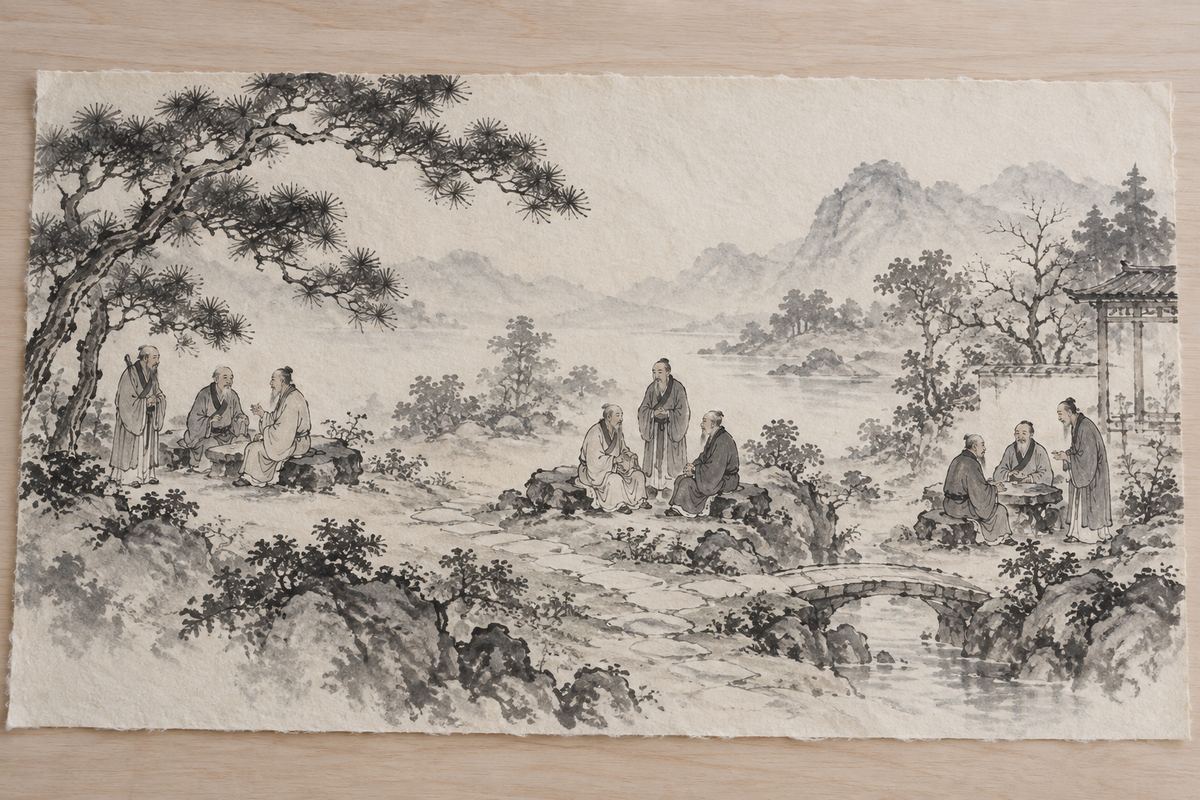
The Orchid Pavilion Gathering, Lanting Yaji (兰亭雅集), recalls Wang Xizhi and his companions meeting in 353 CE to enjoy spring, drink wine, and compose poetry. The winding stream and cups passing along its course became enduring images of cultivated friendship.
In a carving of this subject, the river can lead the eye between groups of scholars while rocks and trees give each encounter its own little setting. The joy is shared time: conversation, landscape, and words exchanged among people who appreciate one another. It is a lovely story for a friendship gift or a reminder to make space for good company.

The Nine Elders of Mount Xiang
The Nine Elders of Mount Xiang, Xiangshan Jiulao (香山九老), celebrates the gathering associated with the Tang poet Bai Juyi and his retired friends. Its nine elders embody a cherished later-life ideal: enjoying nature, poetry, and companionship after official responsibilities.
A scene of elders among trees can therefore carry warmth beyond the familiar wish for longevity. It imagines a long life filled with friendship, curiosity, and unhurried pleasure. As a retirement or birthday subject, it honors the richness of the years ahead.
Lin Bu, plum blossoms, and cranes
The Song poet Lin Bu (林逋) is remembered through the phrase “plum as wife, crane as child,” mei qi he zi (梅妻鹤子). In art, plum blossoms and cranes surround the figure of a cultivated recluse, evoking devotion to nature and an independent spirit.
The scene suits Bo Yi’s intimate scale: a crane’s slender neck, a branching plum tree, and a quiet human presence can create a complete world with very little raised stone. When this named story is the subject, those details work together. A crane beside a flowering tree can also belong to a broader nature scene; the composition and any inscription help you understand its particular story.

Flowers and birds that carry good wishes
The Four Gentlemen: plum, orchid, bamboo, and chrysanthemum
The Four Gentlemen (四君子)—plum, orchid, bamboo, and chrysanthemum—bring the language of personal character into botanical art. Their different forms also offer the carver four distinct kinds of movement: a weathered branch, sweeping leaves, jointed stems, and clustered petals.

Plum blossom (梅花) opens a story of endurance and renewal. An old, angular branch carrying fresh flowers makes that contrast visible. A pale stone surface can lend the blossoms a feeling of snow and early light, making the subject a tender wish for hope after a difficult season.
Orchid (兰花) suggests quiet refinement and the value of a friendship rooted in shared character. Its slender leaves reward flowing, calligraphic lines; the space around the plant can suggest a secluded valley. An orchid scene feels particularly personal for someone whose kindness or integrity is expressed without display.
Bamboo (竹) carries integrity, resilience, and the wish to rise step by step, jiejie gaosheng (节节高升). Its visible joints give that blessing a memorable form. The familiar phrase zhu bao ping’an (竹报平安), bamboo bringing news of peace, adds a wish for safety and reassuring news from home. A few leaves bending across open stone can hold both firmness and ease.

Chrysanthemum (菊花) brings autumnal composure, longevity, and the pleasure of a life close to nature. Its association with the poet Tao Yuanming and the garden makes it especially at home on a scholar’s desk. A rounded flower beside a weathered rock can suggest gentle abundance without overwhelming the stone.
Pine, bamboo, and plum also appear together as the Three Friends of Winter (岁寒三友). Their shared theme is steadfastness through hardship. Together, they make an encouraging gift for a demanding stage of life or a friendship that has endured change.
Lotus, peony, and daylily
The lotus (莲花) carries purity, integrity, and renewal. In Bo Yi, broad leaves and slender stems can be set against open ground that becomes water. A kingfisher poised near the pond adds watchfulness and summer vitality. The bird and flower first create a living scene; a more specific rebus depends on the actual species and accompanying motifs.

Peony (牡丹) welcomes prosperity and a flourishing life. Its layered petals give the artist a chance to suggest fullness through slight overlaps. With a butterfly, the scene can feel light, affectionate, and abundant. Natural blushes of red or warm yellow may help the flower become the focus.

Daylily (萱草), also associated with “forgetting sorrow” (忘忧), brings a wish for ease and happiness. Its place in art also carries affection for mothers and hopes for their long lives. The long leaves and open flowers suit a graceful, airy composition, making it a thoughtful subject for gratitude and care.
Pine and crane, quails, and a phoenix with lingzhi
Pine with a crane forms the familiar longevity blessing song he yan nian (松鹤延年). The tree’s endurance and the bird’s association with long life make a natural pairing for a birthday or an elder’s gift. In a shallow carving, the contrast between a rugged trunk and an elegant neck gives the blessing visual character.

Quails (鹌鹑) carry a wish for peace through the sound of an, recalling 安, “peace.” A pair strengthens the feeling of peaceful companionship. In a complete decorative rebus, the plants beside the birds contribute additional meaning; identifying them matters. The peace association belongs to quails specifically, rather than to every small bird perched in a branch.

A fenghuang, the Eastern phoenix (凤凰), carrying lingzhi (灵芝) brings auspicious bird imagery together with the longevity fungus. This combination can express a wish for long life and good fortune. The graceful wings and curling fungus provide a flowing design well suited to a small picture field.
These motifs give a gift its voice. A birthday may call for long life, a friendship for quiet understanding, and a departure for ping’an ruyi (平安如意): peace, safety, and life unfolding as wished.
Letting the stone suggest the scene
Before cutting, the carver studies the material through xiangshi (相石), “reading the stone.” Shape, color, grain, surface skin, and existing weaknesses all influence the design. This is designing according to the material. A rounded form may welcome a river bend; a tall face may suggest a steep wooded slope; a pale area can become open sky.
Qiaose (俏色), the artistic use of natural color, works particularly well with this approach. A red patch might become autumn foliage, a white layer snow on a branch, or a darker area the bark of an old tree. These are creative possibilities, chosen to suit an individual stone. Strong color boundaries can be as purposeful as soft transitions when the composition uses them well.

Surface skin provides another layer of possibility. Traditional descriptive names include wuyapi (乌鸦皮), crow-black skin; yin bao jin (银包金), a pale exterior around a yellow interior; and jin bao yin (金包银), a yellow exterior around a pale interior. Their charm lies in how outer and inner colors meet. They describe an appearance, while the material’s identity and origin require their own evidence.
Fine pale veins, mottling, or a weathered patch may become part of mist, water, or a rocky bank. An artist can also align a visible fissure with a branch or cliff so that it sits more comfortably in the image. This changes its visual role; the fissure still needs to be considered as a physical weakness.
Bo Yi often retains much of the stone’s broad outline and body. It is nevertheless subtractive work: lowering the ground removes material, and carving may alter or remove parts of the skin. Its sensitivity comes from choosing what to cut and what to preserve, allowing the stone and the picture to remain in conversation.
Shoushan stone roots and the artists who shaped Bo Yi
Shoushan stone carving developed around Fuzhou in Fujian, and its relationship with seals brought it close to painting, calligraphy, and the scholar’s studio. Early decoration around seal bodies and knobs provided a setting for the later emergence of Bo Yi. The wider tradition includes Qing craftsmen Yang Yuxuan (杨玉璇), known for figures, animal knobs, and skillful use of color, and Zhou Shangjun (周尚均), also named Zhou Bin, celebrated for his Shoushan carving.
During the late Qing Tongzhi and Guangxu periods, the East Gate and West Gate schools became important strands of this local craft. East Gate artists were particularly associated with sculpture in the round; West Gate artists, including Pan Yumao (潘玉茂) and Pan Yuquan (潘玉泉), developed painterly relief from seal decoration. These are strands within the Shoushan tradition, with room for exchange between them.
Lin Qingqing (林清卿, 1876–1948) gave Bo Yi a particularly influential painterly expression. His study of painting helped bring greater attention to composition, line, and poetic atmosphere. Remembering him as a major master of Bo Yi honors that contribution without turning the history of all low relief into the invention of a single artist.

Different hands, different kinds of atmosphere
Looking at particular works makes the differences more interesting than a fixed list of stylistic labels. Lin Qingqing’s flower and landscape carvings invite attention to the relationship between a fluent line and the surrounding ground. Wang Leiting (王雷霆) explored landscape through clearly articulated forms and layered scenes; a catalogued Gaoshan stone work depicting Night Mooring at Maple Bridge offers one example of that landscape interest.
Lin Qidi (林棋俤) is represented in published catalogues by both figure subjects and landscape-and-figure seals. These works reward looking at the way a small figure belongs within the surrounding picture, rather than reducing his career to flower-and-bird carving. He was also the father of the later Bo Yi artist Lin Wenju (林文举).
Lin Shouchen (林寿煁) drew on an East Gate family background while embracing Bo Yi. His Tianhuang works Autumn Mountain Travelers (秋山行旅) and Willows and Geese (柳鹅), featured by the China National Arts and Crafts Museum, bring two different moods into view: the human journey and the pleasures of birds beside water. His work helps show how sculptural modeling and painterly space can meet.
The broader modern Shoushan field also includes Guo Maojie (郭懋介), associated with the East Gate tradition, and Pan Jingshi (潘惊石), whose stone carvings and seal knobs explore fresh interpretations of familiar forms. Their place in the craft is wider than a single Bo Yi style. Learning about makers enriches the encounter, while each object still deserves to be considered through its own subject, workmanship, condition, and recorded history.
The materials behind the colors
Shoushan is a regional family of carving stones, with several mineral compositions and many traditional variety names. Its fine texture and varied colors have encouraged a close partnership between material and picture. A glossy or translucent appearance is one part of that experience; a softly opaque stone can be equally expressive.
Tianhuang (田黄) is especially treasured within the Shoushan tradition. Often yellow, it can also occur in other colors. Its skins, pale thread-like markings, and warm surfaces have inspired generations of carvers. The name “king of stones” and the saying “one liang of Tianhuang, three liang of gold” express historical esteem. The saying is praise, rather than a present-day exchange rate.
Furong stone (芙蓉石) in this context is a Shoushan carving-stone variety, commonly associated with pyrophyllite. Its softly opaque, fine appearance can give a branch or hillside a gentle background. It is distinct from rose quartz, which is also sometimes called furong shi in Chinese gemstone usage.

Gaoshan (高山石), Kengtou (坑头石), Duling (杜陵石), and Shanbo (善伯石) are other names encountered within Shoushan stone culture. They refer to traditional sources or varieties, rather than a shared promise of identical mineral content, transparency, or carving behavior. Translucent examples may be described with dong (冻), suggesting an ice-like appearance; Kengtou examples may carry the name Kengtou jing (坑头晶). Here “crystal” is a trade description, not an identification as quartz.
Color can suggest a mood before the first detail is recognized. Honey and russet tones lend themselves to autumn; pale stone can suggest snow, water, or a quiet sky; dark patches can anchor a bank or tree. Multicolored material offers opportunities for several elements to emerge from the same small surface.

Laos stone comes from a different regional source, even where its appearance or mineral composition resembles a Shoushan variety. Qingtian stone (青田石) belongs to Zhejiang’s carving-stone tradition. Chicken-blood stone (鸡血石), known for red cinnabar-bearing areas in a stone matrix, is associated especially with Changhua and Balin. These names should remain distinct from Shoushan.
Bo Yi Diao in jade and other materials
A contemporary piece described as Bo Yi Diao jade carving may use Hetian jade, a nephrite material, or jadeite (翡翠). Thin relief can preserve the visual flow of a plaque’s surface while creating a branch, bird, or landscape. The tools and finishing decisions differ from those used for softer seal stones.

The name is also used more broadly for very shallow work in crafts such as olive-pit carving. This points to a resemblance in shallow modeling, not automatically to the same workshop lineage or historical development. “Bo Yi” describes an artistic approach; the actual material and making tradition remain part of the object’s individual story.

From reading the stone to finishing the picture
The making process helps explain why such quiet work can feel so considered. It begins with observation and composition, continues through outlining and lowering selected areas of ground, and ends with the details and finishing that bring the scene together.
In lexian (勒线), outlining establishes the principal shapes and their relationships. Jiandi (减地), lowering the surrounding ground, allows selected forms to stand forward. The artist varies those relationships so that a petal overlaps another petal or a nearer rock sits before a distant slope. Fine lines can then describe leaf veins, feathers, bark, or clothing folds.
Finishing is part of the composition too. A smooth interval may carry light across water, while restrained texture makes a bank or trunk feel alive. Decisions about surface finish depend on the particular stone and the intended effect. Preserving the delicacy of the carving matters more than giving every surface the same shine.
For someone drawn to learning the craft, drawing branches, landscapes, and simple overlapping forms is a valuable beginning. Practical carving belongs in supervised instruction with suitable practice material, secure workholding, and controls for sharp tools and stone dust. Historic pieces and valued finished works should be kept separate from experiments in cutting, sanding, or surface treatment.

Bo Yi, incised lines, relief, and openwork
The techniques can coexist in a single object. A three-dimensional animal knob may sit above a shallow landscape, and the landscape may contain incised leaf veins. Recognizing what each part does helps you see the work more clearly.
| Term | What to notice |
|---|---|
| Bo Yi Diao (薄意雕) | Very slight relief organized as a painterly scene, with expressive line and space. |
| Shallow relief, qian fudiao (浅浮雕) | Low raised forms against a ground; a broad category that includes many visual approaches. |
| Incised line carving, yinxianke (阴线刻) | Lines cut into the surface. They may form the whole drawing or add details to raised forms. |
| Jiandi (减地) | Lowering the ground around a design. It is a carving operation that can support different relief styles. |
| Qiaose (俏色) | Using color areas as elements of the image; compatible with relief and three-dimensional carving. |
| Round carving, yuandiao (圆雕) | A form modeled in three dimensions, intended to be appreciated from several viewpoints. |
| Openwork, loukong or toudiao (镂空、透雕) | Openings pass through the material, making real gaps part of the design. |
The broader relief jade carving tradition and openwork jade carving offer different ways of giving a motif depth and space. No technique establishes an object’s artistic value by itself. The relationship between form, material, and meaning is what makes the result compelling.

On a seal, the carved picture on the sides and the characters on the working face also have different roles. Seal carving, or zhuanke (篆刻), arranges characters for an impression in ink paste. A Bo Yi landscape decorates the object’s body. Decoration described as being near its base should not be confused with the working seal face.
Enjoying the details and choosing a companion
Begin with the whole scene, then move closer. Notice where your eye enters, where it pauses, and how the open areas connect to the carved forms. Look at the direction of a branch, the scale of a figure, and the point where a color patch becomes part of the story. Rich detail and simplicity can both be satisfying when those relationships feel coherent.

Soft light from the front shows color; gentle light from the side reveals the shallow relief. Looking from more than one angle brings those impressions together. If you are viewing photographs, a clear overall view, details, and a short turning video can communicate more than one dramatically lit image.
Existing ink rubbings (拓片) offer another way to appreciate line and composition. A rubbing can unfold the sides of a seal into a long picture, making the relationship with painting especially clear. It leaves out the stone’s actual color, translucency, and three-dimensional condition, so it serves a different purpose from seeing the object. Enjoy an existing rubbing or reproduction; making a new one from a valued carving calls for specialist judgment.

When choosing a piece, ask for the material’s precise name, the subject, any known maker or workshop history, condition, and any surface treatments or repairs. Skin color, red veins, “radish” markings, waxy luster, and transparency are observations, not sufficient evidence on their own for Tianhuang origin, age, authorship, or value. A name cut into the stone is likewise one part of its history, rather than the whole story.
Most of all, choose a scene you want to live with. It might be the companionship of two travelers, an orchid’s quiet confidence, or a river with room to breathe. The gift note can be equally simple: “May your days hold good company, a clear path, and moments of peace.”
Caring for the delicate surface
Handle the piece gently over a stable, padded surface, supporting its body rather than a projecting knob or thin edge. Store it separately from hard objects and keep it away from strong sun, heat, and rapid environmental changes. A secure position on a desk lets it remain part of daily life without frequent handling.

For cleaning, seek advice suited to the material, existing finish, and condition, especially for an old or repaired work. Repeated rubbing across shallow details, abrasive polishing, and experimental cleaning can change the picture. Oil, wax, and soaking are not a universal routine for all seal stones, jade, or historic surfaces.
A softly aged surface can be beautiful in its own right. In jade, patina and gentle handling have their own traditions; Bo Yi’s fine lines still deserve particular care. Increased transparency should not be a handling goal. For broader everyday guidance, consult the care guide alongside advice for the specific piece.
Frequently Asked Questions
A quiet story to keep close
Bo Yi asks us to notice how much a small surface can hold: distance, movement, friendship, and the promise of another spring. Its delicate carving gives the stone a scene while leaving room for the viewer’s own hopes. Whether you are drawn to mountains, flowers, or an auspicious bird, that meeting of picture and personal meaning is its lasting pleasure.

Explore the Eastern blessing collection for objects chosen to carry peace, connection, and wishes for a beautiful life.
Related Posts


One Comment