
Zhenwu Dadi (真武大帝), the True Warrior or Perfected Warrior, is a Daoist guardian of the north who carries wishes for peace, protection, courage, and a long, flourishing life. Also revered as Xuantian Shangdi (玄天上帝), he is often pictured with flowing hair, bare feet, a sword, and a tortoise and snake. His presence brings together the strength to protect what matters and the patience to remain faithful to a good purpose.

There is something reassuring about a guardian who can sit so still. Beneath the robes and armor is a story of a prince who chose a demanding mountain path, of perseverance through uncertainty, and of strength devoted to the wellbeing of others. For someone beginning again, caring for a family, or learning to meet difficulty calmly, Zhenwu offers a deeply resonant image of steadfast protection.
Who is Zhenwu Dadi, and what do his names mean?
Zhenwu is a personal deity with a sacred biography, temples, attendants, and a living devotional tradition. His best-known spiritual home is Wudang Mountain in Hubei. Worshippers turn to him for protective blessings, peaceful households, relief from adversity, and the wellbeing of their loved ones.
| Name | Meaning and cultural use |
|---|---|
| Zhenwu (真武) | True Warrior or Perfected Warrior; the familiar name of the Daoist protector. |
| Zhenwu Dadi (真武大帝) | Great Emperor Zhenwu; a respectful title emphasizing his divine authority. |
| Xuantian Shangdi (玄天上帝) | Supreme Emperor of the Dark or Mysterious Heaven; a major title for the same deity. |
| Dangmo Tianzun (荡魔天尊) | A title honoring his power to subdue harmful forces and restore peace. |
| Beidi / Pak Tai (北帝) | Northern Emperor; Pak Tai is the Cantonese name familiar in Hong Kong temple culture. |
In Xuantian, the word xuan (玄) carries a sense of depth, darkness, and mystery. English museum titles often use “Dark Heaven.” The expression belongs to the sacred language of the northern sky: a profound, sheltering celestial presence. “Mysterious Heaven” also conveys that spacious sense of the unseen. Neither translation needs the sinister atmosphere that the English word “dark” can sometimes suggest.

Zhenwu is also counted among the Four Saints of the Northern Pole (北极四圣) in Daoist traditions. Different scriptures and temples arrange divine relationships in their own ways. His enduring importance lies in his work as a protector, and in the trust people place in his courage and compassion.
Zhenwu and Xuanwu: a shared northern heritage
The older Xuanwu (玄武), often called the Black Tortoise or Dark Warrior, is the tortoise-and-snake emblem of the north. It belongs to the Four Symbols (四象), alongside the Azure Dragon, White Tiger, and Vermilion Bird. Its traditional associations include winter, darkness, and Water within the Five Phases, or Wuxing (五行).
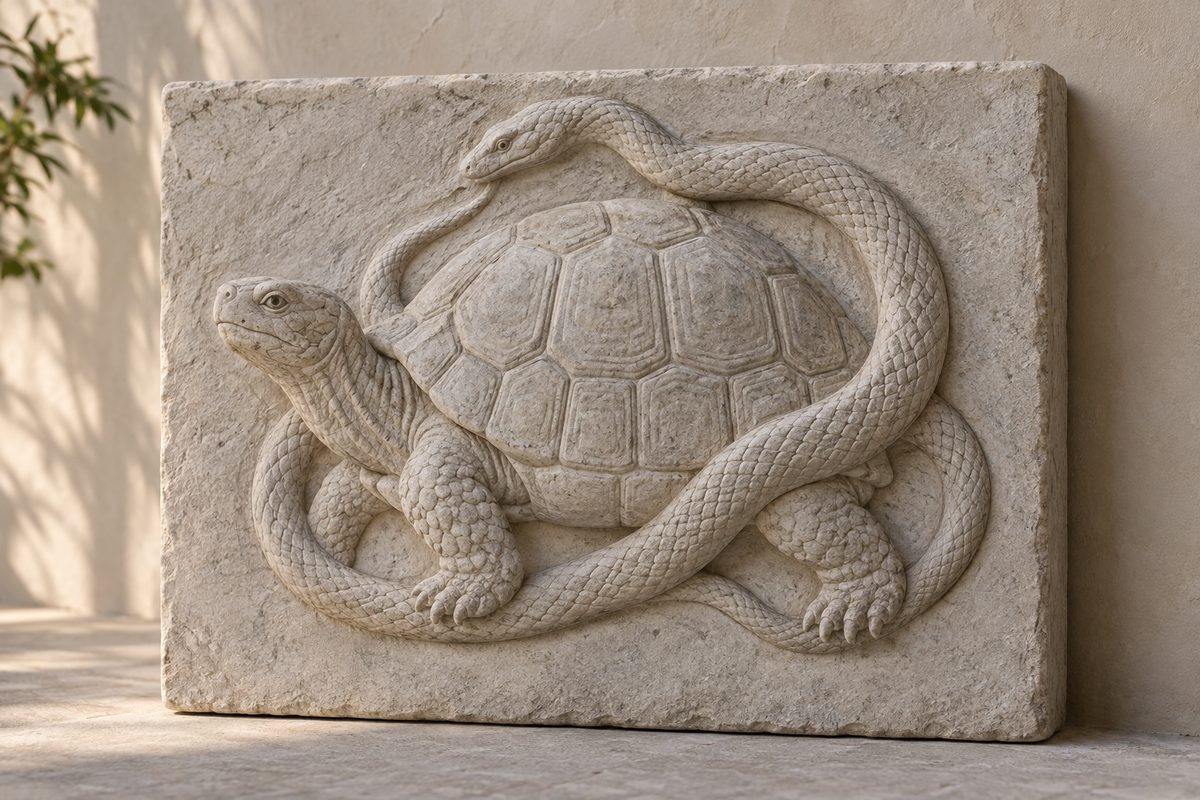
Xuanwu also gathers the seven northern lunar mansions: Dou (斗), Niu (牛), Nü (女), Xu (虚), Wei (危), Shi (室), and Bi (壁). These are seven divisions of the traditional sky, each containing stars, rather than seven individual stars. They give the animal emblem a celestial setting.
Zhenwu’s worship grew from this northern tradition through a long process of religious storytelling, ritual, and imperial support. The Song court’s naming taboo concerning Zhao Xuanlang, its revered sacred ancestor, helped establish the name Zhenwu in place of Xuanwu. Zhao Xuanlang belongs to that sacred-ancestor narrative; the reigning emperor associated with its promotion was Song Zhenzong. The changing name was one part of the deity’s development, alongside an evolving human image and expanding devotional life.
In Yuan times, Zhenwu received the imperial title Xuantian Yuansheng Renwei Shangdi in 1304, before the great Ming building campaigns at Wudang. Later patronage made his presence even more prominent. This history helps explain why the older animal symbol and the human protector can appear together: the tortoise and snake carry a northern memory into the image of a guardian with a face, a story, and a relationship with worshippers.
When looking at an object, the distinction is straightforward. An intertwined tortoise and snake in a directional or star design is Xuanwu imagery. A human Daoist emperor accompanied by that pair is commonly Zhenwu. Local names can overlap, so the surrounding figures, inscription, and temple setting remain helpful.

The prince who chose the mountain
The Scripture of the Perfected Warrior of the North, the Yuanshi Tianzun Shuo Beifang Zhenwu Miaojing (《元始天尊说北方真武妙经》), tells of a prince born to the king of Jingle and Queen Shansheng. Although a royal life lay before him, his deepest wish was to cultivate the Way and protect living beings. He left his parents and entered Wudang Mountain.
In this sacred story, he practiced for 42 years, attained the Way, and ascended to heaven. The Jade Emperor (玉皇大帝) then appointed him to guard the north. The story gives his power a patient foundation: he first learned constancy, and his strength came to serve a generous vow.
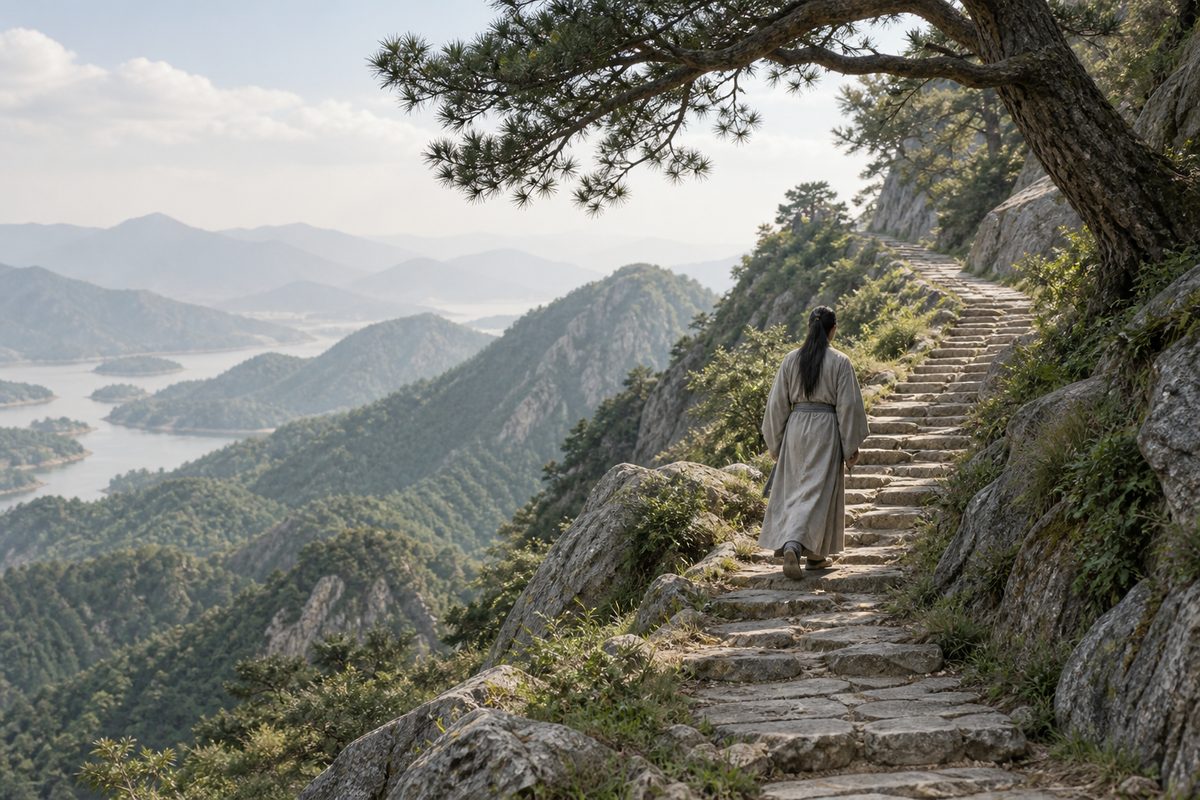
The fuller Xuandi Shilu (《玄帝实录》) tradition describes him leaving home at 15. The young prince’s resolve makes the long mountain journey especially moving. Read as a devotional life story, it speaks to anyone whose important work takes years, whose commitment is tested, or whose chosen path differs from the comfortable one expected of them.
The old woman and the iron pestle
At Wudang’s Needle-Grinding Well, Mozhen Jing (磨针井), a local legend recalls a moment when the prince’s determination faltered. He encountered an old woman patiently grinding an iron pestle into a needle. Such an enormous change seemed impossible, but her steady effort showed him what persistence could accomplish. He returned to his cultivation with renewed purpose.
The familiar saying “grinding an iron pestle into a needle” also circulates in stories about the poet Li Bai. At Wudang, it becomes a tender episode in Zhenwu’s mountain story. Its appeal is wonderfully human: a small repeated effort can sustain a hope that initially feels far away.

Other Wudang stories describe divine guides, tests of resolve, and heavenly recognition. The traditional explanation of the mountain’s name, “only Xuanwu is worthy to match it,” expresses its special relationship with the guardian. It is a sacred naming story, while the mountain’s historic buildings tell their own story of generations of worship and patronage.
The later novel Journey to the North, Beiyou Ji (《北游记》), gives Zhenwu another life in storytelling, with successive earthly trials and encounters with supernatural beings. Its imaginative adventures have helped shape popular scenes of his cultivation. Temple stories, scripture, and fiction each give readers a different way to encounter the guardian’s perseverance and his vow to help others.

How to recognize Zhenwu in a statue or painting
Zhenwu’s art holds dignity and freedom together. The robes can be richly formal, yet his hair falls loose and his feet remain bare. Some figures are commanding and alert; others are so composed that their protective strength seems to come from stillness. Artists select from a shared group of attributes, allowing each work its own character.
Flowing hair, bare feet, robes, and armor
Loose hair and bare feet, pifa xianzu (披发跣足), are among his most familiar features. They recall the prince’s retreat from palace life and the freedom of mountain cultivation. The Northern Zhenwu Scripture also describes him appearing this way as he sets out under divine command to restore peace.
His clothing can combine a long robe with armor beneath it, joining the presence of an emperor to the readiness of a guardian. Black or dark robes connect with the north and Water; gilding, dragon decoration, and carefully rendered armor add solemnity. Painted, ceramic, wooden, metal, and stone images can express these elements differently.

Descriptions such as “civil” and “martial” appearance can be useful ways to discuss a particular statue. One emphasizes flowing robes and a composed bearing; another gives more attention to armor and forceful movement. The actual figure may combine both qualities.
The sword and the strength of a steady posture
A sword expresses Zhenwu’s authority to subdue harmful forces and defend the good. In devotional language it can be described as a demon-subduing sword or a Seven-Star Sword (七星剑), bringing his martial image into the wider world of northern stellar symbolism and the Big Dipper, Beidou (北斗).
Artists may place a sword in his hand, at his side, or with an attendant. A hand can rest on a knee or form a sacred gesture. Seated and standing images each convey readiness in a different way: an upright figure suggests watchfulness, while a firmly seated one offers the reassurance of command held in reserve.

Wudang’s association with martial culture makes that poised strength especially evocative. A statue can inspire thoughts of balance, discipline, and courage, while its pose remains a religious and artistic expression. The stories of a heavenly sword belong to that sacred imagination.
Tortoise, snake, halo, and attendants
The tortoise and snake often appear beneath Zhenwu’s feet or at the base of his throne. A rounded halo may frame his head, and a larger group can include protective generals, sword bearers, and attendants carrying banners. Together they create an image of ordered, watchful guardianship.
The Golden Boy and Jade Maiden (金童玉女) are familiar attendants in Zhenwu temple ensembles. At Wudang’s Golden Hall they appear with a register and seal, while the accompanying Water and Fire generals carry a banner and sword. This arrangement lets the ensemble tell a fuller story than a single portable figure. Other works use different attendants and attributes, reflecting the community or occasion for which they were made.

A dark banner belongs naturally to the imagery of northern authority. In paintings and temple groups, it can help make the god’s retinue visible and ceremonial. Its shape, inscription, and bearer are worth noticing as features of that particular work.
Why the tortoise and snake accompany him
The intertwined animals give Zhenwu one of the most memorable identities in Eastern religious art. They join the sheltering, enduring presence of a tortoise with the flowing movement of a snake. Their place beneath the guardian’s feet recalls his Xuanwu heritage and the northern power he embodies.

There are several meaningful ways to read the pair. In celestial imagery, they represent Xuanwu. In devotional stories, they can appear as beings brought under Zhenwu’s command and welcomed into his protective company. In yin-yang (阴阳) interpretations, their interaction can evoke complementary forces, while Water-and-Fire readings emphasize balance and the settling of opposing energies.
Later popular stories also connect the animals with the prince’s bodily transformation during cultivation. These imaginative tales give inner struggle an outward form: what was unruly becomes ordered, and the guardian’s strength turns toward protection. The stories vary, while the hopeful theme remains recognizable.
For a reader drawn to Zhenwu’s image, the pair can hold a personal meaning too. Steadiness and adaptability belong together. The capacity to stay true to a purpose can coexist with the wisdom to move when life changes. Under the guardian’s calm presence, those qualities become companions.

Wudang Mountain and the wish for a peaceful realm
Wudang’s mountain paths, palaces, and shrines give physical form to Zhenwu’s story. Places associated with the prince’s trials turn an ascent through the landscape into a journey through perseverance, devotion, and attainment. The mountain is both a religious home and a setting in which the story continues to be remembered.
The Yongle emperor, Zhu Di, strongly supported Zhenwu worship and sponsored major construction at Wudang in the early fifteenth century. Accounts of the god’s protection helped connect imperial authority with a wish for a secure realm. The surviving landscape reflects repeated building, restoration, and devotion across different periods. UNESCO inscribed the Ancient Building Complex in the Wudang Mountains on the World Heritage List in 1994.
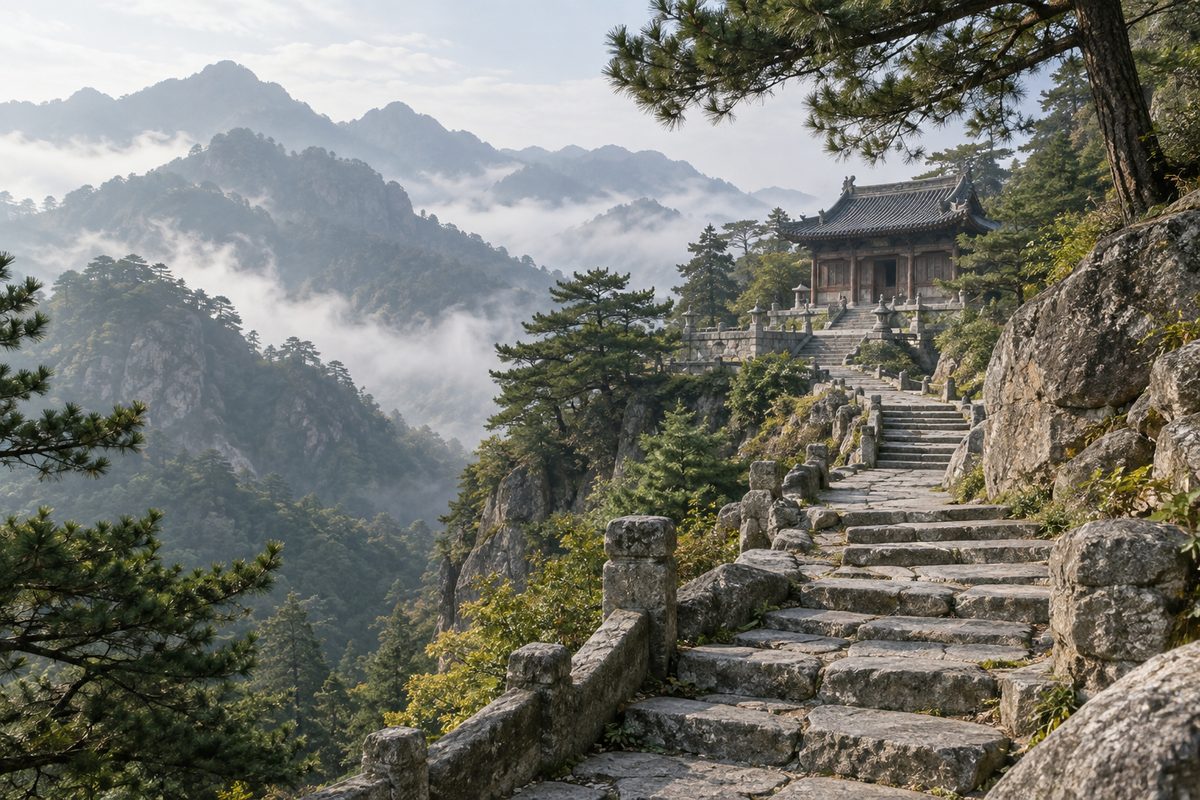
The gilded bronze Golden Hall on Tianzhu Peak provides an especially striking setting for Zhenwu and his attendants. The whole composition conveys celestial dignity through a temple, a seated guardian, and a closely gathered company. Its emotional force comes as much from that concentrated arrangement as from the brilliance of the metal.
In Beijing, Qin’an Hall (钦安殿) brings the northern guardian into the Forbidden City’s Imperial Garden. The Palace Museum describes it as a Daoist hall serving the worship of Zhenwu and Guandi. An inventory begun in 1756 records Zhenwu in the central shrine, with loose hair, bare feet, a tortoise and snake, and a dragon robe. It is a vivid glimpse of how a mountain-centered deity also became part of palace life.
Beyond the court, the same northern and Water associations spoke to communities concerned with rain, rivers, travel, and the safety of their homes. Prayers for protection from water and fire, for health and longevity, and for peace within a community belong to Zhenwu’s living religious meaning. At their heart is the familiar wish that those we love may pass safely through the world.
Zhenwu in art: quiet strength in different forms
A large temple figure and a small household sculpture can share the same reassuring presence. Looking closely at real works reveals how artists carried the guardian’s story through metal, ceramic, painting, and narrative scenes.
A Ming bronze with a named maker
The Art Institute of Chicago’s gilt-bronze Zhenwu, made by Chen Yanqing in 1439, stands 36.4 cm high. Armor appears beneath his robes, while his long hair and bare feet preserve the mountain ascetic’s identity. The inscription names both the maker and the patron, bringing individual people into the story of devotion.
The robe’s lifted edges give movement to an otherwise formal figure. The result feels both commanding and intimate: a protector small enough for personal worship, yet composed with the dignity of a celestial emperor.

The tortoise and snake in a Datong sculpture
A Ming seated Zhenwu from the Guandi Temple cache, described by Datong Museum, bears an inscription dated to the third day of the third lunar month in 1591. His eyes are lowered, his hair loose, and his bare feet emerge beneath the garment. Between them, the tortoise and snake intertwine.
Dragon, lotus, and cloud decoration animate his armor and robe edges. The peaceful expression is especially memorable. Here, the protector’s dignity grows from composure, giving a gentle counterpoint to more forceful images of a sword-bearing god.

Porcelain companions and painted devotion
The Asian Art Museum in San Francisco holds a porcelain Zhenwu group dated 1506–1521, measuring 19.4 cm high. Decorated in underglaze cobalt blue, it shows him in a dragon-patterned civil robe with two assistants identified by the museum as Thousand-Mile Eye and Favorable Wind-Ear. This small group has its own devotional personality, demonstrating the variety within the wider tradition.

Painting gives the guardian room for a more expansive presence. Cornell University’s Herbert F. Johnson Museum of Art holds an early-fifteenth-century Ming painting titled Xuantian Shangdi (Zhenwu), God of the North. Painted in ink and colors on silk, it measures 132 × 98 cm. Zhenwu sits on a rocky throne amid clouds, with attendants and divine marshals gathered around him. The composition extends the sense of dignity from a sculpted body into a painted world.

At Wudang’s Mozhen Jing, murals recount episodes of the prince’s cultivation, including his departure, encounters along the mountain path, and the old woman’s needle-grinding lesson. The scenes invite viewers to follow a life story as well as recognize a divine portrait. Across these different forms, artistic skill makes devotion visible, giving patience, resolve, and protection a face.
Zhenwu and Guan Yu: protection, courage, and loyalty
Zhenwu and Guan Yu (关羽), also revered as Guandi or Guansheng Dijun (关圣帝君), both carry strong protective meanings. Zhenwu’s story centers on northern guardianship and mountain cultivation. Guan Yu’s begins with a historical general and grows into a rich tradition honoring loyalty, righteousness, and trust.
Qin’an Hall offers a concrete example of their worship within one sacred setting: its Qing inventories record both Zhenwu and Guandi. Cornell’s Ming painting offers an artistic example, with the museum identifying Marshals Ma, Zhao, Wen, and Guan in the company around Zhenwu. In such an arrangement, Guan Yu appears as a protective marshal. He also has an extensive independent tradition of worship. Their relationship is best understood through the particular temple or tradition, with room for each deity’s distinct presence.
| Figure or emblem | Visual identity | Meaning to remember |
|---|---|---|
| Zhenwu Dadi | A human guardian, often with loose hair, bare feet, armor or robes, and tortoise-and-snake imagery | Steadfast protection, disciplined courage, and peace |
| Xuanwu | A tortoise entwined with a snake in a celestial or directional setting | Northern guardianship, endurance, and continuity |
| Guan Yu / Guandi | A bearded general, frequently red-faced in popular imagery and associated with a long guandao blade | Loyalty, righteousness, trust, and protective strength |
Seen together, Zhenwu and Guan Yu can invite a thoughtful appreciation of strength used well: the patience to master oneself and the loyalty to stand beside others.

Devotional days and blessings for the family
The third day of the third lunar month is widely observed as Zhenwu’s birthday, also called the Pak Tai Festival in Hong Kong. The ninth day of the ninth lunar month is observed in Zhenwu traditions as a day of attainment or ascension. This latter date is also the Double Ninth Festival, Chongyang (重阳), giving the season a wider resonance with longevity and care for elders.
Temple communities mark these occasions through their own traditions of offerings, prayer, music, and gathering. The date can be shared while the character of the celebration remains local. In Hong Kong, Taiwan, and Wudang-related communities, devotion brings the northern guardian close to everyday family life.

Gratitude belongs here alongside protection. A prayer for parents’ wellbeing, a wish for an elder’s long life, or thanks for support received can give Zhenwu’s strong image a tender meaning. The guardian who stands for courage also makes room for the people toward whom we feel responsibility and love.

Keeping a wish for peace close
A Zhenwu image can accompany a new home, a demanding chapter of work, a long undertaking, or a gift of gratitude. Someone may choose a small statue for its calm presence, a print for the story it recalls, or a pendant as a daily companion carrying a wish for protection and resolve.
Let the choice begin with the meaning that speaks to the person. The mountain prince can recall perseverance. The composed guardian can welcome peace into a household. The sword can express courage in defending a good purpose, while the tortoise and snake suggest the meeting of steadiness and change.
A simple blessing captures that warmth: Ping an ru yi (平安如意), a wish for peace and for life to unfold as hoped. A gift message might read, “May you meet the road ahead with a peaceful heart, steady courage, and the care of those who love you.”

Choose an image whose identity and story are clear, and let its artistic character guide the connection. For an older devotional work, gentle handling and material-appropriate care help preserve its history. In a working temple, follow the community’s customs when viewing or photographing sacred objects.
Zhenwu’s story brings the vast northern sky down to a very human hope: to remain steadfast, to protect what is precious, and to welcome a peaceful life. Explore the Eastern Story blessing collection for meaningful objects that carry wishes of care, courage, and wellbeing.
Frequently Asked Questions
Related Posts


