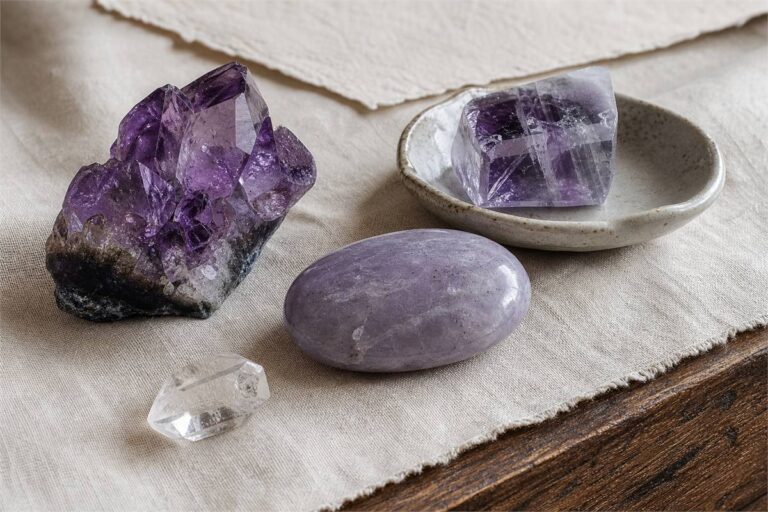
Laos stone, also called Laos seal stone or Laowo Shi (老挝石), is a trade name for carving stones sold as originating in Laos and used for seals and small sculpture. A finished seal can carry a name, a beloved line of poetry, or a wish for a peaceful and fulfilling life. Its warm colors and individual patterns become part of that personal story.

For someone beginning calligraphy, a name seal can mark the start of a creative practice. For a friend moving into a new home or studio, a short blessing can hold affection in a form they will return to for years. Choosing the stone involves both this feeling and a little practical understanding: the same market name can cover pieces with different mineral compositions, carving responses, and care needs.
From a stone blank to a personal seal
In the tradition of Chinese seal carving, or zhuanke (篆刻), lettering, composition, and knife work come together in a small space. A blank becomes personal through the words chosen for its face and the hand that gives those words their rhythm.
A name seal (姓名章) brings its owner’s presence to a painting or calligraphic work. A leisure seal, xianzhang (闲章), may carry a motto, poetic thought, or blessing. A study-name seal can celebrate the room where someone reads, paints, and makes a life of their own.
For a gift, “peace and wishes fulfilled,” Ping An Ru Yi (平安如意), offers a warm starting point. A carver can help compose the phrase in a suitable script and layout. A short side inscription, biankuan (边款 / 邊款), can remember the giver, recipient, or occasion. Keep a photograph and a clear impression with the gift so its words and story remain easy to share.

What the names Laos stone and Baoli stone mean
You may encounter Laowo yinshi (老挝印石), Laowo shizhang (老挝石章), and the market label Baoli stone (保利石). The first two expressions describe Laos seal stone and a seal made from it. Baoli is a commercial name encountered in this trade; the word alone establishes neither a particular mineral nor the supplier of an individual piece.
Names borrowed from familiar seal stones also appear in listings: “Laos Tianhuang,” “Laos Furong,” and “peach-blossom jelly,” for example. They can help describe a seller’s visual category. Read the full description to learn what stone is actually being offered, where the seller says it came from, and whether its surface has been altered.

Northern material, southern material, water material, and dongshi
Northern and southern Laos both appear in accounts of the stone trade. For an individual blank, a named region is useful background only when it belongs to that piece’s supply history. Broad labels are not reliable rankings of softness, stability, or carving quality.
| Market expression | How to understand it |
|---|---|
| Northern material (北部料), including northern yellow material | A geographic trade description. Mineral studies of selected northern yellow stones identify dickite-rich material, but a northern label alone says little about a particular blank’s fissures or knife response. |
| Southern material (南部料) | A broad origin description used for material traded from southern Laos. It does not prescribe one mineral composition, density, or degree of softness. |
| Water material (水料) and water-cave material (水洞料) | Seller terminology that may refer to a claimed recovery setting or a commercial variety. Ask what the seller means; the names do not establish greater stability or a need for moisture treatment. |
| Dongshi (冻石), often translated as jelly or translucent stone | An appearance term evoking a translucent, gel-like look. “Jelly” is not a mineral species or a promise of transparency throughout the block. |
| Mountain material (山料) | A trade description associated with mined material, rather than a universal prediction of cracking, fading, or carving difficulty. |
Specific province or mine names need the same care. A location mentioned for one studied or traded material cannot be assigned to every stone with a similar color. Appreciate a honey-yellow or cloudy white piece for what you can see, while keeping its precise source separate from its appearance.

Minerals and hardness: why individual blanks differ
Examined Laos seal stones include material containing dickite (地开石), kaolinite (高岭石), and nacrite (珍珠陶石), all related clay minerals. Different groups of stones have different proportions. Studies of selected northern yellow material describe dickite as the principal mineral, while other examined market samples include kaolinite-rich and nacrite-rich stones.
Iron-bearing minerals help explain yellow, orange, brown, and some red colors in studied material. Accessory minerals vary as well: hematite and rutile occur in some examined stones, and research on rough outer crusts records a different mixture from the material inside. A mineral list from one sample group should not become a recipe for every Laos-stone seal.
Mohs hardness describes resistance to scratching; it does not measure how neatly a knife releases a chip or how well a thin carved ridge survives pressure. There is no useful single hardness figure to assign to every blank sold under this broad name. Grain, inclusions, fissures, and surface treatments all matter to the carver.

Colors, translucency, and patterns to enjoy
The pleasure of choosing a stone often begins with its color. Look at it in ordinary neutral light as well as from the side: a backlit photograph can create a very different impression from the stone resting on a desk. Polish, surface oil, and camera settings can change the apparent brightness and depth.

| Color or texture | Its visual appeal |
|---|---|
| Honey, lemon, apricot, and brownish yellow | Warm tones that can give a small seal a quiet presence beside ink and paper. |
| Red, orange, and reddish purple | Rich patches or speckling that may inspire a lively composition or a celebratory gift. |
| Milky white, cream, and pale pink | Gentle colors that pair naturally with restrained lettering or a modest floral design. |
| Purple-gray and cloudy gray | Subdued tones whose layered or mist-like appearance may appeal to someone who enjoys a quieter desk object. |
| Mixed colors, bands, and cloudy or water-like patterns | Variations a carver can incorporate into the seal body or knob, giving the finished work an individual character. |
“Peach-blossom” and “cinnabar jelly” are evocative trade descriptions. Pink or red speckles alone do not identify their mineral ingredients, and a red-speckled stone should not automatically be described as containing cinnabar. Likewise, “Furong” in a Laos-stone listing does not identify the stone as Shoushan Furong.
A carver may use a pale patch for a flower and a darker area for surrounding leaves, or leave a band visible around the seal body. This approach lets the color participate in the design. A related tradition, qiaose jade carving (俏色玉雕), also makes color part of the composition. The appeal lies in the relationship between stone and composition, rather than in a rule that clearer, brighter, or more evenly colored always means better.

Laos stone beside Shoushan, Tianhuang, Qingtian, and Balin
Shoushan stone (寿山石), Qingtian stone (青田石), and Balin stone (巴林石) each belong to their own material and carving traditions. Their stones also vary within those names. Laos seal stone can be enjoyed in its own right, without ranking an entire country’s material above or below these established families.

Tianhuang (田黄) has a specific identity within the Shoushan tradition, associated with the Shoushan area of Fujian. Some yellow Laos stones resemble it in color, translucency, or internal veining. Even radish-like patterns are not exclusive to Tianhuang. A shiny surface, a waxy sheen, a particular pattern, heft in the hand, or a test cut cannot by itself establish geographic origin or material identity.
Other labels deserve a brief distinction. Soapstone or steatite ordinarily describes talc-rich stone; softness alone does not make a Laos blank soapstone. Jade is a different material category with different working methods. The jade seal meaning guide explores that object’s associations with trust and scholarly taste. Resin and stone-powder composites are manufactured materials that can imitate stone-like colors; photographs and tapping sounds are not dependable ways to identify them.
Choosing a blank for the words you want to keep
Bring the intended inscription into the conversation early. A short name, a spacious motto, and a dense poem place different demands on the design. For a finished gift, agree on the characters, reading order, face layout, and any side dedication before the carver begins.
Size and composition
Draw the proposed seal face at actual size before ordering. For example, a 2 × 2 cm square gives a different working space from a 2.5 × 2.5 cm square; these are layout examples, not required sizes or quality grades. Try the paper outline beside the calligraphy or painting it will accompany. Choose the final dimensions with the carver, considering the lettering and the recipient’s way of using the seal.

What to look at and ask
- Request clear views of every side, the top, and the intended stamping face, with a ruler for scale. Ask whether the stone was photographed wet, oiled, or under strong backlighting.
- Ask specifically about visible or known cracks, repairs, filled areas, and any dye, wax, resin, or oil treatment. Inspect corners and the intended lettering area. A surface check may reveal a problem, but it cannot rule out a hidden fissure.
- Look for areas where the stone’s texture changes. A color boundary can be a useful place to inspect closely, without being a crack in itself.
- For a finished seal, ask for a clear impression as well as photographs of the carving. Smooth lines alone cannot establish whether the work was entirely hand carved; ask the maker which processes were used.
- Confirm the return terms before carving or altering a blank. Agree separately on the stone, inscription, decorative carving, and delivery arrangements.
If you need a price, request a current quotation for the exact piece and work proposed, with dimensions, condition, included carving, currency, and delivery costs specified. This is more useful than applying a broad price band to unlike objects. A personal seal’s appeal can rest in a beautifully chosen phrase and a thoughtful composition, without a rarity claim.

Knife response and safe carving
Descriptions such as “crisp,” “waxy,” “sticky,” or “soft” describe someone’s experience of a particular stone and tool. They are useful workshop vocabulary, but not a way to identify origin. A single blank may cut smoothly in one area and resist the knife at a harder inclusion nearby.
Before committing a detailed layout to a practice blank you own, an experienced carver can assess an area that will be removed during preparation. Avoid test cuts on finished, borrowed, or historic seals. For fine red-character relief, zhuwen (朱文), the narrow raised lines need sound support. White-character intaglio, baiwen (白文), also needs clean edges and careful control around fissures.
Secure the blank in a padded seal holder, use controlled cuts, and keep fingers out of the blade’s path. If the tool catches, the surface crumbles, or a crack moves, stop and reconsider the work. Wear eye protection against chips. Avoid breathing stone dust: use suitable local dust extraction, avoid dry power grinding in a living space, and have a trained workshop assess respiratory protection for dusty work. Do not blow dust away or dry sweep it. Clean the work surface using dust-capturing methods, keeping cleaning moisture away from the seal itself.

Trial impressions help reveal how the lettering reads before final finishing. A seal impression, yintuo (印蜕), also preserves the completed design on paper. Keep one with the date and the words in ordinary script so the seal remains easy to read and remember.

Gentle care for a finished Laos-stone seal
Care begins with the actual stone, its finish, and its present condition. Treat a repaired, powdery, flaking, or newly cracked surface differently from an intact polished one. “Northern,” “southern,” and “water material” are not enough to choose a care routine, and an increasingly pale surface does not automatically need oil or added moisture.
Dust and seal-paste residue
On an intact surface, lift loose dust gently with a clean, soft brush or a soft dry cloth. Support the body and protect the raised lettering. After stamping, blot accessible fresh paste lightly without pushing it deeper into the cuts. Leave stubborn residue for advice from an experienced seal carver or stone conservator rather than scraping it out with a blade. Stop if color or stone particles transfer.

Keep fragranced remedies, solvents, alcohol, abrasive cleaners, and household stain removers away from the stone. Fengyoujing (风油精), an aromatic topical preparation, is unsuitable as a default seal-paste cleaner. Wet cleaning should be considered only after the particular material, finish, and repairs have been assessed; soaking is not a routine care method.
Storage, oil, and changes in appearance
Store the seal in a clean, padded case that supports its body and leaves the carved face free from pressure and rubbing. Keep it separate from keys, metal tools, and other stones. Choose a stable indoor place away from direct sunlight, heaters, air-conditioning outlets, and damp windowsills. Let any accidental surface moisture dry naturally before putting the seal away; avoid forced heating.

Do not add oil, wax, damp cotton, water containers, or tightly wrapped plastic as a general preservation routine. Oils can alter appearance and may be difficult to remove, while improvised humid storage can create new problems. If a maker recommends maintaining an existing surface treatment, ask for instructions specific to that stone and finish before applying anything.
Handle it with clean, dry hands over a supported surface. Repeated rubbing is not required for preservation. If you notice new cracks, powder, flaking, tackiness, or a changing color, stop using the seal and consult an experienced stone conservator. Keep dated photographs to make the change easier to explain.

Frequently Asked Questions
A small stone with a place in your story
The words on a seal can recall the day a friendship began, welcome a new chapter, or carry a wish for peace each time they meet the page. Choose a stone whose color you enjoy and an inscription you want to keep close. Discover more objects chosen to hold good wishes in the Eastern Story Blessing collection.

Related Posts