
The Black Tortoise, Xuanwu (玄武), is the northern guardian of the Four Symbols, most familiar as a tortoise entwined with a snake. It carries wishes for longevity, peace, enduring protection, and a steady foundation in life. North, winter, Water, and the deep color black belong to its traditional world. The tortoise’s sheltering shell and the snake’s flowing movement bring together two qualities that feel especially precious during change: the strength to remain grounded and the wisdom to adapt.
A Xuanwu pendant can hold a wish for a loved one’s long, peaceful life. A small carving in a new home can welcome stability and companionship. For someone beginning a demanding chapter, the northern guardian offers a reassuring thought: there is strength in moving patiently, keeping your roots, and protecting what matters.

What does Black Tortoise Xuanwu mean?
Xuanwu belongs to the Four Symbols (四象), the animal guardians associated with four great divisions of the traditional Chinese sky. Its northern position connects it with winter and with Water in the Five Phases, Wuxing (五行). Those correspondences give its protective meaning a particular character: deep, patient, watchful, and enduring.
Xuan (玄) suggests darkness, mystery, and profundity; wu (武) means martial or warrior. “Dark Warrior” and “Black Warrior” preserve that sense of guarded strength, while “Black Tortoise” names the best-known animal emblem. “Black Tortoise-Snake” makes the intertwined pair especially clear.
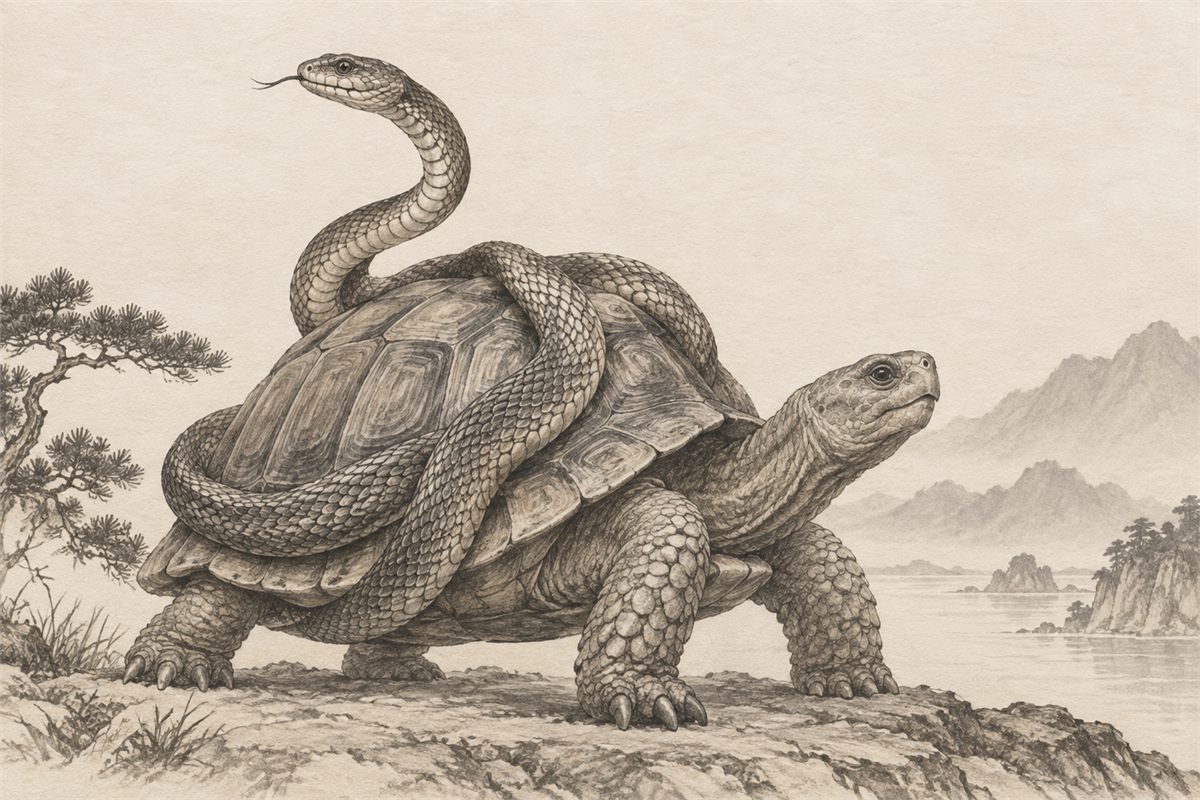
The ancient poem Yuanyou in the Chuci evokes Xuanwu in a celestial journey. Later commentary explains the name through the dark northern direction and the animals’ protective armor. That combination of vast sky and close shelter remains part of the symbol’s appeal: something ancient and expansive, carried in a form small enough to keep near.
Longevity, peace, and lasting companionship
The tortoise has a long place in Eastern longevity imagery. Within Xuanwu, its solid body and enclosing shell lend themselves to wishes for health, a long life, and the continued presence of the people we love. Traditional phrases about a tortoise living for ten thousand years belong to this generous language of blessing. Their beauty lies in the hope of abundant years together.
This makes Xuanwu a thoughtful theme for an elder’s birthday, a retirement, or a family keepsake. Its wish is spacious: may your days be peaceful, may your strength endure, and may there be time to enjoy the life you have built.

Protection, firm roots, and quiet wisdom
As a guardian, Xuanwu is chosen to invite protection and peace around a person or home. Its strength feels contained and dependable. For a new role, a long project, or a move to an unfamiliar place, it can carry a wish for steady progress, good support, and the confidence to stand on firm ground.
The snake brings alertness and movement to this image. Together, the animals suggest wisdom that knows when to hold steady and when to change course. A calm exterior can contain a lively, attentive spirit.

Why are the tortoise and snake intertwined?
In the familiar Xuanwu motif, a serpent winds around a tortoise, across its shell, or toward its raised head. The broad shell gives the composition weight; the snake draws an unbroken line through and around it. Sometimes the two heads face each other, creating an intimate sense of attention and balance.
In yin-yang interpretations, this joining can express complementary forces, the meeting of stillness and movement, and the continuation of life. One familiar reading associates the tortoise’s stillness with yin and the snake’s movement with yang. Daoist and artistic traditions also give the pair other meanings, so the most useful way to enjoy the image is through its relationship: firmness with flexibility, shelter with vitality, patience with renewal.

Historical artists varied the motif to suit roof tiles, stone reliefs, mirrors, and religious sculpture. A round tile might gather the bodies into a compact circle; a rectangular brick can let the snake stretch and turn. Tortoise-centered forms and differently arranged pairs also occur across the history of northern imagery. The full setting, especially its place among the directional guardians, helps identify an older image.
On a worn relief or a small carving, the snake may look like a cord or border. Following its head and curved body can reveal the paired design. A lively curve need not show a fight: it can hold the whole composition together.

North, winter, Water, and the Four Symbols
The four guardians form a shared cultural map. Each brings its own season, color, and quality to the cycle.
| Guardian | Direction | Phase | Season | Traditional color |
|---|---|---|---|---|
| Azure Dragon, Qinglong (青龙) | East | Wood | Spring | Qing: blue-green |
| Vermilion Bird, Zhuque (朱雀) | South | Fire | Summer | Red |
| White Tiger, Baihu (白虎) | West | Metal | Autumn | White |
| Black Tortoise, Xuanwu (玄武) | North | Water | Winter | Black or deep darkness |
Winter gives Xuanwu a particularly gentle emotional depth. Beneath a quiet landscape, life gathers strength for its return. Rest, inward attention, and conserving energy become part of a larger rhythm. For someone rebuilding confidence or moving through a slow season, Xuanwu can be a companion to that patient hope.
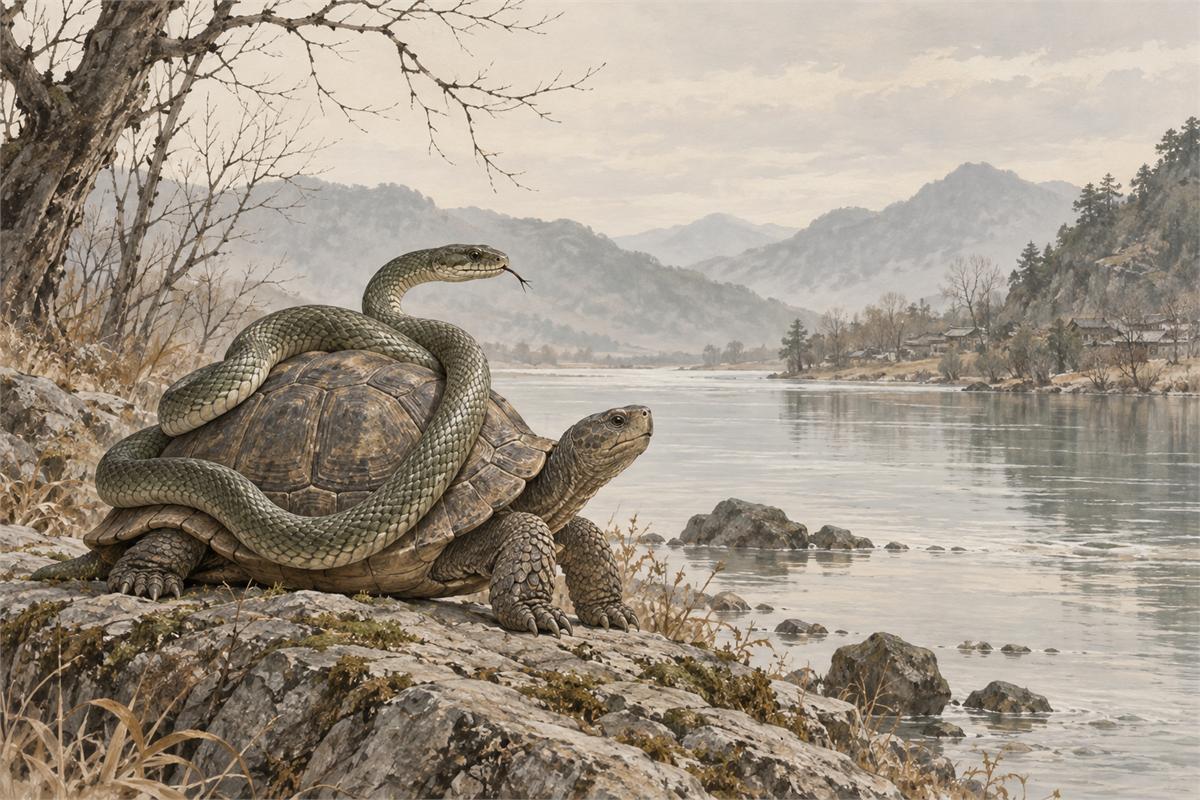
Water adds depth and responsiveness. In later religious traditions, northern Water associations help explain prayers to the northern protector for safety around water and protection from fire. In everyday symbolism, the same connection can evoke clear thinking, resilience, and a peaceful inner reserve.
The directional Four Symbols are also called the four celestial spirits in some contexts. Another traditional grouping called the Four Numinous Creatures brings together the qilin (麒麟), fenghuang (凤凰), tortoise, and dragon (龙). The names belong to different groupings. Within the directional set, Zhuque is the southern Vermilion Bird; its Fire association has its own story, separate from phoenix rebirth imagery.
The seven northern lunar mansions
Xuanwu’s celestial territory contains seven of the Twenty-Eight Lunar Mansions (二十八宿), the traditional divisions used to organize the sky around the paths of the Sun and Moon. The northern sequence is:
| Order | Name | Common English rendering |
|---|---|---|
| 1 | Dou (斗) | Dipper |
| 2 | Niu (牛) | Ox |
| 3 | Nü (女) | Girl |
| 4 | Xu (虚) | Emptiness |
| 5 | Wei (危) | Rooftop |
| 6 | Shi (室) | Encampment |
| 7 | Bi (壁) | Wall |
These are seven mansions containing star groups, rather than seven individual stars. They form one quarter of a 28-part system. The tortoise-and-snake is the cultural image associated with that region; it is not a single fixed outline that every observer must see in the stars.

Dou is associated with the Southern Dipper, Nandou (南斗), a different star group from the Big Dipper, Beidou (北斗). Daoist beliefs about these Dippers include the ordering of life and prayers for longevity. Those beliefs add to the wider world of celestial blessing around Xuanwu, whose meanings also embrace direction, protection, winter, and endurance.
The mansion names belong to a sky-mapping tradition, while the twelve zodiac animals belong to a different cycle. Likewise, someone who enjoys modern Western water-sign imagery may feel a personal connection with Xuanwu’s depth and calm. Cancer, Scorpio, and Pisces are modern points of comparison here, rather than traditional Chinese assignments to Xuanwu.
From northern guardian to Zhenwu, the True Warrior
Xuanwu’s story extends from the animal emblem into Daoist worship. In the tradition of the four directional divine guardians, the northern figure is named Zhiming Shenjun (执明神君). The related personified northern protector became widely known as Zhenwu Dadi (真武大帝), the Great Emperor of the True Warrior, and Xuantian Shangdi (玄天上帝), the Supreme Emperor of the Dark Heaven.
The shift from the name Xuanwu to Zhenwu is associated with Song court avoidance of the character xuan in the name of its revered ancestor Zhao Xuanlang. Religious imagery and devotion developed over time alongside that change. The celestial tortoise-snake continued to have its own life in art, while human images of Zhenwu gave the northern protector a face and a rich body of stories.
A prince, a mountain, and 42 years of cultivation
In a Daoist sacred biography, the future Zhenwu is a prince of Jingle (净乐国) who leaves royal life to cultivate the Dao on Wudang Mountain. After 42 years, he ascends and receives a heavenly charge to guard the north. The story gives his strength a patient beginning: dedication, self-discipline, and the choice of a deeper purpose.
He is often portrayed with loose hair, bare feet, a sword, and robes or armor. The tortoise and snake appear below or near him. In legends of his victories over disorder, the pair become subdued beings and protective attendants, sometimes called the Tortoise and Snake Generals. Their presence connects the human deity with the much older northern animal emblem.

Wudang, the Ming court, and the Forbidden City
Wudang Mountain in Hubei became a major center of Zhenwu devotion. The Ming Yongle emperor supported an extensive temple-building campaign there beginning in 1412. Its mountain palaces and temples give architectural form to the meeting of imperial patronage, sacred landscape, and the northern protector. The ancient building complex entered the UNESCO World Heritage List in 1994.
Within the Forbidden City, Qin’an Hall (钦安殿) in the Imperial Garden houses worship of Zhenwu. The palace’s northern gate offers another echo of the name: completed in 1420, it was called Xuanwu Gate in the Ming period and renamed Shenwu Gate (神武门) under the Qing Kangxi emperor to avoid his personal name, Xuanye.
Farther south, local devotion often knows the god as Beidi (北帝), or Pak Tai in Cantonese, the Northern Emperor. Hong Kong temple traditions include prayers for longevity and safe passage on water. The third day of the third lunar month is celebrated as his birthday; some Daoist communities also commemorate his attainment or ascent on the ninth day of the ninth lunar month. These observances belong to the living traditions of the deity.
Xuanwu in art, architecture, and familiar places
Xuanwu appears among Eastern guardian beasts on objects that surround and shelter human life. Han roof-end tiles place the tortoise and snake in a circular frame. Tomb bricks and reliefs bring the directional guardians into a protected cosmic setting, while mirrors and other decorative objects carry their ordered world into smaller, intimate forms.

A Sui-period Xuanwu stone relief in the Palace Museum captures the balance beautifully: the tortoise feels substantial and the snake light and lively. A Tang tomb brick from Wuchang lets the snake curl toward the tortoise within a rectangular composition. The artists’ different solutions show how a shared protective theme can remain expressive.
The guardian also traveled through East Asian visual traditions. In Japan it is known as Genbu (玄武), and in Korea as Hyeonmu (현무). Local murals and objects give the familiar northern theme their own forms and histories, extending its appeal across places and generations.
Nanjing’s Xuanwu Lake carries another part of this cultural memory. Stories of its name bring together the northern guardian and traditions about a black dragon appearing in the lake. Beside its water, the name holds the same evocative combination of depth, mystery, and protection.
“Xuanwu behind”: the meaning of a dependable backing
In feng shui (风水), the familiar arrangement places the Dragon to the left, Tiger to the right, Bird in front, and Xuanwu behind. The rear position evokes a supporting mountain, or kaoshan (靠山): a dependable backing that lets a home or person feel held.
North is Xuanwu’s cardinal direction in the cosmological map. “Behind” describes a position relative to the front of a building or site. They coincide in a south-facing arrangement; a building with another orientation has a different relationship between its rear and compass north.
As a living metaphor, the image is warm and immediate. A supportive family, a trusted friend, or a settled home can all feel like a mountain at one’s back. A Xuanwu object may be chosen to welcome that sense of rootedness and to honor the people who make life feel steady.
For a small home display, choose a stable, uncluttered surface where the carving can be enjoyed without being easily knocked over. Let the setting feel calm and cared for. The object’s presence can become part of a familiar daily pause, alongside a book, a cup of tea, or a note from someone dear.

Xuanwu, Dragon Turtle, and tortoise motifs
A Dragon Turtle (龙龟) usually has a dragon’s head and a turtle’s body. Xuanwu’s familiar image pairs a tortoise with a snake. A naturalistic tortoise can carry a longevity wish on its own, while a human figure with a sword and the animals nearby may represent Zhenwu.

These distinctions help you choose the story that speaks to you. Xuanwu brings together the northern sky, winter reserve, and the companionship of two different forms. A Dragon Turtle or a simple tortoise can offer a related feeling of grounded strength with a different visual story.
Carrying Xuanwu in jewelry and meaningful objects
A pendant, bracelet, or ring for steady days
A rounded Xuanwu pendant gathers the animals into a close, protective shape. A bracelet charm can make the motif a small part of an everyday ritual; a sculptural ring can let the snake’s curve follow the hand. The design may speak to someone who values calm strength, patient ambition, or a sense of continuity with Eastern culture.

Dark stone, pale jade, warm wood, silver, and gold each give the image a different mood. Hetian jade (和田玉) offers the soft luster associated with nephrite. White chalcedony (白玉髓) belongs to the quartz family and is a different material. Obsidian (黑曜石) brings a glassy darkness; sheen varieties reveal optical effects as the light and viewing angle change. The color can complement Xuanwu’s northern identity.
Some contemporary compositions use antique-looking metal finishes, a dark cord, or a pale bead to set off the animal silhouette. Turquoise (绿松石) or amber (琥珀) can offer a contrasting accent in a mixed-material design. Choose the combination for the feeling it carries and the clothes you enjoy: linen, a simple shirt, or a favorite jacket can all give the motif room to be noticed.
For a sense of scale, a pendant might measure 2.5–4.0 cm; this is an example range to visualize, with the final choice depending on its weight, thickness, cord, and how you like it to sit. A well-composed small piece can be as expressive as a larger carving.

Wenwan and the pleasure of keeping an object close
Wenwan (文玩), the world of small objects kept and appreciated through handling, suits Xuanwu’s patient character. A zitan wood (紫檀) carving or olive-pit carving (橄榄核雕) can place intricate animal lines within a surface that gradually gains a lived-with character. Shield-shaped contemporary designs often emphasize the sheltering shell.
A Xuanwu ornament can also accompany Jingang Bodhi or rudraksha beads (金刚菩提). The pleasure is in a familiar object becoming part of ordinary days: its curves remembered by the hand, its story deepened by the moments it accompanies.

Gifts for a home, a study, or a new beginning
A ceramic Xuanwu tea pet (茶宠) can bring a longevity wish to a tea tray and a moment of companionship to a quiet gathering. A small desk carving can celebrate a new role or the beginning of a business with a hope for strong roots and steady progress.

A seal with a Xuanwu-shaped knob adds a personal dimension. In Chinese seal carving (篆刻), a name or chosen phrase gives the object an individual voice. Shoushan stone (寿山石) and Qingtian stone (青田石) are materials associated with this carving tradition. A carefully chosen inscription can make the gift feel connected to the recipient’s work, character, or hopes.
A jade composition combining Xuanwu with a ruyi (如意) form brings together enduring protection and the wish “as you desire.” A fabric sachet, xiangnang (香囊), offers another gentle way to carry the motif, through stitching, color, and a personal keepsake. It can hang in a room or accompany a bag, where its design can be enjoyed.

The blessing ping an ru yi (平安如意), “peace and may life unfold as you wish,” is especially fitting. A birthday note might read, “May the years ahead be peaceful, full, and shared with those you love.” For a housewarming: “May this home give you a steady place to grow.” For a friend beginning again: “May you find firm ground and a calm heart for the road ahead.”
A brief note on Xuanwu tattoo design
As a tattoo motif, Xuanwu can express enduring protection, balance, and resilience. Ink-wash shading, flowing water, or a simple geometric treatment can bring out the relationship between a grounded shell and a moving serpent. Give both animals enough space to remain legible, and choose a composition whose mood feels personal: quiet, watchful, or full of gathering movement.

Caring for a Xuanwu keepsake
Protect raised snake loops, projecting heads, and carved limbs from knocks or pressure. Store jewelry separately and check the cord, clasp, and setting before wearing it. The material guide can help you understand what a piece is made from, while the care guide offers a starting point for looking after it.
Use a soft cloth for routine surface care and follow instructions appropriate to the actual stone, treatment, metal finish, and construction. Wood and carved pits need protection from soaking, strong sunlight, and abrupt environmental changes. Silver may tarnish; gold, gilding, and plated finishes call for their own care. Pieces with mixed materials, glued components, or delicate cords need an approach suited to the whole object.

A wish that stays with you
Xuanwu brings a distinctive blessing into everyday life: long years, a peaceful home, steady support, and the wisdom to move through change without losing your roots. Its intertwined forms make protection feel alive, and its winter associations leave room for rest as well as growth.
Whether you are drawn to a personal keepsake or a gift for someone important, begin with the wish you want to carry. Explore the Eastern Story blessing collection for objects that can accompany that intention, and let the story become part of the life around it.

Frequently Asked Questions
Related Posts


One Comment