
Quick Answer: What Does the Year of the Tiger Mean in Chinese Culture?
The Year of the Tiger means a year associated with the third animal in the Chinese zodiac, paired with the Earthly Branch Yin (寅). In Chinese culture, the tiger commonly evokes courage, martial strength, authority, vigor, dignity, and protective wishes. Those meanings come from several different settings—zodiac timekeeping, real encounters with a powerful predator, military history, cosmology, art, children’s folk craft, and modern design.
A Tiger year does not make everyone born during it brave, dominant, lucky, or compatible with the same people. Zodiac character sketches and relationship groupings are folklore or astrology, not personality science. A tiger motif can carry a wish for courage or protection, but it cannot guarantee safety, health, wealth, or success.
Tiger in the Chinese Zodiac
The zodiac, called shengxiao (生肖) or shuxiang (属相), follows a repeating twelve-animal order: Rat, Ox, Tiger, Rabbit, Dragon, Snake, Horse, Goat, Monkey, Rooster, Dog, and Pig. Tiger is third and corresponds to Yin, the third Earthly Branch. By the Eastern Han period, the conventional animal order was well established. For the complete cycle, see Eastern Story’s guide to the twelve Chinese zodiac signs.

In common modern use, a person’s zodiac animal is determined by the lunisolar year beginning at Lunar New Year. That is why someone born in January 2022 was not automatically born in a Tiger year. Some Bazi and related specialists instead use Lichun, the “Beginning of Spring” solar term, as a year boundary. Both conventions exist, so any precise claim should name its rule.
How Tiger Years Are Calculated
The animal cycle repeats every twelve years, but a full traditional year name combines one of ten Heavenly Stems with one of twelve Earthly Branches. The combined sexagenary cycle repeats every sixty years. Every Tiger year has Yin as its branch; the stem changes, producing Jia-Yin, Bing-Yin, Wu-Yin, Geng-Yin, and Ren-Yin in sequence.

| Gregorian label | Stem–branch year | Traditional phase label | Lunar-year date boundary |
|---|---|---|---|
| 1926 | Bing-Yin 丙寅 | Fire Tiger | Feb 13, 1926–Feb 1, 1927 |
| 1938 | Wu-Yin 戊寅 | Earth Tiger | Jan 31, 1938–Feb 18, 1939 |
| 1950 | Geng-Yin 庚寅 | Metal Tiger | Feb 17, 1950–Feb 5, 1951 |
| 1962 | Ren-Yin 壬寅 | Water Tiger | Feb 5, 1962–Jan 24, 1963 |
| 1974 | Jia-Yin 甲寅 | Wood Tiger | Jan 23, 1974–Feb 10, 1975 |
| 1986 | Bing-Yin 丙寅 | Fire Tiger | Feb 9, 1986–Jan 28, 1987 |
| 1998 | Wu-Yin 戊寅 | Earth Tiger | Jan 28, 1998–Feb 15, 1999 |
| 2010 | Geng-Yin 庚寅 | Metal Tiger | Feb 14, 2010–Feb 2, 2011 |
| 2022 | Ren-Yin 壬寅 | Water Tiger | Feb 1, 2022–Jan 21, 2023 |
| 2034 | Jia-Yin 甲寅 | Wood Tiger | Feb 19, 2034–Feb 7, 2035 |
| 2046 | Bing-Yin 丙寅 | Fire Tiger | Feb 6, 2046–Jan 25, 2047 |
| 2058 | Wu-Yin 戊寅 | Earth Tiger | Jan 24, 2058–Feb 11, 2059 |
The familiar labels Wood Tiger, Fire Tiger, Earth Tiger, Metal Tiger, and Water Tiger come from the Heavenly Stem’s association with the five phases (wuxing 五行). They are traditional calendrical labels, not a scientific description of a person’s body, temperament, health, or fate.

Earthly Branch Yin, Time, Direction, and the Five-Phase Cycle
Yin (寅) is a calendrical sign older and broader than the animal nickname attached to it. Earthly Branches were used to name years, months, directions, and twelve two-hour periods. Yin hour is conventionally 3:00–5:00 a.m. Claims that this pairing exists because wild tigers are always “most active” at exactly those hours are later folk explanations, not a reliable universal account of how the branch system formed.
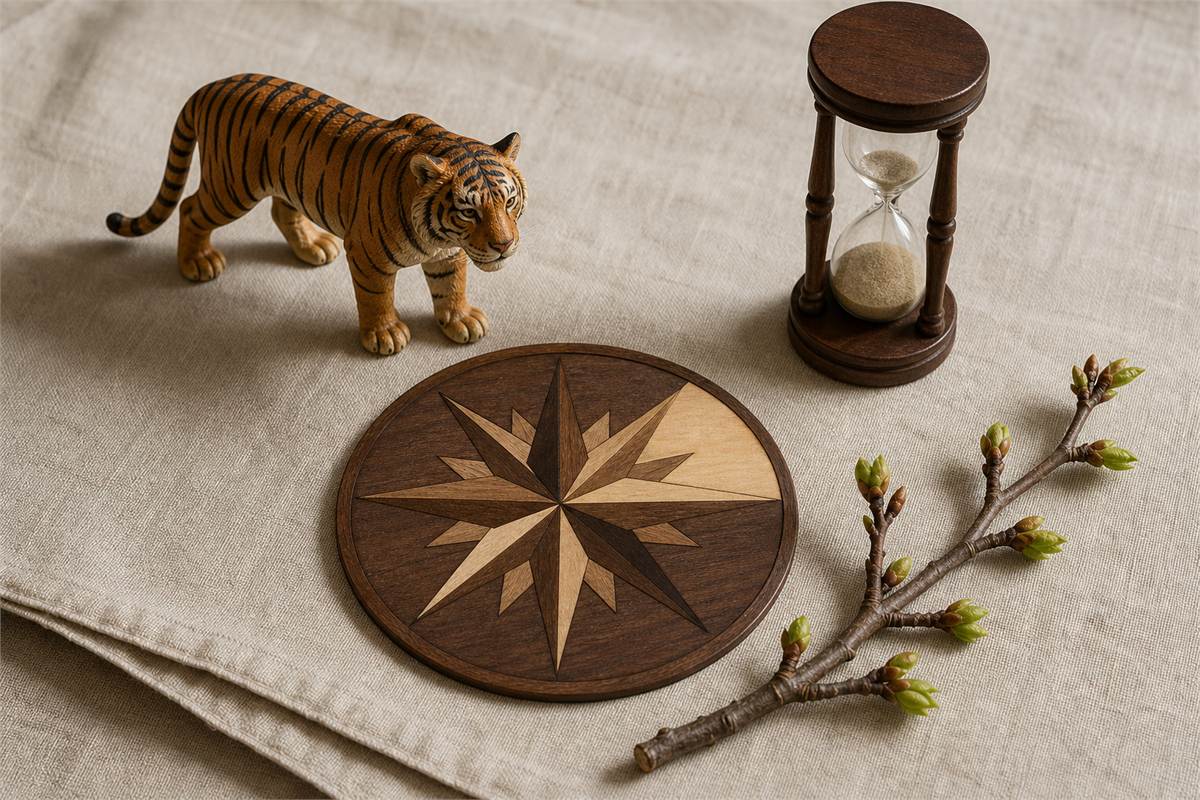
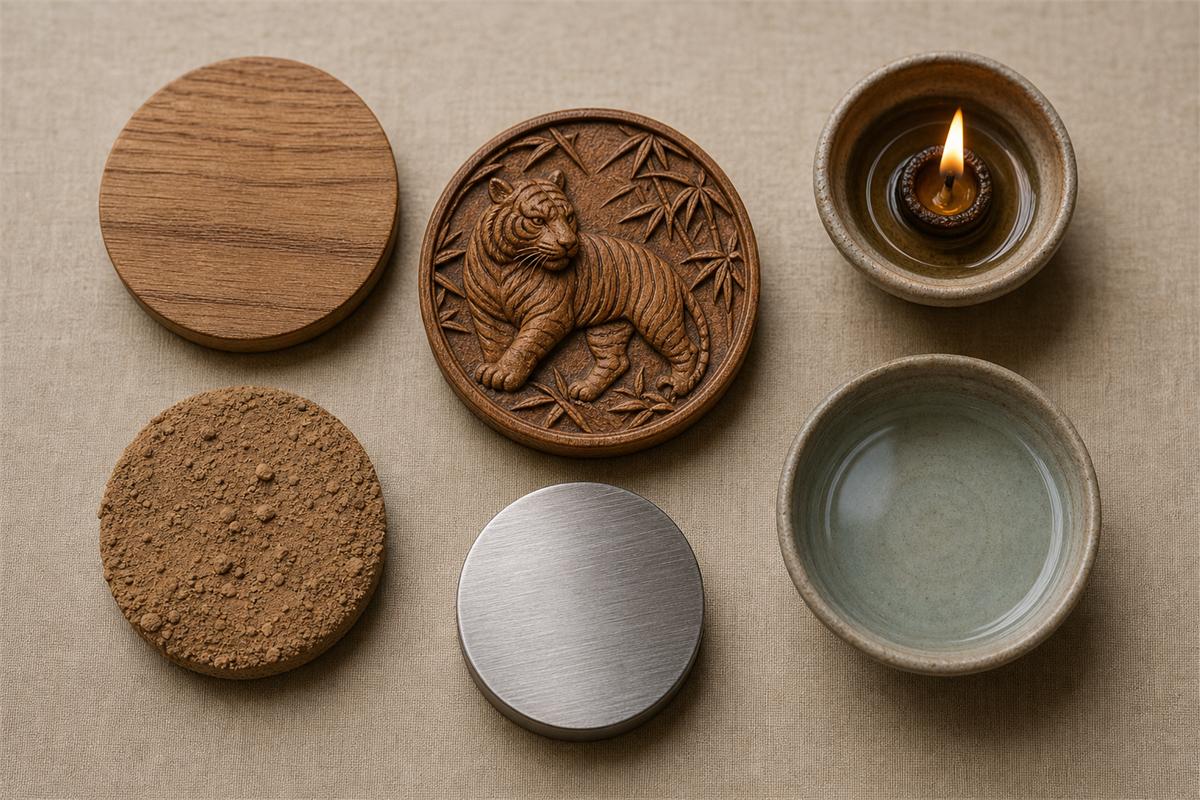
Traditional correspondence tables commonly associate Yin with the first month of spring in branch reckoning, an east-northeast direction, yang polarity, and Wood. This does not conflict with a Metal, Water, Wood, Fire, or Earth Tiger year: the first set describes the branch correspondence, while the year label also uses the stem. Different systems are being layered, so they should not be reduced to a single “tiger element.”
Historical Tiger Symbols
Tiger tallies and military language
A hufu (虎符), or tiger tally, was an official token used to verify military orders. Surviving examples can be formed as a tiger and divided into matching halves: one remained with the ruler and the other with an officer, and the joined parts authenticated authority to mobilize troops. The object’s function was administrative and military; it does not mean every tiger picture, pendant, or carving historically granted command.

Terms such as hujiang (虎将, “tiger general”) praise a formidable commander, while huzhang (虎帐, “tiger tent”) can refer poetically to a military command tent. Such phrases show how tiger language conveyed martial force. They do not prove that all tiger ornament represented intelligence, rank, or imperial power.
The White Tiger and other symbolic systems
The White Tiger, Baihu (白虎), is one of the Four Symbols: the Azure Dragon of the east, Vermilion Bird of the south, White Tiger of the west, and Black Tortoise entwined with a snake in the north. The White Tiger is associated with the west and, in later correspondence systems, autumn and Metal. It is a mythic-cosmological guardian, not the biological ancestor of tigers and not simply another name for the zodiac branch Yin.

| Image or system | What it is | How to interpret it |
|---|---|---|
| Zodiac Tiger / Yin Tiger | The animal paired with the third Earthly Branch | A marker in cyclical time and a folk identity symbol |
| White Tiger / Baihu | The western guardian among the Four Symbols | A cosmological and mythic figure; not identical to the zodiac Tiger |
| Natural tiger | A living wild species and apex predator | An animal with ecological and legal protection, not a magical object |
| Tiger tally / hufu | A split token used to verify military orders | A historical instrument of delegated authority |
| Tiger-head child craft | Shoes, hats, toys, bibs, or textiles using a stylized face | A family and festival blessing expressed through craft |
| Modern tiger motif | Realistic, abstract, striped, cute, or graphic design | A contemporary aesthetic that may or may not reference tradition |
Tiger as a Folk Protector
Because the tiger was feared and admired, folk art often made it a guardian image. Painted tigers, door images, cloth tigers, tiger-head clothing, and festival designs could express wishes to subdue harmful forces and help a household or child grow strong. These are historical and emotional meanings. They should be phrased as what families hoped or symbolized, not as evidence that an object prevents illness, fright, poison, accidents, or misfortune.

The popular idea that forehead stripes naturally form the written character wang (王, “king”) is a visual analogy used in art and storytelling; real tigers have individual stripe patterns. Likewise, “tiger” and “fu” are not a standard Mandarin homophone. Regional puns or product copy should not be promoted as a universal linguistic origin.
Children’s Tiger Crafts and Festival Customs
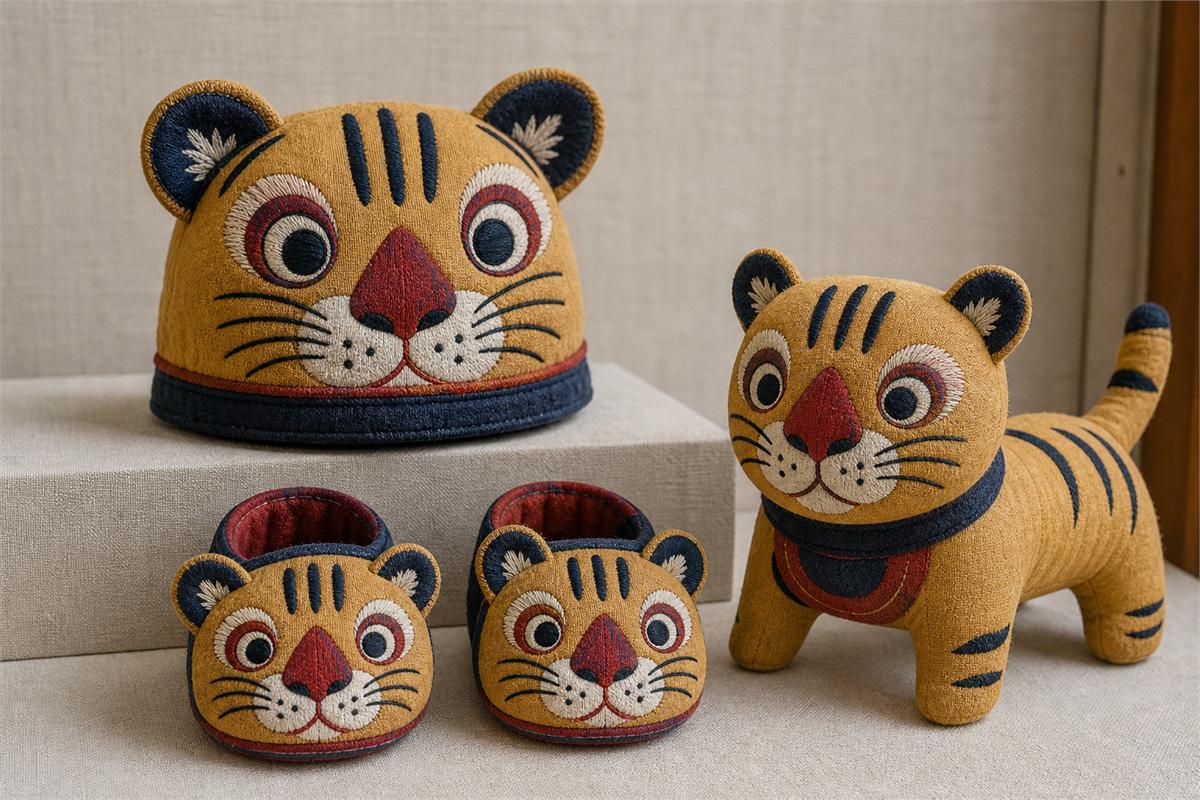
| Object | Region or occasion | Traditional meaning | Modern safety boundary |
|---|---|---|---|
| Tiger-head shoes and hats | Found in several northern and central Chinese folk-craft traditions; often made for infancy, birthdays, New Year, or Dragon Boat season | A wish for vigor, courage, and family guardianship | Choose age-appropriate construction; avoid loose beads, long cords, sharp decorations, unknown dyes, and sleep-area use |
| Cloth tiger / bu laohu | Regional textile and toy traditions, including distinct local craft lineages | A soft guardian image and affectionate symbol of a lively child | Do not call every cloth tiger one national heritage project; inspect seams, stuffing, eyes, bells, and detachable parts |
| Tiger and Five Poisons bib or bellyband | Dragon Boat Festival customs in some regions | The tiger symbolically overcomes the “Five Poisons” in seasonal imagery | It does not repel insects or disease; powders, herbs, pins, beads, and unknown pigments are unsuitable near a baby’s mouth or sleep space |
| Tiger-head ear ornament or sachet | Festival dress and regional handwork | A wearable seasonal blessing | Avoid pins, metal edges, loose contents, fragrances, and long attachment cords for young children |
| Five-color cord and longevity lock | Dragon Boat or childhood blessing customs; not exclusively tiger objects | Long life, connection, and family care in folk language | Long cords can entangle; small metal items can choke or injure and should not be placed in infant sleep areas |
| Baijia clothing or quilt | Family and community gift traditions | Symbolically gathers goodwill from many households | Use safe modern textiles and construction; symbolism does not provide medical protection |
For infants and young children, keep cinnabar, powdered mugwort, loose spices, safety pins, small beads, long strings, sharp peachwood pieces, metal locks, and animal-derived charms away from skin, mouths, cribs, and sleep areas. Risks include swallowing, strangulation, puncture, allergy, and unknown material composition. A display object is not automatically a toy.

Common Tiger Idioms and Blessings
- Huhu shengwei (虎虎生威): a lively wish that someone shows impressive vigor or presence.
- Ruhu tianyi (如虎添翼): “like adding wings to a tiger,” meaning added strength or advantage.
- Longteng huyue (龙腾虎跃): “dragons rise and tigers leap,” an image of energetic activity.
- Hutou hunao (虎头虎脑): literally “tiger head, tiger brain,” affectionately describing a sturdy, lively-looking child.
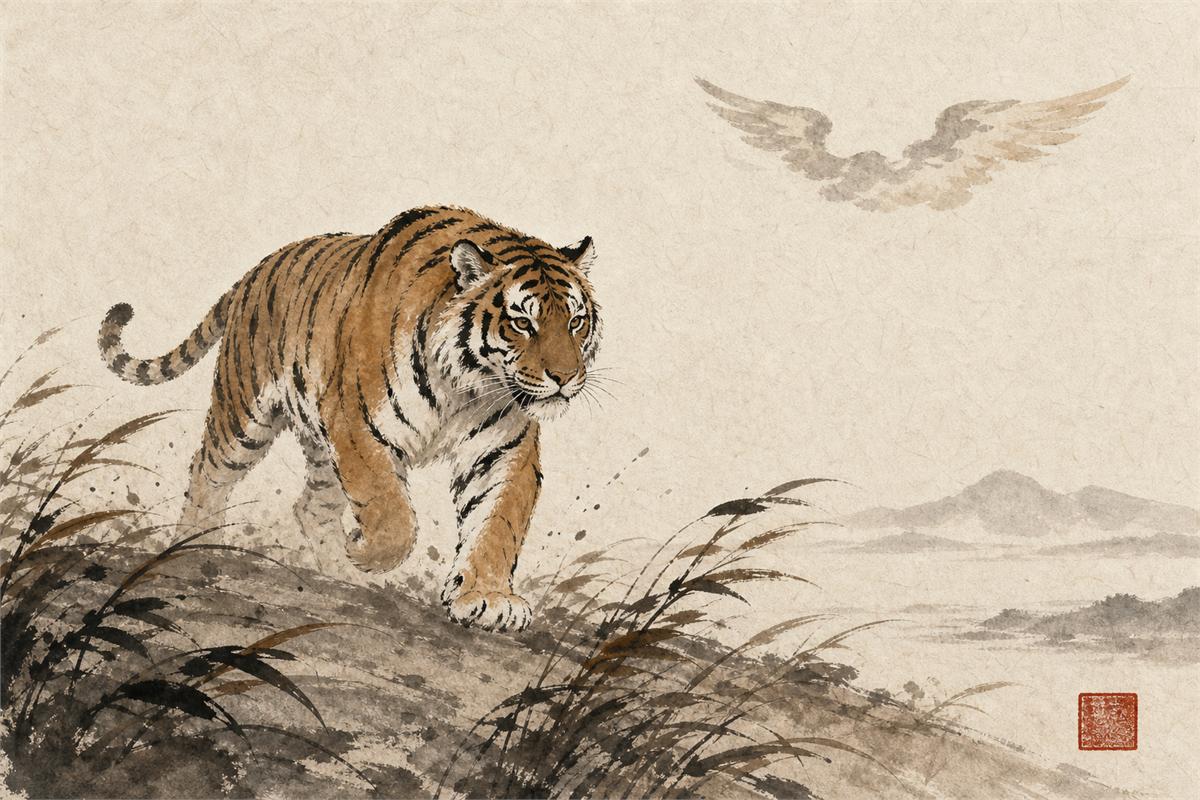
- Wohu canglong (卧虎藏龙): “crouching tiger, hidden dragon,” referring to concealed talent.
- Hukou yusheng (虎口余生): surviving a grave danger, literally escaping from a tiger’s mouth.
Idioms are linguistic images. They should not be turned into promises that a tiger object confers military power, intelligence, wealth, or health. “Up-mountain,” “down-mountain,” and reclining tiger compositions are real artistic choices, but fixed claims about wealth direction, room placement, or personality determined by birth hour vary by modern practice and should not be presented as universal old rules.
Zodiac Personality and Compatibility as Folklore
Popular zodiac writing often calls Tiger people bold, decisive, independent, generous, competitive, impatient, or controlling. These descriptions can be enjoyable cultural shorthand, but a birth-year animal is not a validated personality assessment. People born in the same year differ in family, education, health, culture, experience, and temperament.

Some astrology traditions describe Pig as a liuhe pairing, Horse and Dog as a sanhe group with Tiger, Monkey as a clash, or Snake as a harm. Other layers use hidden stems and combinations such as Yin–Wu fire structures. These belong to specific metaphysical systems and schools. They cannot determine whether two people will love each other, work well together, succeed in business, or experience a particular future. No 2026 prediction, “helpful person” forecast, lucky color, crystal prescription, or product-based remedy is needed to understand Tiger culture.
Tiger Jewelry and Modern Design
Tiger jewelry may use a full zodiac animal, a realistic head, stripes, paws, an abstract tooth shape, a White Tiger reference, a tiger-tally silhouette, or a soft cartoon character. A 999 gold anthropomorphic tiger, a cleverly carved Hetian-jade tiger, a matte gold charm, enamel stripes, or a minimalist line drawing are design directions—not guarantees of investment value, heirloom status, protection, or “timeless luxury.”

Luxury houses including Cartier, Boucheron, and David Webb have made tiger-themed jewels, but model names, dates, gemstones, carat weights, and mechanisms change by piece and collection. Without a current brand archive or authoritative collection record for the exact object, it is safer to discuss the broad design history than repeat sales-copy specifications. This guide therefore does not assign unverified details to particular branded jewels.
Safe and Ethical Tiger-Themed Gifts
A respectful gift begins with the recipient rather than a zodiac stereotype. Check the person’s correct year boundary, age, daily use, taste, size, budget, material durability, metal sensitivity, and the object’s edges, fastenings, small parts, weight, and care needs. Do not infer that a Tiger-year recipient wants extreme sports or a loud statement piece because popular astrology calls Tigers adventurous.

- Identify the motif: zodiac Tiger, natural tiger, White Tiger, tiger tally, child folk craft, or modern graphic.
- Choose transparent substitute materials: gold or silver alloys, other clearly named metals, natural stone, glass, enamel, ceramic, textile, wood, or responsibly sourced synthetic material.
- Treat “tiger tooth” only as an abstract tooth-shaped design unless the material is clearly a non-animal substitute.
- Never buy, sell, collect, or gift real tiger teeth, claws, bone, skin, whiskers, or other tiger derivatives. International commercial trade in tigers and their parts is prohibited under CITES, and national laws can be stricter.
- Avoid ivory and protected coral, and do not use animal names to imply that an unidentified material is a real body part.
- For children, prefer soft, washable, age-appropriate objects without detachable parts, long cords, pins, powders, fragrances, sharp points, or sleep-space hazards.
- For home objects, prioritize a stable base, secure fixing, clear walking paths, rounded edges, and placement beyond children’s reach—not unsupported wealth-direction rules.
- Write the card as a wish: “May this tiger remind you of courage,” not “This tiger will protect you or bring wealth.”
For a broader birth-year present, see the Benmingnian guide. The Blessing collection can also be browsed by message and design, with symbolism understood as a thoughtful wish rather than a guaranteed result.

Common Misconceptions

- “Every person born in a Gregorian Tiger year is a Tiger.” False; check Lunar New Year, and state if a specialist Lichun rule is being used.
- “Yin hour exists because tigers are scientifically most active from 3:00 to 5:00 a.m.” This is a folk explanation, not a secure origin claim.
- “The White Tiger is the original tiger or the same as Yin Tiger.” It is a distinct Four Symbols guardian.
- “A tiger’s forehead literally carries the character wang.” Artists emphasize a resemblance; natural stripes vary.
- “A tiger ornament attracts wealth or protects a home.” Such meanings are wishes or practice-specific claims, not measurable effects.
- “Up-mountain and down-mountain tigers have one fixed placement rule.” Interpretations vary, and practical display safety matters more.
- “Every cloth tiger is national intangible heritage.” Heritage listings name particular projects, bearers, and places.
- “Real tiger parts make a more traditional gift.” They are unethical, legally restricted, and unnecessary; use non-wildlife alternatives.
Frequently Asked Questions
Related Posts


