The Lu character (禄; traditional form 祿, pronounced lù) carries a wish for a secure livelihood, worthy work, recognition, and a life with enough resources to flourish. Its oldest recorded meanings include blessing; in early political and ritual language it also came to name the support attached to office. Later art turned that history into a warm blessing for advancement, opportunity, and abundance—often through the written character, the deer (鹿) rebus, or the wider Fu-Lu-Shou tradition.
That makes Lu more precise than a general sign for money. It honors the hope that ability will be seen, effort will find a fitting place, and work will sustain a good life. People wear, keep, or give Lu objects to welcome steady progress and a beautiful future: a new stage after graduation, a meaningful qualification, a career milestone, retirement, a new home, or a family wish for lasting provision.

What does the Lu character mean?
| Form or expression | Literal center | Warm modern reading |
|---|---|---|
| 禄 / 祿 (lù) | Blessing; support attached to office | Stable livelihood, recognition, opportunity, and prosperity |
| 俸禄 / 俸祿 (fènglù) | Official emolument | The historical link between service and material support |
| 福禄 / 福祿 (fúlù) | Blessing and Lu | Wellbeing joined with a flourishing livelihood |
| 福禄寿 / 福祿壽 (fúlùshòu) | Fu, Lu, and Shou | Blessing, provision, and longevity together |
| 鹿 (lù) | Deer | A visual rebus for Lu when the design context supports it |
English translations such as “prosperity,” “rank,” and “official salary” each capture one layer, but none covers the whole story. In a modern gift, “honored livelihood” can be especially useful: it joins material steadiness with earned trust, meaningful responsibility, and the dignity of seeing one’s abilities put to good use.

The character’s early form and original sense
The traditional character 祿 belongs to the 示 graphic system. The Shuowen Jiezi gives the concise definition “祿,福也” (“Lu means blessing”) and analyzes it as “从示,彔聲”: formed with 示 and the sound element 彔. The modern simplified form is 禄; the two forms represent the same word.

Early bronze inscriptions could borrow 彔 to write the word later distinguished as 祿. Scholars have proposed that the old graph 彔 may picture equipment used to draw water from a well. That proposal concerns the history of the phonetic graph. It does not establish a story in which plentiful well water itself created the meaning “blessing.” In 祿, the securely supported analysis is the one preserved by the Shuowen: 示 supplies the semantic category and 彔 supplies the sound.
Early texts also show why “blessing” and “emolument” should not be forced into a single modern definition. Older uses of Lu could be close to Fu (福), a favorable endowment or blessing. In political life, the word became closely associated with what a ruler or state allotted to people holding office. Both senses shaped the later auspicious character: a good portion in life and the means by which service is sustained.
From blessing to emolument, rank, and recognized work
The Liji chapter “Wang Zhi” places Lu at the end of a sequence for selecting and appointing worthy people: “论定,然后官之;任官,然后爵之;位定,然后禄之”—after evaluation is settled, a person is assigned office; after appointment, rank is conferred; after position is settled, Lu is allotted. In this passage, Lu is not a vague promise of luck. It is material support ordered in relation to a defined position.
The form of that support was not identical in every dynasty. Depending on period and institution, official provision could involve grain, other goods, cash, or revenues connected with land and office. “Lu rice,” “rank,” “office,” and land grants therefore belong to related but distinct historical arrangements. The enduring cultural link is between recognized service, an established place, and the resources that allow a household to live securely.

Later phrases such as “high office and generous Lu” made rank and reward highly visible, while the broader blessing tradition kept Lu connected to wellbeing. Modern readers can translate that inheritance without turning it into a wish for power or social superiority. Lu can welcome a stable profession, growing responsibility, fair recognition, useful opportunities, and the abundance needed to care for oneself and others.

Lu within Fu-Lu-Shou culture
Fu-Lu-Shou (福禄寿 / 福祿壽) brings three hopes into one balanced vision: blessing and wellbeing, a flourishing livelihood, and longevity. Lu stands between the breadth of Fu and the long horizon of Shou. Together, the three speak to a life that is fortunate, sustained, and long enough to be shared.

The familiar three figures did not emerge from one unchanging identity chart. Astronomical names, religious cults, popular prints, household images, and regional workshops contributed different layers over time. Figures may appear as officials or dignified elders and may hold a tablet, scroll, ruyi, or other attribute, but no single costume, child, deer, or handheld object identifies every Lu image.
The Lu Star and Wenchang are related traditions, not one fixed identity
The Shiji “Treatise on the Celestial Offices” records six stars called the Wenchang Palace: Shangjiang, Cijiang, Guixiang, Siming, Sizhong, and, sixth, Silu (司祿). This is an astronomical ordering. Later traditions around Wenchang, office, literary achievement, local deities, and personified Lu images developed through more than one historical path. It is therefore clearer to distinguish the Silu star, Wenchang Emperor traditions, and the popular Lu figure rather than equating Lu Star with Wenchang Emperor, Zhang Yazi, Zhang Xian, or a universal child-giving deity.

For a modern reader, this distinction preserves the beauty of the tradition. A Fu-Lu-Shou image can carry wishes for a full life without turning every detail into a fixed religious formula or a promise about examinations and promotions.
Why deer can express Lu
The word for deer, lu (鹿), sounds like Lu (禄 / 祿). Artists use this homophone as a visual rebus, allowing a living animal to carry an abstract blessing. A deer may therefore suggest provision, office, or a flourishing path, while its companions add other meanings. The full composition matters: the same animal can participate in a landscape, a longevity scene, a narrative, or a specific auspicious phrase.

| What is actually shown | A careful reading |
|---|---|
| A single deer | It may carry the Lu rebus, but the object, inscription, and surrounding motifs decide how strongly that reading applies. |
| Many deer in a landscape | A “Hundred Deer” subject can also be read as “Hundred Lu”; museum examples connect the rebus with the many benefits of an official career. |
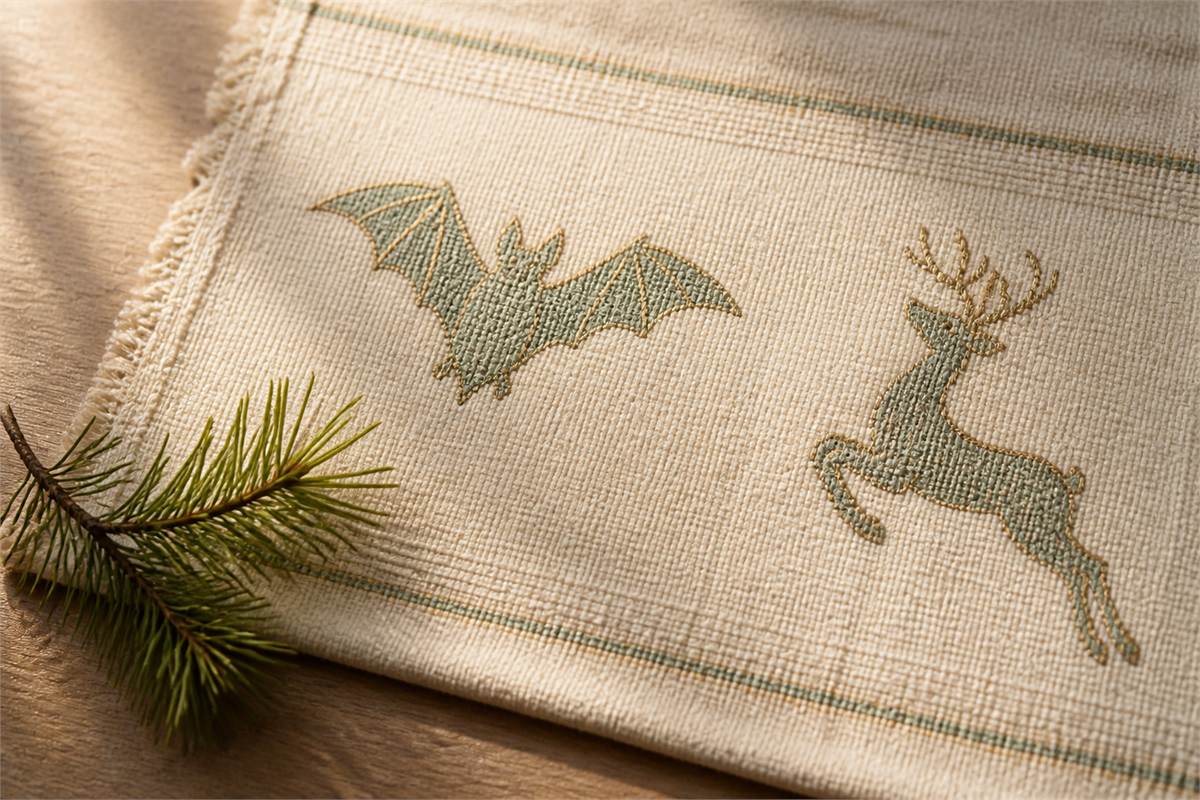
| Bat and deer | When both are clearly present, their sounds can support a Fu-Lu reading: bat for Fu and deer for Lu. |
| Crane and deer | This can belong to the distinct He Lu Tong Chun (鹤鹿同春) theme; the entire composition should be read together. |
| Deer with pine, crane, monkey, an official, or headwear | These combinations may add longevity, career, rank, or narrative meaning, but they should be named from the specific work—not from a universal motif equation. |
Readers who encounter a crane-and-deer design can explore the published He Lu Tong Chun meaning guide. For the paired phrase in which blessing and livelihood are both complete, see Fu Lu Shuang Quan (福禄双全).
Gourds and other ways to carry the sound of Fu-Lu
The gourd hulu (葫芦) is loved for its rounded form, trailing vines, and many seeds, and its name readily invites the sound association “Fu-Lu.” In jewelry, carving, textiles, or a small keepsake, that wordplay can join blessing with an abundant, continuing life. Its emotional strength lies in the layered wish: wellbeing beside livelihood, growth beside continuity, and good things unfolding through the generations.

A design may use the written character, a deer, a gourd, or several symbols together. These are related expressions, not interchangeable labels. “Lu character pattern,” “Hundred Deer,” “Hundred Lu,” “Fu-Lu-Shou,” “Fu-Lu complete,” and “advancing in office and Lu” describe different visual or verbal themes. A trustworthy description begins with what is visibly present and uses an inscription or reliable object record when naming a specific composition.
Lu in jewelry, seals, metalwork, and textiles
On jewelry, 禄 or 祿 can become openwork, engraving, relief carving, or a small seal-script centerpiece. A deer pendant carries the sound through form; a gourd may widen the message toward Fu-Lu. Jade and hardstone give the symbol a quiet, tactile presence, while gold, silver, copper, and other metals can emphasize line, silhouette, or surface pattern. The meaning comes from the design and the story attached to it, not from automatic powers assigned to the material.

A Lu seal can be a jiyu leisure seal—a seal carrying an auspicious phrase—or part of a personal name seal or studio practice. These uses should remain distinct. Script choice depends on the intended impression, the carver’s design, and how the seal will be used; seal script is not the only respectable choice. A side inscription can record authorship, date, or a message, but it is not by itself proof of hand carving or age.
Textiles can repeat the character, deer, gourds, bats, clouds, or other motifs through embroidery, woven pattern, brocade structure, or printing. “Silk,” “Song brocade,” “jacquard,” “couched gold thread,” and named embroidery traditions describe different materials and techniques; one label should not be used as a shortcut for all of them. The most meaningful choice is the one whose visible motif, making method, and everyday use suit the recipient’s story.

Care should follow the actual material and the maker’s instructions. Stone, metal, plated surfaces, carved seals, and textiles respond differently to moisture, abrasion, chemicals, heat, and cleaning. A soft dry cloth and careful storage may suit many objects, but specialized cleaning should never be applied as a universal recipe. The published jewelry material guide offers a broader starting point for understanding materials.
Giving Lu for a meaningful life moment
Lu is most moving when the blessing matches a real transition. It need not center status, authority, or an expensive material. The character can honor the relationship between a person’s gifts, the opportunities ahead, and the steady life they hope to build.
| Life moment | The Lu wish it can carry | Card message |
|---|---|---|
| Graduation or qualification | Ability finding a worthy path | May what you have learned open meaningful opportunities and a bright new chapter. |
| New role or work milestone | Recognition growing with responsibility | May your work be valued, your judgment trusted, and your path continue to flourish. |
| Starting a venture | A livelihood built through useful work and lasting relationships | May this beginning grow with purpose, steady support, and good people beside you. |
| Retirement | Honoring contribution while welcoming spacious years ahead | With gratitude for all you have built, and warm wishes for a richly lived next season. |
| New home or family occasion | Provision, growth, and blessing shared by the household | May this home hold Fu and Lu—wellbeing, abundance, and many good days together. |
A necklace, bracelet, seal, woven object, small artwork, or keepsake can all carry this meaning. Choose by the recipient’s taste, relationship, stage of life, and the place the object will hold—not by gender or by a hierarchy of price. A short explanation of 禄, 鹿, or 葫芦 often makes the gift feel intimate: the receiver understands why this particular symbol was chosen for this particular moment.

Lu is a wish for work to become a flourishing life
Lu began as blessing and became closely tied to the support of office. Across later language and art, it grew into a generous wish: may talent meet opportunity, may contribution receive recognition, and may livelihood become steady enough for life to open. This is why the character still feels at home on an intimate piece of jewelry, a seal kept on a desk, a deer woven into cloth, or a gift marking a new beginning.
They express a wish—a medium through which people hope to bring about wealth, health, virtue, longevity, or a specific outcome in life. For Lu, that wish is especially close to purposeful work, honorable provision, growth, and the quiet confidence of a future taking shape. Explore more single-character traditions in the auspicious Chinese characters guide, or discover objects chosen to carry a personal wish in the Eastern Story blessing collection.
Frequently Asked Questions
Related Posts