
He Lu Tong Chun (鹤鹿同春), also written Lu He Tong Chun (鹿鹤同春), is an auspicious crane-and-deer motif associated with spring, long life, and flourishing well-being. In some documented late-imperial designs, the animals also form a rebus for Liu He Tong Chun (六合同春), “spring throughout the six directions” or, more freely, “spring everywhere.” That wordplay is important, but it is not the only possible reading of every artwork containing a crane and a deer.
He Lu Tong Chun meaning at a glance
| Name | Literal or contextual reading | How to use it carefully |
|---|---|---|
| He Lu Tong Chun (鹤鹿同春) | Crane and deer together in spring | A common modern English-facing name for the combined motif |
| Lu He Tong Chun (鹿鹤同春) | Deer and crane together in spring | The reversed order appears in museum and craft naming |
| Liu He Tong Chun (六合同春) | Spring throughout the six directions; spring everywhere | A related rebus reading supported in specific later designs and texts |
| Song He Yan Nian (松鹤延年) | Pine and crane prolong the years | A separate longevity motif centered on pine and crane |
| He Lu with pine or landscape | A descriptive crane-deer scene | Do not assign a named rebus unless the composition or record supports it |
At its broadest, the motif offers a visual blessing: the crane contributes long-life and immortal associations; the deer can evoke longevity and the Lu (鹿/禄) wordplay of emolument or prosperity; and the spring setting brings renewal and growth. Different works emphasize different parts of that vocabulary.

He Lu Tong Chun and Liu He Tong Chun: related, but not automatically identical
What Liu He means
In classical usage, Liu He (六合) can mean the six directions—up, down, north, south, east, and west—and by extension the world or cosmos. Liu He Tong Chun therefore presents an expansive wish: spring fills every direction and all things flourish.
How the crane-deer rebus works
A Palace Museum study of textiles excavated from the Ming Dingling tomb discusses a pattern named Liu He Tong Chun Qun Xian Zhu Shou (六合同春群仙祝寿). It explains a folk rebus in which deer Lu (鹿) supplies the sound of Lu (陆/六) and crane He (鹤) supplies the sound of He (合). In that documented design, the deer and crane translate the abstract Liu He idea into animals within a larger birthday composition.
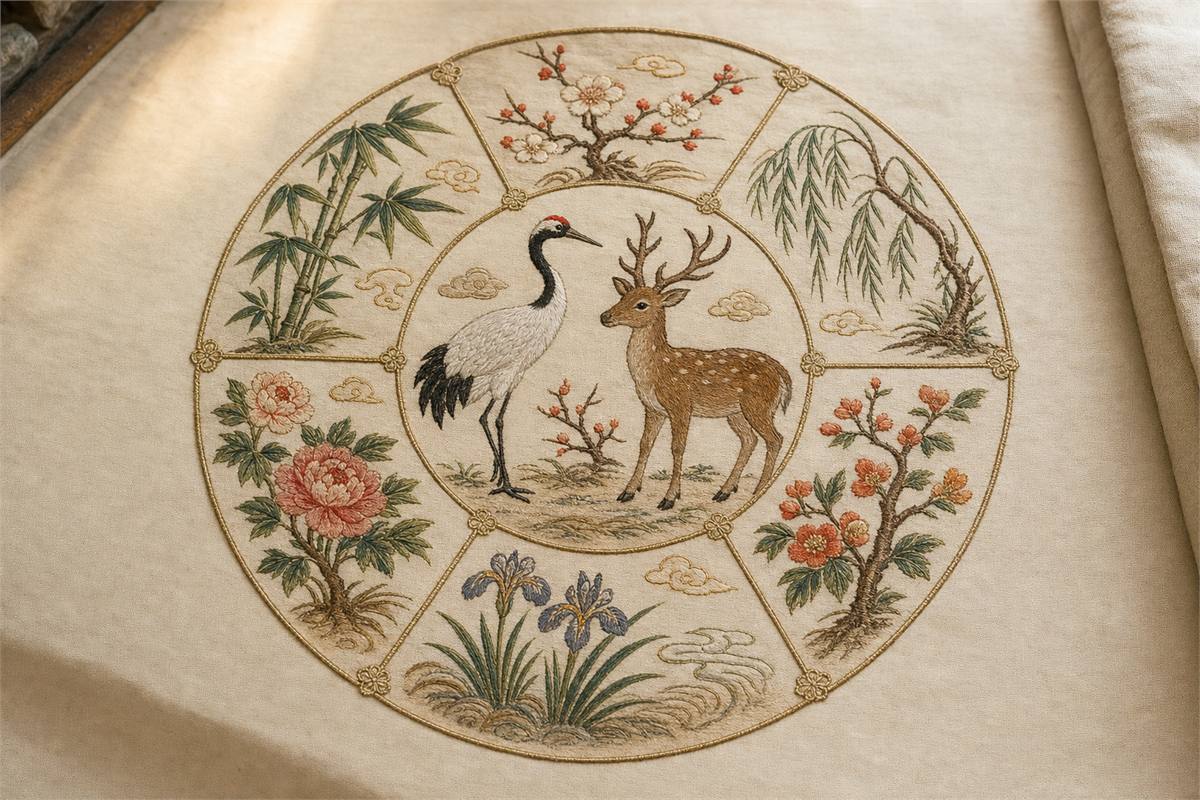
This evidence supports a historical connection between the two names. It does not prove that the rebus was the earliest origin of every crane-deer image, that every period used the same explanation, or that any two animals in one landscape necessarily proclaim peace under heaven. When an object record simply calls a scene “crane and deer,” that description should not be silently replaced with a more ambitious cosmic meaning.
How to recognize a typical crane-and-deer composition
The most secure clue is the presence of both animals. A crane should have a long neck, straight pointed bill, long legs, and a recognizably birdlike body. A deer should show a plausible cervid body, cloven hooves, and—when the animal is male or the design calls for it—antlers that grow from the skull rather than decorative branches floating above it.

- Core pair: one or more cranes and deer sharing the same pictorial space.
- Setting: pine, bamboo, plum, flowering plants, water, rocks, clouds, or open landscape may create seasonal and auspicious atmosphere.
- Long-life accents: lingzhi, peaches, the Shou (寿) character, immortals, or evergreen trees can strengthen a birthday reading.
- Spring cues: blossom, fresh foliage, flowing water, or the object’s recorded title may supply the Chun layer.
- Inscriptions and records: an original label, poem, reign mark, excavation context, or reliable collection record can narrow the meaning more securely than appearance alone.
No auxiliary element is compulsory. Pine is common but does not literally equal spring; a crane and deer can appear without a phoenix tree; and lingzhi may reinforce longevity without being part of the name. The composition also does not require the animals to be a real-world pair. They are assembled through the visual language of art, not zoological companionship.

What the crane, deer, and supporting elements mean
Crane: longevity, immortals, and refined bearing
Cranes have long appeared in literature, religious imagery, painting, textiles, and decorative art. In later auspicious design they are strongly associated with longevity and with Daoist immortals, who may travel by crane. Their pale plumage, tall stance, and measured movement also encouraged readings of age, dignity, and refinement.
Traditional claims that a crane lives for a thousand years belong to poetic and legendary culture, not natural history. In an artwork they help explain why the bird became a long-life emblem; they do not turn a crane object into a promise of health.

Deer: Lu wordplay, immortal landscapes, and long life
Deer entered several overlapping traditions. They could inhabit mountain or immortal realms, accompany the longevity deity Shouxing, carry lingzhi, or contribute the homophone between deer Lu (鹿) and emolument or official stipend Lu (禄). In Ming and Qing auspicious design, that sound relationship made the deer useful in wishes involving livelihood, rank, and material sufficiency.
These layers should not be projected backward onto every ancient deer image. An excavated early deer ornament may have had a different function and context from a later rebus. For the broader animal history, see the deer meaning in Chinese culture guide; for broader material and symbolic context, see the jade meaning in Chinese culture guide.
Pine, bamboo, plum, lingzhi, clouds, flowers, and rocks
| Supporting element | Common role | Important limit |
|---|---|---|
| Pine | Evergreen endurance and longevity | It is not proof that the scene is He Lu Tong Chun |
| Bamboo and plum | Integrity, resilience, seasonal change; with pine, the Three Friends of Winter | Their meaning depends on the full composition |
| Lingzhi | Auspicious and long-life associations | It need not appear in every crane-deer design |
| Clouds | Celestial or auspicious atmosphere | Clouds alone do not identify a named motif |
| Flowers and fresh foliage | Season, renewal, cultivated beauty | Species should not be guessed from stylized carving |
| Rocks and water | Landscape depth, endurance, and an immortal-realm mood | They can be compositional rather than symbolic |
Phoenix tree (wutong), Chinese toon (chun), peaches, and other plants may occur in related works, but none should be declared mandatory through a convenient homophone. The safest interpretation explains visible evidence first and adds wordplay only when the plant can be identified or the title supports it.
History through documented objects, not a single origin story
The crane and deer each have histories far older than the named He Lu Tong Chun motif. What can be dated securely are particular objects and records. Those examples show that the combined theme circulated across courtly, commercial, funerary, and domestic contexts, but they do not form a simple line in which one dynasty invented a finished pattern and every later workshop copied it unchanged.
Ming porcelain and textile evidence
A mid-sixteenth-century Jiajing-period gourd-shaped bottle in the Metropolitan Museum of Art is painted in underglaze cobalt with deer and crane in a landscape. The museum reads both animals as emblems of longevity and identifies pine, bamboo, and plum as the Three Friends of Winter—plants associated with endurance and the approach of spring. The record provides a firm date, material, and composition without requiring a universal title.

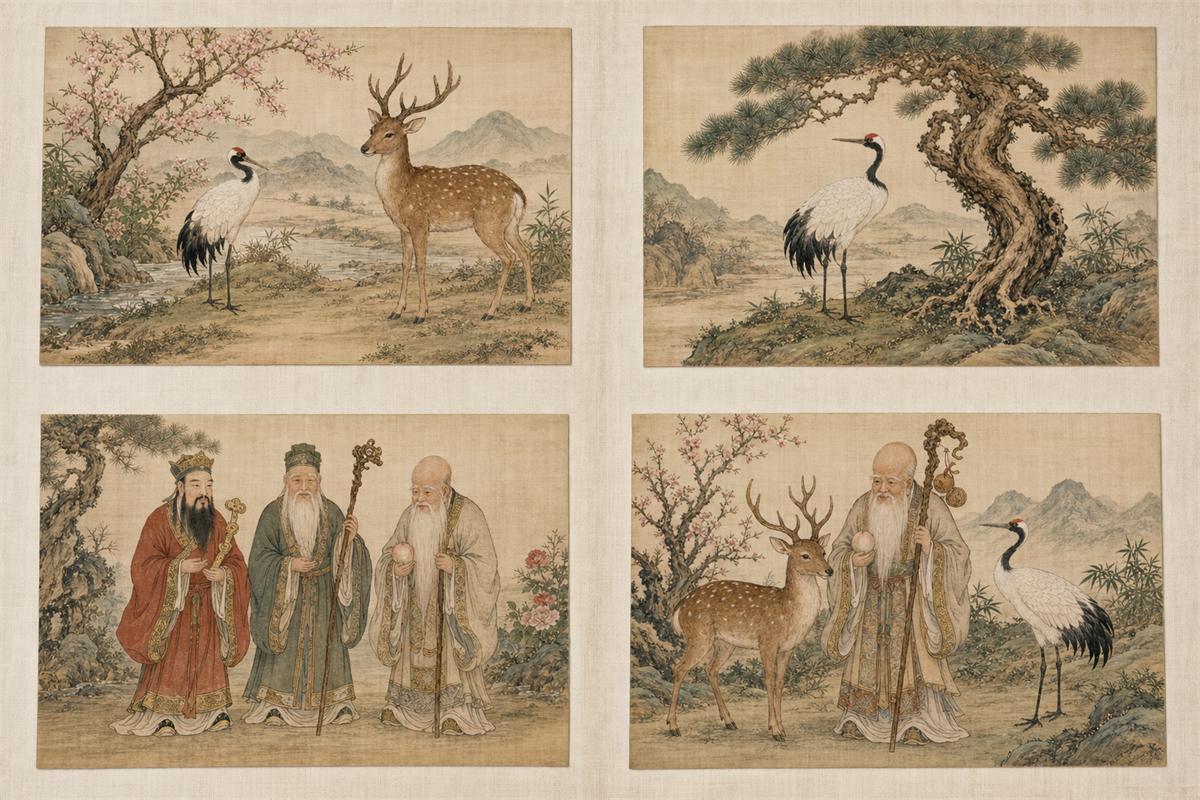
Palace Museum scholarship also records a pair of blue-and-white pine, crane, and deer bottles excavated from a tomb dated to 1624, identifying the scene as He Lu Tong Chun and connecting it with Fu, Lu, and Shou. The Dingling textile study supplies the especially valuable Liu He Tong Chun rebus explanation in a named imperial burial context. Together, these sources confirm late-Ming use while leaving room for other compositions and names.
Qing court and decorative objects
Qing objects demonstrate how widely the theme could travel across materials. The Palace Museum catalogues a carved amber flower holder shaped with pine and bamboo trunks and decorated with crane, deer, lingzhi, and a plum-blossom stand. It also presents a large Qing jadeite mountain carving titled Crane and Deer Together in Spring, with cloud, stream, bridge, landscape, and multiple figures and animals.
A mid-Qing rectangular zitan box in the Palace Museum’s digital collection is likewise titled for a deer-and-crane-together-in-spring scene. Such records show the label functioning in courtly decorative art, yet they also reveal different layouts: flower vessel, mountain carving, and inlaid box are not one fixed composition.

Wood and brick carving, embroidery, brocade, folk prints, paper cutting, lacquer, metalwork, and modern printing can all carry the pair. Unless a particular object has a reliable public record, it is better to describe these as media in which auspicious animal scenes are made than to invent a precise dynasty, workshop, heritage status, or “imperial pinnacle.”
How He Lu Tong Chun differs from nearby auspicious motifs
| Motif | Main visual clue | Primary interpretive center |
|---|---|---|
| He Lu / Lu He Tong Chun | Crane and deer, often in a flourishing landscape | Combined spring, longevity, and later rebus readings |
| Liu He Tong Chun | May use crane and deer as a rebus, but title or context matters | Spring throughout the six directions or the world |
| Song He Yan Nian | Pine and crane | Longevity and endurance |
| Fu Lu Shou | Three star gods or corresponding symbols | Blessing, emolument/prosperity, and longevity as a triad |
| Shouxing with deer or crane | Longevity deity with animal attendants | Immortal and birthday imagery |
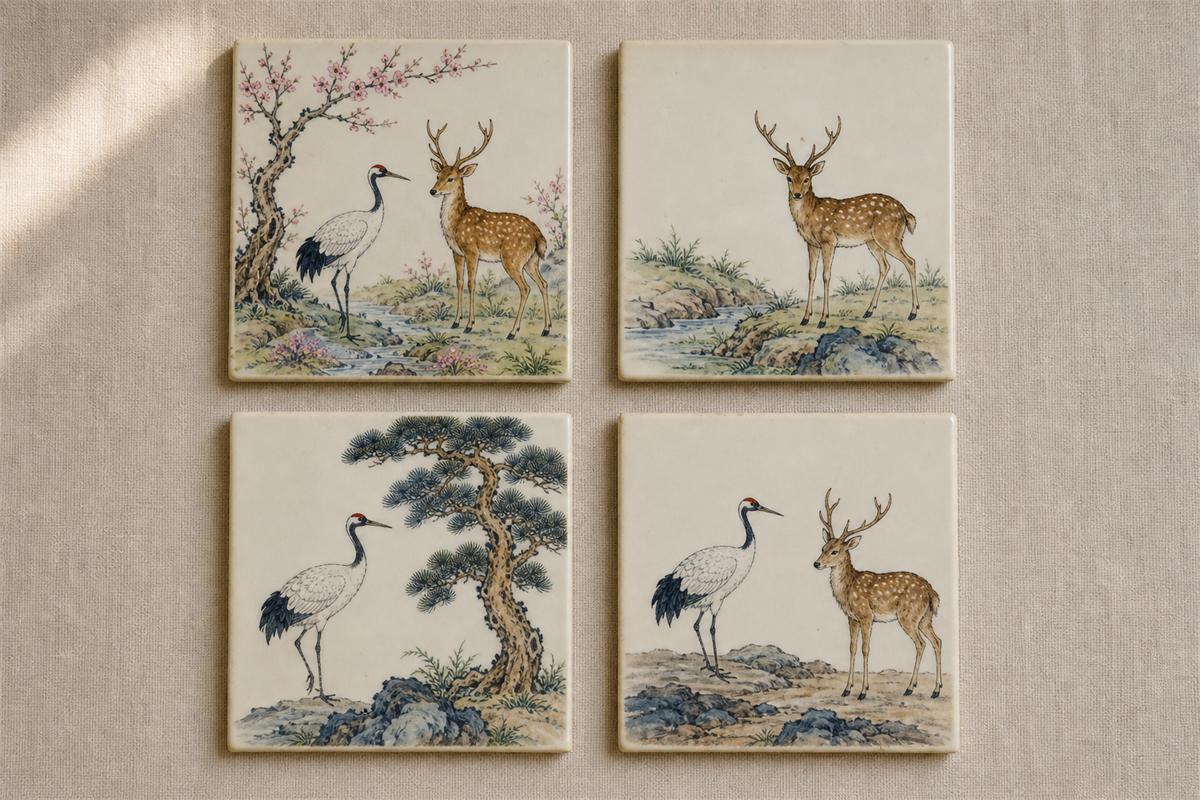
| Crane-deer-pine landscape | Animals and pine without a secure named title | Describe the visible scene before assigning a formula |
Names can overlap in commerce, and museum titles may change as cataloguing research develops. That is not a defect. It is a reason to preserve the recorded title and then explain alternative modern search terms, rather than claiming that all labels have always meant exactly the same thing.
How the motif changes by material and craft
Porcelain: underglaze blue, overglaze enamels, and full landscapes
Porcelain offers a broad curved surface for narrative landscape. Blue-and-white decoration is painted in cobalt beneath a clear glaze; famille rose and related enamel palettes are fired over the glaze. Assess the drawing, color boundaries, glaze condition, balance around the vessel, and whether cranes, deer, rocks, and vegetation remain legible as the scene turns. Do not use one color or decorative technique alone to assign date, kiln, or value.

Jade and other carving stones
“Jade” should not collapse every green or pale carving into one quality system. Nephrite and jadeite are distinct gem materials; Xiuyan jade is often serpentine, although material use and terminology around Xiuyan can be complex. Nephrite may favor compact, tough carving and a subdued surface; jadeite can offer stronger color contrasts and translucency; serpentine may require different expectations for hardness and wear.

Judge the actual material disclosure, structure, finish, and intended use. Natural color zoning can help a carver separate bird, animal, cloud, and foliage, but a clever-color composition is not automatically older, rarer, or more valuable. Inspect antlers, crane legs and bills, narrow openwork bridges, drill holes, sharp edges, surface-reaching fissures, repairs, balance, and the stability of any stand or setting.
Wood, brick, lacquer, textile, paper, and metal
Wood and brick depend on relief depth, grain or aggregate, joinery, vulnerable projections, and the relationship between design and architecture. Lacquer requires attention to the coating system and edge wear. Embroidery and brocade build the scene through stitch, weave, metallic thread, or repeating units; paper cutting translates antlers and legs into connected silhouettes that must remain structurally sound.

In gold, silver, or base metal, the image may be cast, chased, engraved, pierced, filigreed, or assembled from several parts. Terms such as “ancient-method gold,” filigree, or chisel carving describe approaches or marketing categories, not an automatic standard of quality. Look at wall thickness, seams, solder, snag points, clasp strength, comfort, and whether the tiny animals can still be identified.
How to appreciate or choose a He Lu Tong Chun object
- Confirm the image. Can you clearly identify both crane and deer? Is the title supported by the scene?
- Read the composition. Follow foreground, middle ground, and background. Good layouts allow the animals to interact without merging legs, antlers, branches, and clouds into confusion.
- Check anatomy and movement. Stylization is expected, but bills, feet, joints, hooves, and antlers should feel intentional and structurally plausible.
- Match standards to the medium. Glaze, stitch, carved relief, pierced metal, and printed color require different inspection criteria.
- Ask for exact material information. Nephrite, jadeite, serpentine, wood species, ceramic body, metal fineness, coatings, and textile fibers affect use and care.
- Examine condition. Look for cracks, filled losses, loose settings, pulled threads, glaze wear, sharp edges, unstable bases, and vulnerable openwork.
- Check size and weight. A pendant must hang comfortably; a bracelet should not snag; a display carving needs a stable footprint and suitable shelf depth.
- Evaluate meaning after object quality. A beautiful subject does not compensate for unclear carving, unsafe edges, weak construction, or poor material description.
No single color, motif, polish, “skin,” firing effect, or handwork label can determine age, origin, quality, or market value. Comparison works best when the material, object type, scale, condition, and workmanship are alike.

Gift, home, and jewelry use without outcome promises
He Lu Tong Chun can express a cultural wish for a long, flourishing, and well-supported life. That makes it warm for birthdays, anniversaries, retirement, a new home, or a family display—but the recipient’s taste matters more than a rigid rule based on age, gender, or occupation.

For jewelry, choose a scale that keeps the animals readable and a profile that will not catch on clothing. Quiet jade, engraved metal, or a small textile accessory can work with contemporary clothing without requiring ceremonial styling. For home use, consider sightline, lighting, humidity, and the stability of the base. A cultural blessing is a message carried by the object, not a guarantee of health, promotion, wealth, marriage, descendants, or changed fortune.
If the motif and occasion fit, readers can browse the Eastern Story Blessing collection for symbolic gifts chosen by meaning and practical use.
Care by material
- Jadeite and nephrite: use a soft cloth or warm mild soapy water, rinse carefully, and dry. Avoid hard knocks, harsh chemicals, and uncertain ultrasonic or steam cleaning when treatments or settings are unknown.
- Serpentine and softer carving stones: avoid abrasion, impact, strong heat, and chemical exposure; store separately from harder jewelry.
- Porcelain: lift by the body rather than the rim, handles, or projecting animals. Protect enamel and gilding from abrasive cleaning.
- Wood and lacquer: keep away from rapid humidity changes, direct heat, prolonged sun, and wet wiping.
- Textiles and paper: limit strong light, dust gently, avoid damp walls, and support fragile pieces without straining stitches or cut-paper bridges.
- Metal jewelry: wipe after wear, keep clasps and fine projections free of fibers, and store pieces so crane legs, antlers, or filigree cannot snag.
For broader routines across jewelry and carved objects, use the Eastern Story care guide.

Common myths and reading mistakes
- “Every crane and deer image is Liu He Tong Chun.” The rebus is documented, but object title and context still matter.
- “The motif began in one named dynasty and then stayed fixed.” Secure examples can be dated; a universal single-origin story cannot be assumed.
- “Pine, wutong, toon, lingzhi, and clouds are all required.” They are optional supporting elements with different roles.
- “Crane and deer form a natural animal pair or a fixed yin-yang couple.” Their partnership is iconographic, not a zoological or universal cosmological rule.
- “A crane lives a thousand years, so the object improves longevity.” Thousand-year language is traditional lore, not biology or a product effect.
- “A green carving should be judged by jadeite standards.” Nephrite, jadeite, serpentine, and other stones differ.
- “A traditional technique or auspicious subject proves high quality.” Craftsmanship, construction, material, condition, and usability must still be assessed.
The often-repeated attribution “Emperor Huizong’s He Lu Tong Chun painting” is not used here because no reliable public museum or scholarly record was found to establish that title and authorship. The same caution applies to impressive vessel names, auction superlatives, and exact dynasty claims that circulate without a stable collection record.
Frequently Asked Questions
Related Posts


One Comment