
Gray moonstone is a twilight-colored feldspar jewelry name, not one guaranteed mineral identity. A piece may be moonstone with a soft, floating adularescence, gray labradorite with a more directional color flash, or another feldspar sold under a poetic market name. That ambiguity is worth clarifying, yet it need not take away the attraction: gray moonstone is chosen for the way quiet gray can suddenly hold light—a natural image of change, reflection, and a new beginning becoming visible.

In contemporary crystal and jewelry culture, its dusk-like palette carries wishes for calm attention, gentle strength, and steadiness through life’s in-between moments. It can mark a move, a graduation, a changed relationship, a creative return, or any season in which the next path is still taking shape.
What does “gray moonstone” actually mean?
The name describes a visual and commercial category more reliably than a single species. In Chinese-language retail, gray moonstone may be called hui yue guang shi (灰月光石), literally “gray moonlight stone.” The phrase evokes its color beautifully, but it does not by itself tell you whether the gem is alkali-feldspar moonstone, labradorite, peristerite, or another related feldspar.

Moonstone and labradorite both belong to the feldspar family. Moonstone is valued for adularescence, a soft light that seems to billow beneath the surface. Labradorite is known for labradorescence, often seen as a more directional sheet or flash of blue, green, gold, violet, or several colors. Some feldspars sit close enough in appearance that a photograph or color name cannot settle the identity.

| Jewelry name | What it may describe | Typical visual impression | Question to ask |
|---|---|---|---|
| Gray moonstone | An ambiguous market name for gray-bodied feldspar | Silver, white, blue, or occasionally multicolor moving light | Which feldspar does the seller mean? |
| Moonstone | Moonstone material showing adularescence | A soft, floating white-to-blue glow | How does the glow move across this exact piece? |
| Gray labradorite | Labradorite with a gray-to-dark body | A stronger, directional colored flash | Is it disclosed as labradorite? |
| Rainbow moonstone | A trade name commonly used for transparent to translucent labradorite | Blue or multicolored iridescent light | Is the labradorite identity clearly stated? |
Neither identity is a lesser or “inauthentic” member of the feldspar family. Precision simply lets the object’s real material and its story support one another.
The light inside gray feldspar: glow, flash, eye, star, and sparkle
Light effects are easiest to understand when each is given its own name. Adularescence is the drifting, moonlike billow associated with moonstone. Labradorescence is the directional iridescent color seen in labradorite. Chatoyancy forms a narrow cat’s-eye band, while asterism forms a star. Aventurescence is a glittering effect created by many reflective inclusions, familiar in sunstone and aventurine materials. A gray base, blue flash, eye line, star, and glitter are therefore not interchangeable versions of “moonlight effect.”
Turn a piece slowly in ordinary daylight and then under a neutral indoor light. A broad silver mist can be as expressive as a vivid blue flash; one is atmospheric, the other dramatic. The “best” effect is the one that suits the design and still appears through a useful range of angles when the jewelry is actually worn.
Gray moonstone meaning: a piece of dusk to carry forward
Gray moonstone meaning grows naturally from dusk. Gray sits between black and white; its hidden light appears through movement; the stone can seem quiet from one angle and luminous from another. In modern crystal and jewelry culture, these qualities make it a companion for transition, inward listening, patience, and a gentle form of courage.

- Transition: a wish to move with grace between an ending and a beginning.
- Inner clarity: a reminder to pause, look again, and let understanding arrive in its own time.
- Gentle strength: softness that remains steady rather than fragile.
- Relationship and companionship: a quiet promise to meet change with care, honesty, and room for one another.
- New beginnings: the hope that even an uncertain horizon can hold the first light of what comes next.
Some people wear it during journaling, meditation, or a private intention-setting ritual. Others simply let the changing sheen become a tactile reminder: “Trust what becomes visible with time.” As a gift, it can say “I am with you through this change” without needing a long explanation. That makes it especially resonant for a move, graduation, farewell, reconciliation, creative renewal, or a fresh chapter chosen for oneself.
A wish such as ping an ru yi (平安如意)—peace and the fulfillment of one’s hopes—fits the stone’s quiet character. The jewelry serves as a medium through which people hope to welcome steadiness, harmony, and a beautiful unfolding of the next season.
Gray, white, peach, and rainbow moonstone: four different moods
Color names are useful for choosing an atmosphere, but they are not a complete mineral identification or a universal grading system.

| Market variety | Visual mood | Meaning often chosen today | Material question |
|---|---|---|---|
| Gray moonstone | Smoky dusk with silver or blue movement | Transition, reflection, quiet resolve | Moonstone, labradorite, peristerite, or another feldspar? |
| White moonstone | Milky or clear body with a pale glow | Renewal, openness, a fresh page | How is the adularescence oriented? |
| Peach moonstone | Warm peach-to-cream body and soft sheen | Warmth, creativity, affectionate care | What creates the color, and is any treatment disclosed? |
| Rainbow moonstone | Pale body with blue or multicolor iridescence | Imagination, change, luminous possibility | Is it accurately disclosed as labradorite? |
Choose among them by the light and emotional tone you want to live with, not by a rule that one color is more advanced, spiritual, or valuable than another.
How to judge quality without turning beauty into a formula
Retail phrases such as “glass body,” “icy,” “cream body,” “mist body,” “live light,” “full flash,” “7A,” “collector grade,” and “graduation grade” are market language, not one international feldspar grading scale. They can describe a seller’s aesthetic categories, but they should not replace a clear description of the exact piece.
Look at movement, not one perfect photograph
Ask for a slow, uncut rotation video in neutral light. Notice where the glow or flash begins, how far it travels, which angles reveal it, and whether neighboring beads in a strand feel harmonious. A narrow electric flash may suit a small pendant; a broad silver billow may create a more tranquil bracelet. Coverage and intensity matter, but “more” is not automatically “better.”

Let body color and transparency support the design
Gray feldspar can range from pale smoke to charcoal and from translucent to opaque. Transparency can reveal internal light, while a darker body can create contrast. Clouds, inclusions, and color zoning may add visual depth; their identity should not be guessed from a photo. Evaluate whether they interrupt the face, gather near a drill hole, reach the surface, or simply become part of the stone’s landscape.

Check cut, fractures, drilling, and setting
Cabochons and rounded beads are often oriented to reveal shifting light. Inspect polish, symmetry, edge chips, surface-reaching fractures, and the relationship between the optical effect and the chosen face. On bead jewelry, check drill-hole edges, matching, cord tension, knots, spacers, clasp, and plating. On mounted jewelry, look at prongs, bezel pressure, glue, backing, and whether exposed edges are protected. Hardness of about 6–6.5 on the Mohs scale does not make feldspar resistant to every knock; cleavage and finished construction matter too.

Jewelry forms: choose how you want the twilight to move
A pendant gives one cabochon room to hold a wide field of gray and light. Earrings create small flashes as the head moves. A bracelet turns many bead faces through changing angles, so its beauty comes from rhythm as much as any single “perfect” bead. A ring keeps the stone in view throughout the day, while also placing it closest to desks, doors, and other hard surfaces; a low, protective setting suits mindful everyday wear.

Metal choice is an artistic decision, not a rule for maximizing the phenomenon. Sterling silver and white gold can echo cool gray; yellow or rose gold can warm it; gold-plated components introduce a different finish and care profile. Confirm whether a listing means 925 sterling silver, platinum, white gold, solid 18K gold, or gold plate rather than treating these as interchangeable.
For a beaded piece, choose bead diameter and bracelet fit by comfort, movement, and how much contact the strand will meet. Eastern Story’s crystal bracelet size guide offers a measuring path without assigning styles by gender, age, skin tone, or occupation.
A calm buying checklist for an ambiguous trade name
- Ask what material the seller means by “gray moonstone”: moonstone, labradorite, peristerite, or simply gray feldspar.
- Request neutral-light photographs plus a slow rotation video of the exact piece, including the back and sides.
- Ask whether the stone has dye, coating, filling, backing, glue, assembly, or another disclosed treatment.
- Examine the moving light, body color, transparency, cut, fractures, drill holes, matching, and finished construction together.
- Check the metal or plating description, dimensions, return terms, and whether the photographed item is the one being sold.
- Choose the combination of material, light, craftsmanship, and feeling that you genuinely want to carry.
Natural light, a neutral lamp, magnification, and video are useful ways to appreciate and compare a piece, but no single bubble, cool touch, weight, inclusion, flash angle, or phone-light reaction can establish natural origin, treatment, or value. Avoid scratch tests, blades, fire, hot needles, acid, alcohol rubbing, soaking experiments, or attempts to diagnose resin with a home ultraviolet lamp. Eastern Story’s natural versus artificial crystal guide explains why disclosure and several lines of observation work better than one dramatic trick.
How to care for gray moonstone and gray labradorite jewelry
Begin with a clean, soft, lint-free cloth. If the material, treatment, setting, metal, adhesive, and stringing method are all suitable, use a brief gentle clean with lukewarm water and a small amount of mild soap, then dry the entire piece thoroughly. When identity or construction is uncertain, keep the routine dry and conservative.

- Protect feldspar from impact, abrasion, hard neighboring jewelry, and abrupt temperature changes.
- Put jewelry on after perfume, lotion, sunscreen, and hair products have dried; remove it before swimming, household cleaning, or activities likely to strike or snag it.
- Store each piece in a softly lined compartment or individual pouch.
- For bracelets, watch for fraying cord, stretched elastic, damaged drill holes, and loose clasps. For mounted stones, inspect prongs, bezels, bails, glue, and plating when visible wear suggests attention is needed.
- Avoid steam and ultrasonic cleaning when the identity, fractures, treatment, glue, string, or setting is unknown. A jeweler can advise on a specific finished piece.
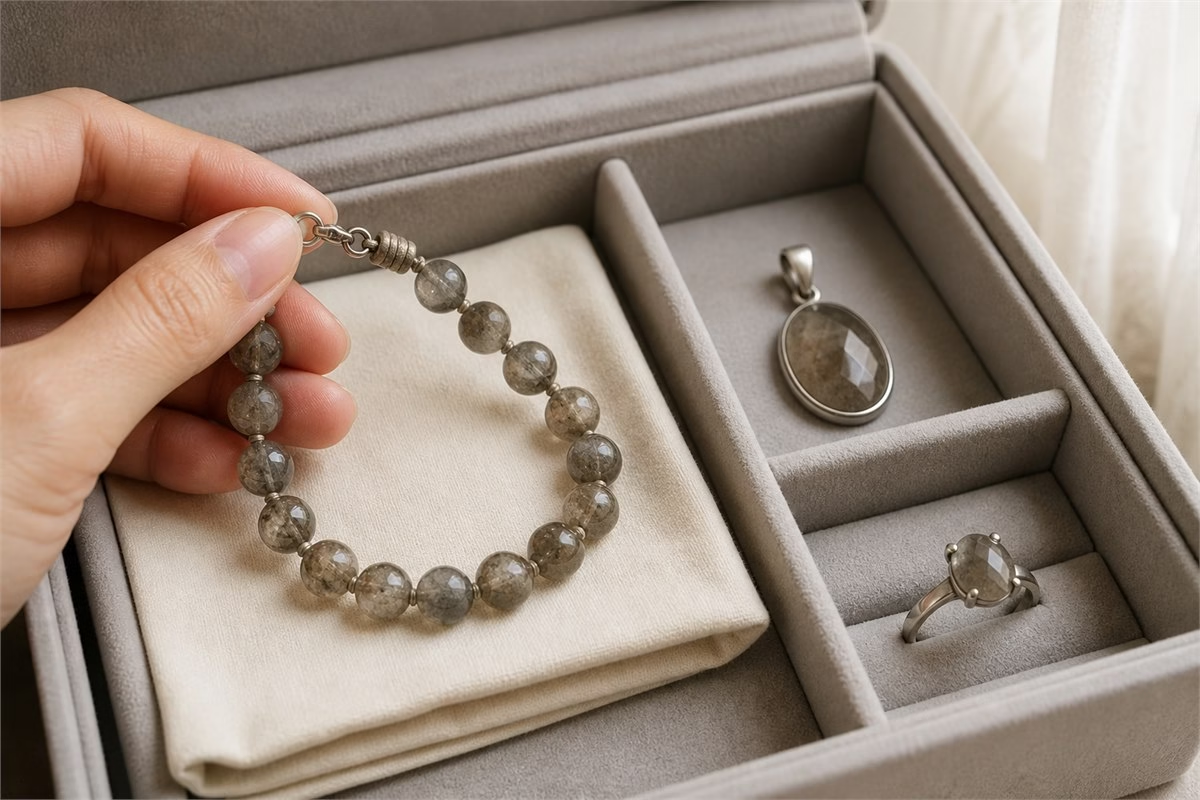
Feldspar does not need “replenishing water” or oil, and hours of soaking add risk for thread, elastic, glue, plating, and fracture-filled material. Moonlight or resting a piece near a crystal cluster may be used as a quiet personal ritual for marking an intention; place the jewelry dry and securely on a soft surface, and keep that meaningful moment separate from physical cleaning. For mixed-material decisions, continue with Eastern Story’s Jewelry Care Guide or the more detailed crystal cleansing guide.
Carry the light that appears between chapters
Gray moonstone does not need a rigid grade or a blurred mineral name to be meaningful. Its strongest story is already visible: a restrained gray field, a light revealed by movement, and a reminder that transition can be both quiet and luminous. Choose it when you want a companion for reflection, a blessing for a new beginning, or a gift that says, “May your next path open with peace, clarity, and gentle strength.”

Explore more materials in Eastern Story’s Material Guide, or browse the Blessing Collection for jewelry chosen to carry hopes for harmony, protection, and fulfillment.
Frequently Asked Questions
Related Posts


