
Yi Zi Sun (宜子孙) is an ancient blessing for descendants, family continuity, and the hope that a household’s goodness will endure. A natural English reading is “may future generations flourish” or “may this remain favorable to descendants.” The longer form, Chang Yi Zi Sun (长宜子孙 / 長宜子孫), adds the sense of lasting through time.

The phrase became especially visible in Han-dynasty material culture, where words were cast, carved, woven, or molded into jade, bronze mirrors, textiles, and architectural tiles. Today it can still speak warmly through a pendant, a family keepsake, or a gift marking a new home, marriage, birth, adoption, reunion, or the passing of a story from one generation to another.
What does Yi Zi Sun (宜子孙) mean?
| Form | Pinyin | Meaning in the phrase |
|---|---|---|
| 宜 | yí | fitting, favorable, beneficial, or conducive to wellbeing |
| 子孙 / 子孫 | zǐsūn | children and grandchildren; more broadly, descendants |
| 宜子孙 / 宜子孫 | yí zǐ sūn | favorable to descendants; a blessing for future generations |
| 长宜子孙 / 長宜子孫 | cháng yí zǐ sūn | may this remain favorable to descendants for a long time |
Yi (宜) gives the blessing its gentle depth. It is not simply a command to have many children. It imagines a condition in which later generations can live well: a settled home, loving relationships, knowledge worth passing on, honorable conduct, material security, and a sense of belonging. Zi Sun (子孙) names descendants, while the traditional form Sun (孫) often appears in historical inscriptions and archaistic designs.

Museums commonly describe the three-character Yi Zi Sun as a compact form related to the four-character Chang Yi Zi Sun. Both belong to the wider world of auspicious character blessings, in which writing is meant to be seen, touched, displayed, carried, and remembered as well as read.
From ancient poetry to Han inscription culture
The wording has an older poetic background, but it is important to separate that background from the later fixed inscription. The Book of Songs includes the line “Yi er zi sun, zhen zhen xi” (宜尔子孙,振振兮) in Zhou Nan · Zhong Si (《诗经·周南·螽斯》), blessing flourishing descendants. Zhou Nan · Tao Yao (《诗经·周南·桃夭》) contains the related household phrase “Yi qi shi jia” (宜其室家), expressing harmony and fitness within the home.

Neither passage needs to be treated as a simple one-line origin story for every later object. They show that the language of yi, family, household, and descendants was already culturally resonant. By the Han period, formulas such as Yi Zi Sun, Chang Yi Zi Sun, Da Yi Zi Sun (大宜子孙), and longer combinations had become an established blessing language on material objects. The text had moved from poetry into everyday sight: a wish could circle a mirror, crown a jade bi, fill a tile face, or travel across patterned silk.
How Han jade turned a blessing into an image
A jade bi (玉璧) is a round jade form with a central opening. In a chu kuo bi, or projecting jade bi (出廓璧), openwork rises beyond the circle, allowing animals, clouds, and written blessings to become part of the silhouette. If you want to understand the form itself before the inscription, begin with our guide to the jade bi disk and its symbolism.

The Yangzhou “Yi Zi Sun” projecting jade bi
The Eastern Han “Yi Zi Sun” projecting jade bi in the Yangzhou Museum is a small, intricate pendant form. It measures 9 centimeters high, 7 centimeters in diameter, and 0.4 centimeters thick. A phoenix rises beyond the ring, with the character Yi tucked beneath its body. Two curling chi dragons (螭龙) occupy the circular field, and the places where their bodies meet help form the characters Zi and Sun.

This is writing transformed into ornament, a design approach often described as wenzi wenyanghua (文字纹样化). The characters are not added after the composition is complete; they help organize it. The phoenix, paired dragons, open spaces, curved strokes, and circular jade body all guide the eye through one visual sentence. That union of script and image is why the object remains so memorable: the blessing is built into the structure.
The Qingzhou “Yi Zi Sun” projecting jade bi
A different Eastern Han example is held by the Qingzhou Museum. It was excavated in 1982 from an Eastern Han tomb at Majiazhongzi in Tanfang, Qingzhou. This larger projecting bi measures 20.8 centimeters in total height, 15.5 centimeters in diameter, and 2.6 centimeters across the central opening. Its inner zone carries rush-mat pattern and 158 raised bosses; coiling chi patterns fill the outer zone; and an openwork paired-dragon crest frames the three seal-script characters Yi Zi Sun.

The 158 bosses are a real recorded feature, not a numerical code that needs an invented meaning. What matters visually is their disciplined rhythm against the freer movement of the dragons and inscription. The museum object is officially listed as an Eastern Han round projecting “Yi Zi Sun” jade bi and as a first-grade cultural relic. Its scale, layered carving, and readable inscription make it an especially strong example of Han artisans joining auspicious language with jade design.
The Yangzhou and Qingzhou pieces should not be blended into one imaginary masterpiece. One is a compact pendant-like composition with phoenix and double chi imagery; the other is a much larger bi with patterned zones, raised bosses, coiling chi, and a paired-dragon crest. Together they show how flexible the same blessing could be.
Where else does Chang Yi Zi Sun appear?
Bronze mirrors
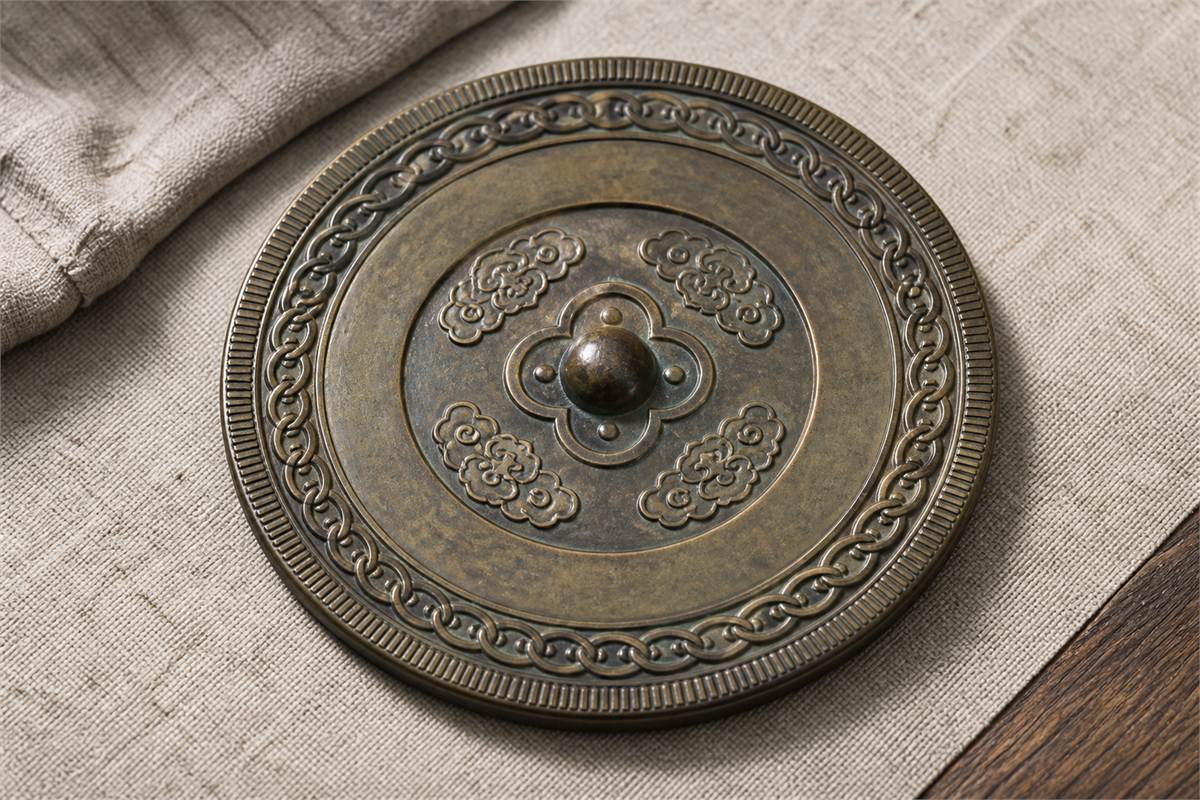
On Han bronze mirrors, Chang Yi Zi Sun often appears in seal-script relief around the central knob or within an inscription band. A documented Han example known as a “Chang Yi Zi Sun” linked-arc mirror is 16 centimeters in diameter and 0.5 centimeters thick, with a hemispherical knob, a four-petal knob seat, the four-character inscription, comb-like borders, and cloud patterns. Here the blessing accompanied a personal object used in daily life and also placed in tombs.
Tiles, textiles, seals, and small objects
Han architectural tiles used related formulas including Chang Yi Zi Sun and Da Yi Zi Sun, bringing a wish for enduring family wellbeing into the built environment. Longer blessing inscriptions also appear on Han and Han-related textiles, where words such as longevity, ten thousand years, noble households, and descendants could be woven into patterned bands.

Auspicious wording also belonged to the world of seals and portable objects. A seal presents the blessing as a repeatable impression; a mirror arranges it around a center; a tile makes the characters architectural; and a jade ornament turns them into openwork. These forms should be recognized as different object types with different structures and uses, even when they share a blessing vocabulary.
What the blessing carries beyond literal descendants
In its historical setting, Yi Zi Sun reflects the importance of family continuity. Yet continuity was never made of lineage alone. A family passed forward names, rituals, land, skills, learning, responsibilities, memories, and objects. The phrase can therefore carry a generous wish: may what is loving, honorable, and sustaining in this household remain available to those who come after.
That reading makes room for many kinds of family. Descendants may be biological or adopted; a household may be blended; a craft tradition may pass from teacher to student; a chosen family may preserve stories with the same devotion as relatives. Yi Zi Sun can welcome a new generation without turning fertility or family size into a demand. Its emotional center is care extended through time.

Objects help that care become tangible. A pendant worn close to the body can be a quiet companion. A jade bi displayed at home can hold the memory of a family milestone. A seal or small desk object can keep the blessing near work, writing, and study. They express a wish—a medium through which people hope to bring about wealth, health, virtue, longevity, or a specific outcome in life.
How to read a modern Yi Zi Sun pendant or gift
- Find the intended top. A cord hole, bail, crest, bird, or central axis usually shows how the design should be viewed.
- Look for three or four characters. The compact form is 宜子孙 or 宜子孫; the longer form is 长宜子孙 or 長宜子孫.
- Expect stylization. Seal-script curves may merge with dragons, phoenixes, clouds, or openwork bridges. A maker’s character diagram can help when the design is highly abstract.
- Read the object and inscription together. A projecting bi, plaque, mirror-inspired charm, and seal-shaped pendant each give the words a different visual voice.
- Keep material descriptions specific to the piece. Color, dark markings, surface sheen, or patina do not establish a mine source, age, authenticity, or value.
For a wider visual vocabulary, the jade carving patterns guide explains how dragons, phoenixes, clouds, openwork, relief, and inscriptions can share one composition. The goal is not to force every curve into a hidden omen, but to see how form and wording reinforce the same family wish.

When Yi Zi Sun makes a meaningful gift
- A wedding or partnership: a wish for a harmonious household and a story built together over time.
- A birth, adoption, or naming celebration: a welcome centered on belonging, care, and the future.
- A housewarming: a blessing for a home where relationships, memories, and hospitality can grow.
- A reunion or anniversary: a way to honor what has endured and what the family hopes to carry forward.
- A succession or apprenticeship: a thoughtful marker when a craft, family business, or body of knowledge passes to a new keeper.
- An heirloom handover: an object that joins its older story with the next person’s life.
A short note can make the gift more intimate: write the characters, their pronunciation, the occasion, and the wish you hope they will carry. “May the goodness of this home continue through every generation” keeps the spirit of Yi Zi Sun while speaking naturally to a modern recipient. For more objects chosen around wishes and life moments, explore the Eastern Story blessing collection.

Caring for a piece that carries the inscription
Care should follow the actual material, finish, cord, setting, and maker’s instructions. For jade or stone jewelry, use a soft clean cloth, avoid knocks against harder surfaces, and store pieces separately so metal fittings or other jewelry do not scratch them. Keep harsh cleaners, perfume, and household chemicals away from porous stones, plated surfaces, cords, and adhesives. Do not oil every object by default: oil may darken cords, collect dust, affect adhesives, or change the appearance of some surfaces.

If the inscription is part of a family keepsake, preserve its story as carefully as its surface. A simple note with the giver, recipient, date, occasion, known material, and any repairs helps the next keeper understand why the object mattered.
Frequently Asked Questions
Related Posts


