
A Liuli bracelet or bangle (琉璃手链 / 琉璃手镯) is an Eastern glass-art accessory valued for flowing color, soft light, hand-formed bubbles, and blessing symbolism. In Eastern tradition, Liuli (琉璃) is linked with the Buddhist Seven Treasures (佛家七宝), clarity of heart, auspicious protection, inner calm, and refined gift giving. It is not a natural stone. It is handmade glass art shaped by heat, color, time, and craft, which is why a good Liuli bracelet feels like wearable light rather than ordinary glass.
Liuli bracelets carry a gentle “fairy-like” mood and a strong story quality. They can be worn as personal jewelry, styled with modern outfits, or chosen as meaningful gifts for friends, elders, partners, students, and yourself. Their beauty comes from three things working together: Eastern symbolism, handcrafted texture, and the way color changes in sunlight, warm light, and evening light.
This guide explains Liuli bracelet meaning, Liuli bangle meaning, ancient Liuli / Gu Fa Liuli (古法琉璃), Buddhist Seven Treasures (佛家七宝) symbolism, lost-wax casting (脱蜡铸造), incense-ash Liuli (香灰琉璃), color meanings, light effects, styling, gifting, choosing, and care. For readers choosing a blessing-led piece, the Eastern Story Blessing collection is the natural place to continue browsing.
Quick Meaning Map: Color, Symbol, Best Gift Use, Styling Mood

| Liuli color | Eastern symbolic meaning | Best gift use | Styling mood |
|---|---|---|---|
| Red / pink Liuli | Passion, celebration, good fortune, joyful relationship wishes, and festive Ben Ming Nian (本命年) energy | Friends, partners, festive birthdays, New Year gifts | Warm, bright, romantic, celebratory |
| Blue Liuli | Calm, hope, peace, health wishes, and clear emotional steadiness | Elders, colleagues, students, travelers | Cool, clean, oceanic, composed |
| Green Liuli | Vitality, compassion, peace, renewal, and flourishing career wishes | Career changes, founders, friends starting fresh | Soft, fresh, elegant, nature-led |
| White / transparent Liuli | Purity, clear mind, wisdom, happiness, and inner and outer clarity / Nei Wai Ming Che (内外明澈) | Students, minimalists, quiet luxury gifts | Moonlight, icy, refined, luminous |
| Purple Liuli | Nobility, wisdom, confidence, inspiration, and graceful presence | Creative people, partners, milestone gifts | Mysterious, rich, elegant |
| Yellow / amber Liuli | Wealth, auspicious fortune, abundance, and bright prosperity | Business owners, career gifts, housewarming | Golden, vintage, warm, generous |
What Is Liuli (琉璃)? Ancient Glass Art, Buddhist Seven Treasures, and Modern Jewelry
Liuli (琉璃) is an ancient Eastern glass art created by high-temperature firing. Unlike jade, crystal, agate, or other natural stones, Liuli is a human-made art material. Color, bubbles, texture, and translucency are formed through fire, minerals, hand control, and kiln variation. This is why Liuli often looks translucent yet not fully transparent, warm like jade, and alive with moving color.
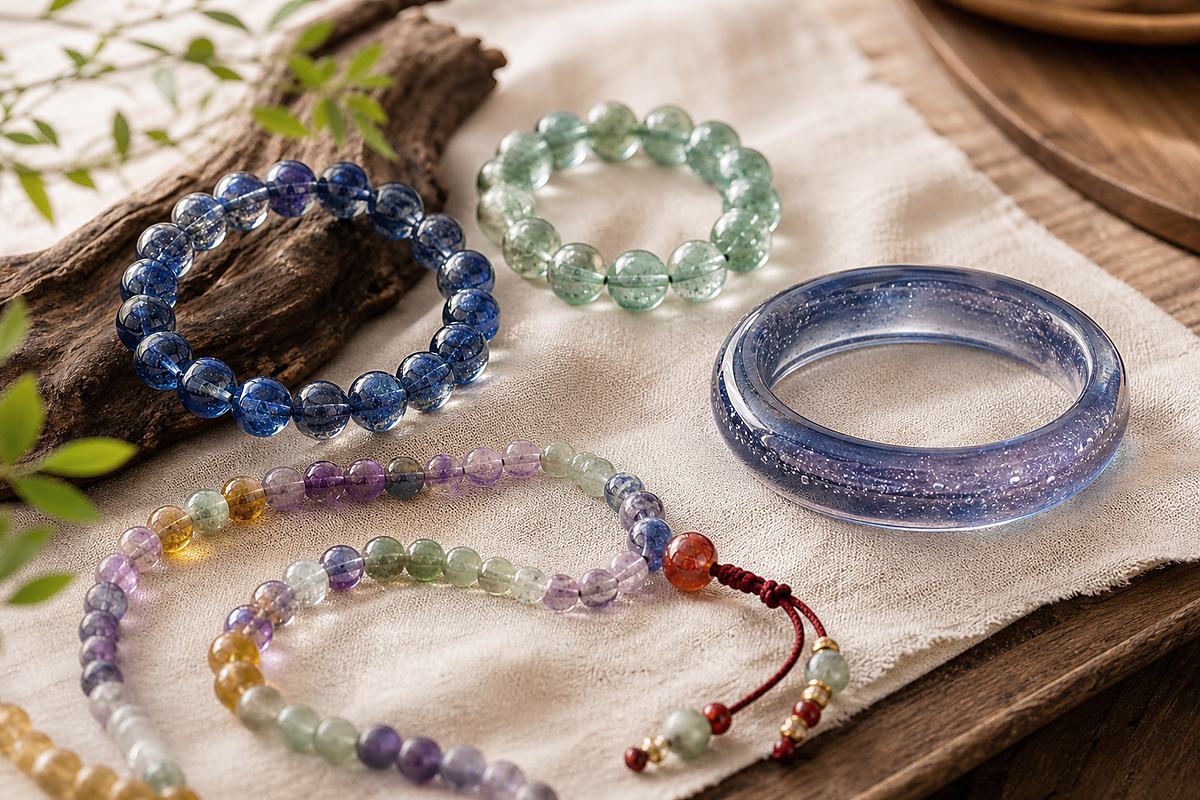
In Eastern tradition, Liuli (琉璃) is counted among the Buddhist Seven Treasures (佛家七宝). It symbolizes clean light, clarity of heart, refined blessing, and the wish to keep the mind bright and unclouded. The phrase inner and outer clarity / Nei Wai Ming Che (内外明澈) gives Liuli its most poetic emotional center: a clear surface, a clear heart, and a life warmed by light.
Historically, Liuli has also been described as one of the Chinese Five Famous Vessels / Zhong Guo Wu Da Ming Qi (中国五大名器), placed beside treasured cultural materials such as gold and silver, jade, ceramics, and bronze in later cultural summaries. Its history can be traced back to the Western Zhou period. During the Warring States period, colored glass was associated with Warring States Five-Colored Stone (五色石). The sword guard of the Sword of Goujian is known for pale blue Liuli inlay, and dragonfly-eye Liuli beads (蜻蜓眼琉璃珠) from the tomb of Marquis Yi of Zeng show how early glass beads reflected exchange, status, and craft.
Classical texts also treated Liuli as precious. The Han-dynasty text Yan Tie Lun (盐铁论) placed jade discs, coral, and Liuli among national treasures. In later imperial periods, especially during the Ming and Qing dynasties, the imperial workshop / Zao Ban Chu (造办处) included Liuli workshops. In 2008, Liuli firing technique was included as national intangible cultural heritage (国家级非物质文化遗产), confirming its place as living craft rather than only antique memory.
Why Liuli Bracelets Feel Special: Flowing Color, Soft Light, Bubbles, and Handcrafted Texture
The charm of a Liuli bracelet (琉璃手链) begins with color that seems to move. Good Liuli does not look flat or printed. Red may melt into amber. Blue may deepen toward the edge. Green may float like mist over clear glass. Purple may show a plum-wine glow under warm light. This flow is created when colored glass materials meet, stretch, and settle at high temperature.

Soft light is the second reason Liuli feels different from ordinary glass. Strong glass can look cold and sharp. Good Liuli reflects in a gentler way, with restrained gloss and internal glow. When light enters the bead or bangle, it bends, scatters, and returns through color layers, bubbles, gold flecks, cat-eye bands, or cloudy gradients.
The third signature is bubbles. In ancient Liuli / Gu Fa Liuli (古法琉璃), natural bubbles are often called Liuli’s breath (琉璃的呼吸). They may be small, large, stretched, clustered, or scattered at random. In sunlight, those bubbles catch tiny points of light like dew or floating foam. Handmade grooves, small black specks, and joint traces can also appear around edges or connection areas; in traditional craft, these marks can belong to the making process rather than to machine-perfect uniformity.
Texture matters too. True Liuli is usually denser and heavier in the hand than ordinary glass or plastic. When gently tapped with care, it can give a clear, lingering stone-and-metal tone. High-quality Liuli is often described as jade-like yet not jade, and in some eyes even warmer than jade because its color feels lit from within.
Craftsmanship: Ancient Liuli, Lost-Wax Casting, One-Mold-One-Piece, and Incense-Ash Liuli
Ancient Liuli / Gu Fa Liuli (古法琉璃) is often associated with lost-wax casting (脱蜡铸造). The process can include making a clay model, forming a silicone negative mold, adding a plaster outer mold, pouring or shaping a wax model, repairing the wax, steaming out the wax to create a cavity, placing Liuli material into the mold, and firing it in a kiln above 1400 degrees Celsius. The full process may involve more than forty handmade steps, and a mistake in heat, timing, mold, or cooling can ruin the piece.
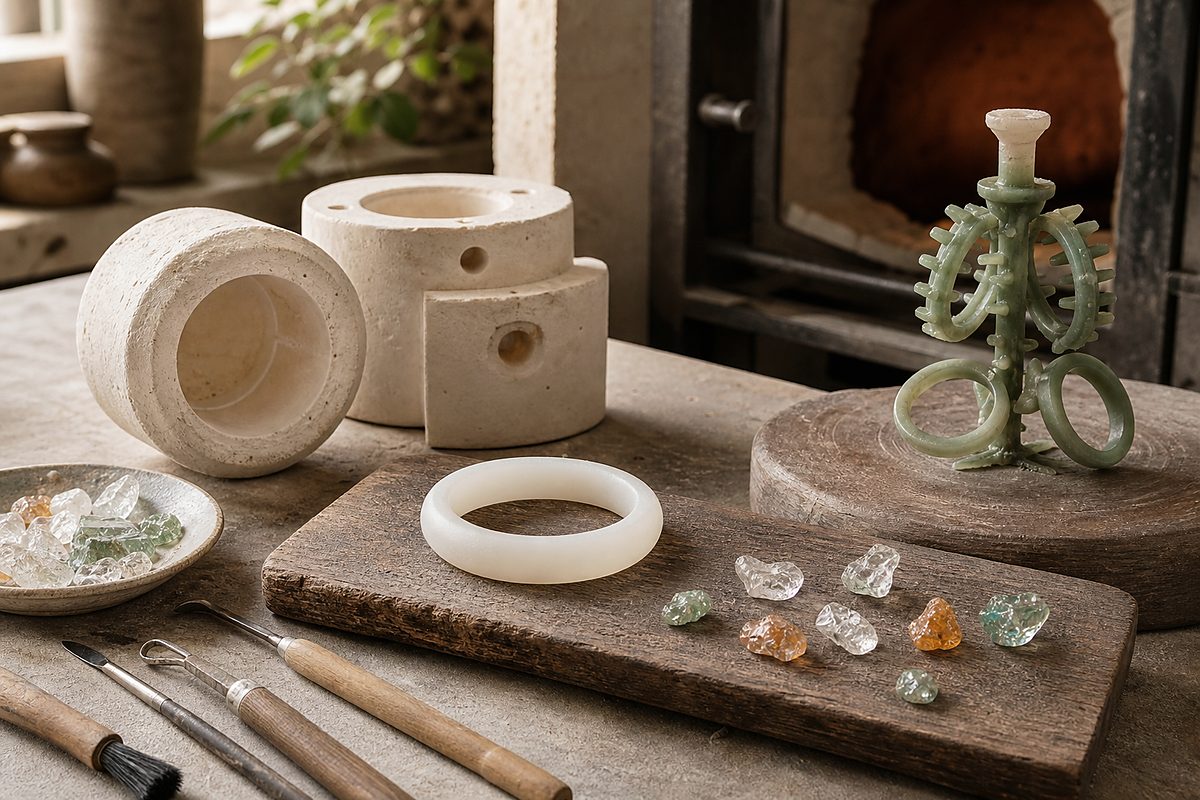
This is where one mold, one piece / Yi Mo Yi Pin (一模一品) becomes important. A mold used for this kind of Liuli casting can only produce one piece and cannot be reused in the same way. Temperature, material ratio, kiln atmosphere, cooling, and hand finishing also introduce randomness. No two Liuli bangles or beads are exactly the same.
Other Liuli methods may include blowing, pulled-flower work, color pouring, and mixed-body texture. Blown Liuli relies on the maker’s timing and breath-like control of molten material. Pulled or poured colors can create flowing lines, misty layers, cloud patterns, or strong color collisions. Mixed-body texture can make the color feel stirred, stretched, or suspended.
Incense-ash Liuli (香灰琉璃) is a modern blessing style that incorporates temple incense ash into the Liuli firing concept. Its emotional appeal comes from remembrance, prayer, and peace. In gift language, incense-ash Liuli (香灰琉璃) is often chosen for wishes of safety, smooth days, and a calm heart.
Color Meanings: Red, Blue, Green, White, Purple, Yellow, and Transparent Liuli
Red Liuli carries enthusiasm, celebration, good luck, and relationship blessing. It suits festive gifting, birthday blessings, and Ben Ming Nian (本命年) styling when the wearer wants a joyful red accent. Pink Liuli softens the same family into friendship, affection, and romantic warmth.
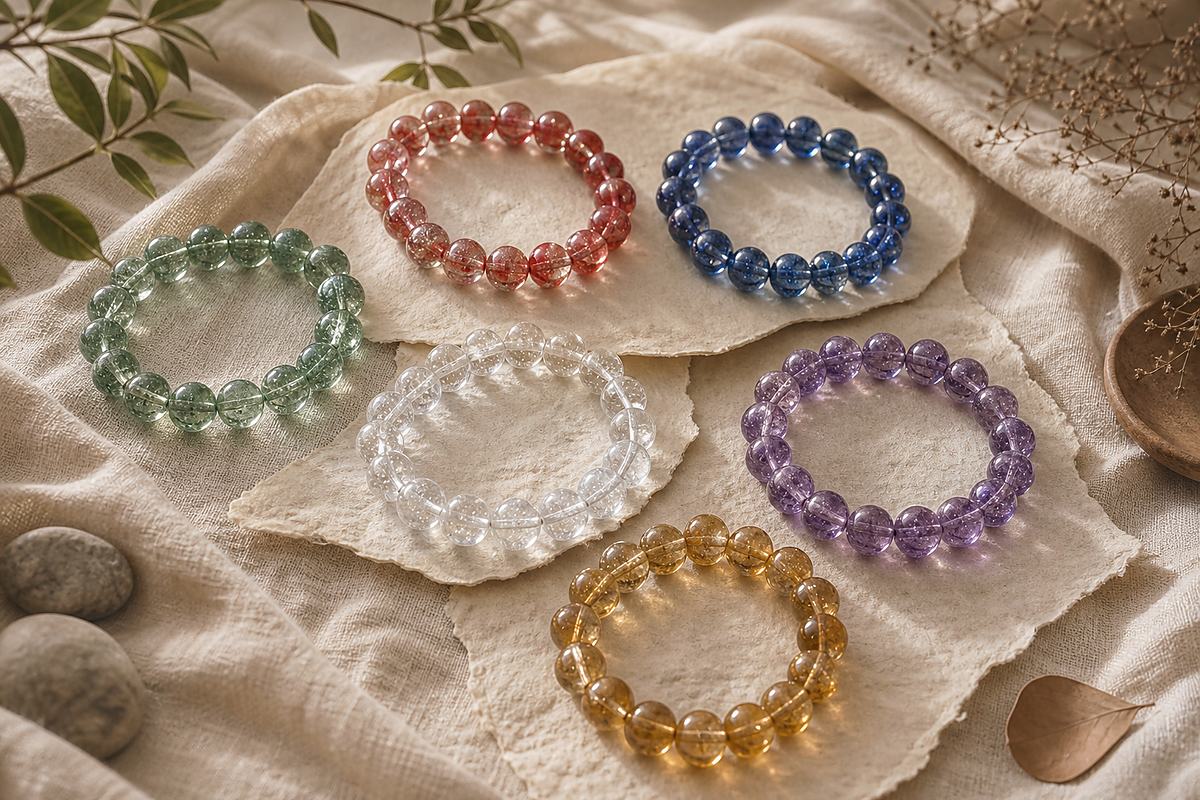
Blue Liuli suggests calm, hope, peace, health wishes, and emotional spaciousness. Deep-sea blue feels quiet and protective; lighter blue feels clean, refreshing, and easy to wear with office or vacation clothing.
Green Liuli symbolizes vitality, compassion, peace, and growth. Misty green, ice-green, and rime-green tones can feel fresh and graceful, especially for career blessings, spring gifts, or new beginnings.
White and transparent Liuli point toward purity, clarity, wisdom, and happiness. Icy white moonlight Liuli is especially useful for modern minimal styling because it gives the wrist light without looking loud.
Purple Liuli represents nobility, wisdom, confidence, and inspiration. A plum-sauce purple or pearl-purple glow can feel mature, creative, and elegant in evening light. Yellow and amber Liuli carry wealth, auspicious fortune, abundance, and golden warmth, making them suitable for business, career, and housewarming gifts.
Light and Color: Refraction, Glow, Cat-Eye Effects, Gold Flecks, and Different Lighting Conditions
Liuli beauty changes with light. In natural light by a window or under the sun, color looks clearest and most truthful. Ice-clear Liuli can show strong water-like depth, while transparent sections reveal bubbles, internal flow, and gentle shadow.

Under warm indoor light or candle-like light, Liuli becomes richer and more vintage. Amber, red, purple, and gold-flecked Liuli can cast soft colored spots and feel more ceremonial. This is why Liuli bangles pair so well with new Chinese style / Xin Zhong Shi (新中式), improved qipao, linen dresses, and evening clothes.
In dim light, transparency drops, but pearl glow, gold flecks, and cat-eye effects can become more noticeable. Cat-eye Liuli catches a narrow moving band of light. Gold-sprinkled Liuli can flash tiny warm points. Incense-ash Liuli (香灰琉璃) often feels especially atmospheric when its darker body catches weak light.
Popular Styles: Ancient Liuli, Incense-Ash Liuli, Ice-Crack/Gradient Liuli, Ethnic Blue-Eye Styles
- Ancient Liuli / Gu Fa Liuli (古法琉璃): heavier color, handmade bubbles, warmer texture, and a deep craft story. It suits Eastern, collector, and quiet luxury styling.
- Incense-ash Liuli (香灰琉璃): a blessing-led style linked with peace, smooth days, and remembrance. It works well as a prayer bracelet or meaningful gift.
- Ice-crack and gradient Liuli: clear, fresh, and youthful, often looking like sunset, starlight, spring mist, or sealed moonlight.
- Blue-eye and ethnic styles: inspired by blue-eye glass traditions, braided cords, leather, and travel jewelry. They feel relaxed, free, and suitable for vacation looks.
- Cat-eye, gold-flecked, white moonlight, plum-purple, and rime-green Liuli: modern jewelry styles that make Liuli easier to match with silver, pearls, chains, and contemporary outfits.
In fashion jewelry history, glass-like materials also appear in high-style European work. The French Gripoix workshop became famous for poured glass used in couture jewelry, often with Byzantine-style settings, camellia forms, grape-cluster shapes, and rich gold-toned bases. For Eastern Story readers, this comparison is useful because it shows that art glass jewelry can be precious through color, handwork, and design language, not only through gemstone rarity.
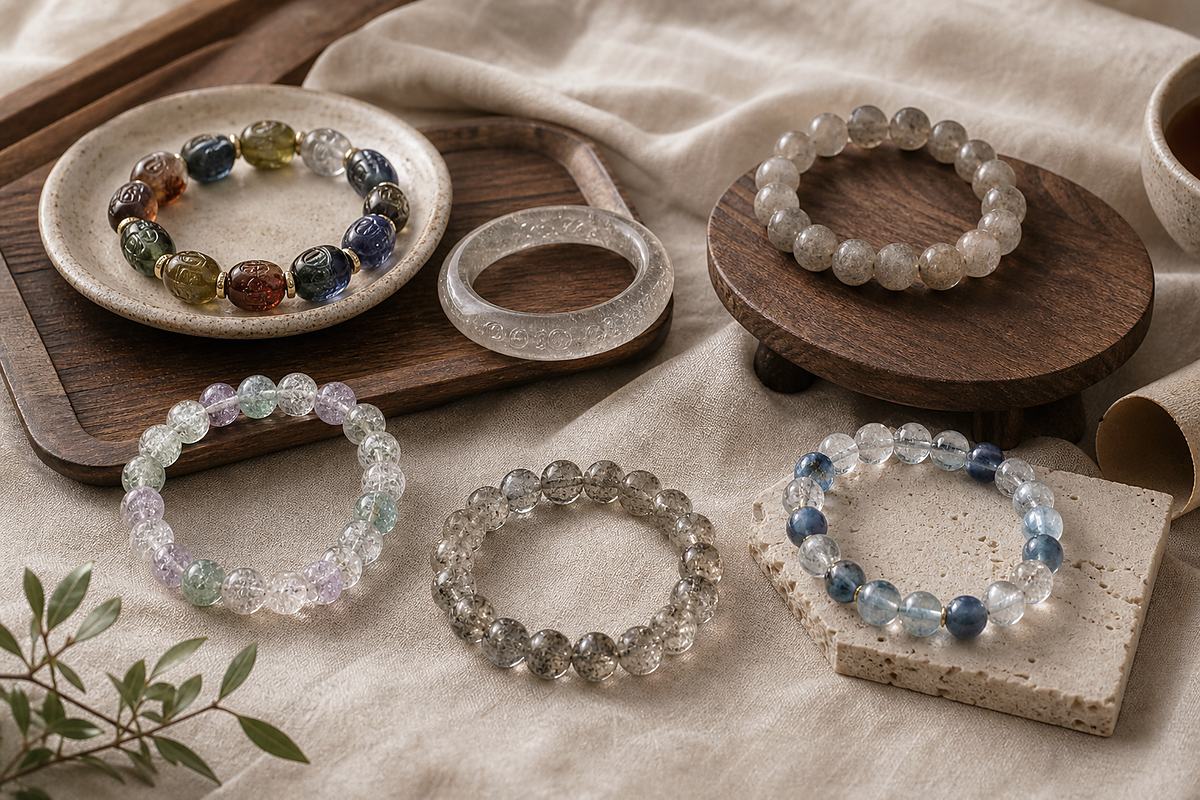
Modern new Chinese style / Xin Zhong Shi (新中式) jewelry often uses Liuli as an innovative material beside jade, silver, butterfly motifs, tassels, pearls, and delicate chains. White moonlight Liuli can echo mutton-fat jade; cat-eye Liuli can echo gemstone light; incense-ash Liuli can bring a quiet blessing mood.
How to Tell Good Liuli from Ordinary Glass or Plastic
| Check | Good Liuli signs | Ordinary glass or plastic warning signs |
|---|---|---|
| Color | Natural flow, layered transitions, soft depth, color that seems to move inside the bead or bangle | Flat color, harsh transitions, overly bright surface color, or painted-looking finish |
| Weight | A denser, heavier hand feel for its size | Light, hollow, or floating feel, especially in plastic copies |
| Bubbles | Irregular, random, sometimes stretched bubbles; Liuli’s breath (琉璃的呼吸) | Perfectly regular round bubbles or no internal life in pieces sold as handmade ancient-style Liuli |
| Sound | A crisp, lingering tone when tapped very gently and safely | Dull plastic sound or thin, sharp glass feel |
| Surface | Soft polish, warm gloss, natural handmade traces in suitable places | Rough grinding, peeling color, sharp seams, or cheap sprayed coating |
Good Liuli should feel intentional. The color should not look dead, the glow should not be harsh, and the surface should not feel cheaply coated. A piece can have bubbles, grooves, specks, or hand traces and still be beautiful when those details match ancient Liuli / Gu Fa Liuli (古法琉璃) craft logic.

For readers comparing meaningful materials, it can help to read Eastern Story's jade meaning guide, jade bracelet meaning guide, and material guide. Liuli is not jade, but both materials carry Eastern ideas of clarity, blessing, touch, and long-term gift value.
How to Wear Liuli Bracelets: New Chinese, Office, Casual, Vacation, and Evening Styling
Liuli is especially strong in new Chinese style / Xin Zhong Shi (新中式). Pair an ancient Liuli bangle with linen, a stand-collar shirt, frog-button blouse, improved qipao, hanfu-inspired layers, or a quiet cotton dress. The bracelet adds cool light and Eastern warmth without making the outfit look costume-like.

For office wear, choose a single-color white moonlight, pale blue, transparent green, or deep-sea blue Liuli bracelet. It works with white shirts, knit tops, structured blazers, and simple trousers. The best office Liuli does not shout; it appears when the wrist moves, catches keyboard light, and adds a refined detail.
For casual summer outfits, Liuli brightens a white T-shirt, denim, floral dress, or simple tank dress. Pink cherry, sea blue, orange-gold, and ice-green styles photograph well because clear color gives a fresh wrist accent. For vacation and evening wear, choose wider bangles, tassel designs, silver details, rich red, peacock blue, plum purple, or gold-flecked Liuli. Under restaurant or hotel lighting, the glass art becomes more luminous.
Skin tone can guide color choice. Yellow undertones or a cool, clean styling goal often suit white moonlight, ice-green, and deep-sea blue. Fair skin or a sweeter mood can wear pink cherry, wine red, and orange-gold beautifully. A wide Liuli bangle is strongest worn alone; a thin strand works better with watches, silver chains, or fine bracelets.
In some Eastern wearing customs, bracelets are often worn on the left hand through the left-in-right-out custom / Zuo Jin You Chu (左进右出), a symbolic way to welcome auspicious energy and release heaviness. In modern styling, choose the wrist that feels comfortable, balanced, and practical for daily movement.
Stacking and Pairing: Liuli with Metal, Wood, Bodhi, Pearl, Silver, and Gold Chains
Liuli stacks best when the materials have different visual temperatures. Liuli with silver feels cool, clean, and modern. Liuli with gold or a fine gold-toned chain feels warm and festive. Liuli with wood, sandalwood, or Bodhi brings a quieter prayer-bead mood, especially for incense-ash Liuli (香灰琉璃) or darker ancient Liuli.

Pearls soften Liuli. A white pearl strand with transparent Liuli feels graceful and gift-ready. A small silver butterfly, star, tassel, or moon charm can make gradient Liuli more youthful. For a stronger fashion look, pair a thick Liuli half-bangle with one fine metal chain, or stack two slim Liuli strands in related colors.
Two to three pieces are usually enough. Control thickness, keep one main color family, and let the shades move from light to dark. Too many large bracelets can hide the color flow that makes Liuli special.
Liuli Bracelet Gift Guide: Friends, Elders, Partners, Yourself, Career, Study, and Blessings
A Liuli bracelet is a strong gift because it combines wearable beauty with blessing language. For a friend, choose colors that match personality: clear blue for calm support, pink or red for warmth, green for renewal, or white moonlight for gentle clarity. The message can be companionship: separate lives, shared light.

For elders or family, blue, green, white, amber, and incense-ash Liuli (香灰琉璃) feel respectful and calm. The gift can carry wishes of peace, warm days, health, and a bright heart. For a partner, red, purple, white moonlight, or a rich gradient bangle can express pure feeling, lasting affection, and protection through daily presence.
For yourself, Liuli can be a self-blessing object: a reminder to stay clear, warm, brave, and graceful through change. For career and business gifts, green and yellow or amber Liuli suggest growth, abundance, and smooth progress. For study gifts, white or transparent Liuli carries wisdom, clarity, and a calm mind before important goals.
Liuli also pairs naturally with other Eastern blessing symbols. Readers who like auspicious jewelry can continue to Eastern Story guides on auspicious characters, including Fu (福), lotus meaning, Pixiu (貔貅), jade carving motifs, including Qilin (麒麟), red string bracelets, white jade bodhi bracelets, and men's lucky bracelets.
Care Tips: Avoid Impact, Chemicals, Heat Shock, and Poor Storage
Liuli is fired at high temperature, but it is still a brittle glass-art material. Avoid hard impact, dropping, knocking against stone counters, or rubbing against harder jewelry. Remove it before heavy housework, gym training, luggage handling, or any activity where the wrist may hit a hard surface.

Avoid perfume, cosmetics, detergents, shower gel, cleaning liquids, and chemical cleaners. Do not wear Liuli while bathing, washing hands for a long time, swimming, or doing dishes. Clean it with a soft cloth and, when needed, mild soap water or purified water. Dry it fully before storage.
Keep Liuli away from heat shock: sudden hot-to-cold or cold-to-hot changes, saunas, high heat, and long direct sun exposure. Store each piece alone in a soft pouch or jewelry box so metal, diamond, or harder stone pieces do not scratch it. For a broader routine, use the Eastern Story care guide.
Blessing Messages for Liuli Bracelet Gift Cards
For a friend: May this wearable moonlight keep your days clear, warm, and bright. May we each shine in our own direction and still meet in the same gentle light.

For an elder: May this Liuli light bring peaceful days, a calm heart, and years that stay gentle and bright.
For a partner: I chose this flowing starlight for your wrist because it feels clear, warm, and lasting, like the way I wish to care for you.
For yourself: May my heart stay like Liuli, clear without losing warmth, bright without losing softness, and brave enough to keep moving forward.
By color: Green Liuli can say, may your work grow like spring branches. Purple Liuli can say, may wisdom and confidence stay with you. White Liuli can say, may your mind stay clear and joyful. Red Liuli can say, may love and celebration fill your days. Blue Liuli can say, may your heart become as wide and calm as sea and sky.
FAQ
Conclusion: Wearable Light, Clear Heart, and Eastern Blessing
Liuli bracelet meaning begins with light. A Liuli bracelet (琉璃手链) or Liuli bangle (琉璃手镯) is beautiful because color flows through it, bubbles breathe inside it, and the surface glows softly instead of shouting. Its cultural power comes from Liuli (琉璃) as Eastern glass art, ancient Liuli / Gu Fa Liuli (古法琉璃), Buddhist Seven Treasures (佛家七宝) symbolism, and the wish for inner and outer clarity / Nei Wai Ming Che (内外明澈).

Choose Liuli by color, craft, comfort, and blessing. Red warms the heart, blue calms it, green renews it, white clears it, purple inspires it, and amber brightens it. Wear it alone, stack it lightly, gift it with a short message, and care for it gently. When the meaning is meant to be worn or given, continue with the Eastern Story Blessing collection, the jade bracelet meaning guide, and the red string bracelet guide.
Related Posts


