What do different jade Buddha colors mean? In Chinese jade (玉) and Buddha-jewelry culture, a green jade Buddha usually suggests vitality, harmony, growth, and wealth symbolism; white suggests purity, peace, restraint, and daily wear; yellow or honey jade suggests dignity, harvest, prosperity, and formal warmth; red, orange, and reddish-brown suggest celebration, vitality, courage, and family blessing; lavender or purple suggests elegance, mystery, and a more modern personal reading; black or very dark jade suggests steadiness, depth, protection symbolism, and mature style; mixed-color or carved-color jade Buddhas add artistic value through contrast and clever use of natural color.
A jade Buddha remains a symbolic object connected with compassion, wisdom, calm, blessing, and cultural memory. Color changes the emotional tone, gift message, styling, and sometimes the gemological value of the carving.
This guide keeps the focus on jade Buddha colors meaning: how different colors are understood, how color affects selection and value, and how to wear or care for a colored jade Buddha respectfully.
Quick Summary: Jade Buddha Color Meanings
| Color or type | Common material examples | Cultural meaning in a jade Buddha | Best use or gift message |
|---|---|---|---|
| Green | Jadeite jade, green nephrite, qing-toned jade | Life, renewal, harmony, balanced growth, wealth symbolism, and the classic look many people expect from jade. | A strong first choice, business gifts, family blessings, and readers who want the most recognizable jade Buddha color. |
| White | White nephrite, mutton-fat Hetian jade (和田玉), white jadeite | Purity, peace, modesty, moral refinement, clean intention, and calm daily companionship. | Daily wear, minimalist jewelry, gentle gifts, and people who prefer understated symbolism. |
| Yellow or honey | Yellow jade, honey jade, yellow jadeite, warm nephrite | Dignity, harvest, prosperity, formal warmth, and stable confidence. | Business settings, elder gifts, formal styling, or anyone who likes warm earth tones. |
| Red, orange, reddish-brown | Red jadeite, red agate, southern red agate, warm brownish jade-like stones | Celebration, vitality, warmth, courage, joy, family affection, and blessing language. | Festive gifts, cheerful personal pieces, and warm-toned styling. |
| Lavender or purple | Lavender jadeite, purple jade, modern lavender-color carvings | Grace, elegance, mystery, tenderness, and personal interpretation. Lavender meanings are often modern rather than fixed ancient tradition. | Modern jewelry, romantic gifts, younger styling, and personal symbolic readings. |
| Black or dark | Black nephrite, ink jade, dark green jadeite, black jade-like materials | Depth, steadiness, maturity, protection symbolism, restraint, and quiet strength. | Mature style, simple menswear or unisex styling, formal looks, and people who prefer low-key jewelry. |
| Mixed color or carved color | Multicolor jadeite, qiaose carving, green-on-white, red-yellow-green combinations | Layered blessing, artistic contrast, individuality, and the carver's skill in using natural color. | Collectors, one-of-one gifts, and readers who value carving design as much as color meaning. |

Do Jade Buddha Colors Change the Meaning?
Yes, but in a layered way. The Buddha figure gives the pendant its main symbolic foundation: compassion, wisdom, calm, generosity, blessing, and inner steadiness. The jade material adds a Chinese cultural language of refinement, endurance, virtue, warmth, and lasting beauty. The color then adds a third layer: green feels alive, white feels pure, yellow feels dignified, red feels celebratory, purple feels graceful, black feels deep, and mixed color feels artistic.

This is why two jade Buddha pendants with the same face and posture can feel different. A pale white jade Buddha may feel quiet and meditative. A vivid green one may feel more auspicious and traditional. A honey-yellow carving may feel warm and formal. A black or ink-dark carving may feel restrained and serious. The figure remains the same, but the color changes the message the wearer notices first.
For Western readers, it helps to separate three levels: material fact, such as jadeite, nephrite, treatment, texture, and color distribution; cultural symbolism, such as purity, blessing, peace, prosperity, or vitality; and personal meaning, such as choosing a pendant because it reminds you to be calm, generous, brave, or grounded.
Why Buddha Jewelry Carries Symbolic Meaning
In Chinese jewelry and gift culture, a Buddha image is not only decoration. It may be worn as a reminder of kindness, patience, wisdom, inner peace, and a generous heart. Many jade Buddha pendants are also linked with the smiling Budai, often called the Laughing Buddha in English. Museum descriptions identify Budai as a tenth-century Chinese monk known for his laughing face and round stomach, later associated with Maitreya, the future Buddha.

That background explains common phrases such as a smiling Buddha representing optimism, an open belly representing tolerance, or the sound of 'fo' and 'fu (福)' being linked in popular blessing language.
Respectful note: Buddha jewelry should be worn thoughtfully and respectfully, especially by readers who treat the image as religious rather than purely decorative. If you wear a jade Buddha as a cultural symbol or personal reminder, keep the tone calm and respectful rather than treating it as a novelty charm.
Green Jade Buddha Meaning
A green jade Buddha is the most familiar choice for many people because green is strongly associated with jadeite in the modern market. Culturally, green suggests life, spring growth, harmony, health blessing, renewal, and the wish for steady prosperity. When the Buddha image is green, the pendant often reads as a symbol of peaceful growth: a calm heart, a generous spirit, and a life that continues to move forward.

The supplied cultural material also mentions green on the belly of a Buddha carving as 'wealth stored in the belly' or a merchant-style interpretation of hidden treasure. This can be kept as a folk and market reading: a green area on the belly may be interpreted as an image of abundance, capacity, or blessing.
Green also affects value because jadeite color is often a major price factor. GIA's jadeite quality guidance emphasizes color, texture, transparency, cut, and matching as important quality considerations. In plain language, a green jade Buddha is more desirable when the color is attractive, the texture is fine, the carving is balanced, and the green is used in a flattering part of the figure. A green patch over the face or eyes may reduce visual appeal, while green placed on the belly, robe, background, or carved accent may become part of the design.
White Jade Buddha Meaning
A white jade Buddha suggests purity, peace, simplicity, and moral refinement. In Chinese jade culture, white nephrite and mutton-fat Hetian jade are often admired for their soft luster and gentle texture rather than bright sparkle. A white Buddha pendant therefore feels restrained, clean, and suitable for daily wear.

White is also a practical color for Western styling because it works with many wardrobes and does not look too ceremonial. It can be a good choice for a first jade Buddha, a quiet gift, or a pendant intended to remind the wearer of calm conduct, kindness, and clear intention.
Cultural traditions associate the white jade Buddha with purity, auspiciousness, peace, wisdom, compassion, spiritual pursuits, and wishes for a smooth and fulfilling life. These concepts serve as symbols and expressions of well-wishes; the white jade Buddha embodies the aspiration for peace and a life of inner purity.
Yellow or Honey Jade Buddha Meaning
Yellow, golden, and honey-toned jade Buddhas carry a warmer and more formal feeling. In Chinese color language, yellow can suggest dignity, centrality, earth, harvest, wealth symbolism, and cultivated status. A honey jade Buddha therefore often feels stable, generous, and quietly prosperous.

This makes yellow or honey jade suitable for business settings, elder gifts, and people who like warm neutrals. It can express wishes for grounded confidence, family harmony, respectful success, and a sunny outlook.
Material identity matters here. Some yellow pieces may be jadeite, some nephrite, some serpentine or other jade-like stones, and some dyed or treated material.
Red, Orange, and Reddish-Brown Jade Buddha Meanings
Red jade Buddha meanings center on celebration, vitality, warmth, courage, and blessing. Red is one of the most important festive colors in Chinese culture, so a red or reddish Buddha pendant can feel joyful, energetic, and gift-friendly. It may be chosen for birthdays, family celebrations, New Year styling, or someone who likes a more expressive piece.

Orange jade Buddha meanings are close to red but usually softer. Orange reads as optimism, warmth, sociability, and emotional openness. It can pair well with the Laughing Buddha or Budai image because the color reinforces a cheerful, generous mood.
Reddish-brown jade Buddha or warm brown jade-like material has a more earthy feeling. It may suggest endurance, rootedness, family warmth, and mature blessing. The supplied material connects reddish-brown jade Buddha with auspiciousness, the sound relationship between Buddha and blessing, tolerance, and optimism. Those meanings are kept as cultural and folk associations, while claims about protective blessing symbolism, wealth, or descendants receiving fortune are softened into symbolic wishes.
Purple or Lavender Jade Buddha Meaning
Purple and lavender jade Buddha pendants often feel elegant, romantic, and slightly mysterious. Lavender jadeite is especially attractive to readers who want a softer modern color rather than classic green or white. Its message can include grace, tenderness, imagination, nobility, and personal calm.

The important boundary is that a 'lavender jade Buddha' does not have one widely fixed ancient meaning in the way that green jade or white jade may have more established cultural associations.
lavender combines the modern flower-language associations of lavender – calm, sincerity, comfort, romance, and hope – with the Buddha-jewelry language of peace, compassion, and reflection. It is a modern creative interpretation, not a settled traditional rule.
Black or Dark Jade Buddha Meaning
A black or very dark jade Buddha suggests depth, steadiness, restraint, and quiet strength. In Chinese jewelry language, dark jade can look mature and serious. It often works well for simple pendants, menswear-leaning styling, formal clothes, or people who dislike bright color.

The supplied material associates black or dark jade Buddha with wisdom, strength, stability, maturity, protection symbolism, calm, and respect for faith. Those ideas can be preserved if they are framed as symbolic readings. A dark jade Buddha can remind the wearer to stay composed, thoughtful, and steady.
Dark material can also hide some details in a carving. When choosing one, look closely at the face, eyes, belly, robe lines, polish, and silhouette. The best dark jade Buddha pendants use contrast, shine, and carving depth so the figure remains readable.
Multicolor, Mixed-Color, and Carved-Color Jade Buddhas
Mixed-color jade Buddhas are especially interesting because the meaning comes from both color symbolism and carving skill. In Chinese carving language, qiaose, or clever use of color, means using the natural color zones in a stone to strengthen the design. A carver might place green in the belly, red-brown near the robe, white in the face, or yellow in the background.

Multicolor combinations may also be marketed with auspicious names such as 'fu lu shou' when green, red or yellow, and purple appear together in jadeite. These names are part of blessing and market language. They can be culturally meaningful, but the physical value still depends on material identity, treatment, color quality, carving, texture, transparency, condition, and demand.
For buyers, mixed color is not automatically better. It is better when the colors are attractive, natural-looking, well placed, and integrated into the Buddha figure. It is weaker when the colors look muddy, the face becomes visually unclear, or the carving seems forced around random patches.
Laughing Buddha vs Seated Buddha: How Form Changes the Message
Color is not the only symbolic layer. The form of the Buddha figure also changes the message. A smiling Budai or Laughing Buddha is usually read as generosity, optimism, tolerance, abundance, and a wide-hearted attitude. The round belly is often interpreted as capacity, forgiveness, and the ability to receive life's difficulties with humor.

A seated Buddha or more meditative Buddha image feels calmer, more solemn, and more connected with reflection, practice, wisdom, and inner stillness. It may suit readers who prefer a quiet spiritual tone rather than a cheerful blessing tone.
A green Laughing Buddha may feel lively and generous; a white seated Buddha may feel peaceful and restrained; a dark seated Buddha may feel serious and grounded; a honey Laughing Buddha may feel warm and welcoming.
How Color Affects Value and Selection
Color can strongly influence value, especially in jadeite, but it should never be reduced to simple percentages. The source material included numerical claims about saturation bands, market share, and value premiums. Those figures were not used because they require a reliable market report and can vary by material, treatment, size, carving, origin, and buyer demand.
A safer way to judge color is qualitative. GIA's jadeite quality guidance highlights color along with texture, transparency, cut, and other matching factors. For a jade Buddha pendant, color should be judged together with material identity, treatment status, carving quality, face quality, polish, proportion, and condition.
| Value factor | What to check | How it applies to a jade Buddha |
|---|---|---|
| Hue | Is the color green, white, yellow, red, lavender, black, or mixed? Is it attractive for that material? | The most marketable hue depends on material. Fine green jadeite is often highly valued; fine white nephrite is culturally important; unusual colors need material proof. |
| Tone and brightness | Is the color lively without looking harsh, flat, gray, or muddy? | A Buddha face usually benefits from clean, pleasant tone. Very dark material needs good polish and carving depth. |
| Saturation | Is the color rich enough to be noticed but still natural-looking? | Avoid rigid percentage claims. Look for a balanced color that suits the carving. |
| Distribution | Is the color even, concentrated, cloudy, patchy, or cleverly placed? | Color on the belly, robe, halo, or background can become a design feature; messy color on the face may distract. |
| Texture and transparency | Is the jade fine, coarse, translucent, waxy, glassy, or dull? | Fine texture and pleasing translucency can make even a pale color feel valuable. |
| Carving and face | Are the eyes, smile, belly, hands, robe, and outline balanced? | A beautiful color cannot save a poorly carved or awkward Buddha figure. |
| Treatment and identity | Is it jadeite, nephrite, treated jade, dyed material, or another jade-like stone? | For higher-value purchases, use a reputable certificate and professional gem testing. |

How to Choose a Jade Buddha Pendant Safely
A good jade Buddha pendant should first feel respectful and well made. Look for a kind or serene face, balanced eyes, a clean forehead, smooth polish, and a body proportion that feels stable. If it is a Budai or Laughing Buddha, the belly should feel generous without overwhelming the whole design.
The old buying advice about 'eye affinity' can be preserved as a practical idea: if two pieces have similar material quality and price, choose the one whose expression and color feel right to you. Jewelry is visual and emotional, not only technical.
| Selection point | Use this checklist | Avoid |
|---|---|---|
| Face and eyes | Eyes balanced, smile gentle, face clean, no obvious crack across the features. | Uneven eyes, distorted expression, cloudy face, or chips on important features. |
| Belly and posture | Belly rounded in proportion; sitting or standing posture stable; head upright. | Belly too thin, figure too flat, head or hands poorly aligned. |
| Material | Ask whether it is jadeite, nephrite, treated jade, or jade-like material. | Vague labels such as 'real jade' without any material detail on expensive pieces. |
| Color | Choose a color that fits the wearer, age, wardrobe, skin tone, occasion, and symbolic message. | Buying only because a seller says one color is universally luckier than all others. |
| Carving | Lines smooth, front and back finished, pendant hole clean, no sharp edges. | Rough tool marks, scratchy edges, weak polish, or fragile thin areas. |
| Size and comfort | Pendant scale matches body size, chain length, and daily movement. | Too heavy, too large, or swinging loosely during work or exercise. |
| Authenticity | For valuable pieces, rely on professional gem testing and a reputable report. | Tongue tests, scratch-glass tests, water-drop tests, or destructive experiments. |

Do not use the tongue test. It is unhygienic and unreliable. Do not scratch glass or scratch the pendant, because you may damage the object and still not identify the material correctly. Do not rely on a water-drop test as proof. These folk tests may appear in older buying guides, but professional gem testing and reputable documentation are the safer route.
How to Wear and Care for a Colored Jade Buddha
A jade Buddha is usually worn upright, with the head facing up and the pendant resting cleanly at the chest. In folk wearing language, people may choose a position close to the heart to make the pendant feel like a personal reminder of kindness and calm. This should be understood as symbolic and respectful, not as a mechanical spiritual rule.
For readers who treat the object religiously, remove it during situations where wearing it would feel disrespectful in your own tradition. For everyday jewelry use, remove it during sports, heavy work, bathing, sleeping if uncomfortable, sauna, swimming, or any setting where the pendant may be hit, pulled, exposed to chemicals, or lost.
| Care need | Recommended practice | Reason |
|---|---|---|
| Daily cleaning | Wipe with a soft slightly damp cloth; use mild warm soapy water when needed. | GIA notes warm soapy water is a safe jade cleaning choice, especially when treatment status is unknown. |
| Chemicals | Keep away from perfume, bleach, strong cleaners, acids, alkalis, and solvents. | Chemicals can affect treated surfaces, metal settings, cords, and polish. |
| Heat and sunlight | Avoid high heat, sudden temperature change, sauna, and long intense sun exposure. | Heat can be risky for treated gems, settings, cords, wax, glue, or inclusions. |
| Impact | Remove during exercise, construction work, lifting, or any activity with hard knocks. | Jade is tough, but pendants can still chip, crack, or damage settings. |
| Storage | Store separately in a soft pouch or lined box. | Harder gems or metal parts can scratch or rub the surface. |
| Repair | If cracked, loose, or badly scratched, ask a professional jeweler or jade specialist. | Home repair can worsen damage; gold or silver repair should be chosen for design and structure, not as a miracle fix. |
| Moisture habits | Brief gentle cleaning is fine; do not soak cords, glued settings, or treated material for long periods. | Cord, glue, metal, and treatment status matter as much as the jade itself. |

Which Jade Buddha Color Should You Choose?
Choose by meaning, material, style, and comfort together. If you want the most classic jade feeling, choose green. If you want quiet daily wear, choose white. If you want a formal warm gift, choose yellow or honey jade. If you want a festive or energetic tone, choose red or orange. If you want modern grace, choose lavender or purple. If you want a restrained mature style, choose black or dark jade. If you want a one-of-one artistic piece, choose mixed-color jade with good carving.
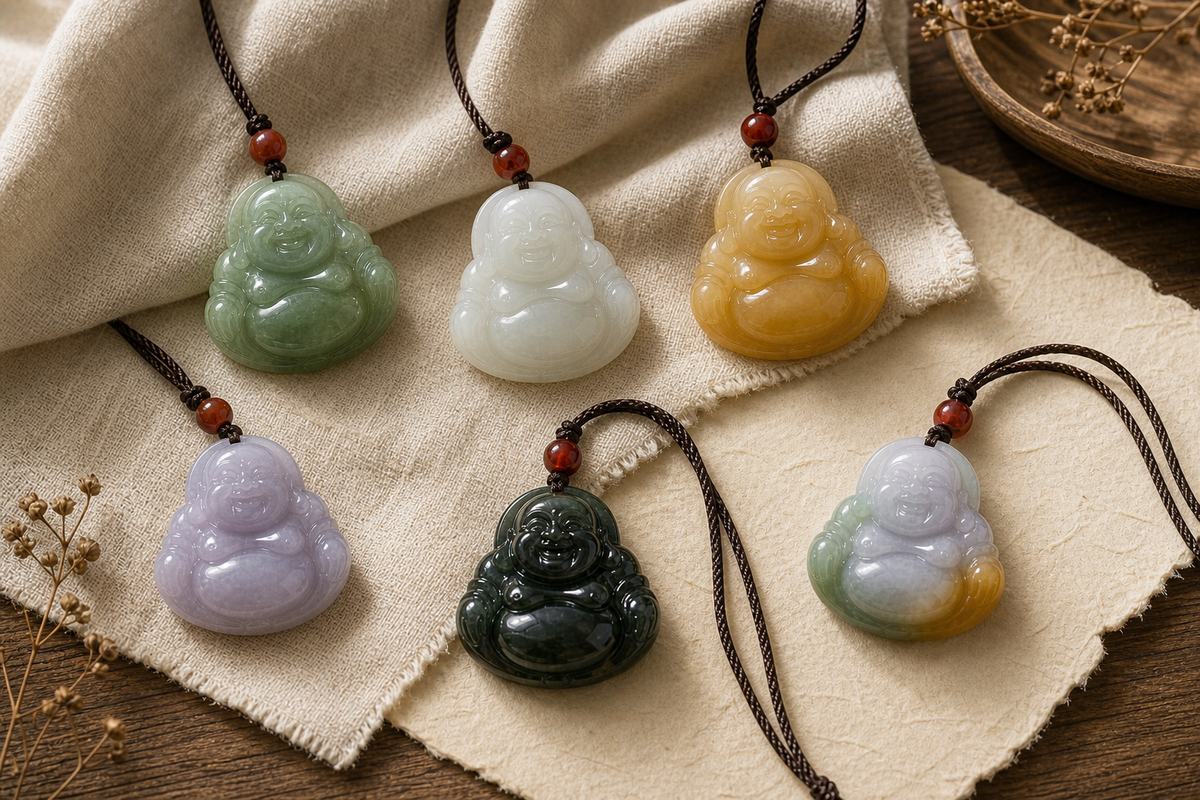
Age and skin tone can guide style but should not become rigid rules. Younger wearers may enjoy light green, white, lavender, or smaller pendants. Older wearers may like deeper green, honey, black, or richer carved pieces. Warm skin tones often pair well with yellow, honey, orange, and warm brown. Cool skin tones often pair well with white, lavender, pale green, and dark green. The safest choice is still the one the wearer finds beautiful and respectful.
Related Eastern Story Guides
- Jade Meaning in Chinese Culture – broader background on jade as virtue, refinement, and symbolic material.
- What Is Hetian Jade? – material and cultural context for white and warm nephrite jade.
- Eastern Story Material Guide – site-wide material framing for symbolic jewelry.
- Eastern Story Care Guide – practical care principles for meaningful jewelry.
- Eastern Story Editorial Policy – how we separate cultural symbolism from guaranteed outcomes.
Frequently Asked Questions
For readers choosing a symbolic gift or wearable blessing, Eastern Story's Blessing Shop offers related pieces organized around protection, harmony, love, clarity, and good wishes.
Related Posts


