
Chilong (螭龙) is a hornless dragon-like auspicious beast in Eastern jade carving and decorative art. It is usually shown with a rounded beast head, no horns, a long coiling body, four feet, and a curled or split tail. In jade, bronze, architecture, furniture, and porcelain, Chilong (螭龙) carries blessings for dignity, protection, rising momentum, family harmony, and refined taste.
This guide explains Chilong meaning (螭龙寓意) from shape, myth, historical style, jade carving technique, gift use, wearing method, and care. It also connects Chilong with broader jade carving motif meanings, Eastern dragon symbolism, and the blessing-focused jewelry language used across Eastern Story.
Quick Meaning Map: Chilong Symbol, Form, and Gift Use
| Chilong element | How it looks | Main meaning | Best use |
|---|---|---|---|
| Hornless dragon / Wu Jiao Zhi Long (无角之龙) | Smooth head without dragon horns | Elegant power, restraint, refined dignity | Jade pendants, antique-style plaques |
| Coiled Chilong / Pan Chi pattern (蟠螭纹) | C-shaped or S-shaped winding body | Movement, vitality, continuous growth | Jade bi (玉璧), bangles, sword fittings |
| Mother-and-child Chilong / Zi Mu Chi (子母螭) | Large and small Chilong forms together | Family continuity, descendants, inherited blessing | Family gifts, heirloom-style jade |
| Paired Chilong / Shuang Chi (双螭) | Two Chilong forms facing or crossing | Harmony, partnership, shared fortune | Couple gifts, home display |
| Chilong holding lingzhi (螭龙衔灵芝) | Chilong biting or holding a lingzhi (灵芝) branch | Longevity, health, Fu-Shou blessing | Gifts for elders |
| Roof-ridge Chiwen (螭吻) | Beast head on ridge or architectural edge | Fire protection, guarding the house, watching over space | Architecture, decor, symbolic display |
What Is Chilong (螭龙)?
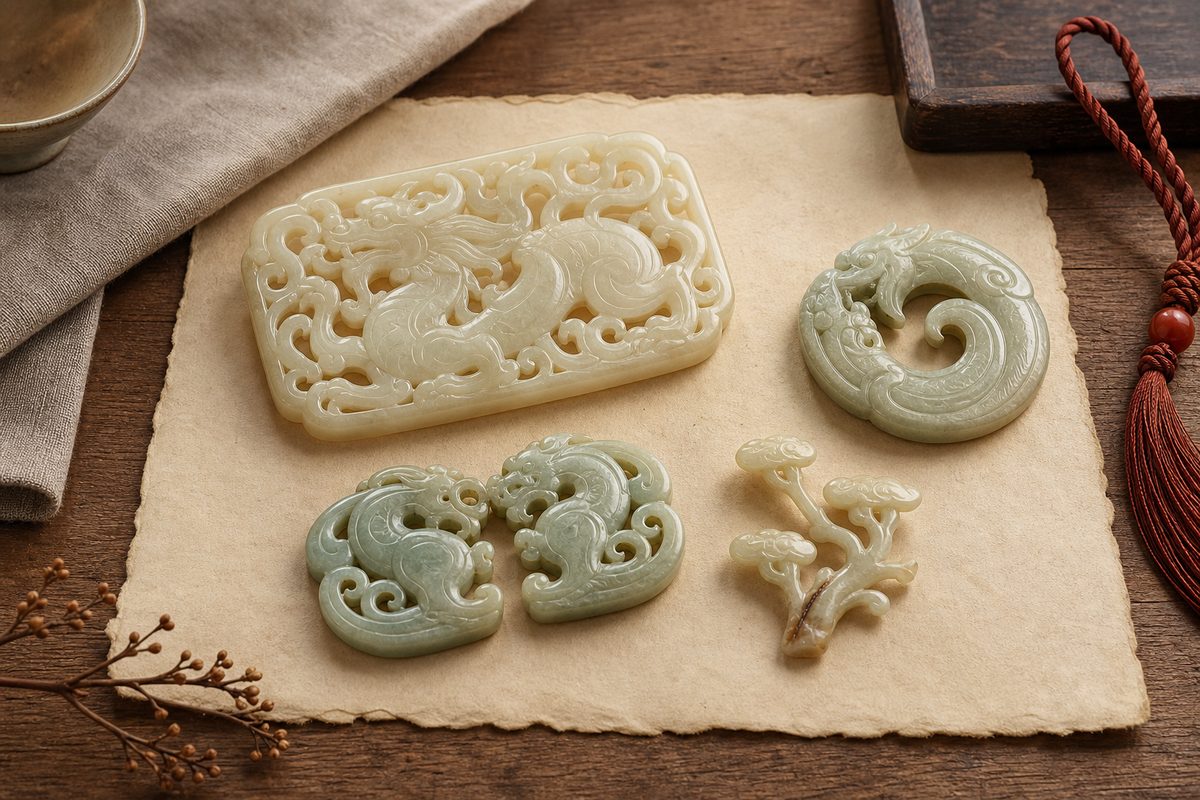
Chilong (螭龙) is usually understood as a hornless dragon-like auspicious beast. Classical descriptions often define it through the phrase hornless dragon / Wu Jiao Yue Chi (无角曰螭). Its head is rounded, sometimes close to a tiger head or cat-like beast head, with large eyes, a strong nose, small upright ears, and a smooth hornless crown.

Its body is long, flexible, and often shown in a coiling, climbing, or crawling posture. Unlike many formal dragon images, a Chilong body usually has no carved scales. The visual power comes from the spine line, the muscular shoulder, the curled tail, and the way the body breaks the surface of jade, bronze, porcelain, wood, or architectural decoration.
This is why Chilong (螭龙) feels different from a standard dragon. It has dragon dignity, but it is more intimate, agile, and ornamental. It can feel protective without being severe, strong without being heavy, and ancient without looking distant.
Classical Definitions: Shuo Wen Jie Zi and Guangya
Eastern Han scholar Xu Shen (许慎) recorded in Shuo Wen Jie Zi (说文解字): “Chi, like a dragon and yellow… or a hornless one is called Chi.” The Three Kingdoms period text Guangya (广雅) also separates dragon forms by horns: a horned one is called Qiu Dragon (虬龙), while a hornless one is called Chilong (螭龙).

These classical notes are useful because they give readers a simple identification rule. When viewing ancient jade, bronze mirrors, furniture, porcelain, or architectural ornaments, start with four clues: hornless head, beast-like face, coiling body, and curled tail. Those clues usually lead toward Chilong (螭龙) rather than a formal horned dragon.
Folk traditions also connect Chilong with the dragon-born-nine-sons idea / Long Sheng Jiu Zi (龙生九子). In some tellings it overlaps with Chiwen (螭吻), the ridge-watching beast that loves to look outward and swallow. In other tellings it is close to Chihu (螭虎), a dragon-tiger hybrid with a stronger beast body and muscular force.
Mythic Origins: Water Spirit, Roof Guardian, and Dragon Branch
One origin story treats Chilong (螭龙) as a branch of the dragon family and a water-related spirit. Because dragons are linked with cloud, rain, and water movement, Chilong can appear as a refined symbol of flow, protection, and natural force.

Another line of tradition links it with Chiwen (螭吻), a roof-ridge guardian. Chiwen is often placed at the edge of palace or temple roofs, watching outward and symbolically guarding against fire. This explains why Chilong-related beasts appear in architecture as protective ridge ornaments and decorative guardians.
A third cultural layer treats Chilong as Chihu (螭虎), a dragon-tiger form. This version gives Chilong more animal strength: tiger-like head, muscular shoulders, and a compact energy that suits jade seal knobs, sword fittings, and vigorous relief carving.
Historical Evolution: Bronze, Warring States Jade, Han Peak, and Ming-Qing Decoration
Shang-Zhou to Warring States
The earliest Chilong-like forms appear in Shang-Zhou bronze and early jade ornament, though they were often grouped under the broader dragon category. The coiled Chilong pattern / Pan Chi pattern (蟠螭纹) became clearer by the Warring States period (战国), when jade artisans developed winding S-shaped bodies, sharp turns, and powerful movement across jade surfaces.

Han Dynasty Peak
The Han dynasty (汉代) is one of the artistic high points of Chilong design. Han jade frequently shows mother-and-child Chilong (子母螭), cloud-piercing Chilong (穿云螭), and Chihu forms with round eyes, large nose, strong neck, curled tail, and full muscular tension. These motifs appear on jade sword slide / Yu Jian Zhi (玉剑璏), jade bi (玉璧), jade heng (玉珩), and tomb-related jade pieces.

Han Chilong often carries an upward, cloud-bound energy. It can be read together with the period’s interest in ascent, protection, and the connection between the human world and the unseen world.
Tang, Song, Ming, and Qing
Tang dynasty (唐代) Chilong forms tend to feel grand and open. Song dynasty (宋代) design, shaped by revivalist taste, often used Chilong on ceramics and antique-inspired objects, with curled tails and controlled old-style rhythm. By the Ming-Qing period (明清时期), Chilong moved further from ritual form into auspicious decoration. It appeared on imperial porcelain, carved furniture, dress ornaments, and jade pieces, often combined with flower leaves, ruyi (如意), and other blessing motifs.
Where Chilong Appears: Jade, Bronze, Architecture, Furniture, and Porcelain
Chilong (螭龙) is one of the most classical motifs in Eastern jade carving. In ancient jade, it appears on sword fittings, jade bi, pendants, heng-shaped ornaments, seal knobs, and ritual-style objects. In modern Hetian jade and jadeite, it is often carved into pendants, hand ornaments, bangles, bracelets, and desk pieces.

In architecture, Chilong or Chiwen-related forms are used as roof-ridge beasts and decorative guardians. The Jin Temple / Jinci (晋祠) Shengmu Hall (圣母殿), for example, includes slender dragon-like carved forms that show the protective and ornamental role of these auspicious beasts in wooden architecture.
In Ming-Qing furniture, Chilong patterns often appear through openwork carving and relief carving on chair backs, table aprons, panels, and screens. In porcelain and bronze, Chilong appears from Warring States bronze mirrors to Ming Xuande blue-and-white Chilong meiping forms. Different eras show different claw counts, lip whiskers, tails, and body rhythms, which helps collectors read period style.
Chilong in Jade Carving: Why the Motif Works So Well
Chilong works especially well in jade because its body can follow the stone. A coiling dragon can wrap around a jade bi (玉璧), break through the edge of a plaque, curl across a bangle, or rise from a jade seal knob. This allows the artisan to balance surface design, openwork, tactile depth, and symbolic movement.

The S-shaped and C-shaped body gives a jade piece visual tension. It breaks a flat composition and creates the feeling that the beast is climbing, circling, guarding, or emerging. A well-carved Chilong is not just placed on jade; it seems to move through the jade.
In antique-style pieces, artisans often combine relief jade carving, incised hairline detail, and openwork jade carving. The shoulders may rise in raised relief, the tail may pierce a ring form, and the body may twist through empty space. These details turn Chilong into a test of both design judgment and hand skill.
Design Principles: Coiling Lines, Openwork, Relief, and Skin-Color Clever Carving
S-Shaped and C-Shaped Movement
The most recognizable Chilong design is a body curved into an S-shape or C-shape. The curve gives the piece motion and vitality. It also lets the artisan create a rhythm of head, shoulder, belly, leg, and tail so the viewer’s eye keeps moving.

Breaking the Edge
On jade bi and plaques, Chilong often breaks the outline. The head, shoulder, tail, or foot may extend beyond the round or rectangular frame. This “breaking out of the bi” effect gives a three-dimensional feeling and prevents the composition from looking stiff.
Relief, Incised Lines, and Round Carving
Warring States and Han-style Chilong jade may use lowered-ground high relief, then add fine incised lines for muscles, fur, and surface movement. On seal knobs and belt hooks, round carving lets the Chilong coil over the top of the object, giving both tactile pleasure and sculptural presence.
Clever Use of Jade Skin Color
When the jade has natural skin color, a designer may turn red, yellow, or brown skin into the Chilong body while leaving pale jade as the background. This qiaose clever-color carving (俏色玉雕) can make the beast stand out naturally and gives the piece a stronger one-of-a-kind character.

Cultural Meanings: Dignity, Protection, Career Rise, Love, and Virtue
Chilong (螭龙) inherits part of the dignity of the dragon. As a dragon form, it can symbolize honor, authority, and noble presence. In jade, that dignity becomes warmer and more personal because jade itself is associated with cultivated character, restraint, and inner refinement.
Protection is another major meaning. Ancient people used Chilong motifs in tomb jade, architecture, and personal ornaments because the beast was associated with guarding, warding off harmful forces, and guiding the spirit. In modern jewelry, this becomes a blessing for peace, safety, and settled daily life.
Chilong’s rising posture gives it a career meaning. It suggests forward movement, strong will, and step-by-step ascent. Because dragon / Long (龙) sounds close to prosperity / Long (隆), Chilong is also used for business flourishing, study success, and a future that opens upward.
Paired Chilong designs carry emotional and family meanings. Two Chilong facing each other can symbolize mutual affection, marital harmony, and family reunion. Mother-and-child Chilong (子母螭) suggests descendants, family continuation, and blessings passed from one generation to the next.
When Chilong appears with lingzhi (灵芝), the meaning shifts toward longevity and health. Chilong holding lingzhi (螭龙衔灵芝) is especially suitable for elder gifts because it combines the rising beast with the Fu-Shou blessing language of longevity.

How to Identify Chilong and Avoid Confusion
| Motif | Key feature | How it differs from Chilong |
|---|---|---|
| Chilong (螭龙) | Hornless head, beast-like face, four feet, long curled tail | Main subject of this guide |
| Qiu Dragon (虬龙) | Usually horned in classical classification | Guangya (广雅) separates it from hornless Chilong |
| Kui Dragon (夔龙) | Often one-footed or highly stylized, sometimes symmetrical | More abstract and formal; not the same four-footed crawling Chilong |
| Chihu (螭虎) | Shorter, more muscular, tiger-like beast force | Often overlaps with Chilong, but has heavier animal body |
| Formal dragon / Long (龙) | May show horns, scales, longer whiskers, more imperial dragon traits | Chilong is usually hornless, more compact, and more ornamental |

A practical recognition formula is: no horns, beast head, coiling body, curled tail, and lively movement. If the piece also has a tiger-like face and muscular shoulders, it may be described as Chihu (螭虎). If it sits on a roof ridge or has a swallowing mouth, the Chiwen (螭吻) tradition may be relevant.
Period style also matters. Warring States Chilong tends to be lean and sharp. Han Chilong often feels muscular and forceful. Song forms may have smoother revivalist curves. Yuan forms can look softer and lower in tension. Ming-Qing forms often become more decorative, with flowers, ruyi, and household blessing patterns.

Modern Wearing: New Chinese Style, Daily Jewelry, Bags, Cars, and Desk Display
Modern Chilong jade no longer has to feel old-fashioned. A small Chilong jade pendant can fit new Chinese style / Xin Zhong Shi (新中式), a white shirt, linen clothing, tea wear, a simple knit, or a quiet office look. The key is to let the carving become a restrained focal point instead of pairing it with too many heavy cultural props.

For neckwear, use a hand-braided cord in black-gold, deep brown, dark green, or blue-white tones. A smaller pendant can also pair with a silver chain, gold chain, pearl strand, or fine necklace for a modern layered look. This works especially well when the jade carving is clean and not too bulky.
For wristwear, a small Chilong jade piece can be set into a leather bracelet, woven bracelet, or mixed-material hand chain. This gives the motif a contemporary feeling while keeping the symbolic meaning of courage, guarding, and rising movement.
Larger Chilong plaques may work better as bag charms, car hangings, or desk display pieces. A larger jade plaque with a refined cord and tassel can soften a plain work bag. A thicker plaque on a wooden stand can become a quiet desk object with cultural weight.

For comfort, a 10g-25g pendant is a practical spring and summer range. With heavier autumn or winter clothing, a 30g-35g jade piece can feel balanced. Very heavy pendants should be worn with a sturdy cord and given breaks during long days.
Chilong Jade Gift Guide
A Chilong jade gift is strong, cultural, and personal. It suits people who appreciate jade, traditional craftsmanship, symbolic animals, or understated power. It is especially suitable for people building a career, studying for advancement, opening a business, starting a new family stage, or collecting Eastern jade art.

- For career people: choose a single rising Chilong (螭龙) to express forward movement, authority, and resilience.
- For elders: choose Chilong holding lingzhi (螭龙衔灵芝) for longevity, health, and Fu-Shou blessing.
- For couples: choose paired Chilong / Shuang Chi (双螭) or crossing Chilong forms for harmony and lasting affection.
- For families: choose mother-and-child Chilong (子母螭) for continuity, descendants, and family blessing.
- For collectors: choose Han-style Chilong, openwork Chilong, or qiaose Chilong where line rhythm and material use are clearly visible.
For a broader gift context, Chilong can sit naturally beside other Eastern blessing gifts, Ping An Kou peace buckles, dragon motifs, phoenix motifs, and jade pieces chosen for personal protection, family harmony, or career blessing.
How to Choose a Good Chilong Jade Carving
A good Chilong jade carving begins with recognizable form. The head should be hornless and alive, the body should have rhythm, the tail should complete the movement, and the legs should not feel pasted on. The carving should show why this is Chilong, not a generic beast or generic dragon.

- Line rhythm: the S-curve or C-curve should feel continuous, not broken into stiff segments.
- Muscle tension: shoulders, haunches, and spine should show force without becoming crude.
- Head spirit: eyes, nose, ears, and mouth should be clear enough to carry expression.
- Tail design: curled, split, or cord-like tails should finish the composition with movement.
- Relief depth: raised areas should have clean transitions and enough volume to catch light.
- Openwork edges: pierced sections should be smooth, safe, and visually necessary.
- Skin-color use: natural jade skin should support the Chilong shape rather than looking forced.
- Polish: both raised surface and recessed lines should feel clean, tactile, and respectful to the material.
When comparing pieces, do not judge only by size or whiteness. Jade meaning is strongest when material, form, and carving quality work together. A smaller carving with good line rhythm can feel more valuable than a larger piece with a stiff or confused beast form.
Care and Daily Respect
Chilong jade should be treated like any meaningful jade ornament. Keep it away from hard impact, sharp metal edges, harsh chemicals, strong perfume, and sudden temperature change. After wearing, wipe it gently with a soft cloth. For broader material care, use the Eastern Story care guide and material guide.

If a Chilong pendant is worn close to the skin, it may gradually look warmer and more polished through normal contact. If it is large or carved with delicate openwork, store it separately in a soft pouch or box so the raised head, tail, and open edges are not scratched by other jewelry.
Traditional jade etiquette often says jade should not touch the ground. In modern use, this can be understood as a habit of respect: keep the piece clean, store it properly, avoid rough handling, and let the carving stay connected with the intention behind the gift.
Frequently Asked Questions
Final Thoughts: Why Chilong Still Feels Alive
Chilong (螭龙) survives because it is both ancient and wearable. It carries the dignity of the dragon, the agility of a beast, the protection of a guardian, and the softness of jade. In one small carving, it can hold mythology, craftsmanship, personal blessing, and daily style.

For readers choosing a Chilong jade piece, start with form and spirit: hornless head, coiling body, curled tail, and living movement. Then look at the jade, the polish, the carving depth, and the gift meaning. When those elements meet, Chilong becomes more than decoration; it becomes a compact Eastern blessing for strength, protection, harmony, and forward movement.
Related Posts


2 Comments