
Auspicious Cloud (祥云) means a fortunate cloud: a sign of blessing, good timing, smooth movement, rising fortune, and harmony between heaven and earth. In Eastern symbolism, Xiangyun (祥云), also called Ruiyun (瑞云), is not a simple background decoration. It is a cloud pattern (云纹) with three linked layers: literal and literary meaning, cultural and philosophical meaning, and decorative motif meaning.
At the literal level, auspicious clouds point to clouds that announce favorable weather, such as fine curling cloud forms that suggest clear skies. In poetry and classical imagination, they become the colorful clouds of immortals, a sign that blessing has entered a place. The sound of yun, “cloud,” also echoes yun, “luck” or “fortune,” so Xiangyun naturally carries the feeling of good fortune arriving.
At the cultural level, clouds mattered because they brought rain. In an agrarian world, clouds, rain, harvest, and life were connected. A cloud could become a messenger between sky and earth, a carrier of qi, a sign of wind and rain in balance, and a visual wish for Guotai Min'an (国泰民安), the peace and flourishing of country and people. This is why cloud designs have survived for more than 3,000 years, moving from bronze vessels and jade carving into clothing, architecture, jewelry, gifts, packaging, and the 2008 Beijing Olympic torch (北京奥运火炬).
Auspicious Cloud Meaning at a Glance
| Layer | Meaning | How to read it |
|---|---|---|
| Literal and literary | A fortunate cloud, colorful immortal cloud, and a poetic sign of blessing | Good omen, arrival of luck, favorable weather, a bright atmosphere |
| Cultural and philosophical | Clouds bring rain, rain nourishes life, and clouds connect heaven and earth | Harmony, vitality, natural reverence, spiritual openness, communication between realms |
| Motif and design | Curving cloud lines frame dragons, phoenixes, bats, cranes, jade objects, and Ruyi forms | Good fortune, elevation, rank, long life, smooth progress, a blessing that continues |
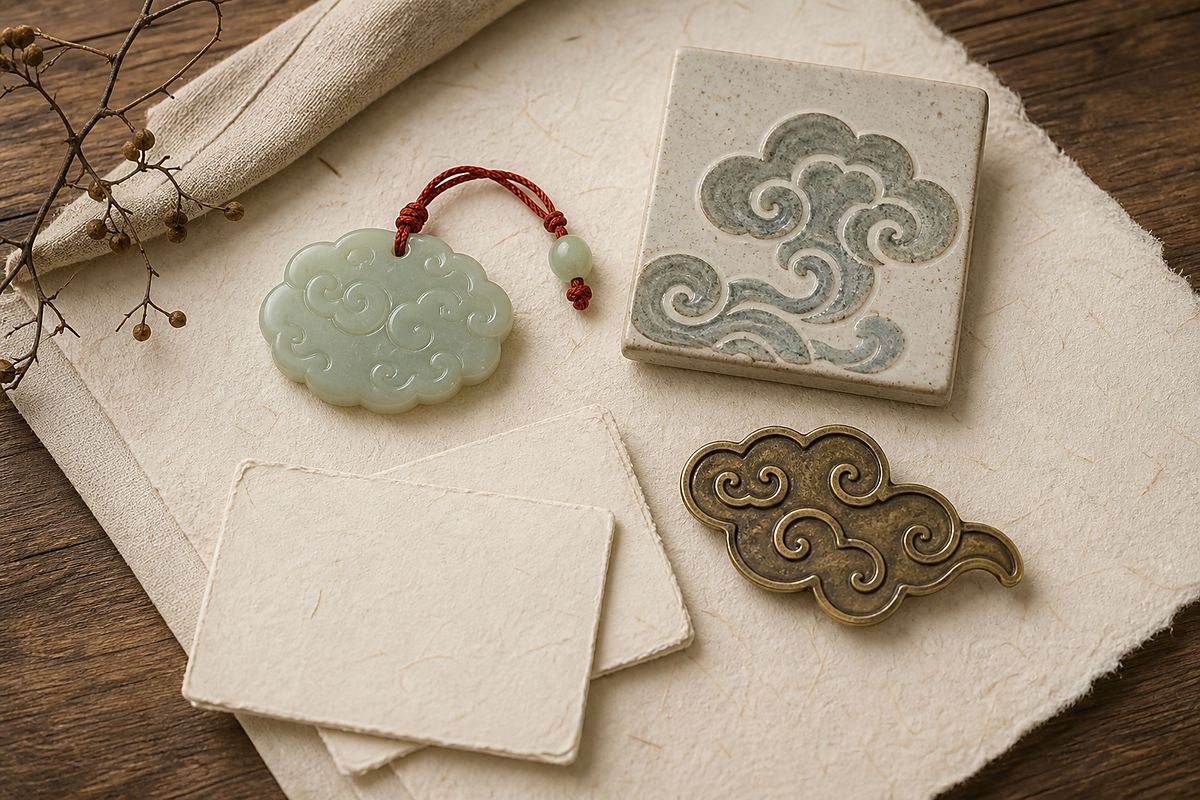
What Is Xiangyun (祥云)?
Xiangyun (祥云) literally means auspicious cloud. Ruiyun (瑞云) carries a similar meaning: a cloud of good omen. In ordinary English, “auspicious cloud” can sound decorative, but in Eastern visual language it is a compact symbol of blessing, rain, life, height, spiritual movement, and graceful order.

The cloud became powerful because it is both visible and mysterious. It appears in the sky, changes shape, gathers rain, drifts between mountains, and disappears. Ancient people saw it as qi in motion, the breath of heaven and earth. That made cloud forms natural symbols for vitality, transformation, and unseen blessing.
In literature, clouds can carry immortals, announce a noble arrival, or protect a scene with fortunate atmosphere. In folk language, cloud imagery also supports phrases of progress. Pingbu Qingyun (平步青云) means rising smoothly into high office or status. Qingyun Zhishang (青云直上) means rising straight toward the blue clouds. These phrases explain why cloud motifs can suit students, professionals, graduates, and anyone entering a new stage.
Why Clouds Became a Core Eastern Symbol
Clouds sit at the center of Eastern symbolic design because they join nature, belief, language, and beauty. The earliest cloud motifs were tied to reverence for natural forces. In farming life, cloud could become rain, and rain could become harvest. A cloud was therefore more than weather. It was life arriving from the sky.

Religious and philosophical traditions deepened the meaning. In Daoist imagination, clouds carried immortals and suggested spiritual freedom. In Buddhist art, clouds and flying forms helped create a celestial atmosphere around deities, apsaras, and sacred scenes. The Book of Changes (周易) phrase Yun Xing Yu Shi (云行雨施), clouds moving and rain being bestowed, gives the cloud a sense of life-giving circulation.
Rank and ornament added another layer. Dragon-cloud compositions could express imperial dignity and authority. In folk design, cloud heads softened into Ruyi (如意) and Lingzhi-like curves, turning high symbolic language into everyday blessing. The same cloud could therefore belong to court robes, temple art, jade pendants, wedding gifts, children's locks, furniture, and modern packaging.
Cloud Pattern History: From Shang-Zhou to Modern Design
The cloud motif did not stay fixed. It changed with each age, moving from solemn bronze geometry into flowing jade curves, Buddhist mural clouds, palace ornament, and modern abstract design. This long history is why a small cloud line on a pendant can feel ancient and contemporary at the same time.

| Period | Cloud form | Main feeling | Typical use |
|---|---|---|---|
| Eastern Shang-Zhou period (商周时期) | cloud-thunder pattern (云雷纹) | Geometric, solemn, mysterious | Bronze vessels, ritual objects, early ground patterns |
| Warring States to Eastern Qin-Han period (战国至秦汉时期) | curling cloud pattern (卷云纹), hook cloud, cloud qi pattern (云气纹) | Dynamic, rising, immortal, energetic | Jade carving, lacquer, tomb art, mythical beasts |
| Wei-Jin, Tang, and Song periods (魏晋唐宋时期) | flower-cloud, flowing cloud pattern (流云纹), soft flying clouds | Open, elegant, Buddhist and Silk Road-influenced | Dunhuang murals, textiles, ceramics, decorative art |
| Song-Yuan and Eastern Ming-Qing period (宋元至明清时期) | Ruyi cloud pattern (如意云纹), four-harmony cloud pattern (四合云纹), round cloud pattern (团云纹), layered cloud pattern (叠云纹) | Full, ornate, auspicious, court and folk shared | Dragon robes, porcelain, architecture, jade, furniture, festival objects |
| Modern design | minimal cloud line, abstract cloud motif, reconstructed Xiangyun | Clean, cultural, refined, international | Jewelry, packaging, fashion, home decor, brand graphics, Beijing Olympic torch |
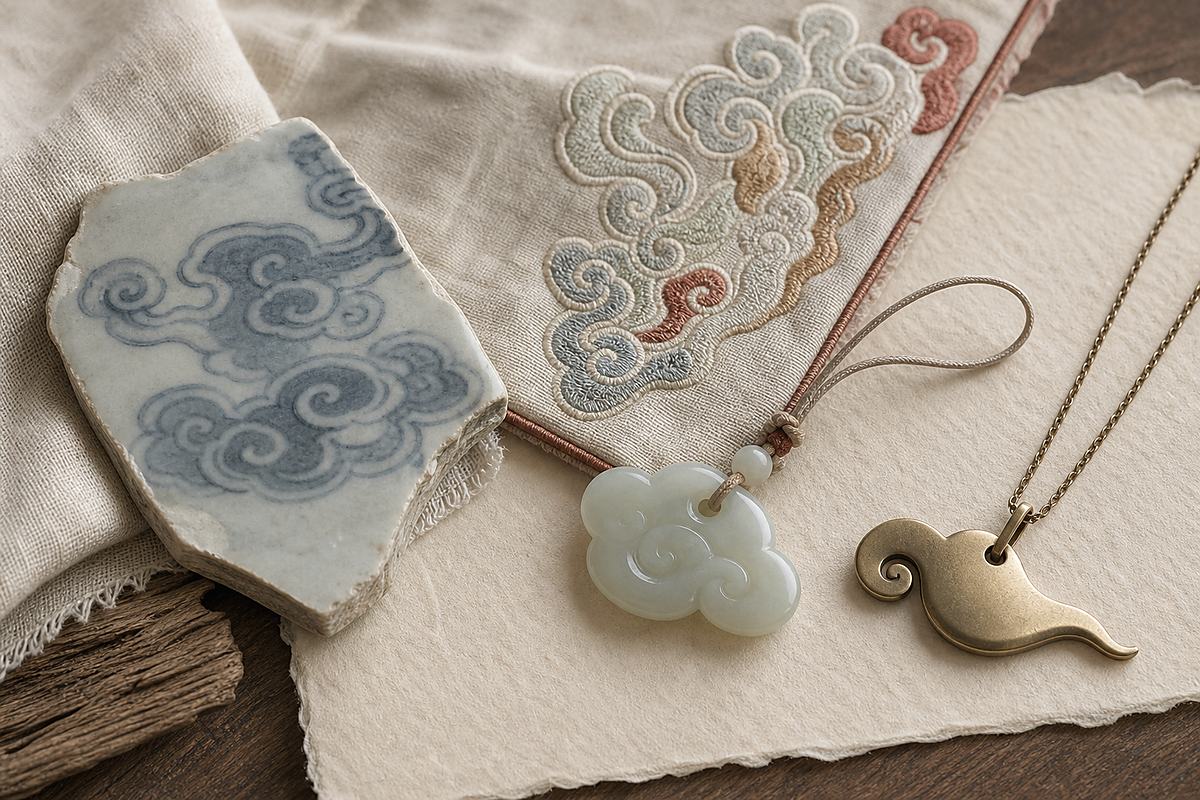
The 2008 Beijing Olympic torch made this history visible to the world. Its auspicious cloud design used a red-and-silver visual language inspired by Han-style lacquer red and relief-like cloud movement. The design expressed origin, shared life, harmony, and connection, showing how an ancient motif can still carry modern Eastern confidence.
Major Cloud Patterns and What They Mean
Cloud patterns are not one shape. Their meaning shifts with line, density, pairing, and object. A strict cloud-thunder pattern feels ancient and ceremonial. A Ruyi cloud feels gentle and giftable. A flowing cloud feels free and airy. A layered cloud can suggest fullness and rising movement.

| Pattern | Visual character | Symbolic reading |
|---|---|---|
| cloud-thunder pattern (云雷纹) | Continuous square spiral or “hui” turning lines | Ancient order, sacred atmosphere, power that continues without a clear beginning or end |
| curling cloud pattern (卷云纹) | S-shaped curls, hooked turns, thick moving lines | Movement, rising qi, spiritual freedom, upward progress |
| cloud qi pattern (云气纹) | Free drifting curves, often combined with beasts and immortals | Immortal atmosphere, heaven-earth communication, living breath |
| Ruyi cloud pattern (如意云纹) | Full cloud head, smooth curling tail, often Lingzhi-like | Wishes fulfilled, smoothness, harmony, elegant blessing |
| four-harmony cloud pattern (四合云纹) | Symmetrical center-facing or radiating layout | Four directions in harmony, reunion, wholeness, balanced space |
| round cloud pattern (团云纹) | Rounded cloud cluster with balanced head and tail | Completeness, fullness, noble decoration, often used with dragons or auspicious creatures |
| layered cloud pattern (叠云纹) | Overlapping curved bands with depth | Step-by-step elevation, abundant blessing, visual richness |
| flowing cloud pattern (流云纹) | Natural, loose, free-moving curves | Freedom, ease, lightness, a graceful path forward |

Some cloud patterns become visual idioms when paired with other symbols. A cloud-bat pattern (云蝠纹) reads as Fu from the Sky (福从天降), because bat fu (蝠) sounds like blessing fu (福). A cloud-crane pattern (云鹤纹) points toward long life and refined elegance. A cloud-dragon pattern (云龙纹) suggests dragon rising through clouds, power in motion, and auspicious authority. A cloud-phoenix pattern (云凤纹) gives the phoenix a bright, ceremonial atmosphere.
The important point is that the cloud rarely erases the meaning of the main motif. It changes the atmosphere around it. A bat already carries blessing language, but clouds make the blessing feel as if it descends from above. A crane already suggests longevity and high refinement, but clouds make it feel more celestial. A dragon already carries power, rain, and movement, but clouds turn that movement into rising force. This is why cloud patterns are so useful for reading complex pendants and carved scenes: they help the viewer understand direction, mood, and the level of blessing.
Auspicious Cloud Meaning in Jade Carving
In jade carving, clouds are both symbolism and structure. A cloud curve can soften the edge of a pendant, hide a transition between motifs, create an opening for a cord, or balance the empty space around a dragon, phoenix, crane, or Ruyi lock (如意锁). This is why cloud patterns are so useful in carved jade. They carry meaning while solving the shape of the object.
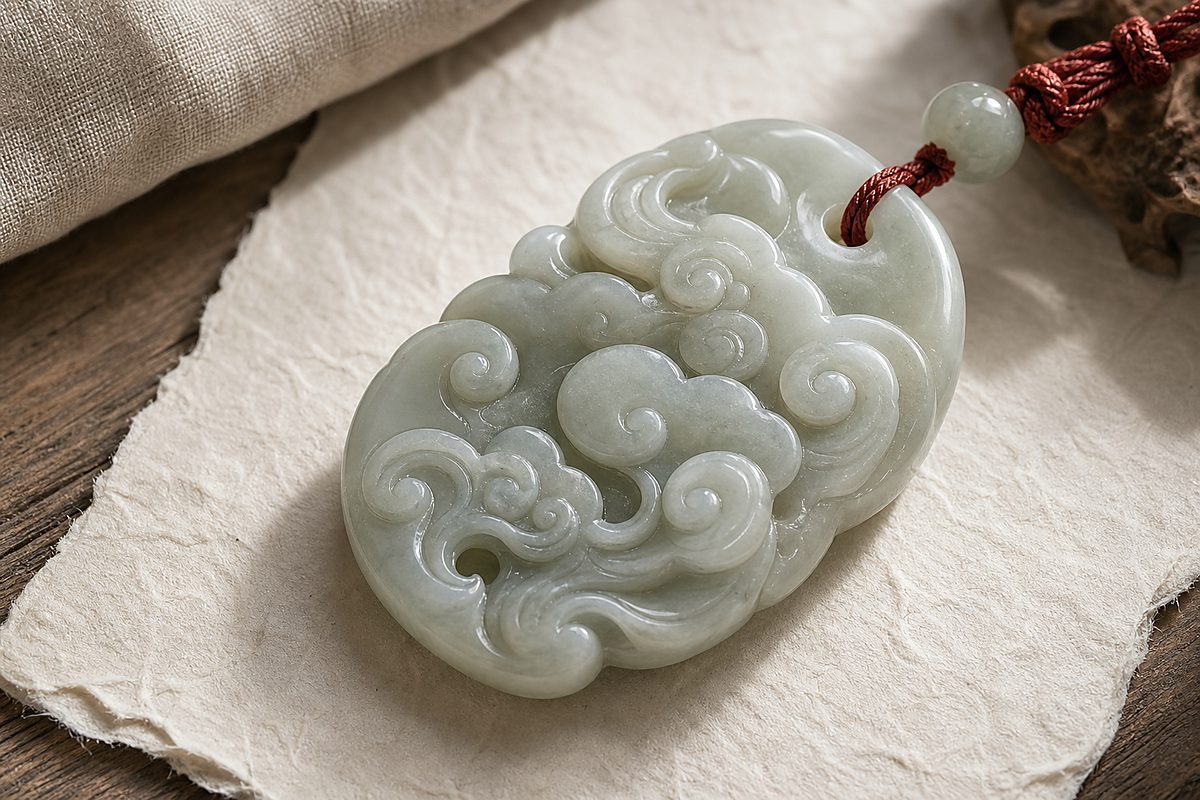
Cloud motifs in jade often carry the blessing of Pingbu Qingyun (平步青云): rising smoothly, progressing with dignity, and moving into a better position. They also suggest wind and rain in balance, because ancient people read cloud and rain as signs of harvest, prosperity, and life continuing. In Han-period imagination, cloud qi could mark the boundary of an immortal realm, so a jade cloud could also express spiritual openness and freedom.
For broader motif reading, see our guide to Chinese jade carving meanings. For material background, read jade meaning in Eastern culture. A cloud motif on Hetian jade feels warm and restrained. On jadeite, it can feel brighter and more polished. On gold, silver, or 18K gold, the same cloud line becomes more refined, wearable, and jewelry-focused.
- Ruyi cloud pendant: smoothness, wish fulfillment, and quiet blessing.
- Cloud jade bangle: continuous blessing, graceful movement, and daily elegance.
- Cloud with dragon: rising strength and auspicious authority. For the dragon side, read Eastern dragon meaning.
- Cloud with crane: long-life grace, scholar-like refinement, and high atmosphere.
- Cloud with Ruyi lock: a wish to keep peace, happiness, affection, or childhood blessing close.

Gift and Wearing Meaning of Auspicious Clouds
An auspicious cloud gift is a gentle way to say: may your path be smooth, may good timing arrive, may blessing gather around you, and may you rise with calm confidence. It works especially well when the message should feel elegant rather than loud.

For elders and close family, Xiangyun can carry wishes for health, long life, peace, and family happiness. For students and professionals, it naturally connects with Pingbu Qingyun (平步青云) and Qingyun Zhishang (青云直上): steady progress, study success, career elevation, and a future that opens upward. For partners, paired cloud motifs or a Ruyi lock (如意锁) with cloud lines can express a wish to keep affection, safety, and happiness close. For children, a cloud lock or jade cloud pendant feels like a soft blessing for safe growth and good fortune.
Daily wearing gives the cloud a personal emotional layer. Many wearers treat a cloud pendant, bracelet, or ring as a quiet reminder to stay hopeful during difficulty, to move gently through change, and to keep a bright mental horizon. This psychological and emotional meaning matters. The cloud's softness can make the object feel calming, while its upward movement suggests courage and forward motion.
Material changes the message. Hetian jade and jadeite make cloud jewelry feel warm, cultural, and understated. Gold, ancient-style gold, or 18K gold makes the motif more ceremonial and suitable for formal dress, wedding jewelry, or meaningful occasions. Silver gives it a literary, classical, and everyday feeling. For blessing-oriented gifts, the Eastern Story Blessing collection is the natural next stop.
Modern Jewelry, Gift Packaging, and Home Decor
Modern design keeps returning to auspicious clouds because the shape is adaptable. It can be ornate or minimal, historical or contemporary, ceremonial or soft. A designer can reduce Xiangyun into one clean curve, repeat it as a subtle ground pattern, carve it as relief, pierce it into metal, or use it as an edge silhouette.
In jewelry, auspicious cloud patterns appear in new-Eastern wedding rings, carved jade pendants, gold baby locks, jadeite hairpins, cloud-shaped earrings, and gemstone-inlaid designs. A traditional Ruyi cloud can become a hollow ring shoulder, a winding 18K gold band, a cloud-shaped pendant border, or a flowing support around a jade phoenix or gemstone centerpiece. Ancient-style gold and filigree techniques can make cloud locks lighter and more detailed, while simple cloud lines suit daily commuting and modern new-Eastern outfits.
In gift packaging, cloud motifs add ceremony and cultural depth. Tea gifts, mooncake boxes, incense boxes, beauty gift sets, stationery, and business gifts often use embossed clouds, gold stamping, carved window shapes, or matte paper with subtle cloud texture. The purpose is not only decoration. It turns opening the gift into a small ritual, making the blessing visible before the object is even touched.

In home decor, cloud patterns work well because they can be quiet. Bedding may use a soft cloud repeat, modern dot-like cloud forms, or 120S long-staple cotton jacquard with gold and silver thread so the pattern changes with light. Lamps, humidifiers, fragrance objects, tea sets, carved trays, and tableware may use cloud silhouettes on rims, handles, screens, or light openings. The result is not theatrical mysticism; it is a refined way to let Eastern blessing language enter daily life.

How to Read a Cloud Motif on Jewelry or Objects
Start with the main subject. If the cloud is the main subject, read it as auspicious atmosphere, smooth movement, and blessing. If it surrounds another symbol, it modifies that symbol. A dragon in clouds is different from a dragon alone. A crane in clouds feels more celestial than a crane standing on a rock. A bat in clouds turns the design toward Fu from the Sky (福从天降).

Then read the line. Square spiral cloud-thunder forms feel ancient and powerful. Smooth curling clouds feel lively and upward. Ruyi clouds feel gentle, full, and giftable. Dense layered clouds feel ornate and formal. Sparse flowing clouds feel free and contemporary.
Finally, connect the motif to the occasion. A graduation gift can emphasize Pingbu Qingyun (平步青云). A wedding or partner gift can emphasize Ruyi, harmony, and paired cloud movement. A new home gift can focus on peace, prosperous atmosphere, and family blessing. A personal pendant can hold the softer emotional meaning: a quiet reminder to move through change with steadiness.
For a gift, choose the clearest message first. If the recipient is starting school, changing jobs, or taking an exam, a clean upward cloud line or Ruyi cloud can express progress without sounding formal. If the gift is for a child or a family keepsake, a cloud lock, cloud jade pendant, or cloud-and-bat motif carries a softer family blessing. If the piece is for daily wear, restraint matters: a small cloud curve in jade, silver, or 18K gold often feels more modern than a dense all-over pattern.
Auspicious Clouds in Emotional and Visual Psychology
Clouds also speak to modern emotion because they are soft, open, and changeable. In drawing and visual psychology, a cloud can represent ideals, distance, imagination, and a place the mind moves toward. A large cloud may suggest gathered dreams. A soft cloud crossing a scene can reduce harshness and make the picture feel easier to breathe in.

This emotional layer helps explain why cloud jewelry feels wearable. It does not need to shout. It can be a small personal symbol of hope, timing, and a gentle way forward. In modern branding, cloud shapes also suggest freedom, lightness, environment, and digital ideas such as cloud computing. Those meanings are modern, but they still borrow from the same visual fact: clouds float, connect, soften, and move.
What This Page Covers and What Stays Separate
This guide owns the general meaning of auspicious clouds, Xiangyun, Ruiyun, and cloud patterns in Eastern symbolism, jade carving, gifts, wearing, jewelry, packaging, and home design. It includes companion motifs when they help explain how cloud meaning changes.

Some related topics deserve their own page boundary. The Eastern dragon (龙) has its own history of rain, power, zodiac meaning, and imperial symbolism. The phoenix has a separate Fenghuang (凤凰) tradition. Jade carving has a broader motif system. Ruyi, Lingzhi, bat, crane, and cloud-thunder patterns can also become focused support topics when the main search question changes. Keeping those boundaries clear makes each article more useful.
Frequently Asked Questions

Auspicious cloud meaning is strongest when the cloud is read as both symbol and setting. It is blessing, movement, rain, qi, rising fortune, and visual grace. In jade, jewelry, gifts, packaging, and home objects, Xiangyun turns an ordinary curve into a quiet wish for good fortune and smooth passage.
To continue the symbol journey, explore Chinese jade carving meanings, read about jade meaning in Eastern culture, learn the Eastern dragon meaning, or browse the Eastern Story Blessing collection for meaningful jewelry and symbolic gifts.
Related Posts



One Comment