
The ruyi cloud pattern, or ruyiyunwen (如意云纹), is a rounded cloud motif shaped like a ruyi head. It is recognized by a broad, usually lobed cloud head and a curling stem or tail. In later decorative arts, it became a flexible visual language for wishes that life unfold smoothly, for harmony and completeness, and for auspicious greetings expressed through objects, textiles, jewelry, and architecture.
The term needs care. Ruyi cloud is not a label for every spiral, heart, three-lobed ornament, lingzhi fungus, or cloud-shaped border. Nor is it identical to the handheld ruyi object, the ancient cloud-and-thunder pattern, or the garment structure called a cloud collar.
Ruyi cloud pattern: quick definition and terminology
| Term | What it describes | Important boundary |
|---|---|---|
| Ruyi cloud / ruyiyunwen (如意云纹) | A cloud motif drawn with the rounded head associated with a ruyi form | A motif category, not every conventional cloud |
| Ruyi-head pattern / ruyitou wen (如意头纹) | A single ruyi-shaped unit used as a border, panel, foot, bracket, or repeating ornament | May function as edging without depicting a complete cloud |
| Ruyi object (如意) | A long, slightly curved handheld or display object with a broad head | The object's history is related to, but not identical with, the history of the motif |
| Lingzhi pattern / lingzhi wen (灵芝纹) | A motif based on the branching, lobed form of lingzhi fungus | Some ruyi heads resemble lingzhi, but the names are not automatically interchangeable |
| Cloud collar / yunjian (云肩) | A collar or shoulder-covering garment and decorative structure | It can use four-lobed ruyi outlines and many other motifs; it is not another name for ruyi cloud |
Museum terminology supports this distinction. The Palace Museum describes ruyi cloud as a cloud drawn in the form of a ruyi head on crafts from the Song period onward. That useful definition identifies a documented decorative convention.

How to recognize a ruyi cloud head
Start with the silhouette. A clear ruyi cloud head has a full central crown with one or more rounded side lobes. Its lower line narrows into a neck, curl, stem, or trailing cloud line. The head may be nearly symmetrical when used as a pendant, border unit, furniture foot, or architectural bracket. In a moving cloud composition, the tail may stretch to one side and make the overall design deliberately asymmetrical.

- Look for a coherent head-and-tail relationship. A random trefoil or heart outline without a cloud stem may belong to another decorative family.
- Read negative space. In openwork jade, metal, or wood, the empty areas should clarify the lobes rather than break them into unrelated holes.
- Check repetition. A border may repeat small ruyi heads; a textile may combine four units; a vessel may place single heads around the shoulder, rim, or foot.
- Use context. Museum catalogues may call similar outlines ruyi-head, lingzhi-cloud, cloud, or palmette according to the object and scholarly convention.
Shape alone cannot settle every case. A three-lobed ceramic panel, a heart-shaped opening, and a lingzhi-shaped carving can resemble one another while serving different functions. Reliable identification comes from the complete composition, not from one isolated curve.

Ruyi cloud compared with nearby motifs and objects
| Name | Typical visual character | Common context | Why it differs |
|---|---|---|---|
| Cloud-and-thunder pattern / yunleiwen (云雷纹) | Tight angular or squared spirals, often continuous | Especially associated with early bronze decoration and later revival designs | Its geometry and historical use differ from the soft ruyi head; the draft page on yunleiwen remains a separate topic |
| Curled-cloud pattern / juanyunwen (卷云纹) | Scrolling hooks and rotating cloud curls | Jade, lacquer, metalwork, textiles, and other media across different periods | A broader descriptive family; not every curled cloud has a ruyi head |
| Cloud-vapor pattern / yunqiwen (云气纹) | Flowing bands that suggest rising or circulating vapor | Painting, lacquer, textiles, tomb art, and decorative backgrounds | Emphasizes atmospheric movement rather than a discrete ruyi-headed unit |
| Individual cloud / duoyunwen (朵云纹) | A separate cloud cluster or cloud blossom | Textiles, ceramics, painting, and architectural color | It may be ruyi-shaped, lingzhi-shaped, or another cloud type |
| Lingzhi pattern / lingzhiwen (灵芝纹) | Lobed fungus heads and branching stems | Jade, wood, porcelain, textiles, and auspicious objects | Botanical and auspicious associations can overlap with ruyi, but the subject may remain explicitly lingzhi |
| Cloud collar / yunjian (云肩) | A shoulder-covering form with lobes or pendant sections | Dress and theatrical or ceremonial clothing | A garment category that can carry flowers, birds, figures, geometric borders, and ruyi-derived outlines |
This comparison prevents two common mistakes: presenting all cloud motifs as stages of one design, and treating modern English translations as if historical makers used one fixed vocabulary. Names can vary by period, medium, excavation report, collection catalogue, and the feature a researcher chooses to emphasize.


History and the limits of a simple timeline
Early art contains cloud-thunder, hooked-cloud, scrolling, and vapor-like forms, but visual resemblance does not prove that ruyi cloud developed through a single line from Shang and Zhou bronze grounds to Spring and Autumn curls, Tang international ornament, and then one final Song-Yuan form. Those categories have different names, shapes, media, and research histories.
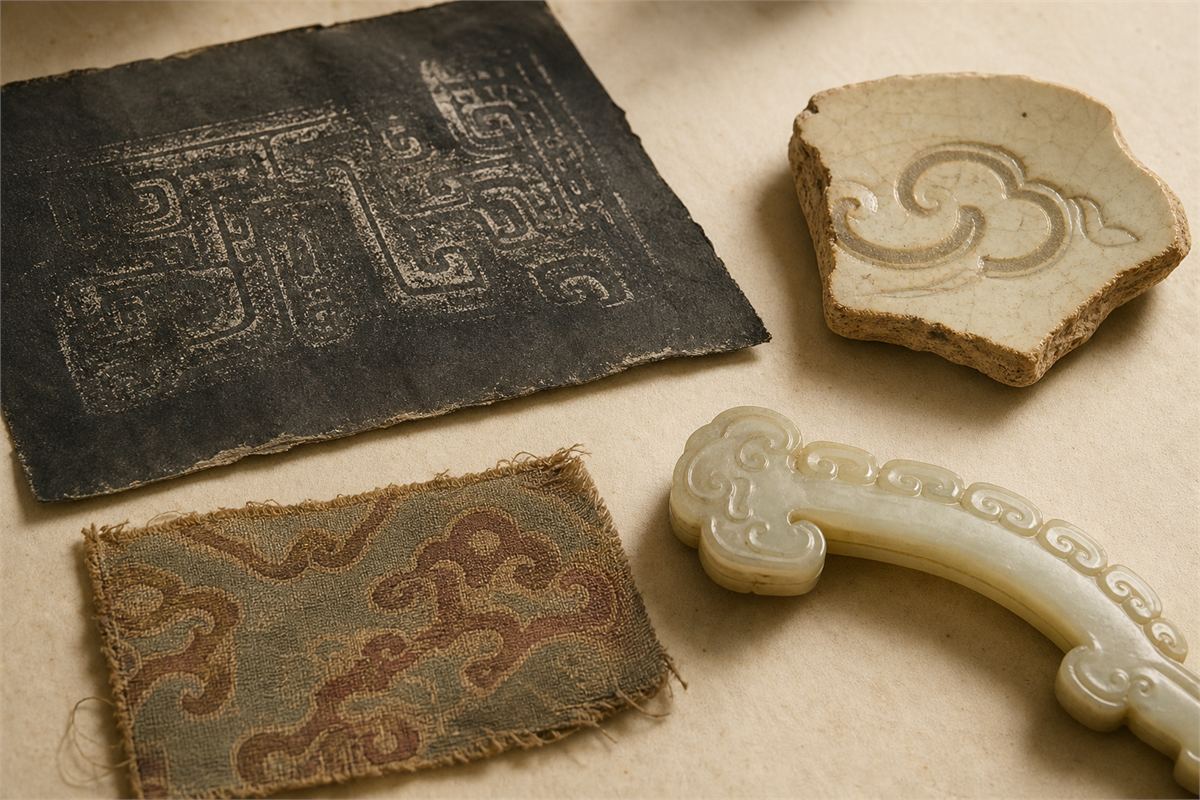
A more defensible history is layered. Ancient artisans already had rich vocabularies of spirals, hooks, clouds, and moving vapor. Later makers also worked with palmettes, scrolling plants, lingzhi-like lobes, and the increasingly recognizable ruyi head. Cross-cultural exchange certainly shaped textile and decorative design, especially along Eurasian trade networks, but a general claim that one Western-Asian heart-shaped pointed motif created ruyi cloud is too narrow for the available evidence.
For the named motif, the Palace Museum's concise boundary is useful: from the Song period onward, clouds on some crafts were often drawn in a ruyi-head shape and called ruyi clouds. Textile evidence then shows increasing diversity rather than a single standardized endpoint. Four-unit ruyi clouds, connected ruyi clouds, single ruyi clouds, and flower-like combinations appear in later silk design. Ming court textiles include both established and transformed four-unit compositions, while Qing decorative arts extended ruyi heads across dress, ceramics, jade, enamel, wood, metal, and architectural detail.
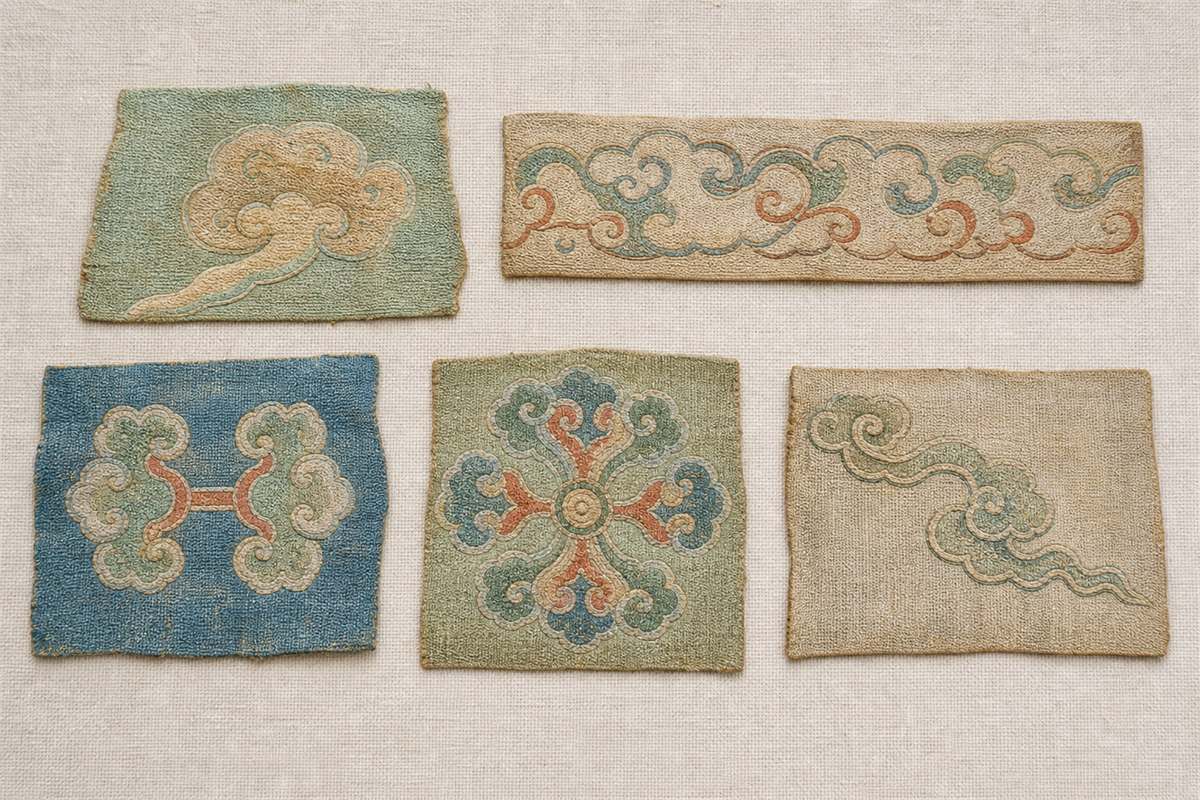
It is therefore reasonable to describe Song-and-later use, major Ming textile development, and wide Qing circulation. It is less accurate to say the motif was “formally fixed” in one dynasty or reached one final peak. Forms remained medium-specific and continued to change.
The ruyi object and the ruyi cloud motif
The handheld ruyi and the decorative ruyi head should be explained together but not collapsed into one origin story. Museum accounts connect the object with an ancient claw staff or back-scratcher, while historical use also includes gesturing, conversation, display, court presentation, collecting, wedding gifts, and imperial rewards. The familiar idea that it could reach an itch helps explain one practical strand; it does not by itself explain every later form or prove one uncontested etymology.

As the object became a prestigious bearer of good wishes, its broad head could resemble a cloud, lingzhi, leaf, heart, or softened claw. Craftspeople then used the head as a detachable visual unit on other objects. The direction of influence is not always simple: cloud and lingzhi conventions helped shape how ruyi heads were imagined, while recognizable ruyi heads also reshaped later cloud ornament.

Ruyi should also not be called one of the Buddhist Eight Auspicious Symbols. That established group comprises the wheel, conch, parasol, victory banner, lotus, vase, paired fish, and endless knot in common Chinese enumerations. Ruyi can appear in Buddhist and Daoist imagery and on religious objects, but that is a different iconographic relationship.
For a closer guide to the full object, pendant, and jade tradition, read Jade Ruyi Meaning. This page stays focused on the cloud-headed pattern rather than repeating the object's entire history.
Meanings: from auspicious language to modern design
The most direct later meaning comes from ruyi (如意), “as wished” or “in accordance with one's intention.” On gifts and domestic objects, the pattern can express chengxin ruyi (称心如意), satisfaction and things proceeding as hoped. When read as cloud ornament, it can also participate in later associations with auspicious atmosphere, elevation, and the phrase “rising through the clouds.” Rounded recurrence supports visual readings of completeness, harmony, continuity, and balanced rhythm.
These meanings belong to layers of cultural use. A Qing court gift, a wedding furnishing, a woven robe, a temple bracket, and a contemporary pendant do not communicate in exactly the same way. Modern designers may use the motif for visual flow and cultural recognition even when no specific blessing phrase is intended.
For gifting, the safest and most meaningful language is relational: “May your plans unfold smoothly,” “Wishing your household harmony,” or “For a new chapter shaped with care.” The motif carries wishes and memory through design.

Common combinations and wordplay
Later auspicious design often uses rebus, homophone, and established object combinations. The precise components matter because similar English translations can hide different visual formulas.
| Name | Verified or defensible composition | How the meaning works | Context note |
|---|---|---|---|
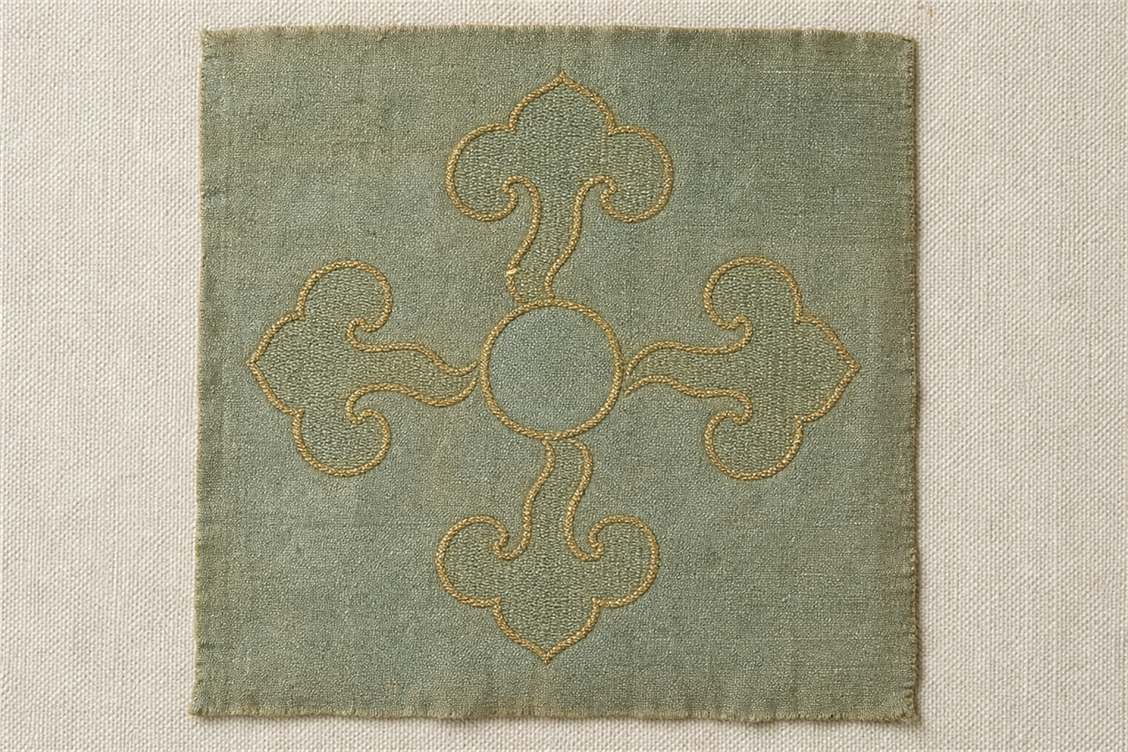
| Four-unit ruyi cloud / sihe ruyiyun (四合如意云) | Four ruyi-cloud units arranged around a center, sometimes with connected cloud tails | Creates four-direction balance and a visually unified cloud field | Well documented in later textiles; avoid invented formulas such as “heaven, earth, people, and self” unless an object's own inscription supports them |
| Cloud and bats / yunfu (云蝠) | Clouds with bats | Bat, fu (蝠), sounds like blessing, fu (福) | Common in Qing decorative arts; the exact blessing depends on accompanying emblems, numbers, and inscriptions |
| Wealth and ruyi / fugui ruyi (富贵如意) | Peony with ruyi | Peony supplies the later “wealth and honor” association; ruyi supplies the wish formula | Documented in painting and craft terminology |
| Peace and ruyi / ping'an ruyi (平安如意) | A vase and ruyi; some more elaborate compositions add other objects | Vase, ping (瓶), sounds like peace, ping (平) | Do not automatically merge it with quail-based peace rebuses; object-specific compositions should be named from the evidence |
| Everything as wished / shishi ruyi (事事如意) | Two persimmons with ruyi, or a documented persimmon-and-ruyi textile arrangement | Persimmon, shi (柿), sounds like matter or affair, shi (事) | This is different from “peace and ruyi” and from “hundred matters as wished” |
| Hundred matters as wished / baishi ruyi (百事如意) | One documented Ming example combines cypress, bai (柏), persimmon, and ruyi; other documented designs use lily, persimmon, and lingzhi | Bai can evoke “hundred,” persimmon evokes “matter,” and ruyi completes the phrase | The name should follow the actual pictured elements; do not freely substitute lion, lily, cypress, or lingzhi |
| Certainly as wished / bidding ruyi (必定如意) | Brush, ingot, and ruyi | Brush, bi (笔), and ingot, ding (锭), form the sound of bidding (必定) | Documented on late Qing ceramics; a brush alone is incomplete |
These formulas became especially prominent in later auspicious art, court gifts, dress, and seasonal display. They should not be projected unchanged onto every early cloud motif.

Major media and craft techniques

Jade carving and jewelry
Jade carvers can turn the ruyi head into a pendant silhouette, shallow relief, openwork border, lock-shaped plaque, bead, earring, hair ornament, or detail on a larger carving. The best work keeps the lobes legible while protecting narrow bridges and drilled openings. Jade contributes its own cultural language of refinement, warmth, durability, and cultivated restraint; in modern use, that language is expressed through craft, gifting, and personal meaning. For broader context, see Jade Meaning in Chinese Culture.
Metal, enamel, and ceramics
Gold, silver, copper alloy, cloisonne, painted enamel, and ceramic bodies can use ruyi heads as rims, cartouches, handles, feet, repeated borders, or the main silhouette. Chasing and repousse create raised metal lines; filigree makes an airy outline; enamel supplies controlled color; underglaze and overglaze painting repeat the form around vessels. Material labels such as 18K gold, gold-plated silver, or synthetic red and blue corundum belong only to a specific, accurately described object, not to the motif in general.
Textiles, dress, and cloud collars
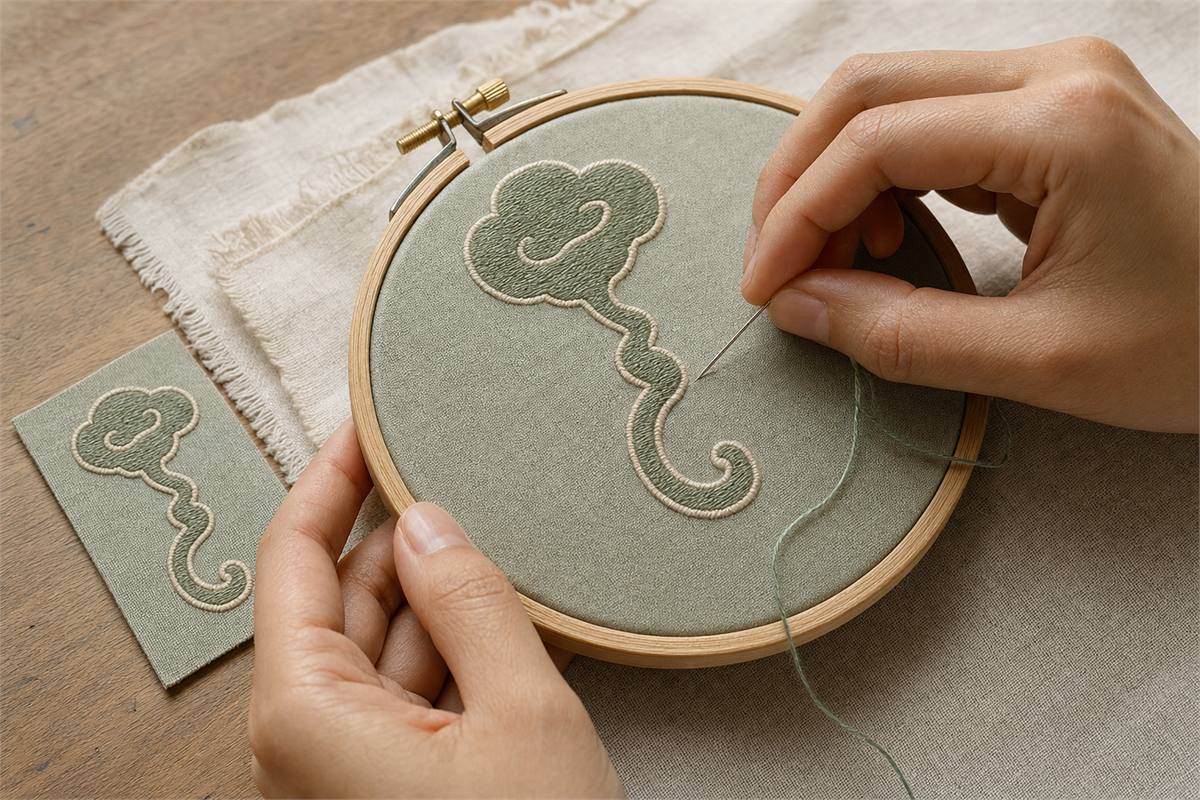
Damask, brocade, woven-gold silk, embroidery, and applique can build single ruyi clouds, four-unit clouds, connected clouds, and ruyi-head borders. A cloud collar may use a four-lobed ruyi outline, but its surface can carry peonies, fish, birds, figures, longevity symbols, or geometric edging. In other words, the collar is the structure; ruyi cloud is one possible shape or decorative component.
Furniture, architecture, tea ware, and packaging
Furniture makers use ruyi-head feet, apron curves, pierced panels, and carved scrolls. Architectural woodwork, stone carving, painted brackets, windows, and railings can repeat the unit as a border. Tea ware and incense objects often place it at rims, shoulders, knobs, or feet. Contemporary cultural products and packaging may simplify the silhouette into a frame or repeating band; good design retains proportion and rhythm instead of reducing it to a generic “Eastern” flourish.

A practical guide for modern designers

- Name the reference precisely. Decide whether the source is a ruyi cloud, a ruyi-head border, a lingzhi form, a cloud collar outline, or another cloud family.
- Preserve the head-to-neck transition. If the crown is simplified beyond recognition, the design becomes an ordinary trefoil or heart.
- Choose a rhythm for the medium. Jewelry needs durable connections and comfortable edges; textile repeats need clean intervals; packaging needs enough negative space to avoid visual noise.
- Use combinations intentionally. A bat, peony, vase, persimmon, brush, or ingot changes the message. Do not add them as interchangeable lucky icons.
- Separate shape from claim. Cultural wording can describe wishes, harmony, celebration, and continuity without promising protection, wealth, or a changed destiny.
- Avoid false heritage stories. Do not attach an invented dynasty, museum object, imperial provenance, commercial partnership, or exclusive material to a modern design.
A restrained modern application can be highly abstract. One lobe may become a clasp; a four-unit structure may organize a pendant; a trailing curve may form a package border. What matters is that the source remains intelligible and the execution suits the material.

How to choose and appreciate a ruyi cloud piece
Whether you are considering a jade pendant, bracelet charm, peace buckle, ruyi lock, tea object, textile, or carved furnishing, begin with workmanship and use rather than gender-based rules or exaggerated symbolism.

- Motif clarity: the lobes, neck, and curl should read cleanly at the actual viewing distance.
- Carving depth: relief needs enough depth for definition without leaving fragile ridges; incised lines should not look ragged or abruptly stop.
- Edges and polish: wearable pieces should have smooth edges, protected points, and no uncomfortable burrs.
- Symmetry and rhythm: exact symmetry is appropriate for some pendants and borders, while moving clouds may be intentionally asymmetrical. Judge coherence, not ruler-perfect mirroring.
- Material durability: thin jade bridges, brittle ceramic projections, soft plating, enamel edges, and textile floats require different handling.
- Size, weight, and comfort: check how a pendant rests, whether a bracelet charm turns or catches, and whether a lock or buckle sits comfortably against clothing.
- Holes and settings: drill holes should have adequate surrounding material; bails, prongs, bezels, hinges, and cord channels should not cut into the motif or skin.
- Object-specific description: confirm the actual material, dimensions, finish, and construction instead of relying on the word “ruyi” as a quality grade.
There is no universal rule that pale jade is for one gender, dark wood for another, or a particular cloud direction changes the piece's effect. Scale, clothing, tactile comfort, maintenance, and the recipient's taste are better guides.

Common mistakes in identifying ruyi cloud
- Calling every ancient spiral a ruyi cloud. Early cloud-thunder, hooked-cloud, and curled-cloud designs have their own contexts.
- Writing a straight evolutionary chain. Similar curves can arise, coexist, travel, and be renamed across different media.
- Treating lingzhi and ruyi as synonyms. They overlap visually, but catalogue names and subject matter still matter.
- Calling cloud collar a motif. Yunjian is primarily a garment and decorative structure, not a universal alternative name for ruyi cloud.
- Assuming three lobes prove identity. Palmettes, trefoils, heart-shaped panels, leaves, fungi, and cloud heads can share outlines.
- Inventing fixed meanings for four-unit clouds. The four-way organization is real; elaborate cosmic formulas need object-specific support.
- Using one museum-like name for an unchecked object. A metal dish, blue-and-white washer, or huanghuali table should be cited only when its collection record, date, material, and title can be checked.
These boundaries make the motif more interesting, not less. Ruyi cloud belongs to a network of cloud, fungus, object, textile, and auspicious-design traditions whose relationships change with time and craft.

Frequently Asked Questions
Carry the pattern with clarity
Ruyi cloud is most compelling when its rounded line, material, and context remain visible. It can frame a vessel, organize a textile, soften a piece of furniture, or become a quiet pendant without losing its history. If you are choosing a meaningful object for a milestone or everyday reminder, explore Eastern Story's Blessing collection and look for a design whose craft, comfort, and message belong together.
Related Posts


One Comment