
Hejin wedding cups symbolize two people beginning a shared life, with wishes for harmony, companionship, and lasting affection. Hejin (合卺, hé jǐn) names a traditional Chinese wedding drinking rite associated with two ladles made by dividing one gourd. The paired vessels give a simple, moving shape to a promise: we will share a home, care for one another, and welcome the years together.
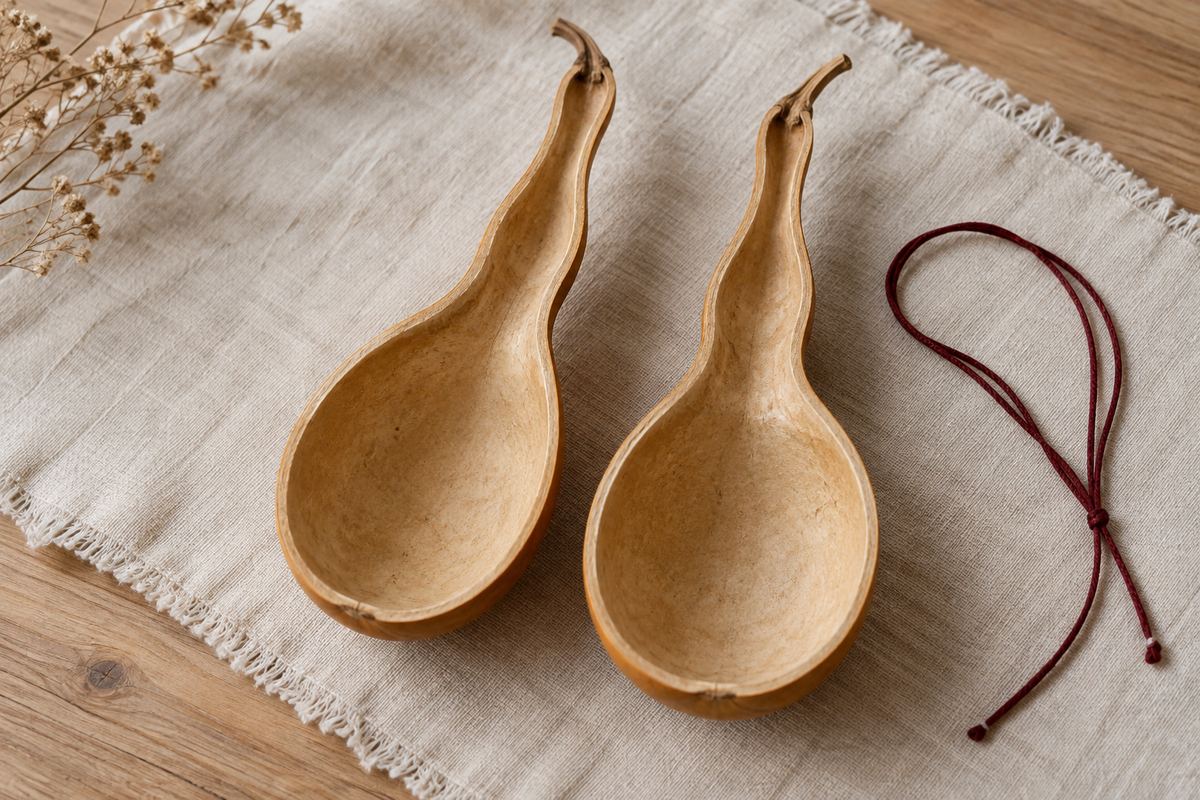
That image still feels intimate beside the celebration of a wedding. Two people lift their cups, pause, and turn toward each other. Whether the vessels are inspired by the old gourd form or are a pair chosen for a modern ceremony, the moment can hold a wish for a beautiful everyday life: meals shared, good news celebrated, and difficult days faced with kindness.
What does Hejin mean, and how is it pronounced?
Say hé jǐn: hé has a rising tone, and jǐn has the third tone, like 锦. He (合) means joining or uniting. Jin (卺, also written 巹) is the nuptial drinking vessel, traditionally a ladle made from a split pao gourd (匏). It names the vessel rather than simply being another word for the whole fruit.
The bottle gourd (葫芦) belongs to a much wider world of Eastern household objects and auspicious imagery. Here its two halves become a wedding pair. By extension, Hejin also evokes marriage itself, which is why it appears in elegant wedding greetings and the names of commemorative cups.

| Expression | What it refers to |
|---|---|
| Hejin (合卺) | The nuptial rite associated with paired gourd vessels; also a literary expression for marriage. |
| Hejin cups (合卺杯) | Vessels for the rite or objects whose paired form celebrates marriage. |
| Hejin wine (合卺酒) | The wedding drink associated with the rite, rather than one fixed recipe or beverage. |
| Jiaobeijiu (交杯酒) | Wedding wine shared through a cup ceremony; today often associated with a crossed-arm toast. |
The wishes carried by two gourd halves
A shared life, with room for two people
The beauty of the paired gourd is its visible relationship: two vessels belong together. As a wedding symbol, it celebrates a new household and a common future. Each person brings a history, a voice, and a character of their own. The promise is to build something together through affection and mutual care.
“Forever of one heart,” or yong jie tong xin (永结同心), expresses this hope warmly. A cup can become the keepsake of the day that promise was spoken, and an anniversary can give the same object another chapter.

Sweetness and hardship shared
A familiar later interpretation connects the bitter gourd and wedding wine with tong gan gong ku (同甘共苦): sharing life’s sweetness and hardship. It gives the cups a tender message of companionship through changing seasons. The early ritual passages emphasize union and closeness; the bitter-and-sweet explanation belongs to the later language of the symbol.
For a couple today, that wish can be expressed through a favorite drink and a few sincere words. There is no need to make a drink bitter. Keep natural or ornamental gourds as decorative keepsakes unless their suitability for the intended food and drink use has been established, and never drink a bitter gourd infusion.

A flourishing home
In broader Hulu symbolism, the gourd carries wishes for blessing and prosperity through its association with fu lu (福禄). Its seeds and spreading vines also feature in traditional hopes for descendants and family continuity. For a wedding gift, choose the wish that fits the couple: a flourishing home, a loving family, shared adventures, or years of peaceful companionship.
The most personal gift message is often the simplest. “May your home be full of warmth” leaves space for the recipients to imagine the life they want to build.

The early wedding rite: sharing food and drink
The Book of Rites, in its Hun Yi chapter (《礼记·昏义》), places the drink alongside a shared meal: “共牢而食,合卺而酳.” The sense is that the couple eat from the same sacrificial animal and take the nuptial drink from the paired vessels. The passage connects these acts with joining the couple, sharing ritual standing, and drawing them close.
The last character, 酳, is pronounced yìn. In this setting it refers to a small drink of wine after eating, associated with refreshing the mouth and settling the meal. “Rinsing the mouth” alone misses the shared drinking act that gives the wedding passage its meaning.
The Yili, in Shi Hun Li (《仪礼·士昏礼》), describes the couple seated for a meal and a sequence of drinks afterward. It specifies the gourd vessel for the third drink. The familiar image of two gourd halves therefore belongs within a fuller meal-and-drink ceremony, rather than a rule that every vessel at an early wedding had to be a gourd.

These classical accounts give Hejin deep roots in the early ritual tradition associated with Zhou marriage customs. They offer a rich cultural inheritance without fixing an exact first wedding or an unchanging ceremony across the centuries.
Where Hejin fits among the Six Rites
The Six Rites (六礼) describe the larger marriage sequence: proposal gifts, asking the name, reporting an auspicious divination, betrothal gifts, requesting the wedding date, and personally welcoming the bride. Hejin belongs to the wedding celebration after that welcome; it is not a separate seventh rite or another name for the entire sequence.
The familiar phrase “Three Letters and Six Rites” (三书六礼) brings wedding documents and ceremonial stages together. It provides a broader setting for marriage customs, while the paired cups focus on the intimate moment when the newlyweds share food and drink.
From linked cups to the modern wedding toast
As wedding customs developed, different families and settings gave the shared drink different forms. Gourds, separate cups, cords, and specially joined vessels appear in the tradition. Their attraction is easy to understand: an ordinary act of drinking becomes a visible expression of belonging together.
In the Song-period Dongjing Meng Hua Lu (《东京梦华录》), Meng Yuanlao describes two cups joined with a colored knot and calls the shared drink jiaobeijiu. His account also includes placing the cups’ fortunes in their positions after they were thrown beneath the bed. This is a historical wedding scene, not a step needed for a ceremony today. The description of connected cups and drinking does not specify the modern crossed-arm movement.
At a contemporary wedding, jiaobeijiu often means interlinking arms to take a sip from separate glasses. A Hejin-inspired moment may instead use gourd-shaped cups held side by side. Both can carry the same heartfelt wish for closeness. The vessel and movement can suit the couple, the setting, and their comfort.

| Detail | Early Hejin imagery | A contemporary choice |
|---|---|---|
| Vessels | Paired ladles made from a split gourd. | Food-safe gourd-shaped cups, ordinary cups, or stemmed glasses. |
| Movement | Drinking within a seated meal-and-ritual sequence. | Facing one another, raising cups together, or an optional crossed-arm sip. |
| Connection | The relationship of the two gourd halves. | A shared toast, coordinated cups, or an optional decorative cord. |
| Meaning | Union and closeness expressed through a shared meal and drink. | A personal promise of affection, care, and a future together. |
A cord makes an especially clear image of connection. A tongxin knot (同心结), a knot associated with hearts joined in affection, can accompany the cups or a gift card. It belongs to the wider language of the Chinese knot (中国结). Tying cups together or rejoining decorative gourd halves can be a lovely modern gesture, chosen for its meaning rather than treated as a compulsory action at every traditional wedding.

When wedding cups became objects to treasure
The paired form also inspired carved and decorated objects whose appeal reaches beyond the wedding day. An elaborate cup can gather several wishes into a small space: the connection between its two sides, an auspicious creature, a cord, or an inscription for long life.

A Ming-dynasty example in the Palace Museum in Beijing bears a “Zigang made” mark and the name “Hejin cup.” It stands 8.3 cm high and has two connected cylindrical bodies. Carved rope bands encircle them, a phoenix forms the handle between them, and two chi dragons (螭龙) decorate the front. The words wan shou (万寿) add a wish for longevity. The name recalls the celebrated jade carver Lu Zigang (陆子刚); the museum identifies the inscription as a mark, an important distinction when appreciating works associated with his name.
Another expression of the paired shape survives at The Metropolitan Museum of Art: an 18th-century nephrite object catalogued as a water vessel in the shape of a marriage cup. Its two joined rhombuses express union, while children and auspicious objects carry hopes for a flourishing family. Marriage-cup shapes could travel into other kinds of objects, so a double vessel need not have been a cup from which newlyweds actually drank.
Court weddings also surrounded the shared meal with auspicious objects and food. The Palace Museum records zisun bobo (子孙饽饽), dumplings associated with hopes for descendants, among the foods at Qing imperial Hejin banquets. This belongs to that courtly setting. A modern couple can celebrate their own hopes through food and drink they enjoy, with any ceremonial food fully cooked and suitable to eat.

Choosing the message on a wedding cup
Start with the feeling you want the couple to carry home. A quiet pair with a small inscription may feel as personal as an elaborate carving. Read the actual words and motifs, and let the gift card explain the connection you see.

| Motif or detail | A wish it can carry |
|---|---|
| Double Happiness (囍) | Shared wedding joy and two lives celebrating together. |
| Dragon and Phoenix Bring Auspiciousness (龙凤呈祥) | Harmony, good fortune, and a flourishing partnership. |
| Bingdi lotus (并蒂莲) | Two flowers on one stem, a tender image of companionship. |
| Mandarin ducks (鸳鸯) | An affectionate pair in traditional art and a wish for loving company. |
| A cord, paired handles, or a joining form | Connection, continuity, and the choice to share a life. |
| A longevity inscription | Many years of warmth and companionship. |
A commemorative object can be displayed beside a wedding photograph or brought out on an anniversary. If it is intended for drinking, choose a maker who clearly identifies the complete vessel as suitable for the beverage and temperature you plan to use. Jade, lacquer, wood, gilding, ceramic decoration, or a natural gourd surface should not be assumed safe for food contact from appearance alone.
A decorative pair and a usable pair can serve different parts of the celebration. Keep the sculptural piece for photographs or display, and use ordinary food-safe cups for the drink. Modern stemmed glasses are also a comfortable choice when they fit the couple’s celebration.

A gentle Hejin-inspired ceremony for today
The following is a modern adaptation for a wedding, commitment celebration, or anniversary. It keeps the shared intention at the center and leaves room for a couple’s own words.
1. Prepare two cups and a comfortable setting
Use clean drinking vessels made for the intended use. Set them on a stable tray or table, with any decorative gourd pair nearby. Rehearse how the cups will be held and returned. If a cord is included, keep it clear of rims and drinks, with enough slack that moving one cup cannot pull the other over. It can instead rest beside the cups until after the toast.

2. Choose a drink both people welcome
Water, cooled tea, or a clearly labeled alcohol-free drink can accompany the ceremony. If wine is chosen, keep the serving comfortable and optional for each person. Fruit wine and rice wine contain alcohol unless specifically made and labeled otherwise. There is no need to fill the cups to the brim or finish them.

3. Speak a short shared wish
A celebrant can introduce the gourd image in one sentence: “These paired cups honor the life you are beginning together.” The couple can then exchange a promise, name something they hope for, or simply meet each other’s eyes before raising the cups.
4. Sip in a way that feels natural
Each person may drink from their own cup while facing the other. A crossed-arm toast is another modern option if both people find it comfortable. Neither a cup exchange nor a prescribed half-cup measure is necessary for this adaptation. A small sip, or simply raising the cups together, lets everyone participate without pressure.
5. Keep a memory of the moment
Return the cups to the table. A decorative ribbon can then be placed around an empty display pair, or two decorative gourd halves can be brought together as a keepsake. Put a dated card beside them with the words you chose. This small record can make the object feel close again years later.

Wedding blessings and anniversary words
Hejin gives invitations, a celebrant’s introduction, and a gift card a graceful cultural touch. Hejin tongxin (合卺同心) evokes hearts joined through the nuptial rite; hejin zhi huan (合卺之欢) refers to the joy of marriage. A brief translation helps guests who are meeting these words for the first time.
For a personal card or ceremony, these original lines offer a starting point:
| Moment | Words to share |
|---|---|
| Wedding toast | “May these two cups hold the beginning of a warm and beautiful life together.” |
| Gift card | “合卺同心,岁岁相伴。 May your hearts stay close through every year.” |
| Anniversary | “For the ordinary days we have made beautiful, and all the days still to come.” |
An anniversary ritual can be as small as sharing tea in the same cups and remembering the meal, music, or laughter of the wedding day. Add a note about one kindness you have treasured during the past year. The keepsake grows richer through lived memories, while the wish remains beautifully simple: to keep showing up for each other.

Caring for the cups and their memories
For usable modern cups, follow the maker’s instructions for washing, drink temperature, and dishwasher use. Where hand washing is recommended, use the specified cleaner and a soft cloth or sponge, rinse appropriately, and dry fully before storage. Keep gilded or metal-decorated vessels out of the microwave, and avoid sudden temperature changes. Warming a cup first does not make it heatproof.
A decorative or antique vessel needs care suited to its material, surface, and repairs. Dusting a natural gourd or wooden ornament does not prepare it for drinking, and an anti-mold treatment or glossy coating is not evidence of food-contact suitability. Keep damaged or cracked pieces for display rather than use as drinking vessels. For ceramic cups, neither boiling nor washing can make an unsuitable glaze safe.
Store the pair dry, with support beneath each body and soft separation between pieces. Avoid strain on a joined handle or old cord, direct sun, damp cupboards, and nearby heaters. Keep a lid off until the inside is fully dry, then store it as the maker recommends. A labeled box, the wedding date, and the accompanying card preserve the story along with the object.

Frequently Asked Questions
A wish to carry into everyday life
The lasting beauty of Hejin lies in the life imagined beyond the toast: a table set for two, patience on an unsettled day, and happiness made fuller by sharing it. Choose a keepsake that feels true to that wish. For other objects that carry affection, harmony, and hopes for a beautiful life, explore the Eastern Story Blessing collection.
Related Posts


