
Dragon and Phoenix (龙凤) meaning centers on paired auspiciousness: the dragon (龙) brings authority, strength, rain-bringing vitality, and upward movement, while the phoenix (凤/凤凰) brings grace, virtue, beauty, renewal, and peaceful order. Together, they form Dragon and Phoenix Bringing Auspiciousness (龙凤呈祥, Long Feng Cheng Xiang), one of the clearest Eastern symbols for joyful union, balanced yin and yang, wedding blessing, family prosperity, and dignified celebration.
This page explains the pair as a single motif. It does not turn the article into a full dragon encyclopedia or a full phoenix encyclopedia. The core subject is the relationship between the two: how dragon and phoenix became a visual language for harmony, why the phrase Long Feng Cheng Xiang is used for happy occasions, how the motif appears in weddings, jade carving, coins, gifts, and wearable objects, and how to choose a piece with the right symbolic message.
Dragon and Phoenix Meaning at a Glance
| Key idea | Meaning | Where it appears |
|---|---|---|
| Dragon and Phoenix (龙凤) | A paired Eastern symbol of strength with grace, authority with virtue, and masculine-yang energy with feminine-yin beauty. | Wedding decor, jewelry, jade carving, textiles, porcelain, architecture, charms, and blessing gifts. |
| Long Feng Cheng Xiang (龙凤呈祥) | Dragon and phoenix bring auspiciousness; a phrase used for joyful, ceremonial, and fortunate moments. | Wedding greetings, new-home blessings, decorative art, festival images, and family celebration language. |
| Dragon (龙) | A symbolic being connected with imperial authority, rain, vitality, ambition, ascent, and the image of the true dragon son of heaven (真龙天子). | Dragon robe (龙袍), dragon chair (龙椅), jade motifs, zodiac symbolism, architecture, and auspicious design. |
| Phoenix (凤/凤凰) | A symbolic bird of refined beauty, virtue, noble presence, renewal, feminine grace, and peaceful order. | Phoenix coronet and embroidered cape (凤冠霞帔), wedding dress language, textiles, jewelry, and noble feminine symbolism. |
| Paired motif | Harmony, love, marriage, family blessing, shared prosperity, and the meeting of Heaven-and-Earth imagery. | Dragon-phoenix bangle (龙凤镯), dragon-phoenix wedding candles (龙凤花烛), dragon-phoenix wedding cakes (龙凤喜饼), and dragon-phoenix jade ornament (龙凤玉挂饰). |
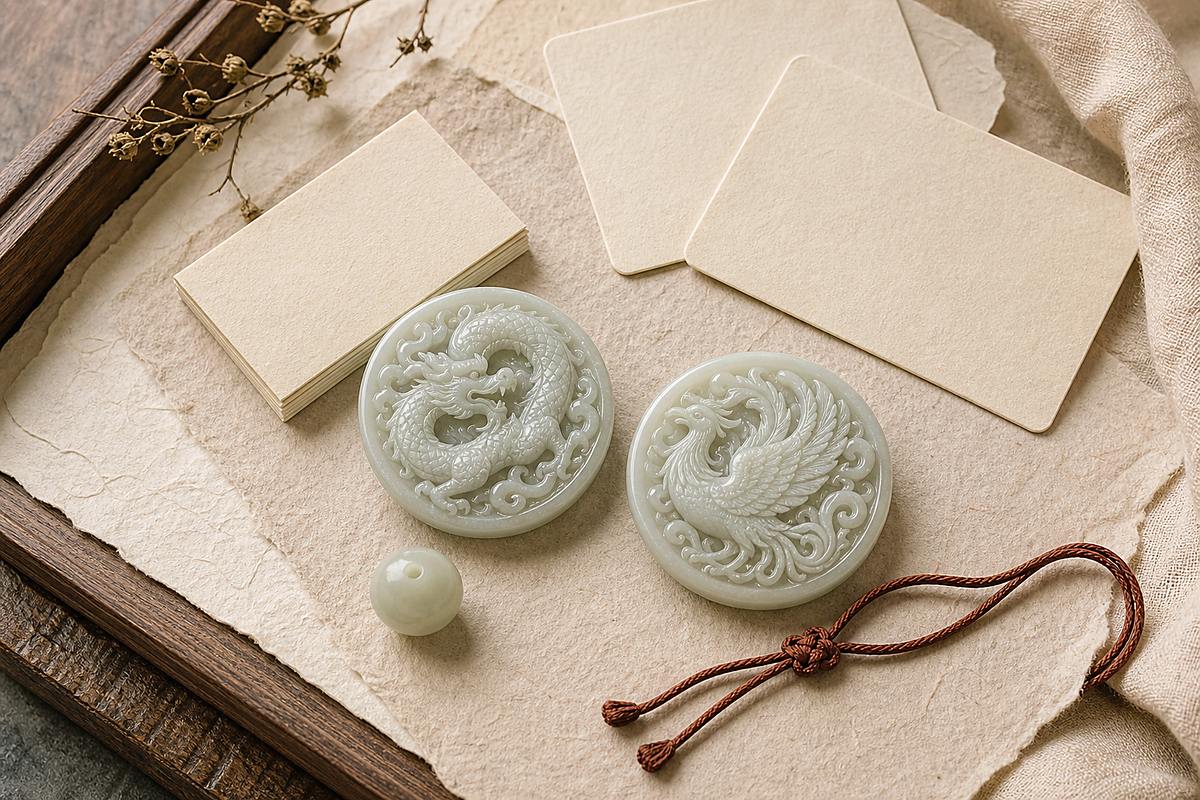
What Does Dragon and Phoenix Mean?
In Eastern symbolism, dragon and phoenix work as spiritual and cultural emblems rather than ordinary animals. Their forms gather layers of totemic memory, ritual imagination, imperial language, folk blessing, and decorative art. The dragon is often described as the leader of scaled creatures and a composite being with nine features, including antlers, scales, claws, and a serpentine body. The phoenix is often called the king of birds, especially in later literary and decorative traditions, and carries the refined language of virtue, beauty, and auspicious order.

When the two appear together, the meaning becomes relational. The dragon rises, moves, commands, and brings rain. The phoenix descends, harmonizes, beautifies, and brings order. The pair therefore expresses a full picture of balance: yang and yin, Heaven and Earth, public authority and inner virtue, passionate movement and graceful restraint. This is why Dragon and Phoenix Bringing Auspiciousness (龙凤呈祥) is used for festive scenes, weddings, children, household blessing, and ceremonial gifts.
The phrase can be used as a blessing for “happy and auspicious things.” In Chinese literary history, auspicious-creature language appears in Han-period texts such as Kongcongzi, while later drama and wedding language helped fix the paired phrase Long Feng Cheng Xiang as a joyful idiom. In modern use, the phrase is direct and warm: a dragon-and-phoenix scene suggests that good things are arriving together.
Dragon Symbolism: Authority, Strength, Rain, and Ascent
The Eastern dragon (龙) is a symbol of elevated force. It is linked with clouds, rain, rivers, imperial authority, masculine yang, and the ability to move between water, earth, and sky. In dynastic language, the ruler could be called the true dragon son of heaven (真龙天子), while the dragon robe (龙袍) and dragon chair (龙椅) signaled legitimate authority and courtly power. In folk language, “hoping a son becomes a dragon” expresses the wish for a child to grow into a person of ability and achievement.

In symbolic design, dragon imagery carries ambition and forward movement. A dragon coiling through clouds can suggest command over changing conditions; a dragon turning toward a pearl can suggest pursuit of wisdom, light, or a precious goal. Earlier ritual and cosmological images also connect dragon-like forms with the path between the human world and the heavens. Some Neolithic Gaomiao pottery patterns, for example, are discussed in relation to sun-bearing and heaven-connecting imagery, a useful reminder that dragon symbolism was never only decorative.
For the broader single-symbol guide, see Eastern Loong Meaning. This page keeps the focus on what changes when the dragon stands beside the phoenix.
Phoenix Symbolism: Virtue, Beauty, Renewal, and Noble Grace
The Eastern phoenix (凤/凤凰), also known through the Fenghuang tradition, carries a different kind of dignity. It is associated with beauty, refined conduct, auspicious peace, feminine grace in later court language, and the idea that noble virtue brings order to the world. In some early traditions the phoenix was not simply “female”; the later pairing of dragon and phoenix gradually made the phoenix more strongly connected with empresses, brides, and feminine ceremonial beauty.
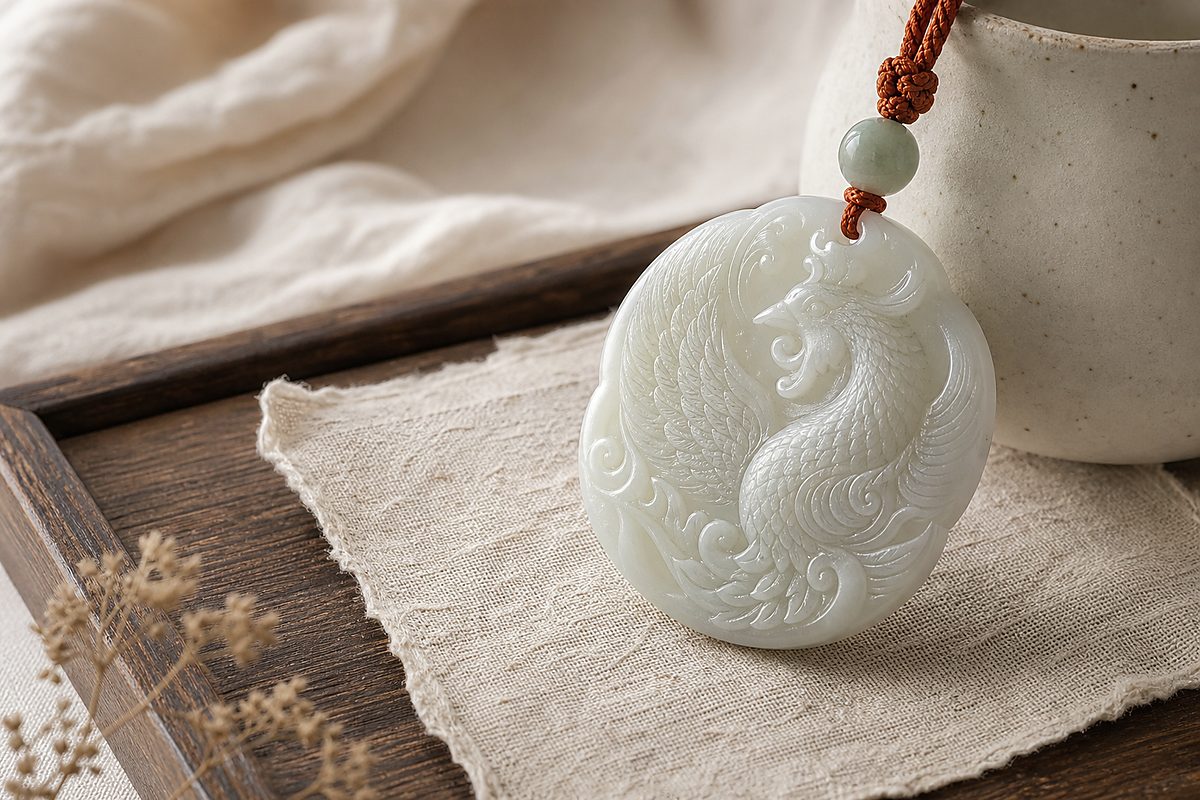
As a stand-alone symbol, the phoenix can suggest renewal, high character, rare talent, and elegant presence. Phrases such as “phoenix feather and qilin horn” (凤毛麟角) praise something rare and excellent. In wedding dress language, the phoenix coronet and embroidered cape (凤冠霞帔) became a powerful image of noble bridal beauty. In dragon-and-phoenix pairing, the phoenix does not merely decorate the dragon; it completes the balance.
The phoenix side of the motif also explains why dragon-and-phoenix gifts feel more graceful than a dragon-only gift. A dragon-only design may feel powerful and commanding. A dragon-and-phoenix design adds beauty, harmony, and shared ceremony.
Long Feng Cheng Xiang (龙凤呈祥): The Auspicious Idiom
Dragon and Phoenix Bringing Auspiciousness (龙凤呈祥) is a positive idiom used when a scene feels fortunate, joyful, and complete. Literally, dragon and phoenix appear together and present auspicious signs. In practical English, it can mean “a harmonious and fortunate union,” “a joyful blessing,” or “auspiciousness arriving through the dragon-and-phoenix pair.”
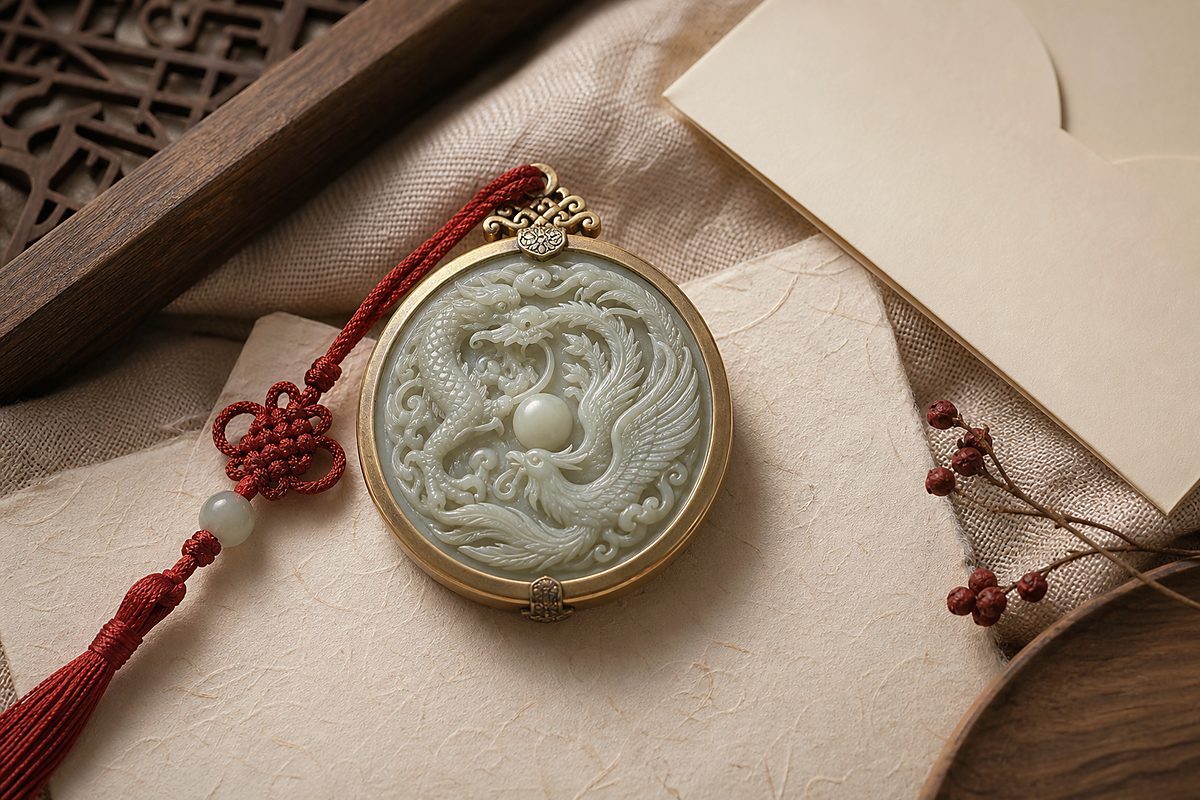
The idiom is especially strong because it joins two symbolic systems. The dragon contributes nobility, yang strength, imperial memory, rain-bringing power, and active ascent. The phoenix contributes beauty, yin grace, refined virtue, peaceful order, and celebratory elegance. When used for a wedding, the pair may represent the groom and bride; when used for a household, it can express harmony and prosperity; when used for art, it communicates a full auspicious scene rather than a single creature.
| Use | Example wording | Meaning |
|---|---|---|
| Wedding greeting | Long Feng Cheng Xiang, a perfect match blessed with harmony. | A wish for a joyful couple and a balanced shared life. |
| New home blessing | May dragon and phoenix bring auspiciousness to the household. | A wish for peace, dignity, prosperity, and family unity. |
| Art description | Dragon and phoenix face each other among clouds and pearl imagery. | A visual composition of paired good fortune and cosmic harmony. |
| Birth blessing | Dragon and Phoenix twins (龙凤胎). | A boy-and-girl twin pair described through the language of paired auspiciousness. |
Two Main Forms: Paired Composition and Hybrid Form
Dragon and phoenix appear in two major visual forms. The first is the paired composition, the familiar image of dragon and phoenix facing, circling, or flying toward each other. This is the common Dragon and Phoenix Bringing Auspiciousness (龙凤呈祥) form. From Song-period ceramics and architectural decoration onward, the paired form became especially visible in formal objects, festival images, and wedding scenes. It remains central to marriage-registration imagery and ceremonial design because it reads quickly as couple harmony.
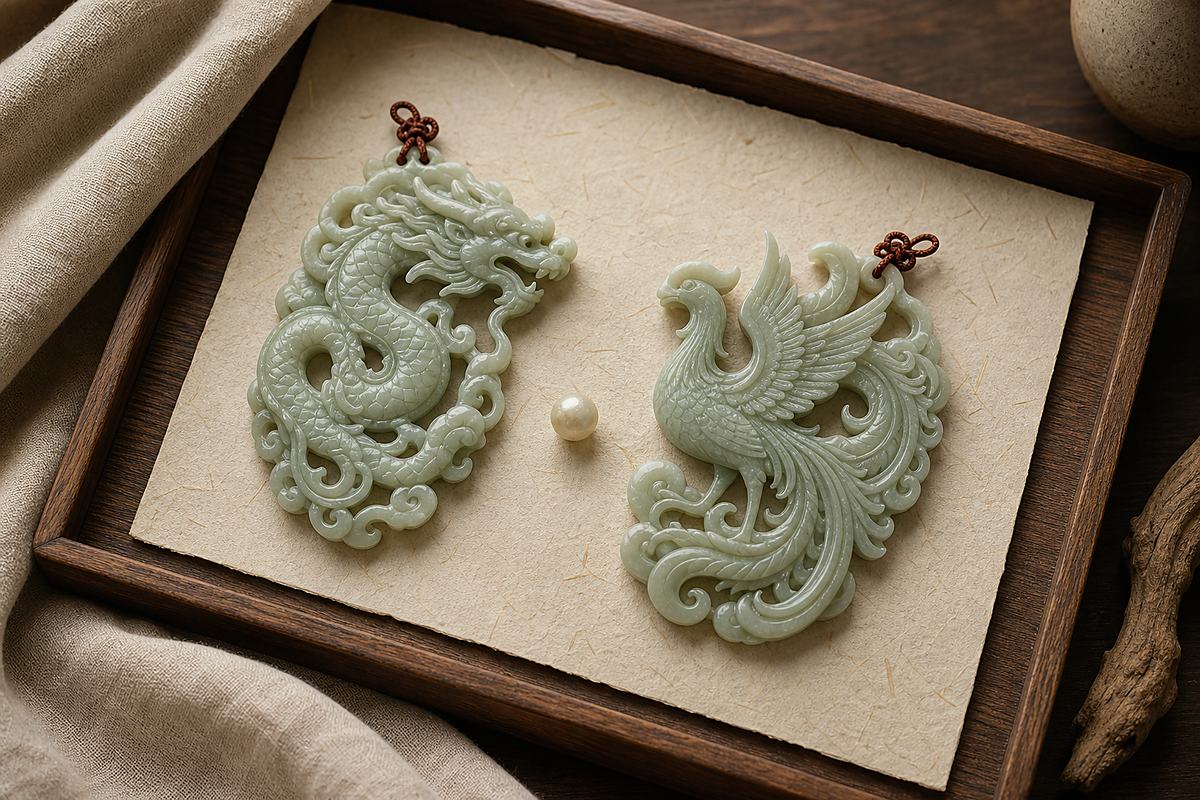
The second form is the hybrid or fused body, sometimes described as dragon-phoenix combined form. In this design logic, dragon and phoenix features join within one object: a dragon-like body may carry a phoenix-like tail, or a bird form may include dragon elements. Early bronze and ritual art already show related experiments. A Sanxingdui-style bronze example with dragon body and phoenix-tail logic illustrates how the form can emphasize divine transformation, protection, and the ability to connect different worlds.
| Form | Visual structure | Main meaning | Best modern use |
|---|---|---|---|
| Dragon and Phoenix Bringing Auspiciousness (龙凤呈祥) | Dragon and phoenix appear as two readable figures, often facing, circling, or flying together. | Harmony, wedding blessing, balanced yin-yang, joyful union. | Wedding gifts, anniversary jewelry, home decor, ceremonial jade plaques. |
| Dragon-phoenix hybrid form | Dragon and phoenix features fuse into one body or one ritual image. | Divine power, transformation, protection, and heaven-earth connection. | Art-historical discussion, museum-style objects, symbolic design with stronger mythic presence. |
| Dragon-Phoenix Playing with Pearl (龙凤戏珠) | Dragon and phoenix move around a pearl, orb, or central treasure. | Pursuit of wisdom, shared preciousness, bright fortune, and dynamic harmony. | Jade carving, pendants, decorative plaques, wedding motifs. |

Dragon and Phoenix in Wedding Customs
Dragon and phoenix are among the most important symbolic pairs in traditional Eastern wedding language. The dragon can stand for the groom’s strength and dignified presence; the phoenix can stand for the bride’s beauty and graceful virtue. The point is not a rigid gender rule for modern couples. The deeper message is harmony: two different forces meeting in a balanced household.

Wedding objects often make the meaning visible. A dragon-phoenix bangle (龙凤镯) is traditionally worn as a pair, especially with a dragon-and-phoenix wedding jacket or embroidered bridal outfit. Wearing a single bangle changes the visual message, because the ideal phrase is “in pairs and in harmony.” Dragon-phoenix wedding candles (龙凤花烛) mark the ceremonial glow of the wedding night, while dragon-phoenix wedding cakes (龙凤喜饼) carry the blessing into food and gift exchange.

Traditional wedding process may also include three letters and six rites (三书六礼), bowing to Heaven and Earth (拜天地), and cross-cup wine (交杯酒). These customs are not required for every modern wedding, but they show why dragon-and-phoenix imagery feels ceremonial rather than casual. It belongs to a larger language of family agreement, shared blessing, public joy, and a couple beginning life together.
In the Eastern Ming period (明朝), dragon-and-phoenix imagery was closely tied to court and elite identity. Empresses and high-ranking women could wear complex ceremonial headdresses, including the famous nine-dragon nine-phoenix crown (九龙九凤冠) associated with Empress Xiaoduanxian of the Wanli era. In the Eastern Qing period (清朝), phoenix-crown language became even more distinct in court dress. Modern wedding use is less about court rank and more about blessing, beauty, family joy, and a dignified visual tradition.
Dragon and Phoenix in Jade Carving
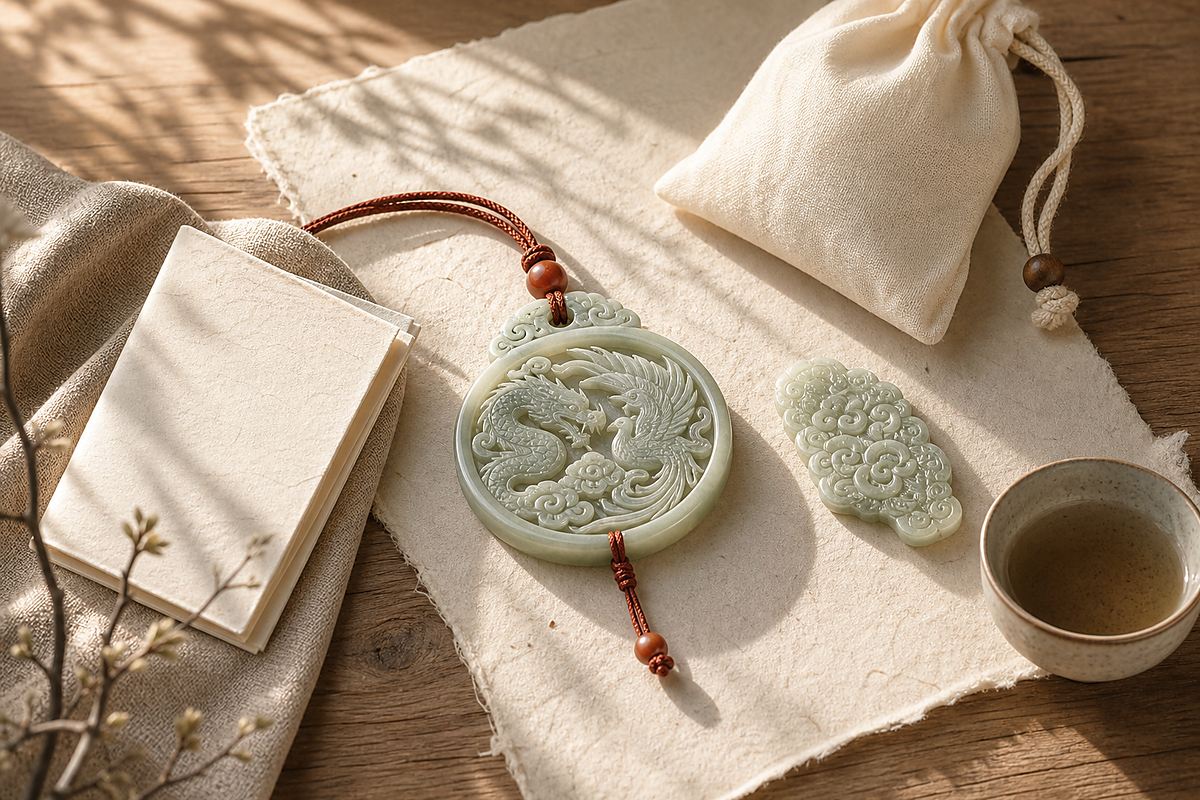
In jade carving, dragon and phoenix become a compact cultural story. Jade (玉) is already associated with refinement, warmth, virtue, and long-lasting value; adding dragon and phoenix creates one of the most complete auspicious compositions in Eastern decorative art. The dragon can represent strong foundation, broad ambition, and upward career movement. The phoenix can represent family peace, refined dignity, prosperity, and annual renewal. Together, the pair suggests Heaven and Earth in harmony, a household in balance, and blessing carried through material form.

The motif has deep historical roots. Since the Eastern Shang-Zhou period (商周时期), jade has carried status, ritual, and identity. Dragon and phoenix forms developed across bronze, textile, painting, and jade traditions. During the Eastern Warring States period (战国时期), dragon-and-phoenix jade carving reached a high point. A famous example is the sixteen-section dragon-phoenix jade ornament (十六节龙凤玉挂饰) excavated in 1978 from Leigudun Tomb No. 1 in Suizhou, Hubei (湖北随州擂鼓墩 1 号墓). It is more than 2,400 years old and is carved with 37 dragons, 7 phoenixes, and 10 snakes, with grain patterns, cloud patterns, and diagonal-line motifs that show the technical sophistication of the period.

Good dragon-and-phoenix jade carving depends on both material and composition. Dragon lines should feel strong, coiling, and alive; phoenix lines should feel elegant, layered, and graceful. High relief, shallow carving, intaglio, openwork, and rounded carving may appear together when the material allows it. In refined pieces, the figures answer each other across the surface instead of sitting as two unrelated decorations.
- Composition: dragon and phoenix should echo each other through posture, cloud movement, pearl placement, or circular rhythm.
- Carving quality: look for clean turns, confident line work, readable eyes, orderly feathers, and balanced openwork.
- Material: a strong piece uses suitable jade material with enough body for carving depth, smooth polish, and stable structure.
- Meaning: dragon supports ambition and authority; phoenix supports grace and peace; together they form Dragon and Phoenix Bringing Auspiciousness (龙凤呈祥).
For a broader motif system, read Jade Carving Meanings. For the material background, see Jade Meaning in Chinese Culture.
Dragon-Phoenix Gifts, Jewelry, and Wearing Ideas
A dragon-and-phoenix gift is strongest when the occasion matches the meaning. For a wedding, the symbol says “may two people live in harmony.” For an anniversary, it says “may strength and grace continue together.” For a family or new home, it says “may the household be dignified, peaceful, and prosperous.” The same motif can be formal in jade, warm in gold jewelry, and approachable in a small charm.
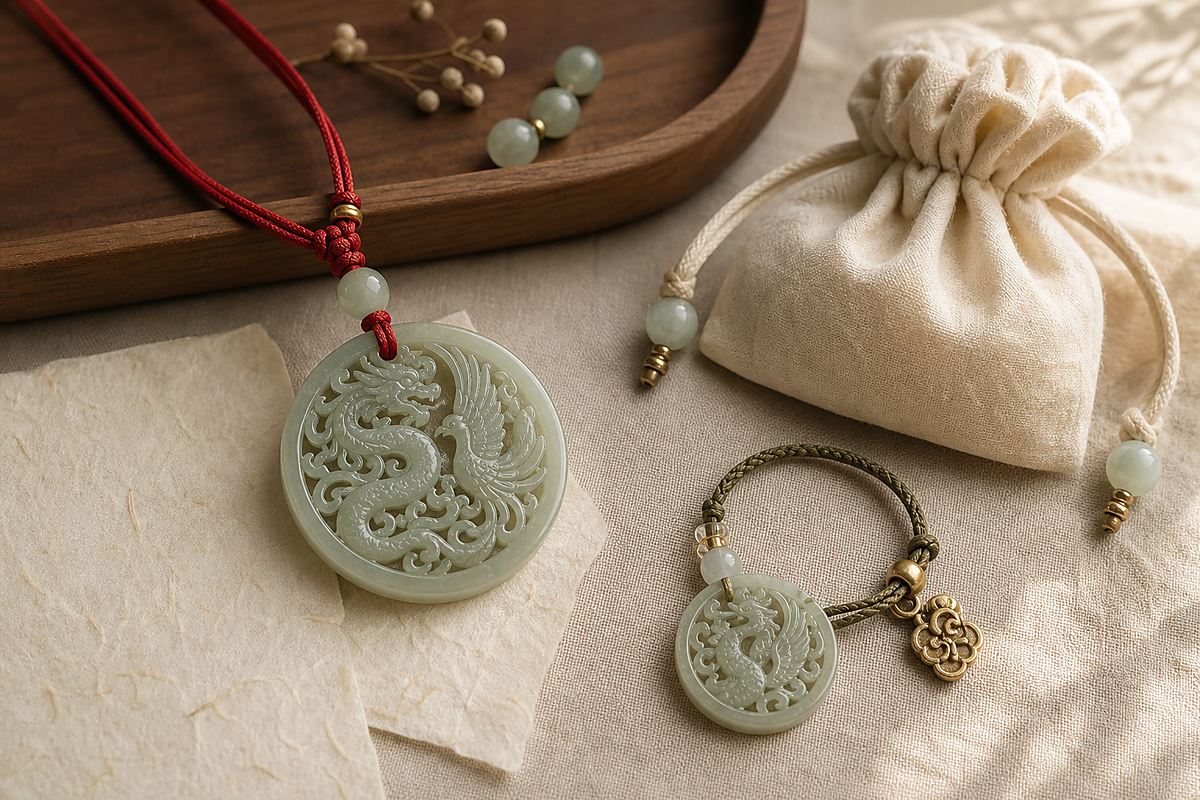
A dragon-phoenix pendant can be worn on a necklace, bracelet, or small hanging chain. On a necklace, choose a length that places the pendant below the collar and near the center of the chest. On a bracelet, keep the charm centered and comfortable so it does not strike hard surfaces. As a hanging ornament, it may be tied with cord and placed near clothing, a bag, a key ring, or a personal object. Formal occasions suit jade or gold-toned pieces; daily wear can be smaller, lighter, and more subtle.
A dragon-phoenix bangle (龙凤镯) is traditionally most meaningful as a pair. A pair of gold bangles carved with dragon and phoenix imagery matches the idea of “double blessing” and “paired harmony.” A dragon-phoenix jade ornament (龙凤玉挂饰) may be worn as a necklace, bracelet charm, waist ornament, or clothing decoration depending on size and construction. A dragon-phoenix coin charm (龙凤花钱) can be tied at the waist, hung indoors, placed on a bag, or worn with a red cord as a small blessing charm.
| Object | How it is used | Meaning | Choosing tip |
|---|---|---|---|
| Dragon-phoenix bangle (龙凤镯) | Usually worn as a pair, especially for weddings. | Couple harmony, paired blessing, joyful union. | Choose balanced carving and a comfortable size; pairs preserve the symbolic message. |
| Dragon-phoenix pendant | Worn on a necklace, bracelet, or hanging chain. | Personal reminder of strength with grace. | Keep the figures readable; avoid overcrowded designs. |
| Dragon-phoenix jade ornament (龙凤玉挂饰) | Worn or displayed, sometimes inspired by ancient group-pendant forms. | Refinement, family blessing, auspicious continuity. | Check carving depth, cord strength, polish, and material identity. |
| Dragon-phoenix coin charm (龙凤花钱) | Hung at home, tied to a bag or keys, or worn with cord. | Folk blessing, protection language, auspicious pairing. | Choose clear motifs and sturdy hanging points. |
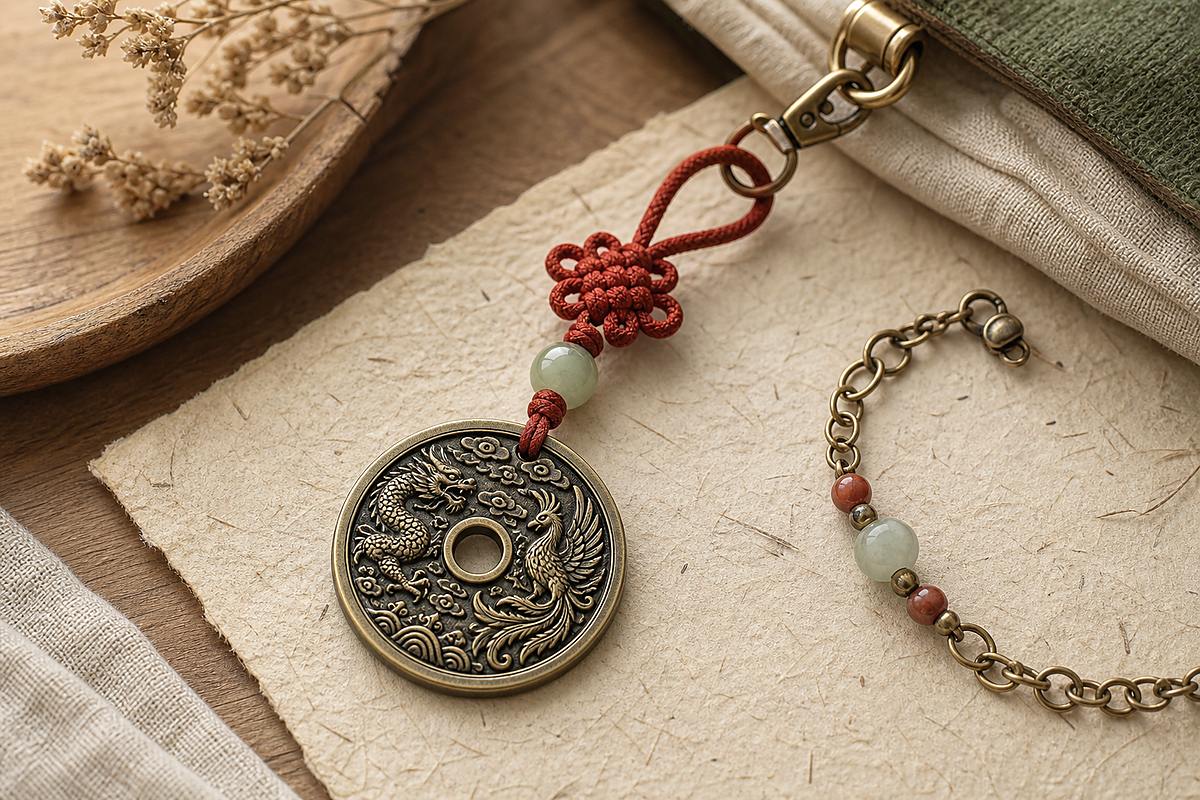
For everyday symbolic pieces and gift ideas, the Blessing collection is the best next step. The meaning should guide the choice: wedding and family objects can be more ceremonial; daily-wear pieces should feel comfortable, balanced, and personal.
How Dragon and Phoenix Changed Over Time
Dragon-and-phoenix meaning did not appear fully formed in one moment. Early phoenix imagery could be more fluid in gender, and some early traditions treated the phoenix as a male or composite auspicious bird. From the Han period onward, as dragon-and-phoenix pairing became closely linked with court hierarchy and yin-yang symbolism, the phoenix increasingly became associated with empresses, noble women, brides, and feminine ceremonial beauty.
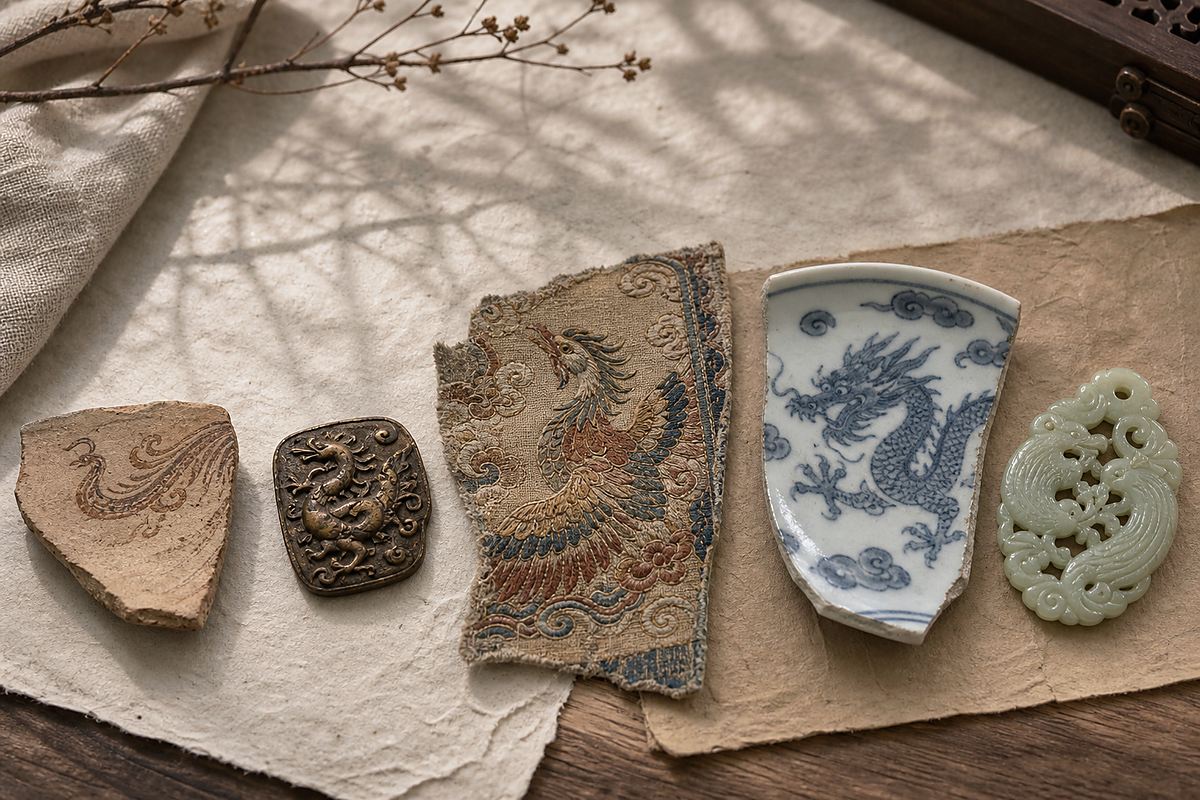
The pair also moved between elite and folk contexts. In court art, dragon and phoenix could signal imperial rank and noble order. In folk use, Dragon and Phoenix twins (龙凤胎), Dragon-Phoenix Playing with Pearl (龙凤戏珠), dragon-phoenix wedding candles, and dragon-phoenix wedding cakes became part of blessing language. Modern designs still use dragon and phoenix on clothing, festival imagery, sports-event patterns, jade objects, jewelry, and brand visuals because the pair remains easy to understand: two auspicious forces meet in one joyful image.
How to Choose a Dragon-and-Phoenix Piece
Start with the occasion. A wedding gift can carry a larger and more symmetrical composition. An anniversary object may be smaller, more refined, and easier to wear. A home blessing can be a plaque or ornament. A personal pendant should be comfortable, readable, and easy to pair with daily clothing.
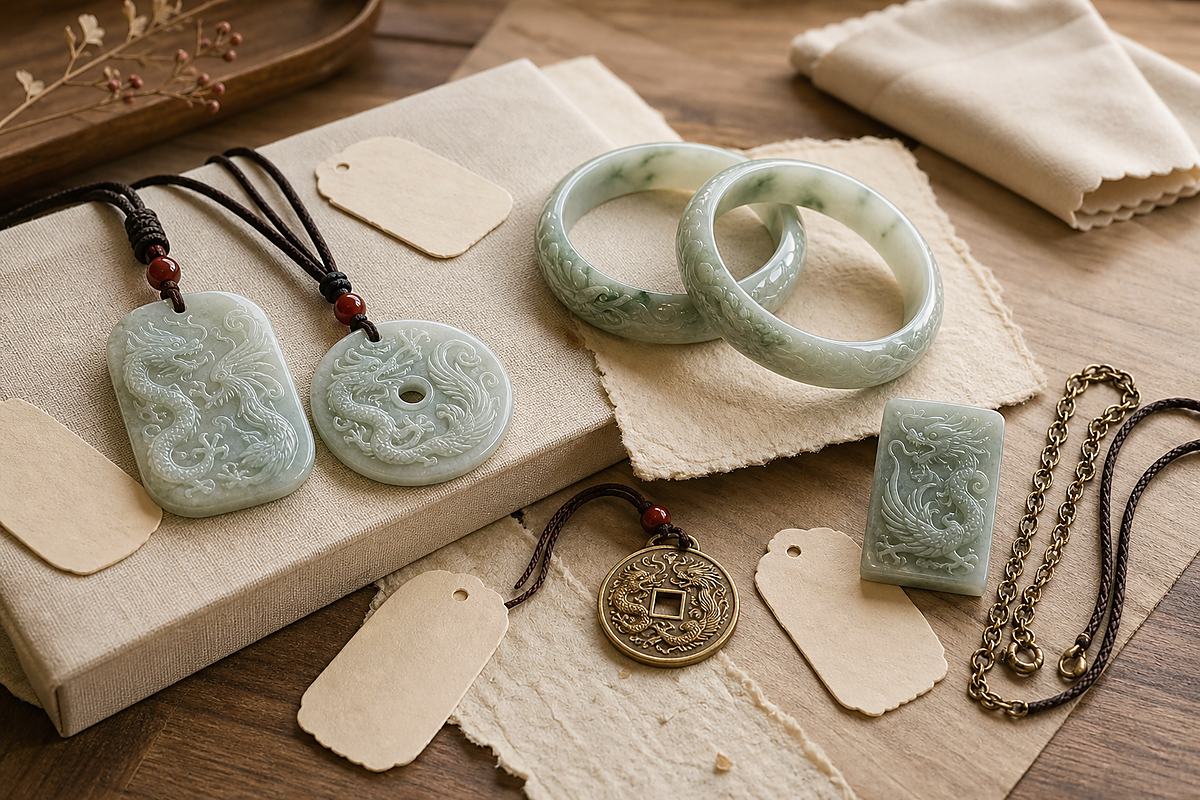
Then look at the design. A strong dragon-and-phoenix piece should show the relationship between the figures. They may face each other, circle a pearl, fly through clouds, or balance opposite sides of a pendant. If the dragon is clear but the phoenix disappears into decorative lines, the pair loses meaning. If both figures are readable but stiff, the object may feel symbolic but not lively.
- Confirm the purpose: wedding, anniversary, family blessing, home decor, personal reminder, or symbolic jewelry.
- Choose the form: bangle, pendant, jade plaque, coin charm, textile motif, or decorative object.
- Check readability: dragon, phoenix, pearl, cloud, and circular rhythm should be easy to identify.
- Check material and construction: jade, gold, silver, cord, chain, bail, and carving depth should suit the object’s weight and use.
- Match the message: pair designs suit union and harmony; dragon-only designs suit strength; phoenix-only designs suit grace and renewal.
For jewelry care, use gentle cleaning, avoid hard impact, and store carved pieces separately so raised lines and openwork do not rub against harder objects. See the Eastern Story Care Guide for practical care steps.
Frequently Asked Questions

Where to Go Next
Dragon and Phoenix (龙凤) is best understood as a paired blessing: strong enough for ceremony, graceful enough for jewelry, and clear enough for meaningful gifts. If you want the single-symbol background, read Eastern Loong Meaning for the dragon side and use this page as the paired-motif guide. If you are choosing a symbolic object, explore the Blessing collection and compare jade motifs through Jade Carving Meanings.
Related Posts


2 Comments