
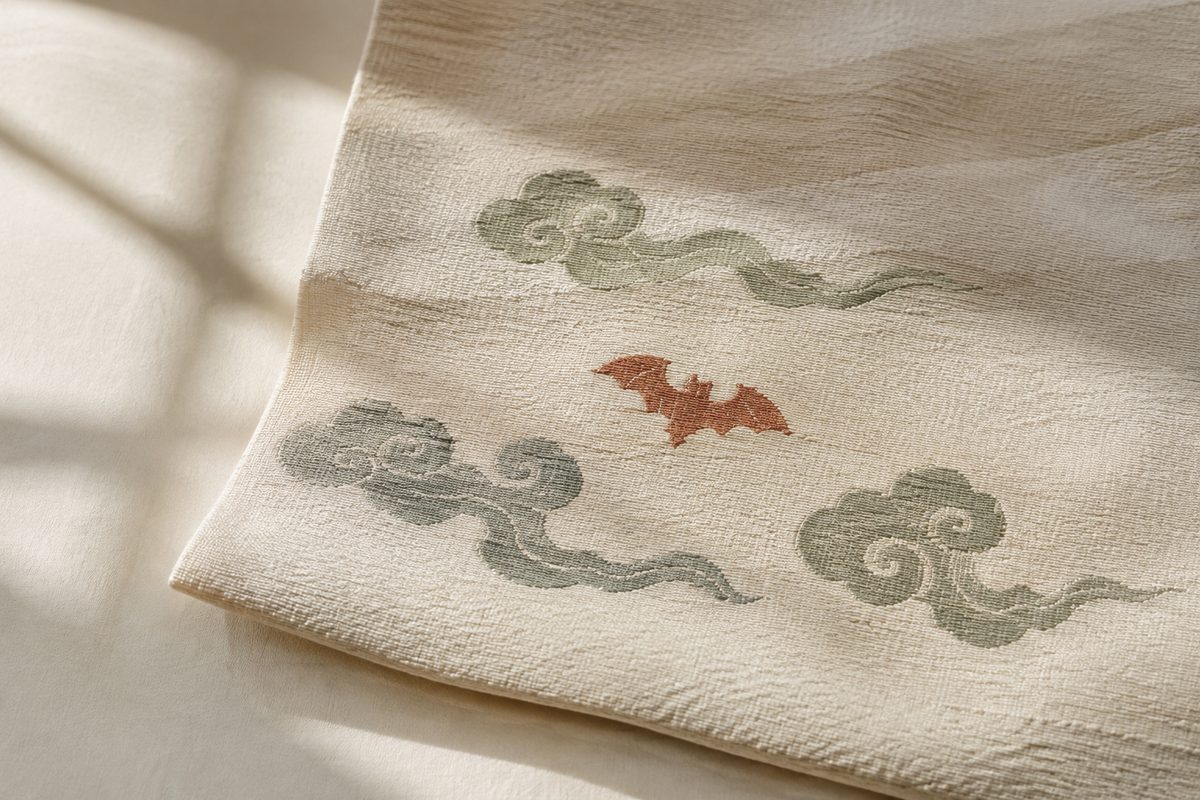
The cloud-bat pattern, Yunfu Wen (云蝠纹 / 雲蝠紋), combines auspicious clouds and bats to welcome good fortune, blessings from heaven, and happiness that continues through life. Its beauty lies in movement: small, outstretched wings pass between curling clouds, giving an everyday object the feeling of a sky filled with possibility. Red bats among clouds express Hongfu Qitian (洪福齐天), “blessings as vast as the heavens.”
On a robe, a bowl, or a pendant, the wish becomes something close enough to touch. Cloud-bat designs can accompany a fresh beginning, bring a joyful note to a home, or tell someone you love that you hope good things will keep finding them. Their flowing lines hold both the warmth of a blessing and the pleasure of graceful decoration.

Why clouds and bats carry such a generous blessing
The word for bat, bianfu (蝙蝠), contains fu (蝠), which sounds like Fu (福), the word for blessing and good fortune. This sound relationship gives the bat motif its joyful role in traditional Chinese decorative art. A flying bat can turn an abstract wish into a lively arrival: fortune coming toward you.
Auspicious clouds, Xiangyun (祥云), give that arrival a welcoming setting. They evoke the heavens, favorable signs, peace, and a hopeful sense of rising. Their curls and trailing forms also let the eye travel across a surface. Together, cloud and bat offer an expansive wish: may blessings surround you, and may your path open toward good things.
The flowing design lends itself to the words Fuyun Lianmian (福运连绵), a wish for continuing good fortune. You might describe it to a loved one as “blessings drifting with the clouds.” The emotional appeal is easy to recognize even before every small detail has been named: the sky is open, the movement is gentle, and happiness is on its way.

Red bats and the wish Hongfu Qitian
Red adds another layer of wordplay. Hong (红), “red,” sounds like hong (洪), “vast” or “great,” so hongfu (红蝠), a red bat, echoes hongfu (洪福), great blessing. Place red bats among clouds and the picture expresses Hongfu Qitian: good fortune reaching as high and wide as the sky. It is a generous message for a celebration, a new chapter, or someone whose future you hope will be bright.

Cloud-bat designs also appear in blue, gold, a single thread color, or the natural tone of a carved material. The joining of cloud and bat gives these compositions their identity. A red palette emphasizes the Hongfu pun; a quiet monochrome version can carry the broader wish for flowing, ever-present good fortune.
Recognizing the cloud and the bat
Clouds may gather into rounded lobes, stretch into vapor-like tails, or roll back on themselves. Ruyi clouds (如意云) have a distinctive lobed head associated with ruyi, “as you wish.” Some cloud heads resemble lingzhi (灵芝), the fungus of longevity in Eastern art, which helps explain the familiar description “lingzhi-shaped clouds.” Flowing cloud scrolls can be looser and more elongated. These variations give the motif different moods, from a gentle drift to a rich, curling sky.
The bat usually has a compact body between spread wings. Scalloped wing edges, small ears, or a suggestion of a face may remain visible even in a highly stylized design. In carving and weaving, the wings sometimes curl like the surrounding clouds, letting the two forms share one rhythm. Look for the central body and the way the wings attach to it before reading an isolated curl as an animal.
Cloud-bat patterns, cloud-and-thunder scrolls, and meanders
The cloud-and-thunder pattern, Yunleiwen (云雷纹), is a geometric vocabulary particularly familiar from ancient bronze decoration. It uses repeated spirals: rounded turns are described as cloud forms, squared turns as thunder forms. Huiwen (回纹), or a meander border, likewise catches the eye through returning, angular lines. These patterns can frame an object or fill a background, while a cloud-bat scene brings recognizable bats into a setting of clouds. A curl alone does not make a cloud-bat motif.
On a richly decorated vessel, several kinds of ornament may share the surface: a geometric band at the rim, free clouds across the body, and bats between them. Seeing each part separately makes the whole design more enjoyable. The measured border steadies the composition while the flying forms bring it to life.

How the arrangement makes blessings feel alive
Open skies and scattered motifs
A few bats spaced between floating clouds can feel airy and peaceful. The empty ground becomes part of the sky, giving each wing and curl room to be seen. In a denser all-over design, repeated bats and clouds make the surface feel full of good wishes. Scattered placement and dense coverage are different choices: a scattered pattern can leave generous open space.

This contrast is especially lovely on porcelain. The curve of a bowl or vase slowly reveals the next bat as you turn it. There may be no single view that holds the whole composition; the blessing continues around the object.
Balanced pairs and circular gatherings
An arrangement balanced across a central axis feels settled and welcoming, well suited to a panel or a framed ornament. Two bats facing inward can draw attention to a central emblem and suggest blessings coming together. A pair by itself does not require the specific name “Double Happiness”; the surrounding imagery gives the message its fuller meaning.

In a roundel, bats and clouds curve around a center, creating a feeling of embrace. The center might be an open space, a flower, or a longevity emblem. Such a gathering makes a natural image for a birthday wish or a home where loved ones come together.
Flowing paths and continuous borders
An S-shaped trail or wave-like cloud line can carry the eye along a sleeve, a textile border, or a long carved panel. Bats become small moments of emphasis along that path. Repeating cloud-bat borders around a rim or circular ornament create a sense of continuity, a fitting visual companion to the wish that good fortune will remain close through changing days.

The same idea can guide a modern design. A single cloud trail and one clearly drawn bat can feel intimate and calm; a fuller repeat feels festive. Muted colors allow the curves to lead, while a small red accent brings the Hongfu wordplay forward. The amount of detail can follow the object and the feeling you want it to carry.
When other symbols join the clouds
Companion motifs give a cloud-bat design a more personal wish. Begin with what is actually present, then let those details tell the story.
| What appears in the design | The wish it carries |
|---|---|
| Five bats | Wufu (五福), the Five Blessings: longevity, prosperity, health and peace, love of virtue, and a peaceful completion of life. |
| Five bats around Shou (寿), the longevity character, or a clearly identified longevity center | Wu Fu Peng Shou (五福捧寿), the Five Blessings gathered around long life. The central longevity emblem is an essential part of this reading. |
| Bats with longevity peaches (寿桃) | A warm wish for blessing and long life together, especially fitting for birthday celebrations. |
| An upside-down bat | Fu dao: the wordplay of “bat reversed” and “fortune arrives.” In a flying scene, orientation may also contribute to movement. |
| A bat with a traditional pierced coin | Fu Zai Yan Qian (福在眼前), “fortune before your eyes”: bat/Fu, coin/qian (“before”), and the coin’s central “eye” work together. |
| the Wan sign (卍) with bats | Wanfu (万福), abundant or ten-thousandfold blessings. A Shou character or another longevity element brings a further wish for long life. |
A cloud-bat motif can consist simply of bats and clouds. Five bats, red coloring, an inverted bat, and a longevity center are meaningful possibilities, rather than ingredients required in every example. On a long repeating textile, a deliberate group of five is also different from five bats that happen to fall within a cropped view.

Butterflies, flowers, and leafy scrolls
In a crowded design, butterflies and bats can look surprisingly alike. Butterflies often show antennae and two pairs of wings; a bat more often reads as a compact body with a continuous membrane-like wing on either side. Leaves attach to stems, while cloud heads tend to extend into curls or vapor trails. Highly abstract forms are easiest to understand in the context of the complete ornament.
A recognizable butterfly can add a longevity wish through the sound relationship between die (蝶), “butterfly,” and die (耋), an age-related term. Scrolling foliage can link the elements with a feeling of continuing growth. More specific readings belong to more specific plants: the wish Guadie Mianmian (瓜瓞绵绵), generations flourishing like spreading melons, calls for a recognizable melon-and-vine composition. Ordinary leaves and clouds have their own beauty without needing that name.
Cloud-bat beauty in porcelain, silk, and carved wood
Surviving Qing objects show how warmly this motif could inhabit very different materials. A painted cloud creates a flowing line, a woven cloud travels with the cloth, and a carved cloud gains depth from light and shadow. The shared wish remains recognizable as the surface changes.
A sky around a porcelain vessel
The Palace Museum in Beijing holds a Xuantong-period straight-necked vase decorated with blue clouds and iron-red bats. Its height is 33.5 cm. The blue-and-white painting creates the clouds, while the iron-red decoration picks out the flying bats; together they express Hongfu Qitian. As the motif moves around the rounded body, its wish seems to spread beyond a single viewpoint.

Another Palace Museum entry identifies a Qing bowl with a Yongzheng mark and a cloud-bat design in doucai (斗彩). Doucai combines underglaze blue with overglaze colors. Here, the name describes the ceramic technique, while “cloud-bat” describes the motif: a useful distinction when appreciating how the same blessing can take different painted forms.
A robe filled with birthday wishes
The Palace Museum’s yellow kesi robe with clouds, bats, and longevity characters dates to the Qianlong period. About 100 round Shou characters share its surface with multicolored clouds and red bats. The repeated longevity signs and the cloud-bat imagery turn the garment into a generous birthday wish for great blessing and a long life.
Kesi (缂丝) is silk tapestry weaving: colored wefts work across selected areas to build the design into the cloth. Embroidery instead adds stitches to an existing ground fabric. On this robe, the main yellow surface is kesi, while the dark collar and sleeve borders include embroidery. The flowing pattern is therefore both an image and part of the fabric’s making.
Clouds given depth in wood and jade
Prince Kung’s Palace Museum describes a zitan cloud-bat trestle table whose decoration runs along the edge of the top and onto its supports. On a related cloud-bat table, pierced decoration brings together bats, peaches, and the Wan sign. Those combined elements add longevity to the wish for abundant blessing. The dark wood and the openings give the curling forms a quiet play of light and shadow.

In jade carving, too, a cloud can rise gently from the surface or open into a space through the ornament. Light passing around the wings makes the bat seem to hover. On a small pendant, this can bring the feeling of a spacious sky into something held in the palm. The attraction is intimate: a large and generous wish carried in a small object.
Wearing, keeping, and giving cloud-bat designs
Choose the part of the story that feels close to your own life. A gently rising cloud trail can accompany a new beginning; a circular gathering can speak of warmth and belonging; red bats in an open sky make a joyful wish for a bright future. A piece chosen with that thought becomes a quiet companion to what you hope to welcome.
For everyday wear, imagine a small cloud-bat pendant against a plain shirt, or an embroidered detail at a cuff where it appears as the hand moves. A flowing scarf can let the clouds unfold gradually. Simple surroundings give the motif room to be noticed and let its meaning arrive as a small discovery.

At home, a cloud-bat vessel, cushion, or framed textile can bring a welcoming wish into a reading corner or a shared living space. An airy arrangement suits a restful setting; a richly repeated pattern can lend warmth to a celebratory table or family gathering. Choose a place where the curves and wings can be enjoyed, making the blessing part of ordinary days.

For someone starting a new job or moving into a home, a natural message is: “May good fortune follow you into this new chapter.” For a birthday, a design with Shou or peaches can carry: “May your days be full of happiness, health, and long life.” A simple cloud-bat design also suits Ping An Ru Yi (平安如意): peace, safety, and life unfolding as you wish. The words can be your own, shaped by the person receiving them.
A little attention keeps delicate details easy to enjoy. Support carved pieces around the body rather than thin wing tips, avoid rubbing painted or gilded decoration, and follow the care needs of the actual material. Historic textiles deserve specialist care. For everyday pieces, our care guide offers a starting point.
Frequently Asked Questions
Carry a little of that open sky with you
Cloud-bat designs give good wishes a graceful way to travel: across a vessel, through a woven surface, or close to the heart. Whether you are choosing for yourself or giving to someone dear, let the image carry a wish that feels personal. Explore our Blessing collection for pieces chosen to welcome good fortune and keep meaningful stories close.

Related Posts